
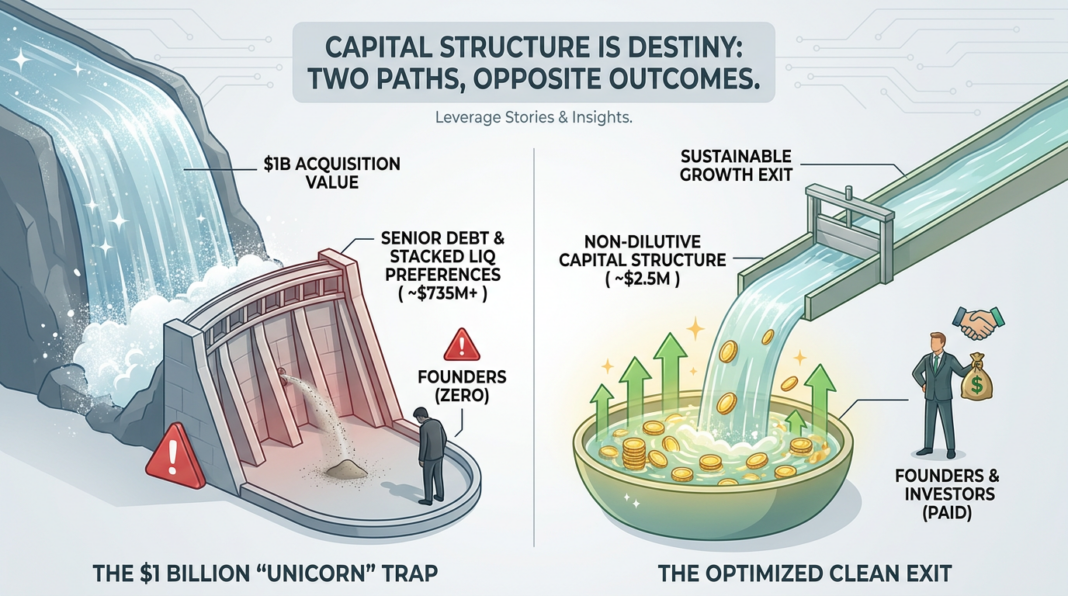
Two Founders. Two Capital Strategies. Same Era. Opposite Outcomes.
In January 2025, a rent-to-own startup called Divvy Homes was acquired by Brookfield Properties for approximately $1 billion. It was the kind of headline that should have marked a triumphant finish line, a unicorn exit, the payoff for years of grinding. Instead, the company’s CEO, Adena Hefets, wrote a letter to shareholders confirming the brutal truth: after repaying outstanding debt, transaction costs, and liquidation preferences to preferred shareholders, neither common shareholders nor holders of the Series FF preferred stock would receive any consideration.
A billion-dollar business. The founders got zero.
Around the same time, a founder named Simon Turner quietly completed a very different journey. His retail sales enablement platform, Myagi, was acquired by Rallyware, a performance enablement company backed by Peakstone Capital. Turner’s team made money. His investors made money. He made money. The exit wasn’t a billion-dollar headline. But it was real, it was clean, and it was his.
Same market window. Opposite outcomes. The difference wasn’t product quality, founder talent, or market timing. It was the capital structure each founder chose, and what that structure did to the payout waterfall when the exit finally arrived.
This is a story about two numbers: $735 million and $2.5 million. And what each one cost the people who built the companies carrying them.
Part I, The Story: How Capital Structure Becomes Destiny
Divvy Homes: The Unicorn That Ate Its Founders
Founded in 2016, Divvy Homes operated a rent-to-own model designed to help renters transition into homeownership. The mission was genuine and the traction was real, the company helped more than 2,000 families access the homes they wanted. Andreessen Horowitz backed it. Tiger Global poured money in. By 2021, the company was valued at $2.3 billion and had raised more than $700 million in debt and equity from a roster of brand-name investors.
The capital structure that built Divvy’s scale, however, was also its undoing. The business model was inherently rate-sensitive: Divvy bought homes and leased them back to aspiring owners. When interest rates surged in 2022, the model fractured. Three rounds of layoffs followed. New home acquisitions were paused entirely in 2023.
When Brookfield acquired the company in early 2025, the waterfall was devastating. The debt, reported at $735 million, sat senior to everything. Below that sat hundreds of millions in preferred equity carrying its own stacked liquidation preferences across Series A through D. By the time the $1 billion acquisition price ran through those obligations, there was nothing left for common shareholders, founders, or employees holding Series FF preferred stock.
As CEO Hefets wrote to shareholders: “While I am not proud of the financial outcome, I am proud of the impact we had on our customers’ lives.” That letter is now one of the starkest capital structure lessons in recent startup history.
Myagi: The Exit That Rewarded Everyone
Simon Turner had been around the capital markets long enough to be skeptical. He’d built companies before, understood the venture playbook, and had grown wary of what it actually asked of founders. When Myagi needed growth capital in early 2021 (coming out of the pandemic, revenue at $2.4 million in ARR) Turner didn’t go back to the VC circuit. He turned to TIMIA Capital for a $2.5 million non-dilutive debt facility.
The funds went into the levers that actually moved Myagi’s needle: referral-based sales, software capabilities, and the land-and-expand customer success model that defined the business. Within roughly 17 months, annual recurring revenue had grown from $2.4 million to $4.4 million, an 83% increase. In May 2023, Rallyware acquired Myagi, absorbing its platform into a performance enablement suite for large retail sales forces.
Turner’s equity was largely intact. The cost of the debt facility was fixed, finite, and a small fraction of the value that was created. Everyone at the table made money.
Part II, The Decision: What Made These Capital Structures So Different?
The surface-level read on Divvy is that it was punished for taking on too much debt. But that misses the deeper structural problem. Divvy’s capital structure had two distinct failure modes stacked on top of each other.
First, the debt itself was mismatched to the underlying business. A $735 million debt load tied to a portfolio of real estate assets that are intrinsically interest rate-sensitive is a leveraged bet on a stable rate environment. When rates moved sharply in 2022, the collateral values shifted and the cash flow model broke. This is a fundamental underwriting error: debt sized to market assumptions rather than business fundamentals under stress.
Second, the preferred equity stacking compounded the damage. Multiple rounds of VC financing, each with its own liquidation preference, created a waterfall that required the company to generate an exit well above the total capital raised before founders and employees saw a dollar. As data from Carta confirms, median founding team ownership falls from approximately 56% after seed to 36% after Series A and roughly 23% by Series B. With each round, not only does ownership shrink, but the liquidation preference stack grows taller, demanding ever-higher exit multiples before common equity participates meaningfully in a sale.
Myagi’s structure contained neither of these failure modes. The $2.5 million debt facility was sized to actual recurring revenue: modest, serviceable, and cleared cleanly at acquisition. There were no stacked liquidation preferences consuming the proceeds. The cost of capital was the interest on the debt, not a compounding equity claim that grew with every passing year.
Turner was explicit about why he made this choice: “One thing venture capital doesn’t take into account is that many businesses have a natural cadence at which they grow. For many companies, growing too fast can be detrimental to the business as founders try to force growth in a market that can’t sustain it.” His capital decision was a deliberate refusal to let external investors set a growth clock that his business couldn’t organically sustain.
| Capital Structure Metric | Divvy Homes | Myagi |
|---|---|---|
| Total Capital Raised | $700M+ (debt + equity) | ~$6M (equity) + $2.5M (debt) |
| Peak Valuation | $2.3 billion (2021) | Not disclosed |
| Exit Price | ~$1 billion (Brookfield, Jan 2025) | Not disclosed (Rallyware, May 2023) |
| Senior Debt at Exit | ~$735 million | $2.5 million (largely repaid) |
| Liquidation Preference Stack | Multi-round, consumed exit proceeds | Minimal / cleared at exit |
| Founder / Employee Proceeds | $0 | Positive, team and investors paid |
| ARR Growth (pre-exit) | Paused / declined | $2.4M → $4.4M (+83%) |
Part III, The Outcome: Running the Counterfactual
The counterfactual for Myagi is instructive. Had Simon Turner raised a $2.5 million venture round in 2021 instead of a debt facility, he would likely have surrendered 20–25% of the company to do so, a dilution figure consistent with median Series A economics reported by Carta for Q1 2024. At acquisition, that equity would have translated directly into dollars leaving his pocket and entering a fund’s. Instead, the cost of the debt was fixed and finite. The economic upside of the revenue growth the capital funded stayed on Turner’s cap table.
The counterfactual for Divvy runs in the opposite direction. Had the company’s debt been sized to a fraction of its recurring revenue, rather than to the scale of an ambitious real estate portfolio, the exit waterfall would have looked entirely different. A $1 billion acquisition with $50 million in senior debt and reasonable preferred equity tranches distributes meaningfully to founders and employees. A $1 billion acquisition sitting below $735 million in senior debt and stacked liquidation preferences distributes nothing.
This dynamic is not unique to Divvy. It is structural. In the current era of capital markets, the private credit market has reached approximately $1.5 trillion and is projected to grow to $2.8 trillion by 2028, a deep, competitive lending environment that gives founders genuine optionality. Meanwhile, venture debt deal value hit a record $53 billion in 2024, even as deal count dropped to its lowest level in a decade: reflecting fewer, larger, and more deliberate debt transactions by founders who understand the trade-off.
Cohesity, the web-scale data management platform, offers a third data point. After a $1 billion+ Series G equity raise, the company closed a $3.1 billion debt deal in 2024, using debt strategically to finance its acquisition of a Veritas business unit and scale operations, all without forcing a further dilutive equity round at a critical growth juncture. The combined company was valued at approximately $7 billion. Debt, structured correctly to match the company’s durable subscription-based cash flows, enabled Cohesity to pursue an ambitious M&A strategy while preserving the equity stake of existing investors and the founding team.
The pattern across all three cases is consistent: debt that is sized and structured to match the underlying business cash flows and exit scenarios is a powerful tool. Debt that is sized to ambition, stacked against mismatched assets, or buried beneath layers of compounding preferred equity becomes an anchor that sinks founders even when the headline outcome looks large.
Part IV, The Lessons: A Framework for the Capital Decision
The Divvy and Myagi stories sit at opposite ends of the capital structure spectrum, but the principles they surface apply to nearly every founder facing a financing decision today.
1. Model the waterfall before you accept the term sheet.
The most critical analysis a founder can run before any capital raise is a waterfall model at multiple exit scenarios: conservative, base, and optimistic. Every dollar of senior debt and every liquidation preference multiplier sits ahead of you. At smaller exits, the bite is enormous. Experts advise modelling exit scenarios at $50M, $150M, and $300M and evaluating what percentage of proceeds actually reaches common equity at each level. If common receives less than 40–50% at your most likely exit scenario, that is a signal to renegotiate the structure, not just the valuation.
2. Debt sized to business fundamentals is an accelerant. Debt sized to ambition is an anchor.
TIMIA’s $2.5 million facility to Myagi was underwritten against actual recurring revenue and a credible growth thesis. The debt service was manageable, the exit cleared it easily, and the value created between draw and exit accrued to the founding team. Divvy’s $735 million debt load was underwritten against a real estate portfolio that was inherently vulnerable to rate cycles. The distinction is not debt versus equity in the abstract; it is whether the debt structure can be serviced and cleared in a range of realistic exit scenarios, not just the optimistic one.
3. Venture capital imposes a growth velocity that may not match your market.
Turner’s post-exit reflection on VC was pointed. Venture capital demands growth at all costs because fund economics require exits within a defined window. For businesses with natural growth cadences that do not match a VC’s required return timeline, that pressure produces hiring ahead of revenue, geographic expansion before product-market fit is proven, and sales cycles that stress culture and unit economics simultaneously. Non-dilutive capital lets founders grow at the pace the business actually sustains. That rhythm protects margin, culture, and ultimately exit multiple.
4. Equity dilution is cumulative and compounding, and it affects both ownership and waterfall priority.
Median founder ownership falls from approximately 56% after seed to 36% after Series A and roughly 23% by Series B, according to Carta data. But ownership percentage and economic outcome at exit are not the same number. Every preferred share issued adds to the liquidation preference stack that stands ahead of common equity. Founders who focus exclusively on headline valuation while accepting aggressive liquidation multiples or participating preferences often discover at exit that their cap table percentage translates to a fraction of what they expected in proceeds.
5. The private credit market now offers founders a genuine third path.
Non-sponsor direct lending went mainstream in 2025, with founder-owned companies driving growth in bespoke structures including delayed-draw term loans, hybrid overlays, and asset-based facilities. The market has matured to the point where founders are no longer forced to choose between bank lines and institutional equity. Private credit on borrower-friendly terms now sits squarely in the middle, a structural shift that meaningfully expands the toolkit available to founders who want to grow without surrendering control of their outcome at exit.
Key Insights
- The waterfall is the real scoreboard. Cap table ownership percentages are a starting point, not a finish line. The exit waterfall (senior debt repayment, liquidation preferences, transaction costs) determines what founders and employees actually receive. Model it before signing anything.
- Non-dilutive debt preserves ownership but does not guarantee outcome. Myagi’s $2.5M debt facility was modest, serviceable, and cleared cleanly at exit. Divvy’s $735M debt load was senior, rate-sensitive, and consumed the entire exit price. The instrument matters less than the sizing and structure relative to real cash flows.
- VC incentives and founder incentives are not the same thing. Venture capital funds require exits within a defined window at multiples that justify LP returns. That mandate creates pressure for growth velocity that may not match a business’s natural cadence, a misalignment that founders absorb, not investors.
- Stacked liquidation preferences are a silent tax on exit proceeds. Each new equity round adds a preferred class that stands ahead of common shareholders. By Series C, the preference stack can consume the majority of a mid-market exit price before founders see a dollar. Negotiate for 1x non-participating preferences and model the full stack at realistic exit multiples.
- The private credit market now offers a credible third path. With U.S. direct lending volumes reaching $380 billion in 2025 and non-sponsor lending growing as a distinct category, founder-owned companies can access institutional capital on genuinely competitive terms, without handing over a seat at the board table or a claim on the upside of everything they build.


