
The Story: Cash in the Bank, Name Still on the Door
In early 2021, the founder of a B2B workforce-enablement company called Myagi found himself at a familiar crossroads. Annual recurring revenue had reached $2.4 million. The product worked. Customers renewed. But growth required capital, and returning to the VC circuit meant accepting the deal terms, the board seats, the investor timelines, and the liquidation preferences that come with institutional equity.
He said no.
Instead, Myagi’s founder turned to TIMIA Capital for a $2.5 million non-dilutive investment facility. The capital funded a referral-based sales expansion, improved software capabilities, and supported a land-and-expand customer success model. Annual recurring revenue grew from $2.4 million to $4.4 million. In 2023, Myagi was acquired by Rallyware, a performance enablement platform for large-scale sales forces, in an outcome that rewarded the founding team and preserved the company culture they had spent years building, per TIMIA Capital’s public portfolio disclosures.
The founder’s post-exit reflection on venture capital was pointed. He observed that VC doesn’t account for the natural cadence at which many businesses grow, and that forcing hyper-growth in a market that cannot sustain it can be actively detrimental.
That instinct, to reach for debt before dilution, is no longer an outlier. It is becoming the defining capital strategy of founder-owned businesses that understand what a liquidation waterfall actually does to founder proceeds when an exit finally arrives.
Myagi’s story sits at the smaller end of the market. But the same logic, applied at scale, is driving one of the most significant structural shifts in private markets today: the leveraged recapitalization boom.
The Decision: Three Paths, One Clear Winner for the Right Business
To understand what a leveraged recap actually solves, consider the problem it is designed to address. A founder-owned business generating $8 million in EBITDA is, on paper, worth somewhere between $40 million and $64 million at a 5x–8x multiple. On paper. In practice, that wealth is entirely illiquid, 100% concentrated in a single asset, and inaccessible without a transaction that either dilutes ownership or transfers control.
The three conventional paths each carry costs:
- Full sale: Maximum liquidity, zero remaining upside, complete loss of control.
- Venture or PE equity raise: Partial dilution, new governance obligations, misaligned exit timelines, and liquidation preferences that stack against common shareholders at exit.
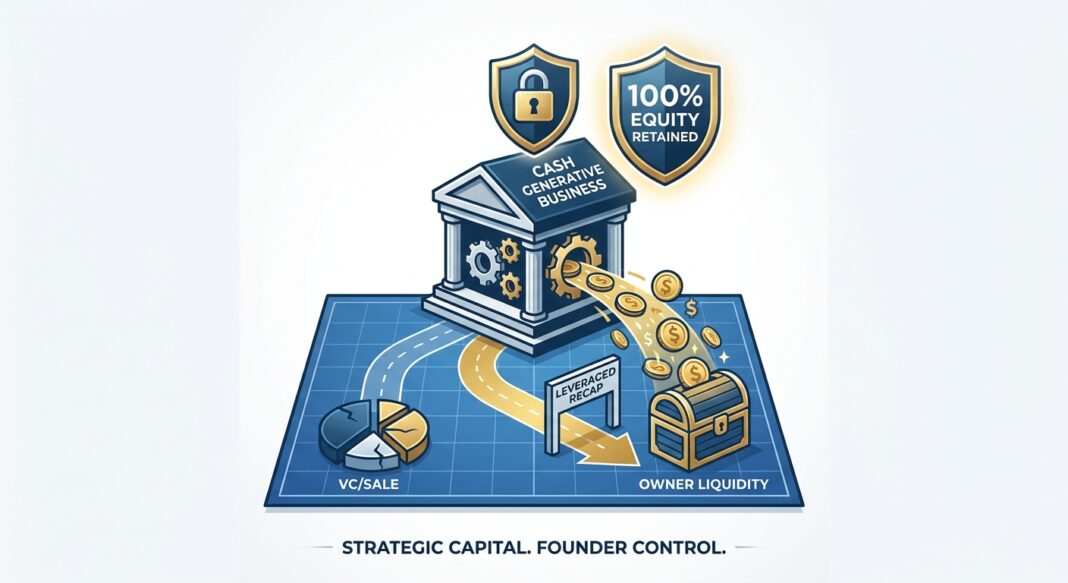
- Leveraged recapitalization: The company borrows against its own cash flows, typically 3x to 5x EBITDA in the lower middle market, and distributes the proceeds to the owner as a special dividend or share redemption. The owner receives cash. The cap table is unchanged. Operational control stays in place.
The mechanics are straightforward: the business issues a senior secured term loan, uses the proceeds to pay a distribution to existing shareholders, and then services that debt from ongoing free cash flow. No new equity investors. No board seats surrendered. No preferred liquidation preferences inserted above the founder’s common equity.
Hypothetical Scenario (Illustrative Example Only): A specialty healthcare services business generating $8M in EBITDA, valued at $56M (7x), executes a leveraged recap at 4x EBITDA. The company raises a $32M term loan at SOFR + 400 basis points (approximately 9.3% all-in, consistent with 2025 market pricing per McKinsey’s Global Private Markets Report). The owner receives a $29M distribution after transaction costs, roughly 52% of the business’s enterprise value, without selling a single share. Remaining annual debt service runs approximately $3.0M–$3.5M, well within a business generating $8M in EBITDA. The owner retains 100% of the equity and all future appreciation. If the company grows to $12M EBITDA over three years and sells at 7x, the equity is worth $84M at exit, debt repaid, founder still whole on the upside.
This is not financial engineering. This is what the capital markets are actually designed to do for cash-generative, founder-owned businesses.
The Outcome: What the Market Is Telling Us
The market has spoken loudly on this strategy. According to PitchBook LCD data cited by the ABF Journal, PE-backed companies issued $70.2 billion in leveraged loans earmarked for dividend recapitalizations through the first eleven months of 2025 alone, a post-Global Financial Crisis record. Sponsors extracted $43.6 billion in dividends from the broadly syndicated loan market by early December, surpassing every prior full-year total.
That volume is being driven, in significant part, by a structural problem in private equity: exits have not materialized. With M&A exit volumes still well below 2021 peaks and IPO windows largely closed for sponsor-backed companies, dividend recapitalizations have become the primary mechanism for returning capital to limited partners pressing for distributions. Bain & Company’s 2025 Global Private Equity Report documented the lowest ratio of distributions to paid-in capital in over a decade, with many 2019–2021 vintage funds still holding unrealized portfolios well past expected exit timelines.
The sponsors using this tool are, in effect, doing what smart founder-operators have always known: a cash-generative business is a borrowing asset. You do not need to sell the asset to realize its value. You borrow against the cash flows it produces.
Pricing has made the strategy increasingly attractive. Average yields on recap-related institutional term loans compressed from 10.11% in 2023 to 7.76% in early 2025, per PitchBook data. For businesses with stable EBITDA margins and predictable revenue (healthcare services, software, insurance brokerage, home services) the cost of debt is meaningfully lower than the implicit cost of equity dilution.
Now contrast this with the cautionary tale that should be required reading for every founder considering a VC raise. In January 2025, a rent-to-own startup called Divvy Homes sold to Brookfield Properties for approximately $1 billion. The founders received $0. So did most employees. The $735M+ in debt repayment came first. Then came the preferred equity liquidation preferences from Series A through D investors. Common shareholders, including founders, received nothing. A billion-dollar business. And nothing to show for it financially. The debt in that case wasn’t a tool the founders controlled. It was structural debt layered in by investors to fund a business model that was acutely sensitive to interest rate risk: a mismatch that the leveraged recap framework, applied to a stable cash-flow business, is designed to avoid entirely.
The Lessons: When Leverage Wins and When It Destroys
The leveraged recap is not a universal solution. It is a precision instrument. The difference between a wealth-creating recap and a value-destroying one comes down to a single variable: the match between the company’s cash flow profile and its debt service obligations.
The tool works when specific conditions are present. Predictable, recurring revenue is the first requirement. Subscription SaaS platforms, healthcare services businesses, B2B service providers with long-term contracts, and specialty distribution companies with sticky customer relationships are natural candidates. The lender underwrites the cash flow, not the collateral, which means the business must demonstrate that revenue will continue regardless of macroeconomic conditions.
The tool breaks when leverage is sized against optimistic projections rather than durable cash flows. Deals that failed in the 2020–2023 vintage were often structured as “quasi-equity bets dressed as debt”, buying thin or no-profit companies at 10x+ revenue with 40%–60% leverage, betting on hyper-growth and a 3–4 year exit to refinance. When growth slowed and multiples reset in 2022–2023, the math broke catastrophically.
The discipline that separates smart recaps from reckless ones is leverage sizing. Lower middle market recapitalizations typically close at 3x to 5x EBITDA in total debt, according to the Pepperdine Private Capital Markets Report (2024). The key test: can the business service the debt through a downturn, not just in a base case, but in a scenario where EBITDA falls 20%–30%? If yes, the recap is a wealth creation event. If no, it is a ticking clock.
One broader principle emerges clearly from the data. The private credit market has made debt genuinely accessible for founder-owned companies in ways it simply was not a decade ago. Non-sponsor direct lending went mainstream in 2025, with founder-owned companies driving growth in bespoke structures including delayed-draw term loans, hybrid overlays, and asset-based facilities. The market has matured to the point where founders are no longer forced to choose between bank lines and institutional equity. A third path, private credit on borrower-friendly terms, now sits squarely in the middle.
The founder who reaches for a leveraged recap at the right moment (when EBITDA is stable, when the business has a 5–10 year growth runway, and when the proceeds can de-risk personal wealth concentration without compromising operating flexibility) keeps both the cash and the upside. That combination is what separates generational wealth creation from a hard-earned company sold too early, or a VC-backed exit where the waterfall left nothing for the people who built it.
The Framework: Five Questions Before You Recap
- Is your EBITDA durable? Stress test it at minus 25%. Can you still service the debt comfortably? If yes, proceed. If the answer requires an optimistic scenario, revisit the leverage multiple.
- Is your revenue sticky? Subscription, contract, or relationship-based revenue is what lenders underwrite. Transactional revenue with high customer concentration makes for a fragile borrowing base.
- What is the personal liquidity objective? Are you diversifying concentrated wealth, funding a partner buyout, or creating an estate planning event? Each objective leads to a different structure and a different conversation with a lender or private credit partner.
- What does the counterfactual cost? Model the equity round alternative. What percentage of the company would a Series A or growth equity investor demand for the same dollar amount? What do their liquidation preferences cost you at a realistic exit multiple? The answer is almost always more expensive than debt at current pricing.
- How much runway do you want before the next event? The recap buys time: time to grow, to wait for better exit conditions, to run the business on your own terms. Size the debt to preserve operating flexibility for that full horizon, not just for the first 18 months.
Key Insights
- The recap boom is real and market-validated. Leveraged loan issuance tied to sponsored dividend recaps reached $74.3 billion in 2025, an 11% increase over 2024’s record-breaking year, driven by stalled exits and LP distribution pressure. Founder-owned companies are accessing the same playbook institutional sponsors have used for decades.
- Debt leaves the cap table unchanged; equity never does. Every equity round inserts new liquidation preferences, governance rights, and exit timeline pressures. A leveraged recap distributes cash to existing shareholders with no new investors, no board seats, and no preferred waterfall layered above common equity.
- The Divvy Homes outcome is the equity warning sign. A billion-dollar acquisition that returned $0 to founders and common shareholders is not an anomaly; it is the logical output of a capital structure with $735M+ in debt and multiple rounds of senior preferred equity layered above common. The instrument matters as much as the business.
- Private credit has made the third path real. Non-sponsor direct lending is now mainstream, with founder-owned businesses accessing bespoke structures (delayed-draw term loans, unitranche facilities, asset-based lines) that simply did not exist at this scale five years ago. The window is open.
- Discipline in leverage sizing is the only variable that separates wealth creation from distress. Recaps sized to 3x–5x EBITDA on businesses with durable, predictable cash flows have consistently produced the intended outcome. Those that pushed leverage against optimistic projections on cyclical or thin-margin businesses created the cautionary tales. The business model, not the tool, determines the outcome.


