
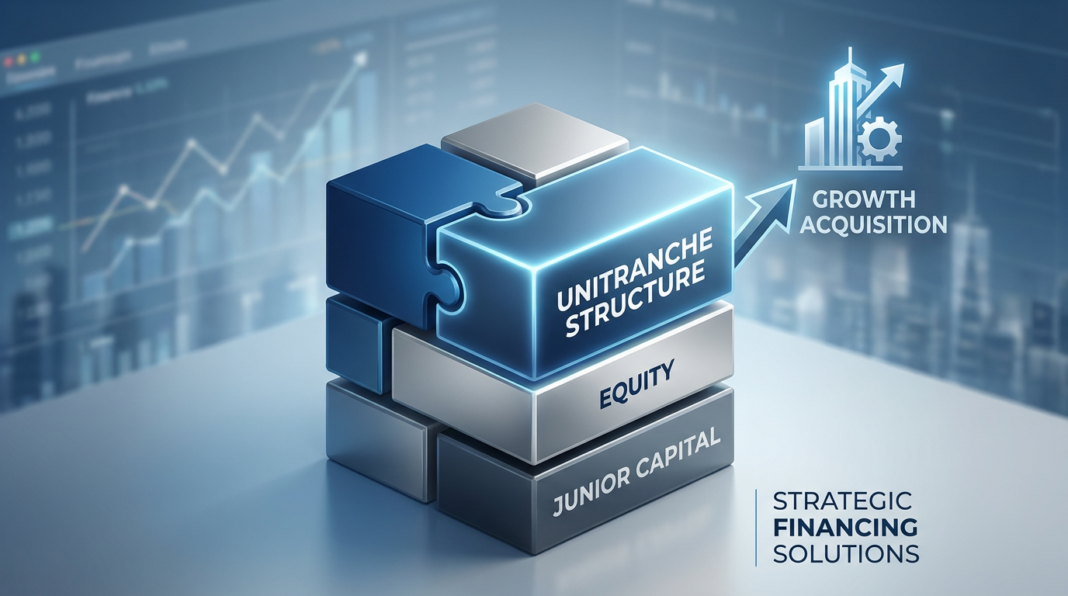
The Financing Gap That Defines Growth-Stage Acquisitions
A growth-stage business reaching $5M–$15M in EBITDA sits at a structural inflection point. It has outgrown SBA financing and seller note-dependent structures, but it is not large enough, nor its cash flows predictable enough, to access broadly syndicated loans at competitive pricing. When the board decides to pursue a platform acquisition or a transformative bolt-on, a transaction that will double revenue overnight, the capital structure question becomes the entire deal.
This is the financing gap that has made unitranche debt the defining instrument of lower and core middle-market acquisition financing in 2026. The structure solves a specific, recurring problem: how does a growth-stage company with $5M–$20M EBITDA finance an acquisition in the $25M–$200M enterprise value range without navigating two lender relationships, two intercreditor negotiations, and two covenant packages?
Understanding when unitranche is the right answer (and when it is not) requires a precise mapping of the capital stack, an honest assessment of the cost-of-capital spectrum, and a disciplined process for quantifying the gap, preparing materials, running the process, and negotiating the final structure.
Structure Breakdown: How Unitranche Actually Works
The Core Mechanics
A unitranche facility is a single loan agreement that blends what would otherwise be a senior secured tranche and a subordinated or mezzanine tranche into one instrument, governed by one credit agreement, with one collateral package, and one ongoing lender relationship. From the borrower’s perspective, there is one set of covenants, one closing process, and one counterparty to manage post-close.
Behind the scenes, in bifurcated structures, a separate Agreement Among Lenders (AAL) governs the priority waterfall between first-out and last-out lenders, but this document is typically not signed by the borrower and does not alter the borrower’s obligations under the credit agreement.
Illustrative Term Sheet: A $55M Unitranche for a $110M EV Business Services Platform
Consider a lower-middle-market business services platform with $11M in EBITDA, acquiring a competitor at a 10x multiple ($110M enterprise value). The acquirer brings $55M in equity. The remainder is financed as follows:
- Facility Type: Senior Secured Unitranche Term Loan
- Facility Size: $55M (5.0x leverage on $11M EBITDA)
- Revolver: $7.5M revolving credit facility (super-senior, first-out)
- Pricing: Term SOFR + 575 bps (blended), with a 50 bps SOFR floor
- All-In Rate: Approximately 10.2%–10.8% at current SOFR levels
- OID: 2.0%–2.5% of funded principal, paid at close
- Amortization: 1% per annum (effectively a bullet structure)
- Maturity: 5 years
- Prepayment Premium: 2% in year one, 1% in year two, none thereafter
- Accordion / Incremental Facility: Up to $20M for future add-on acquisitions, subject to leverage compliance
- Covenant: Single net total leverage maintenance covenant at 6.25x, tested quarterly, with 25–30% headroom to closing leverage
- Equity Cure: Two cures permitted per four-quarter period, up to four cures over the life of the facility
This structure closes in 45–60 days. A traditional senior-plus-mezzanine split on the same deal would require coordinating two lender groups, an intercreditor agreement, and separate closing documentation, adding 30–60 days and 50–100 bps of all-in blended cost in fees and legal expense.
Mapping the Cost-of-Capital Spectrum for This Stage
Growth-stage acquirers in the $25M–$200M enterprise value range face a well-defined capital menu. Understanding where each option sits on the cost-versus-access curve is the first step of any disciplined structuring process.
| Instrument | All-In Cost (2026) | Leverage Available | Best For |
|---|---|---|---|
| Bank Senior (C&I Term Loan) | SOFR + 200–350 bps (~6.5%–8.0%) | 2.5x–3.5x EBITDA | Investment-grade or near-IG credits with strong collateral |
| SBA 7(a) / 504 | Prime + 2.75%–3.75% (~11%–12%) | Up to $5M total project | Very small acquisitions (<$10M EV) |
| Unitranche (Direct Lending) | SOFR + 500–700 bps (~9.5%–11%) | 4.0x–6.0x EBITDA | $25M–$200M EV acquisitions, platform builds |
| Senior + Mezzanine (Split) | Blended 9.0%–11.5% | 4.5x–6.5x EBITDA | Larger deals where mezzanine pricing advantage justifies complexity |
| Mezzanine (Standalone) | 12%–20% (cash + PIK + equity kicker) | Typically fills 1.0x–2.0x gap above senior | Recapitalizations, growth capital, equity gap fills |
| Preferred Equity | 14%–18% preferred return | N/A (equity layer) | Non-dilutive growth capital for businesses avoiding full equity raise |
| Broadly Syndicated Loan (BSL) | SOFR + 300–450 bps (~7.5%–9.0%) | 4.5x–6.5x EBITDA | Deals above $300M EV with strong sponsor backing |
The structural reality of 2026 is that for the $25M–$200M EV range, unitranche has become the default: not because it is always the cheapest option, but because the execution certainty, speed, and structural simplicity justify the spread premium in most transactions.
Unitranche vs. Traditional Senior + Mezzanine: The Real Trade-Off
The most common structural alternative to unitranche in growth-stage acquisition financing is a split-tranche structure: senior bank debt (typically 3.0x–3.5x EBITDA) combined with mezzanine financing (an additional 1.5x–2.5x EBITDA) to reach total leverage of 5.0x–6.0x. Each tranche has distinct pricing, separate documentation, and a formal intercreditor agreement governing enforcement priority.
On the surface, the senior tranche often prices inside unitranche rates, and a blended senior-plus-mezzanine cost can appear marginally cheaper on a basis-point comparison. In practice, the gap is narrow. A traditional 50/50 senior-plus-sub structure can price at a 9.0%–10.5% blended all-in rate, only marginally cheaper than a unitranche at 9.5%–11.0%, while introducing materially more execution complexity, a longer close timeline, and an ongoing intercreditor relationship that complicates future amendments, add-on acquisitions, and restructurings.
When Each Structure Wins
- Choose Unitranche: When execution certainty and speed are critical (competitive auction, LOI deadline), when the borrower needs an accordion for future add-ons, when the deal is $25M–$200M EV, or when a single lender relationship simplifies portfolio management.
- Choose Senior + Mezzanine: When the deal is large enough that the senior tranche can be competitively syndicated at a meaningful price discount, when the mezzanine provider brings strategic value beyond capital, or when total leverage requirements exceed what a single unitranche lender will provide.
- Choose BSL: When enterprise value exceeds $300M, sponsor backing is strong, and the additional time required for syndication is manageable given process dynamics.
Current Market Terms: What Borrowers Face in 2026
The unitranche market in 2026 is characterized by spread compression at the top, pricing stability in the core middle market, and rising selectivity across all lender types. Here are the key data points shaping the market:
- Pricing: Unitranche facilities in 2026 are pricing at SOFR + 500–700 bps for the $25M–$200M EV segment, with all-in blended costs of approximately 9.5%–11.0% at current SOFR levels. Upper-middle-market sponsored transactions can clear at SOFR + 425–475 bps for the strongest credits.
- OID and Fees: OID on private credit deals is running at 2.0%–3.0% of funded principal at close. Prepayment premiums of 2%–3% are standard in the first 24 months, declining to zero thereafter.
- Leverage: Average total leverage in sponsored middle-market unitranche deals has hovered at approximately 5.0x EBITDA, with lenders underwriting to free cash flow generation and covenant headroom rather than peak EBITDA multiples.
- Spread Compression: Global new-issue direct loan median spreads peaked at 716 bps in March 2023 and have declined steadily to approximately 544 bps at year-end 2025, a compression of 172 bps driven by capital inflows and competitive pressure among direct lenders.
- All-In Yields: New-issue all-in yields in private credit declined to approximately 9.3% in 2025, down from 10.5% in 2024, reflecting lower base rates and spread compression acting simultaneously.
- PIK Toggle Trend: PIK provisions, once limited to mezzanine instruments, are increasingly appearing in senior secured unitranche documentation, particularly for borrowers under cash flow pressure. This signals a structural shift in how lenders are managing covenant stress without triggering formal defaults.
- Covenants: Most middle-market unitranche facilities retain at least one financial maintenance covenant (typically a single net total leverage test), in contrast to the broadly syndicated loan market where over 90% of senior loans carry no meaningful maintenance covenants. The standard initial cushion runs 25%–35% over the borrower’s base case closing leverage.
The accordion feature, which allows the borrower to upsize the facility post-close for add-on acquisitions, has become a critical negotiating point for platform-building strategies. Standard 2026 accordions provide $20M–$50M of incremental capacity, subject to pro-forma covenant compliance and lender consent. Sophisticated sponsors are pushing for pre-approved, fixed-spread accordions of $100M or more, with no consent required if pro-forma leverage tests are met.
The Gap Capital Playbook: Running the Unitranche Process
Step 1: Quantify the Need
Begin with a precise capital gap analysis. Determine: (a) total enterprise value to be financed, (b) maximum equity the sponsor or operator will contribute, and (c) the debt capacity supported by trailing and projected EBITDA at standard leverage multiples. The gap between total capital need and available equity defines the debt quantum, which in turn determines whether a unitranche is the right fit (typically $15M–$500M in debt) or whether the deal requires a different structure.
For every $1M of EBITDA at a 5.0x leverage multiple, the unitranche market can theoretically support $5M of debt. A business generating $11M in EBITDA can support approximately $50M–$55M of unitranche debt. If the acquisition requires more, the operator must either increase equity, reduce purchase price, or layer in subordinated capital.
Step 2: Prepare the Credit Package
A unitranche lender’s underwriting centers on four core questions: (1) What is the quality, defensibility, and trajectory of EBITDA? (2) What is the free cash flow available for debt service after capex and working capital? (3) What is the collateral package securing the loan? (4) What is the quality of management and the equity sponsor’s track record?
A well-prepared credit package includes: an audited or reviewed financial history (minimum three years), a detailed trailing-twelve-month income statement with clear EBITDA add-back documentation, a management-prepared forward projection with a base and downside case, a customer concentration analysis, and a sources-and-uses table. Lenders will request tax returns, a current cap table, details on the use of proceeds, and any existing debt obligations or liens.
Step 3: Run a Competitive Process
Even in the lower middle market, running a competitive lender process yields measurably better terms. Submit the credit package to three to six direct lenders simultaneously. The goal is not simply to find the lowest spread; it is to create competitive tension around the covenant package, accordion size, prepayment structure, and equity cure rights. Lenders who know they are competing will flex on structural terms as much as pricing.
Mandate one lender only after receiving at least two term sheets. Use the competing term sheet as the basis for final negotiation, not as a fallback option.
Structuring and Negotiation Guidance
For Operators and Sponsors: The Five Points That Matter Most
- Covenant Headroom: Negotiate 30%–35% of headroom on the leverage maintenance covenant above your closing leverage. This is your buffer for an earnings miss, integration costs, or a market shock. Headroom below 20% creates near-term technical default risk on any operational disruption.
- Accordion Size and Pre-Approval: If your strategy involves add-on acquisitions, the accordion is your most valuable structural feature. Push for the largest pre-approved incremental facility you can support on a pro-forma basis. A $50M pre-approved accordion at a fixed spread cap dramatically simplifies future M&A execution.
- Equity Cure Rights: Negotiate at least two equity cure rights per four-quarter period, with the ability to cure using proceeds from new equity contributions. This is your insurance policy against a temporary covenant breach.
- Prepayment Flexibility: Standard call protection runs 2%–3% in year one and 1% in year two. Push for a shorter non-call window (12 months rather than 24 months) and a declining schedule that reaches zero by year three. This preserves refinancing optionality as your business scales and market conditions improve.
- Most-Favored-Nation (MFN) Protection: MFN clauses in incremental debt provisions prevent the lender from repricing new-money tranches materially above the original facility spread without offering the same economics to existing holders. Standard market MFN protection caps new-money margin increases at 50 bps for 6–12 months after close. Borrowers should understand how this constraint affects future capital-raising flexibility.
For Investors: What to Evaluate in a Unitranche Structure
When reviewing a portfolio company’s unitranche documentation, the critical variables are: (1) the leverage maintenance covenant level relative to the company’s actual and projected EBITDA trajectory; (2) whether PIK toggle provisions exist and under what conditions they activate; (3) the accordion facility size relative to the platform’s acquisition pipeline; and (4) the intercreditor arrangement between the revolver and the term loan, specifically, whether the revolving facility carries first-out priority and what enforcement rights that creates relative to the term loan holders in a stress scenario.
Key Takeaways
- Unitranche has become the structural default for $25M–$200M EV acquisitions in 2026, offering 4.0x–6.0x EBITDA leverage at SOFR + 500–700 bps in a single credit agreement, eliminating the intercreditor complexity of split-tranche structures at a marginally higher blended cost.
- The all-in cost advantage of senior + mezzanine over unitranche has narrowed materially. At a 50/50 senior-sub split, the blended rate difference is often 50–100 bps: insufficient to justify the execution complexity, extended timeline, and ongoing intercreditor management for deals under $200M EV.
- Covenants remain the defining structural battleground in 2026 middle-market unitranche deals. Unlike the broadly syndicated loan market, where over 90% of senior loans carry no meaningful maintenance covenants, most middle-market unitranche facilities retain at least one financial maintenance test. Negotiating the right headroom level at close is the single most important risk management lever available to the borrower.
- The accordion facility is the platform-builder’s most critical structural feature. Pre-approved incremental capacity of $20M–$100M, sized to support future add-on acquisitions on a pro-forma leverage basis, can materially accelerate a roll-up strategy by eliminating the need for a full refinancing with each bolt-on deal.
- Run a competitive lender process, always. Even in the lower middle market, competing term sheets from three to six direct lenders create structural tension that drives improvements in covenant headroom, accordion size, equity cure rights, and prepayment flexibility, often delivering more value than the last 25 basis points of spread negotiation.


