
The Growth-Stage Capital Problem Nobody Defines Precisely
A company generating $8M in annual recurring revenue with 35% EBITDA margins and a clear acquisition pipeline walks into a capital raise. The bank offers $4M. The equity sponsor wants 40% of the business. Neither answer fits the actual need. This is the gap capital problem, and it is endemic to the growth stage.
Growth-stage operators, broadly defined as companies running $5M to $50M in revenue with demonstrated unit economics but still scaling toward maturity, sit in one of the most structurally misunderstood positions in the capital markets. They are too large for seed-stage instruments, too operationally lean for traditional leveraged buyout financing, and too growth-oriented to satisfy a conservative bank’s cash flow tests. The result is a capital mismatch that either leaves money on the table or inflicts unnecessary dilution.
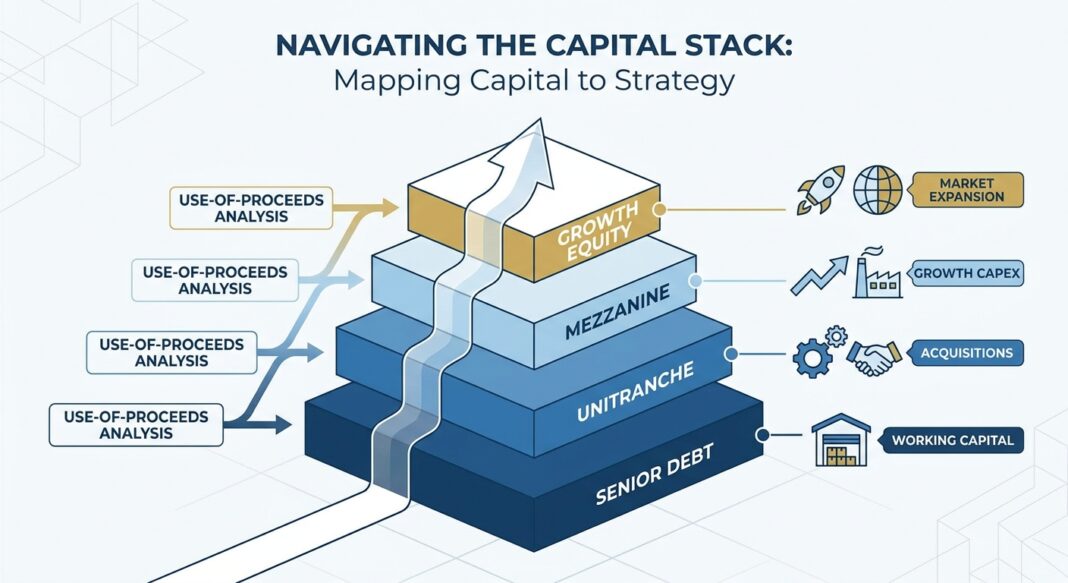
The solution is not a single instrument. It is a disciplined framework: map the use-of-proceeds first, then work backward through the cost-of-capital spectrum to identify the right layer of the stack. This article provides that framework, grounded in how the market is actually pricing and structuring deals in mid-2026.
The Cost-of-Capital Spectrum: From Senior Debt to Growth Equity
The capital stack is not a menu. It is a hierarchy of risk-return trade-offs, and each layer carries a specific price, governance implication, and appropriate use-of-proceeds. Understanding where each instrument sits (and what it costs) is the first analytical move any operator or CFO should make before approaching the market.
Layer 1: Senior Bank Debt (Lowest Cost, Most Restrictive)
Commercial banks remain the lowest-cost source of capital for operating companies with hard assets or predictable cash flow. Revolving credit facilities and term loans at this level typically price at SOFR plus 200–350 basis points, require full asset liens, and come packaged with the most restrictive covenant suites in the market. The trade-off: banks cap leverage at 2.5–3.5x EBITDA for most middle-market operators, cap advance rates on receivables and inventory, and impose personal guarantees on closely held businesses. For working capital needs tied to organic operations, this remains the optimal starting point. For growth ambitions that exceed those leverage thresholds, it is an incomplete solution.
Layer 2: Unitranche / Direct Lending (The Growth-Stage Workhorse)
When a company outgrows what a commercial bank will lend but does not yet warrant a full two-tranche capital structure, the unitranche loan is the market’s answer. Unitranche debt combines what would otherwise be separate senior and subordinated debt layers into one loan with one set of documents, one interest rate, and one lender relationship. From a borrower’s perspective, there is one credit agreement and no intercreditor negotiation.
This structure has become the dominant financing vehicle for acquisitions and recapitalizations in the $25M–$200M enterprise value range. Current 2026 pricing runs at SOFR plus 500–700 basis points, with a 2–3% original issue discount and a prepayment fee declining over the first 24 months. For a typical five-times-leverage deal, the all-in cost of capital lands between 9.5% and 11% blended. Total leverage capacity typically runs 4–6x EBITDA in a single facility, materially higher than what senior-only lenders will provide.
The speed premium is real. A unitranche can close in 45–90 days versus 90–150 days for a traditional senior-plus-mezzanine structure. For operators running competitive acquisition processes or time-sensitive recapitalizations, sponsors and CFOs often justify 50–100 basis points of incremental spread to avoid financing gaps or broken syndications.
On the covenant side, unitranche facilities are maintenance-covenant instruments. Most private credit deals retain at least one financial maintenance covenant, typically a maximum net leverage ratio tested quarterly with an initial cushion of 25–35% over the base case. This stands in sharp contrast to the broadly syndicated loan market, where over 90% of new senior loans in 2024 carried no meaningful maintenance covenants. For lenders, the maintenance covenant is an early-warning mechanism. For borrowers, it is a governance constraint that demands realistic financial modeling before signing.
Layer 3: Mezzanine Financing (Subordinated, High-Yield, Equity-Adjacent)
Mezzanine sits between senior debt and pure equity in the capital stack. It is subordinated to all senior lenders, meaning senior creditors are paid first in any liquidation scenario, and it prices to reflect that risk premium. Typical all-in mezzanine yields run 12–20%, combining a cash coupon, payment-in-kind (PIK) interest (where accrued interest is added to principal rather than paid in cash), and an equity kicker (either warrants or a conversion feature) that provides lenders with upside participation.
Mezzanine is not the most common instrument in 2026 for sponsored deals, where the unitranche has largely compressed the mezzanine opportunity. But for unsponsored companies: operators without a private equity partner who need to fill the gap between senior capacity and the equity they are willing to issue, mezzanine financing remains structurally critical. It fills the gap between what senior lenders will provide and what equity investors wish to contribute, providing growth capital without forcing a full equity recapitalization.
The PIK feature deserves specific attention as a use-of-proceeds tool. PIK interest allows cash-constrained growth companies to preserve liquidity during an investment phase (for example, a company funding a new product build-out or geographic expansion) while the accumulated interest is settled at maturity or upon a monetization event. Mezzanine fundraising rebounded approximately 26% in 2025 after a sharp decline in 2024, reflecting renewed demand for junior capital in transactions where unitranche capacity alone is insufficient.
Layer 4: Venture Debt (For Pre-Profitability Growth Companies)
Venture debt is minimally dilutive term financing designed for growth-stage companies that may not yet be profitable. Unlike bank loans, it does not require hard assets as collateral or the strict covenant packages that banks impose. Unlike equity, it does not require giving up 20–25% of the company or accepting board-level governance constraints. It is structured as a senior secured loan with interest-only payments and a small warrant tranche. The global venture debt market reached roughly $49 billion in 2025, with Deloitte projecting the asset class could grow to represent 20% of total venture funding by 2027. Interest typically runs 8–14%, with warrant coverage of 0.5–2% of equity.
Venture debt is purpose-built for two scenarios: extending runway between equity rounds and bridging a valuation gap when a company has grown since its last raise but does not want to price a new round at a flat or down valuation. Many growth-stage companies raise venture debt alongside or shortly after an equity round to extend runway and reduce the total amount of equity dilution required.
Layer 5: Growth Equity and Preferred Equity (Highest Cost, Most Flexible)
Growth equity (minority stakes from growth equity funds or PE firms) sits at the top of the cost-of-capital spectrum but offers the highest structural flexibility. Growth equity investors typically take 20–40% stakes with limited governance rights, targeting companies with demonstrated unit economics and a repeatable customer acquisition model. Median dilution in 2025 for Series A-equivalent growth rounds sat at approximately 18–19.5%, though investors have been demanding more ownership in the post-2021 repricing environment. Structured equity (preferred shares with liquidation preferences and dividend features) can bridge the gap between pure debt and common equity for operators who need flexibility without full subordination risk.
Use-of-Proceeds Mapping: Which Capital Type Fits Which Need
The single most common structuring error at the growth stage is raising capital without a specific, defensible use-of-proceeds framework. Generic capital raises for “general corporate purposes” signal weak capital discipline to sophisticated lenders and investors alike. The mapping below provides a tactical guide for matching the business need to the right instrument.
| Use of Proceeds | Optimal Instrument | Why It Fits | What to Avoid |
|---|---|---|---|
| Working capital / AR financing | Senior revolver / ABL | Lowest cost; revolving structure matches the cycle of the asset | Equity for working capital (over-dilutive); mezzanine (over-priced) |
| Platform acquisition (EV $25M–$200M) | Unitranche direct lending | Speed, 4–6x leverage, single counterparty; closes 45–90 days | Broadly syndicated for sub-$200M deals (too slow, too complex) |
| Add-on acquisitions (repeat, smaller) | Unitranche with acquisition accordion / delayed draw | Pre-committed capital at known pricing; no re-underwriting for each bolt-on | Equity issuance for each add-on (cumulative dilution compounds) |
| Growth capex / product build-out | Mezzanine with PIK toggle | PIK preserves cash during investment phase; paid at exit or refi | Senior bank debt (cash covenant pressure during build phase) |
| Runway extension (between equity rounds) | Venture debt | Non-dilutive; preserves equity for a higher-valuation raise later | Down-round equity (permanent dilution at compressed valuation) |
| Founder / early investor liquidity | Dividend recapitalization (unitranche or mezz) | Extracts liquidity without requiring a full sale process | Equity secondary (requires full valuation process, governance change) |
| Market expansion / scaling GTM | Growth equity (minority stake) | Aligns capital with long-horizon, equity-return use case; no repayment obligation | Senior debt for speculative use-of-proceeds (covenant breach risk) |
The Gap Capital Playbook: Quantify, Prepare, Run, Negotiate
Identifying that a capital gap exists is the easy part. Executing against it (efficiently and at favorable terms) requires a disciplined four-step process that most operators under-invest in.
Step 1: Quantify the Gap Precisely
Before approaching any capital provider, operators must produce a precise gap analysis. This means building three scenarios in the financial model (base, downside, and upside) and identifying the minimum capital required to achieve the next strategic milestone, not the maximum the business could absorb. Lenders and investors both penalize over-raising: over-levered balance sheets compress covenant cushions, and over-diluted cap tables signal poor capital discipline.
The gap analysis should include: (1) the specific dollar amount and deployment timeline by use-of-proceeds line item; (2) the EBITDA, revenue, and leverage metrics at draw-down and at maturity; (3) the debt service coverage ratio at base case and downside; and (4) the equity value sensitivity across exit multiples. This output becomes the foundation of every lender and investor conversation. As one practical framework notes, presenting capital needs as “$12M for sales team expansion, $8M for product development, and $10M for strategic M&A” is meaningfully more compelling than “general corporate purposes.”
Step 2: Prepare the Capital Markets Package
A credible capital raise at the growth stage requires a purpose-built package: a confidential information memorandum (CIM) or lender presentation calibrated to the specific instrument, a detailed financial model with covenant sensitivity tables, a management presentation covering unit economics and capital deployment milestones, and a clear description of the collateral package or equity story. For debt processes, lenders will underwrite primarily on cash flow, leverage, and covenant compliance. For equity processes, investors will underwrite on revenue growth, margin trajectory, and total addressable market.
One of the most common preparation failures is treating a debt raise with an equity pitch deck, or approaching mezzanine lenders with a bank credit package. Each instrument class has a distinct diligence protocol and the materials must match.
Step 3: Run a Competitive Process
Even for a $15M unitranche, running a competitive process (engaging three to five lenders simultaneously, setting a defined timeline, and requiring term sheets by a common deadline) materially improves outcomes. The private credit market in 2026 is well-capitalized: global private credit assets under management reached approximately $2.1 trillion in 2025. That capital is competing for quality deals, and operators who run structured processes capture that competition in the form of better pricing, looser covenants, and more flexible structural terms. Key lenders active in the $25M–$200M unitranche market include Ares Capital, Blue Owl Capital, Antares Capital, Twin Brook Capital Partners, Apollo Global Management direct lending, Golub Capital, and Monroe Capital.
For venture debt, specialized lenders including Horizon Technology Finance and Western Technology Investment are active in the growth-stage market, alongside an expanding set of alternative debt providers who entered following the disruption of SVB in 2023.
Step 4: Negotiate the Structure, Not Just the Price
Most operators focus almost entirely on the interest rate when reviewing term sheets. Sophisticated borrowers negotiate the structure. The most impactful structural terms to focus on, in order of long-term economic importance:
- Covenant cushion: The initial leverage covenant should provide 25–35% cushion over the base case financial model. A tighter cushion translates directly to amendment risk, and amendments cost fees, management time, and relationship capital. The financial covenant is typically a single net first-lien or total net leverage covenant with a stepping-down threshold as cash flow grows.
- Incremental / accordion capacity: For acquisition-oriented platforms, the uncommitted accordion facility, pre-approved incremental debt capacity for future add-ons, is often more valuable than the initial pricing. Negotiate the size, conditions, and MFN protection on the accordion at close, not when you need it.
- PIK toggle: If the use-of-proceeds involves a growth investment with a lag between capital deployment and cash flow generation, negotiate a PIK toggle option that allows the company to elect to accrue rather than pay cash interest for a defined period. This is standard in mezzanine and increasingly available in senior unitranche structures for creditworthy borrowers.
- Prepayment flexibility: Unitranche facilities typically carry a declining prepayment premium over the first 24 months (commonly 2–3%). Negotiate for a make-whole structure that converts to a premium-free window earlier if the company anticipates a refinancing or sale within the initial term.
- Equity kicker scope: For mezzanine structures, the warrant coverage percentage and the valuation methodology (pre-money vs. post-money, and the basis for exercise price) have material economic consequences at exit. Negotiate warrant coverage caps and include anti-dilution carve-outs for subsequent qualifying equity rounds.
Current Market Terms: What the Data Shows in Mid-2026
The private credit market in 2026 is well-capitalized but increasingly differentiated by credit quality. The following represent current market benchmarks for growth-stage companies navigating the capital stack:
- Unitranche pricing (2026): SOFR plus 500–700 basis points for core middle-market credits; SOFR plus 425–475 basis points for upper middle-market sponsored transactions. All-in cost for a typical five-times-leverage deal: 9.5–11% blended. OID of 2–3% is standard. Unitranche now dominates direct lending for the $25M–$200M EV market, with roughly 70–80% of deals in that range using some form of unitranche structure.
- Leverage multiples: Unitranche capacity runs 4–6x EBITDA. Senior-only bank capacity typically stops at 2.5–3.5x. Traditional senior-plus-mezzanine structures can reach 5–6x on a blended basis, but at greater execution complexity and cost. The simplified unitranche prices only marginally higher than a traditional split structure: on a 50/50 senior-to-subordinated split, the traditional structure prices at 9–10.5% all-in versus 9.5–11% for unitranche, a marginal cost premium for materially simpler execution.
- Covenant standards: In private credit, the vast majority of deals in 2024 contained at least one financial maintenance covenant, in sharp contrast to the broadly syndicated loan market, where over 90% of new large-corporate institutional loans in 2024 were covenant-lite (incurrence-only). For middle-market borrowers, the distinction matters: maintenance covenants require quarterly financial testing regardless of any borrower action, providing lenders with early intervention rights; incurrence covenants only trigger when the borrower takes a specific action (incurring new debt, paying a dividend, making an acquisition). Borrowers should model the difference carefully, a maintenance covenant breach at 4.6x leverage against a 4.5x covenant triggers lender rights even with zero operator action, while the same performance under an incurrence structure triggers nothing unless the company moves to incur debt or take distributions.
- Venture debt market size (2025): The global venture debt market reached approximately $49 billion in 2025, with interest rates running 8–14% plus 0.5–2% warrant coverage. Standard venture debt facilities are structured as senior secured loans with interest-only payments and a small warrant tranche, typically sized at 20–40% of the company's last equity round.
- Mezzanine market: Mezzanine fundraising rebounded approximately 26% in 2025 following a sharp decline in 2024, reflecting renewed demand for junior capital in structures where unitranche leverage capacity alone is insufficient. Mezzanine lenders typically target total returns of 12–20%, combining cash coupon, PIK, and equity kicker returns.
- Default environment: According to Fitch, the U.S. private credit default rate climbed to 5.7% in early 2025, up sharply from near zero in 2022. The Proskauer Private Credit Default Index showed improvement to 1.76% by Q2 2025. For borrowers, this environment has translated into more rigorous lender underwriting, greater emphasis on EBITDA quality and adjustments, and less tolerance for optimistic covenant structures.
Structuring Guidance: For Operators and Their Advisors
For Operators and CFOs
Treat capital raises as a continuous strategy, not a one-time event. The most costly capital mistakes happen when operators raise reactively: approaching lenders when cash is constrained, under a time deadline, with limited process leverage. The capital stack should be mapped proactively, 12–18 months ahead of the actual need, against the company's strategic milestones. As one practitioner framework notes, reactive fundraising costs materially more than strategic fundraising: in pricing, in structural concessions, and in dilution.
Stack capital sequentially. Attempting to close multiple facilities simultaneously creates overlapping covenants, competing liens, and a negotiating environment where each lender has reduced certainty about the others' terms. Close one facility, deploy the capital, hit the milestones, then approach the next layer of the stack from a position of demonstrated performance.
In 2025–2026, the market rewards capital efficiency and fundamental performance over revenue growth alone. Lenders and investors are focused on EBITDA margin trajectory, CAC payback periods, and churn, not headline growth metrics. The company that enters a capital raise with demonstrated improvement in unit economics will consistently negotiate from a stronger position than one that is growing fast but burning cash to do it.
For Investors and Advisors Evaluating Deal Structure
When reviewing a proposed structure, the first question is always alignment: does the proposed capital type match the stated use-of-proceeds, and does the repayment profile fit the company's cash flow generation timeline? A PIK mezzanine tranche funding an acquisition that generates immediate EBITDA contribution is well-aligned. A senior term loan funding a multi-year product build-out with no near-term cash flow return is structurally mismatched, and that mismatch will appear in the covenant model, not the headline pricing.
The covenant package is a risk proxy. Maintenance covenants with meaningful cushion (25%+ over base case) and lender intervention rights signal a disciplined underwriting approach. Cov-lite structures at the middle market level, where the borrower lacks the credit depth to justify incurrence-only documentation, are a red flag worth scrutinizing carefully, particularly in a rising default environment.
Finally, watch the accordion structure in unitranche facilities. Pre-committed incremental capacity at defined MFN-protected pricing is a significant embedded option for platform operators running acquisition strategies. The size and conditions of that accordion often determine whether a mid-market platform can scale efficiently over a three-to-five-year hold period without requiring a full capital markets process for each add-on.
Key Takeaways
- Match capital type to use-of-proceeds, not to convenience. Working capital belongs in a revolving credit facility. Acquisitions belong in unitranche direct lending. Growth investment with a cash flow lag belongs in mezzanine with a PIK toggle. Equity is for long-horizon, speculative, or governance-intensive use cases. Using the wrong instrument for any of these creates a structural mismatch that surfaces in covenants, dilution, or debt service constraints.
- Unitranche is the growth-stage workhorse, but it is not free. At SOFR plus 500–700 basis points with a 2–3% OID and maintenance covenants tested quarterly, unitranche delivers speed, leverage, and structural simplicity at a price. The 45–90-day close window and single-counterparty structure justify the cost premium over broadly syndicated alternatives for most $25M–$200M EV transactions.
- The maintenance-vs.-incurrence distinction is not a technicality. A maintenance covenant is a trip wire that gives lenders intervention rights when leverage drifts, regardless of operator action. An incurrence covenant is a gate that only triggers when the company moves. For growth-stage operators carrying meaningful leverage, understanding which covenant regime governs their facility determines how much operational headroom they actually have.
- Gap capital strategy is a proactive discipline. The companies that consistently raise capital at the best terms (in price, structure, and governance) are those that map their capital needs 12–18 months in advance, prepare purpose-built materials for each instrument class, and run competitive multi-lender processes from a position of financial strength.
- Structure negotiation matters as much as pricing. Covenant cushion, accordion capacity, PIK toggle optionality, prepayment flexibility, and equity kicker scope have long-horizon economic consequences that dwarf a 25-basis-point difference in spread. Operators who focus exclusively on the headline interest rate, and not the structural terms governing their flexibility for the next three to five years, consistently under-negotiate the deals that matter most.


