
The Deal That Closes in Four Weeks
Imagine you are a private equity sponsor trying to close a $150 million buyout of a software-enabled services company. The clock is ticking: your purchase agreement gives you 45 days, and you need committed debt financing before you can sign. The traditional path (a syndicated senior loan arranged through a bank, plus a separate mezzanine tranche from a subordinated debt fund) can easily take 60 to 90 days and requires two separate sets of documentation, two creditor constituencies, and two intercreditor agreements to negotiate. Then the syndicated market pivots on you, pricing widens, and your deal hangs in the balance.
This is precisely the gap that the unitranche loan was engineered to fill. It is the dominant debt structure in middle-market private credit today, and understanding how it works (mechanically, economically, and structurally) is foundational for anyone evaluating private credit as an asset class or seeking capital for a business.
What Is a Unitranche Loan?
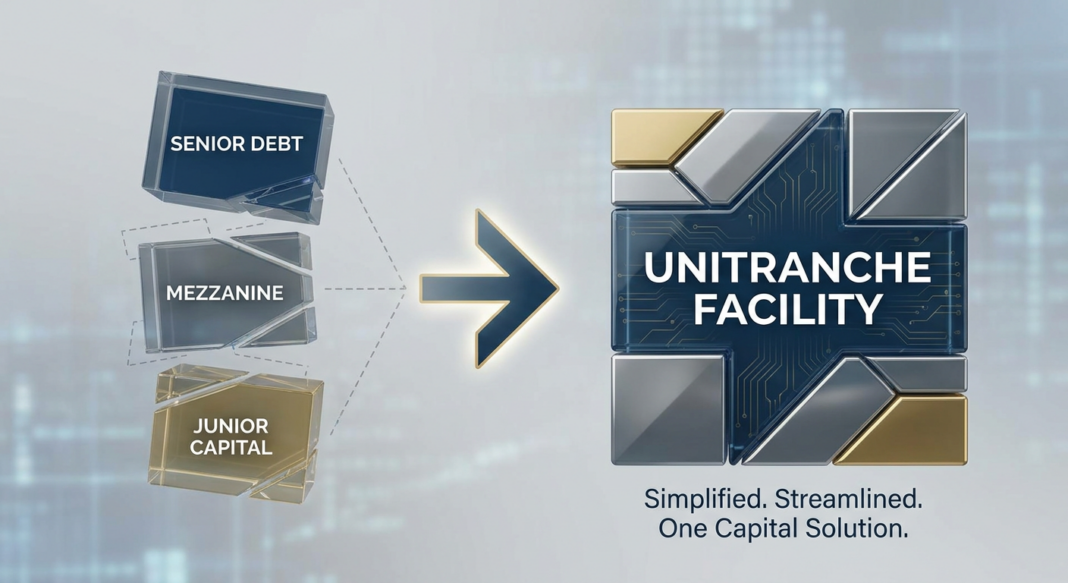
A unitranche loan is a single, first-lien senior secured credit facility that effectively replaces what would traditionally be multiple layers of debt (a senior bank revolver, a senior term loan, and often a mezzanine or second-lien tranche) with one unified instrument. The borrower faces a single lender relationship, a single loan agreement, a single interest rate, and a single set of covenants. Execution is dramatically simplified.
As defined in SEC filings by multiple Business Development Companies (BDCs), including those managed by Goldman Sachs and Phillip Street Middle Market Lending Fund, unitranche loans are first lien loans that extend deeper into a borrower’s capital structure than traditional first lien debt and may provide for a waterfall of cash flow priority between different lenders in such loan. That last phrase is key. Behind the single face the borrower sees, private credit managers frequently divide the unitranche into an “first-out” (FO) tranche and a “last-out” (LO) tranche via a private contract called an Agreement Among Lenders (AAL). This internal architecture is invisible to the borrower but drives the economics for investors.
How the First-Out / Last-Out Split Works: A Concrete Example
Consider a $100 million unitranche facility on a business with $15 million of EBITDA, a 6.7x leverage multiple, typical for a sponsored lower-middle-market transaction. The borrower pays one blended all-in rate. Internally, the lender group splits the facility:
- First-Out (FO) Tranche, $40 million: This portion receives payment priority. In a default or restructuring, the FO lender is made whole before the LO lender receives anything. Because of this seniority, the FO lender accepts a lower yield, typically pricing closer to a conventional senior secured spread.
- Last-Out (LO) Tranche, $60 million: This portion is subordinated within the facility. It absorbs first-dollar losses beyond the FO tranche. In exchange, as confirmed in filings from Phillip Street Middle Market Lending Fund and Goldman Sachs Private Middle Market Credit II, the “last-out” portion generally earns a higher interest rate than the “first-out” portions of the loan.
The borrower sees none of this. They service one loan at one rate, deal with one agent, and comply with one covenant package. The AAL allocates internal cash flow between FO and LO lenders privately. The net effect: the borrower gains simplicity and execution speed; investors gain exposure calibrated precisely to their risk appetite within a single legal structure.
On pricing, the market in mid-2026 reflects a higher-rate environment. According to ABF Journal’s Middle Market Debt Weekly (June 2026), typical lower-middle-market unitranche deals are pricing at 500 to 700 basis points over SOFR, with potential for a further 25 to 50 basis points of widening on competitive bids. Blended all-in rates for top-tier upper-middle-market borrowers are running approximately 9% to 10%, with smaller or more marginal credits carrying all-in costs of 10% to 11%, per Private Capital Global (September 2025).
Current Market Relevance: Why Unitranche Is Winning
The structural dominance of unitranche in middle-market lending is not an accident; it is the direct result of bank retrenchment and persistent demand for execution certainty.
| Market Metric | Data Point | Source |
|---|---|---|
| U.S. Private Credit AUM (2025) | Crossed $2 trillion | CT Acquisitions / Preqin, 2026 |
| Projected Global Private Credit AUM (2030) | $4.5 trillion | Preqin via IQ-EQ, February 2026 |
| CDLI 2025 Full-Year Return | 9.3% (20-year avg: 9.5%) | Cliffwater / Morningstar, March 2026 |
| Middle Market Unitranche Spread (LMM, mid-2026) | SOFR + 500–700 bps | ABF Journal, June 2026 |
| Bank C&I Lending Standards (Q1 2026) | Tighter for all firm sizes (4th consecutive quarter) | Federal Reserve SLOOS, April 2026 |
The Federal Reserve’s April 2026 Senior Loan Officer Opinion Survey (SLOOS) confirmed that bank lending standards tightened for commercial and industrial loans to firms of all sizes in Q1 2026. That same survey found that banks also reported tighter standards across all categories of non-depository financial institution (NDFI) loans, with higher risk premiums, stricter covenants, shorter maturities, and lower maximum credit line sizes. This structural tightening by banks is not a blip; it has been a consistent feature of the credit landscape across multiple consecutive quarters, directly expanding the addressable market for private credit unitranche providers.
Meanwhile, Octus data (May 2026) shows that large-cap direct lending deal activity surged 37% in 2025, while middle-market deal flow increased 14% versus 2024. Spreads in Q4 2025 held steady at approximately SOFR+480 basis points for large-cap direct loans and SOFR+500 basis points for middle-market direct loans, reflecting compressed but stable pricing in a competitive environment. The Cliffwater Direct Lending Index (CDLI), which tracks approximately 21,000 U.S. middle-market loan holdings totaling $549 billion in assets, delivered a 9.3% full-year return for 2025, driven primarily by interest income of 10.4% for the year.
Decision Framework
For Investors Evaluating Private Credit Exposure
Investors considering unitranche-focused funds or BDCs benefit from understanding which position within the unitranche structure their manager holds. A fund primarily holding first-out positions is taking a profile closer to conventional senior secured lending, lower yield, lower loss severity in default. A fund concentrated in last-out positions is accepting subordination risk within what appears to be a first-lien structure and should command a meaningful yield premium to compensate. Investors evaluating private credit managers typically examine: (1) the percentage of the portfolio in unitranche versus traditional first-lien structures; (2) average attachment points and leverage multiples at origination; (3) non-accrual rates as an early signal of credit stress; and (4) net investment income coverage of dividends, which reflects the durability of yield. The PwC Global Private Credit Survey 2026, based on more than 120 credit portfolio managers surveyed between January and March 2026: notes that managers are navigating their first meaningful credit cycle as a prominent asset class, with stress expected to be most acute over the next one to two years in consumer, retail, and automotive sectors.
For Business Owners and Operators Seeking Capital
For an operator evaluating whether unitranche financing fits their situation, the core trade-off is cost versus certainty. A unitranche typically prices 50 to 100 basis points wider than an equivalent bifurcated senior/mezz structure, but it offers execution in as few as four weeks versus six to ten weeks for a syndicated deal, a single lender relationship to manage, and a unified covenant package. Operators with time-sensitive acquisition financing, founders executing a first institutional leverage recap, or businesses in sectors where bank appetite is constrained by trade exposure or AI disruption concerns are the natural unitranche candidates in today’s market. The key structural questions to resolve: Is there an AAL, and if so, which tranche will the lead lender retain? What is the prepayment protection (call protection) structure? And does the covenant package include a financial maintenance covenant, a critical early-warning mechanism that sophisticated operators can actually use to their benefit in a covenant negotiation.
Key Takeaways
- One loan, one relationship: Unitranche replaces a multi-tranche capital structure with a single facility, reducing execution time, documentation complexity, and the number of creditor relationships an operator must manage.
- The AAL is the invisible architecture: Behind the borrower-facing simplicity, lenders frequently divide the unitranche into first-out and last-out positions via an Agreement Among Lenders, a private contract that allocates yield and loss absorption between lender parties without the borrower’s direct involvement.
- Risk and yield scale within the structure: Last-out investors accept subordination within a first-lien instrument in exchange for higher yield; first-out investors accept lower yield in exchange for payment priority. Investors evaluating private credit funds should understand which position their manager predominantly holds.
- Bank tightening is structural, not cyclical: The Federal Reserve’s SLOOS data, confirmed through Q1 2026, shows persistent bank credit tightening across all business sizes. This is the macro tailwind underpinning private credit unitranche market share gains, not a temporary dislocation.
- Pricing reflects the rate environment: With SOFR remaining elevated and bank competition reduced, middle-market unitranche spreads are running 500–700 bps over SOFR in mid-2026. Operators should model all-in costs carefully and evaluate whether covenant packages include financial maintenance provisions that provide an early renegotiation trigger, a feature that can protect both sides of the deal.


