
Why Borrowers Are Choosing a Single Lender Over a Stack of Creditors
For decades, a middle-market company seeking financing for an acquisition faced a familiar challenge: assemble a capital stack from multiple lenders with competing interests, negotiate an intercreditor agreement that could take months, and hope the deal didn’t fall apart in the process. Senior lenders, mezzanine funds, and second-lien providers each brought their own documentation, pricing, and enforcement rights to the table, along with their own lawyers.
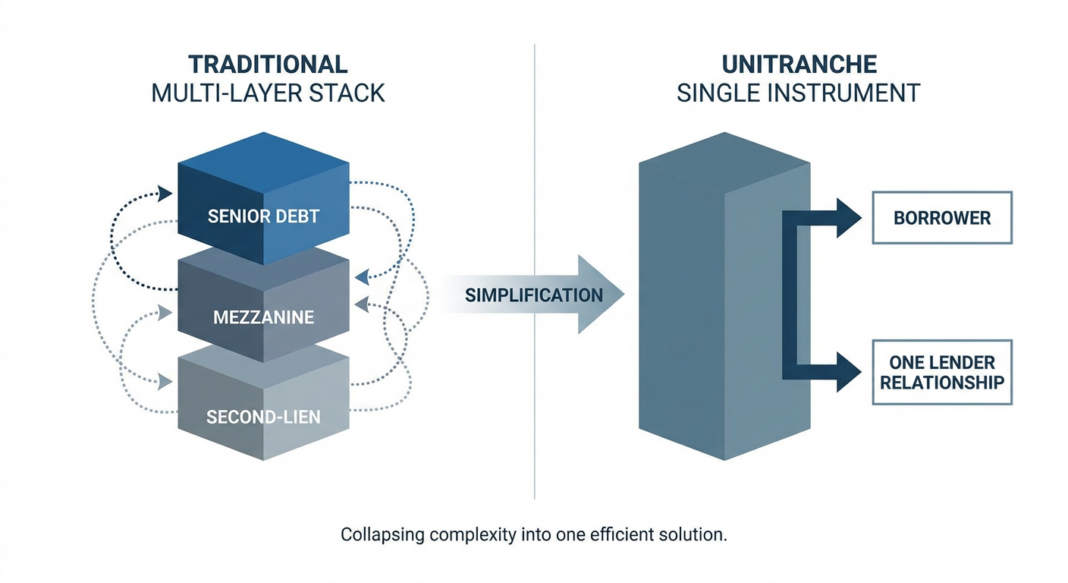
The unitranche loan was designed to collapse that complexity into a single instrument. Today, it has become the dominant structure in middle-market private credit. According to PipelineRoad (2026), unitranche facilities now represent the majority of middle-market private credit transactions in the United States. Understanding how this instrument works (and why it gained such dominance) is essential knowledge for any investor evaluating private credit allocations or any business owner seeking growth capital.
What Is a Unitranche Loan? Definition and Mechanism
A unitranche loan is a single debt facility that combines what would otherwise be separate senior and subordinated debt layers into one instrument, with one credit agreement, one interest rate, and one lender relationship. As described by PipelineRoad, the borrower signs one credit agreement; there is no intercreditor agreement to negotiate, and the entire debt structure below equity collapses into a single instrument.
The blended interest rate reflects both the lower-risk senior portion and the higher-risk subordinated portion. But this simplicity on the borrower’s side masks a more nuanced structure behind the scenes. When multiple direct lenders participate in a unitranche, they typically divide the facility internally through an Agreement Among Lenders (AAL). As explained by Private Equity Bro, the AAL creates a first-out tranche: which receives priority of payment and carries lower risk, similar to a traditional senior lender, and a last-out tranche, which absorbs more risk and earns a higher spread, akin to a mezzanine position. The borrower makes one payment; the economics are allocated privately according to the AAL waterfall. The borrower is not party to the AAL.
This structure lets direct lenders with different risk appetites participate in the same deal without creating documentation complexity for the borrower. Critically, PipelineRoad notes that unitranche facilities typically include maintenance covenants: a meaningful lender protection compared to the broadly syndicated loan market, where covenant-lite has become the norm.
How It Works: A Concrete Example With Numbers
Consider a private equity sponsor acquiring a manufacturing services business with $20 million in EBITDA at a total enterprise value of $140 million (7x EBITDA). The sponsor wants to deploy $50 million in equity and finance the remaining $90 million, roughly 4.5x leverage, through debt.
Option A: Traditional Senior + Mezzanine Stack
- Senior secured term loan: $65M at SOFR + 400 bps (~7.5% all-in in 2026), 6-year term, one lender group, first lien on all assets
- Mezzanine debt: $25M at 12% cash interest + 2% PIK (14% all-in), 7-year term, subordinated, plus equity warrants
- Blended cost of debt: approximately 9.4% weighted average
- Time to close: 100–130 days; two separate negotiations; intercreditor agreement required
- Total legal/closing cost: $450,000–$650,000+
Option B: Unitranche Structure
- Single unitranche facility: $90M at SOFR + 575 bps (~10.0% all-in), 6-year term, first lien, one credit agreement
- All-in blended cost: approximately 10.0%
- Time to close: 45–90 days; one negotiation; no intercreditor
- Total legal/closing cost: materially lower, one set of documents
The unitranche costs the borrower roughly 60 basis points more per year in interest, approximately $540,000 annually on a $90M facility. Against a $140M enterprise value acquisition with time-sensitive deal mechanics, many sponsors consider that premium a fair price for execution certainty and speed. As noted by Private Equity Bro, if a unitranche can close 30 to 45 days faster than a syndicated alternative, sponsors often justify an extra 50 to 100 basis points of spread by avoiding financing gaps or broken syndications that jeopardize purchase agreements.
Current Market Reality: Pricing, Volume, and the Macro Backdrop
The unitranche is not merely a structural curiosity; it now defines the middle-market financing landscape, and its current pricing reflects a higher-for-longer rate environment with tightening bank credit.
On the pricing front, Valuation Research Corporation’s Q2 2026 Private Markets Update reports that unitranche structures continue to dominate new issuance, with coupon spreads generally ranging from 4.75% to 5.50% over SOFR, approximately 25 basis points higher than year-end 2025 levels, and overall unitranche yields ranging between approximately 9.00% and 9.75%. That represents a decline of roughly 250 basis points from late 2023 peak levels near 11.5%, driven by SOFR declining approximately 170 basis points from its peak. Meanwhile, ABF Journal (May 2026) notes that lower-middle-market unitranche deals are pricing at 500 to 700 basis points over SOFR, with origination teams expecting further 25 to 50 basis points of widening on competitive bids over the coming two quarters.
Leverage levels reflect selective underwriting: according to VRC’s Q2 2026 update, competitive dynamics have supported leverage in the 5.0x–6.0x EBITDA range for high-quality transactions through mid-2026, though underwriting standards have become more conservative since March amid expectations for higher base rates and constrained M&A volumes.
The macro backdrop has been consistently favorable for unitranche adoption. The Federal Reserve’s April 2026 Senior Loan Officer Opinion Survey (SLOOS) reported that banks, on balance, tightened lending standards for commercial and industrial loans across firms of all sizes during Q1 2026, while also tightening all terms surveyed: including higher premiums on riskier loans, stricter covenants, shorter maturities, and lower maximum credit line sizes. That sustained bank retrenchment continues to push middle-market borrowers toward private credit and unitranche structures. This trend is corroborated by ABF Journal, which noted that a banking system continuing to tighten C&I standards is steadily ceding ground to asset-based and non-bank lenders.
At the market scale level, PIMCO (March 2026), citing Preqin data, reports that total AUM in North American direct lending portfolios grew roughly sevenfold over the past decade, from $93 billion in 2015 to approximately $644 billion by year-end 2025. Unitranche has been a primary engine of that growth: per CT Acquisitions (2026), the unitranche market grew from roughly $20 billion in annual issuance in 2015 to over $200 billion in 2025, as direct lenders displaced traditional bank syndication for sub-$1 billion EBITDA borrowers.
| Metric | Current Level | Source |
|---|---|---|
| Unitranche coupon spread (US middle market) | SOFR + 475–550 bps (coupon); 500–700 bps (LMM) | VRC Q2 2026 |
| All-in unitranche yield range | ~9.00%–9.75% | VRC Q2 2026 |
| Typical leverage (high-quality credits) | 5.0x–6.0x EBITDA | VRC Q2 2026 |
| 3-month Term SOFR (June 2026) | ~3.69% | VRC Q2 2026 |
| North American direct lending AUM (year-end 2025) | ~$644 billion | PIMCO / Preqin, March 2026 |
Decision Framework: Investors and Operators
For Investors Evaluating Private Credit Allocations:
Unitranche structures offer a distinctive risk-return profile that sits between pure senior direct lending and mezzanine strategies. Investors consider several criteria when evaluating unitranche-focused funds:
- First-lien security matters. Despite the blended pricing, unitranche loans typically carry first-lien collateral, meaning that in a restructuring, lenders maintain priority over equity. As noted by PipelineRoad, unitranche strategies generally target gross returns of 9–13%, positioning them between pure senior direct lending and mezzanine funds.
- Maintenance covenants are a differentiator. Unlike broadly syndicated covenant-lite loans, most unitranche facilities include financial maintenance covenants that require borrowers to meet periodic leverage and coverage tests, giving lenders early warning and intervention rights before a default becomes irreversible.
- Floating-rate income in a higher-for-longer environment. With VRC reporting that SOFR is expected to stabilize near 4% through 2026 and market participants now generally forecasting one to two 25-basis-point rate increases by year-end, the floating-rate nature of unitranche debt continues to provide income buffering against duration risk.
- Manager selection is critical. With McKinsey (June 2026) reporting that the top 25 managers captured approximately 72% of total private credit fundraising in 2025, access to institutional-quality origination, underwriting discipline, and workout expertise is concentrated among a small number of scaled platforms.
For Business Operators Considering a Unitranche:
A unitranche is most appropriate when certainty of execution, speed, and control matter more than achieving the absolute lowest blended cost. Operators and sponsors evaluate this structure by weighing the following:
- Time-sensitive acquisitions. When a purchase agreement has a fixed closing deadline, the 45–90 day unitranche timeline, versus 100–130 days for a senior-plus-mezz syndication per CT Acquisitions, can be the deciding factor.
- Debt service capacity. At 9–10% all-in cost and 4.5–5.5x leverage, operators should stress-test interest coverage under flat or declining EBITDA scenarios. VRC notes that more recent transactions reflect coverage ratios above 2.0x, supported by SOFR declining from its peak, but borrowers should ensure adequate headroom.
- Covenant headroom. Maintenance covenants require ongoing compliance. Operators entering a unitranche should negotiate covenant thresholds with sufficient cushion relative to their base case EBITDA projections, and understand their equity cure rights.
- Refinancing optionality. Prepayment premiums, typically 2–3% OID plus a 102/101/par call schedule declining over 24–36 months per ABF Journal, mean operators should evaluate their likelihood of refinancing within the call protection window before committing.
Key Takeaways
- One lender, one document, one rate. A unitranche collapses the traditional senior-plus-mezzanine stack into a single facility, eliminating intercreditor complexity and accelerating execution by 30 to 45 days or more relative to syndicated structures.
- The rate is blended, not cheap. Unitranche pricing reflects both senior and subordinated risk. Current mid-2026 all-in yields of approximately 9.00%–9.75% are meaningful debt service obligations, operators should model conservative coverage scenarios before committing.
- Behind-the-scenes, the risk is still layered. The Agreement Among Lenders (AAL) privately divides the facility into first-out and last-out tranches among direct lenders, the borrower benefits from simplicity, but lenders still manage differentiated risk positions internally.
- Bank retrenchment is structural, not cyclical. Multiple consecutive SLOOS surveys through Q1 2026 confirm banks continue tightening C&I lending standards. This creates a durable origination window for unitranche lenders and a structural reason for middle-market borrowers to engage private credit.
- Investor protections are stronger than in public markets. Maintenance covenants, first-lien collateral, direct lender relationships, and bilateral amendment rights give unitranche investors more control over credit outcomes than broadly syndicated loan investors typically enjoy, a fundamental advantage that investors consider when assessing risk-adjusted return profiles.


