
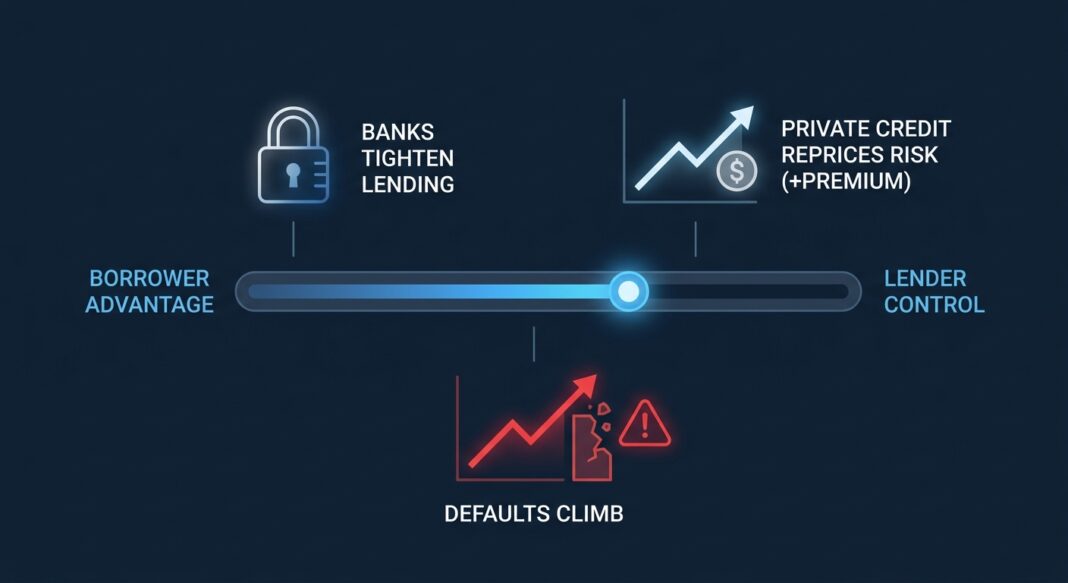
The Lender-Friendly Reset: Private Credit Reprices Risk as Banks Tighten and Defaults Climb
Bond Capital Market & Sector Intelligence | July 9, 2026
Macro Headline: A Structural Repricing, Not a Cyclical Blip
The U.S. credit market has crossed a meaningful threshold. After two-plus years in which borrowers dictated terms (grinding spreads tighter, pushing leverage higher, and extracting covenant-lite documentation) the pendulum has swung decisively back toward lenders. This is not a brief episode of volatility. It is a regime change driven by the convergence of three seismic forces: an AI-driven credit quality reassessment in software, geopolitical shock from the U.S.-Iran conflict, and a liquidity stress test in semi-liquid private credit vehicles that exposed structural fragility at scale.
lordabbett.com captured the shift precisely at midyear: “spreads [have widened] by roughly 50 to 100 basis points higher since late 2025, while defensive terms have also improved, according to PitchBook.” Critically, the structural change runs deeper than price. lordabbett.com notes that new loans are increasingly coming with “less leverage, more covenants, fewer PIK requests, and tighter documentation”, a combination that reshapes risk-adjusted return dynamics for disciplined capital providers.
Simultaneously, the regulatory overlay is tightening. The April 2026 Federal Reserve Senior Loan Officer Opinion Survey (SLOOS) found that federalreserve.gov banks reported, on balance, “tighter lending standards and basically unchanged demand for commercial and industrial (C&I) loans to firms of all sizes” over Q1 2026. For non-depository financial institutions (NDFIs), the channel through which banks fund private credit platforms, the tightening was even more pronounced: federalreserve.gov reports that “significant net shares of banks reported tighter standards for NDFI loans to business credit intermediaries” alongside stricter collateralization requirements and higher risk premiums. FRED data confirms: the net percentage of large domestic banks tightening C&I standards for large and middle-market firms reached 10.0% in Q2 2026, per fred.stlouisfed.org. For small firms, the equivalent reading was 6.6% as of May 4, 2026, per fred.stlouisfed.org. This bank-channel tightening is not an independent development; it is structurally linked to the rising cost of fund-level leverage for private credit managers, compressing the overall supply of readily available capital and creating a more selective origination environment.
Quantitative Snapshot: Where the Data Sits Right Now
The table below synthesizes the most current pricing, volume, and credit quality data available as of July 2026.
| Metric | Current Value | Prior Period | Direction | Source |
|---|---|---|---|---|
| US Direct Lending Avg. Spread (1Q26) | S+504 bps | S+486 bps (4Q25) / S+519 bps (1Q25) | ↗ vs. Q4 2025; Premium over BSL maintained at ~200 bps | ionanalytics.com |
| Unitranche All-In Yield Range (Q2 2026) | 9.00%–9.75% | ~11.5% peak (late 2023) | ↘ 250 bps from peak; +50 bps vs. YE 2025 on swap-adjusted basis | valuationresearch.com |
| Unitranche Coupon Spread Range (Q2 2026) | 475–550 bps | ~450–525 bps (YE 2025) | ↗ ~25 bps since year-end; OID stable at 98.75–99.25 | valuationresearch.com |
| BSL B-Rated Loan Spread (June 2026) | ~43 bps wider than YE 2025 | Tightest at YE 2025; +Q1 peak was ~20 bps wider than June | ↗ Widening off 2025 tights; software subsector +245 bps vs. YE | valuationresearch.com |
| US Direct Lending Deal Volume (1Q26) | ~$82bn / 838 deals | ~$74bn (1Q25) | ↗ +10% YOY in volume; deal count slightly lower | ionanalytics.com |
| Fitch US Private Credit Default Rate (May 2026) | 6.0% (TTM record high) | ~1.5% (2025 avg, KBRA headline); 2.73% (Proskauer Q1 2026) | ↗↗ Sharply elevated; Moody’s notes ~65% are distressed restructurings | valuationresearch.com / forbes.com |
| Morningstar LSTA Leveraged Loan Index Spread | S+313 bps | YTM: 8.31% | B-rated: S+337; CCC: S+472; reflecting severe bifurcation by quality | morganstanley.com |
| Fed SLOOS, C&I Tightening (Q2 2026, Large/MM Firms) | +8.1% net tightening | Tightening persisted through 4Q25 and 1Q26 | ↗ Consecutive quarters of net tightening for C&I and NDFI loans | fred.stlouisfed.org |
Sources as linked. Data as of most recent available quarter unless noted. All spreads expressed over SOFR unless otherwise stated.
A key structural data point for underwriters: pitchbook.com reports that on typical non-sponsored loan financings, lenders are now requiring approximately S+500 with 40–50% loan-to-value, 4x leverage, 60% equity, and 1–2 maintenance covenants: meaningfully tighter structural terms than prevailed a year ago. Fixed charge coverage ratio (FCCR) sensitivity is rising in parallel: with the Fed funds target held at 3.50%–3.75% and the 3-month SOFR hovering near 3.69% as of June 2026, per valuationresearch.com, floating-rate borrowers face a base case in which rate relief has been postponed or replaced by two-sided rate risk, as abfjournal.com notes. A soft June jobs report has tempered, but not eliminated, the risk of a 2026 hike. Operators running FCCR below 1.25x on floating-rate debt are now firmly in lender review territory.
Sector Analysis: Winners, Watch Lists, and Emerging Fault Lines
The single most defining sector story of 2026 is the bifurcation between AI-beneficiary lending and AI-disruption lending, a fault line that now cuts across every major industry classification.
Technology / Software: From Market Darling to Active Risk Zone
valuationresearch.com documents software secondary spreads at approximately 245 bps wider than year-end 2025 levels and roughly 229 bps above the broader B-rated loan index as of June 19, 2026. pitchbook.com notes that new software-related direct lending transactions are pricing at premiums of approximately 75–100 bps above year-end levels. Meanwhile, pitchbook.com confirms that tech’s share of new direct lending deals has remained below 2025 levels all year, as fears around AI vulnerabilities have hampered activity. Despite these headwinds, TMT still dominated 1Q26 direct lending in absolute dollar terms, attracting $17.6bn in financing: nearly $5bn ahead of industrials, per ionanalytics.com. This reflects concentration in infrastructure-oriented and AI-enabling tech names rather than traditional SaaS. The January 2026 SLOOS confirmed the bifurcation explicitly: a federalreserve.gov major net share of banks reported being less likely to approve C&I loans to firms adversely affected by AI while remaining more willing to lend to firms that benefit from it.
Healthcare: Volume Leader, Stress Emerging
Healthcare ranked third in 1Q26 direct lending by dollar volume at $11.8bn, and by deal count was the largest sector YTD through April 30, per pitchbook.com. However, quality has bifurcated sharply. ionanalytics.com notes that healthcare refinancing activity collapsed, only $600m of healthcare loans were refinanced in 1Q26 versus over $8bn in 1Q25, with rising distress among private credit healthcare borrowers cited as the driver. cnbc.com flags highly leveraged healthcare roll-ups as a concentration risk, noting some smaller issuers recording a 10.9% default rate. FTI Consulting’s 2026 leveraged loan survey places healthcare third among sectors most likely to experience distress. Lender appetite remains for platform-quality healthcare assets with defensive revenue profiles, but covenant-lite healthcare roll-ups built on aggressive EBITDA add-backs face significantly tighter scrutiny.
Industrials: Emerging Bright Spot Under Geopolitical Shadow
Industrials was the second most active 1Q26 direct lending sector at approximately $12.7bn, with Audax and Churchill each commanding an 8.4% market share in the space, per ionanalytics.com. Structural tailwinds remain strong: onshoring, defense supply chains, and energy infrastructure continue to draw lender interest. The cloud is the geopolitical overlay: capstonepartners.com reports that lenders have responded by tightening underwriting standards for energy-intensive industries and businesses whose leverage was predicated on stable energy costs, following the U.S.-Iran conflict’s impact on energy markets. Businesses with pass-through pricing power and manageable energy cost exposure remain well-financed; energy-intensive operators face incremental spread premiums and tighter leverage constraints.
Business Services: Resilient Core
Business services registered $8.5bn in 1Q26 direct lending, per ionanalytics.com. Asset-light, recurring-revenue business services platforms, particularly those demonstrating AI integration rather than AI displacement, continue to attract constructive lender appetite at tighter credit structures. valuationresearch.com confirms that for higher-quality companies, credit spreads remain generally tight and underwriting standards aggressive, while cyclical or AI-exposed businesses require materially higher risk premiums.
Consumer & Retail: Persistently Constrained
fticonsulting.com survey respondents again placed retail & consumer products as the industry sector most likely to experience distress in 2026, with more first-place citations than in any prior year. Consumer-facing operators with variable cost structures, trade-sensitive supply chains, or high leverage inherited from 2021–2022 vintage deals face the tightest lender appetite across any major sector.
Implications for Institutional Investors and Operators
For Institutional Investors
The market reset creates a materially more attractive forward entry point for new direct lending capital, but only for disciplined platforms. am.jpmorgan.com confirms that 51% of institutional investors plan to increase allocations to private credit and 41% plan to maintain them, reflecting continued conviction despite headline stress. The critical operational distinction is vehicle structure. valuationresearch.com reports that approximately $1.8bn was withdrawn from the ten largest direct lending funds in Q1 2026, with many funds operating at contractual redemption limits of ~5% even as requests exceeded those thresholds. Investors in semi-liquid structures must price illiquidity risk explicitly; the gating experience of Q1 2026 has permanently altered how institutional allocators will model these vehicles. For fresh capital, morganstanley.com points toward asset-based finance and distressed/opportunistic credit as increasingly attractive alternatives to traditional direct lending, given the latter’s concentration in repricing-risk sectors. withintelligence.com notes that distressed and opportunistic credit funds have collectively raised $100bn over the past two years, positioning for exactly this environment. Valuation governance is also now a hard differentiator: abfjournal.com identifies NAV credibility (independent third-party marks, documented methodologies, and consistent PIK treatment) as a critical factor in institutional capital retention for the second half of 2026.
For Operators and Borrowers
The borrower-friendly regime of 2023–2025 is over. Operators seeking to refinance or raise new debt in H2 2026 face a materially different negotiating environment. Key operational implications include:
- Spread costs are 50–100 bps higher than late 2025 on plain-vanilla deals, with the typical LBO now pricing around S+509 vs. S+474 in Q1, per pitchbook.com. For a $100mm floating-rate credit facility, this translates to $500K–$1mm in incremental annual interest cost, a material FCCR impact at 5–6x leverage multiples.
- Covenant requirements are returning. Lenders are requiring 1–2 maintenance covenants on standard transactions, per pitchbook.com, and lordabbett.com emphasizes free cash flow and loan-to-value as the primary underwriting anchors, meaning EBITDA add-backs and covenant-lite structures that were commonplace 18 months ago are being scrutinized far more rigorously.
- AI disruption risk is now a formal underwriting criterion. capstonepartners.com confirms that an AI strategy and an evaluation of AI’s potential risk have emerged as critical analytical components in every new transaction underwrite and portfolio review. Borrowers without a coherent AI risk narrative face higher pricing and reduced access.
- Vintage 2021–2022 credits face the most acute pressure. valuationresearch.com notes that VRC’s proprietary 2021 cohort data shows leverage up approximately 0.9x and adjusted cash interest coverage down roughly 0.4x as of Q1 2026. As these vintages approach maturity, refinancing risk has increased materially.
Forward-Looking View: The Second Half of 2026
The defining theme for H2 2026 is dispersion. lordabbett.com frames the forward landscape as one defined by where managers are lending, how loans are structured, and whether free cash flow is genuine, not broad asset-class exposure. valuationresearch.com reports that middle market private equity activity showed signs of improvement with deal value up approximately 10.7% YOY and exit activity rising 14%, suggesting that the M&A pipeline is rebuilding even as deal terms tighten.
Rate risk remains two-directional. May PCE printed at a three-year high 4.1% headline and 3.4% core, per abfjournal.com, and nine of nineteen Fed policymakers are still penciling in at least one 2026 hike. A soft June jobs report has reduced near-term hike probability but has not eliminated it. Floating-rate middle market borrowers face a base case of rates-higher-for-longer that compresses FCCR headroom for any credit operating near break-even cash coverage.
The structural reconfiguration of the market is also accelerating. pitchbook.com reports the broadly syndicated loan market has taken the majority of LBO financing volume in 2026, a reversal from prior years, as private credit reprices. The public/private arbitrage window, which defined 2024–2025 refinancing waves, is now operating in reverse for some borrowers. Platforms with dry powder, established origination networks, and the analytical rigor to conduct AI stress testing on target credits are positioned to originate the highest-quality new paper of the cycle. For everyone else, columbiathreadneedle.com counsels a more cautious stance toward credit risk with a bias toward higher-quality exposures.
Key Market Insights: Five Actionable Takeaways
- 📊 Spreads have structurally repriced. Direct-lending spreads of S+475–550 bps on unitranche and S+500+ on non-sponsored deals represent the widest terms since early 2023, a genuine entry-point improvement for lenders with dry powder, not a transient spike. New capital deployed today benefits from improved structures that compressed-spread vintages of 2024–2025 do not.
- ⚠️ Default rate disclosure gaps are a systemic risk. Fitch’s 6.0% TTM private credit default rate, Proskauer’s tracker at 2.73%, and headline rates near 1.5% all describe the same market because each captures a different definition of default. Moody’s estimate that ~65% of 2025 private credit defaults were distressed restructurings underscores that headline rates dramatically understate economic stress. Institutional due diligence must now reconcile multiple default methodologies before allocating.
- 🏥 Healthcare is volume-large but quality-bifurcated. Platform healthcare with GLP-1 adjacency, recurring revenue, and conservative leverage remains highly fundable. Covenant-lite healthcare roll-ups from 2021–2022 vintages with deteriorating interest coverage face restructuring pipelines. Underwriters must model FCCR explicitly under a rates-stable scenario, not a rates-declining assumption.
- 🤖 AI risk is now a mandatory underwriting variable. The January 2026 SLOOS formalized what practitioners already knew: bank lenders and direct lenders alike are bifurcating approval probabilities based on AI exposure. Any underwrite that does not include a formal AI disruption stress test (across revenue, margin, and customer retention assumptions) will be viewed as incomplete by top-tier lenders and institutional counterparties.
- 💰 Dispersion favors active managers and sector specialists. The BSL market has retaken LBO financing share from direct lenders, secondary loan markets are repricing at 3–10 cent discounts, and BDC redemption queues continue to clear at partial fill rates. In this environment, platforms with diversified origination, independent valuation governance, and genuine sector expertise in industrials, non-software tech, and defensive services are likely to capture the best risk-adjusted return opportunities of the post-2022 credit cycle.


