
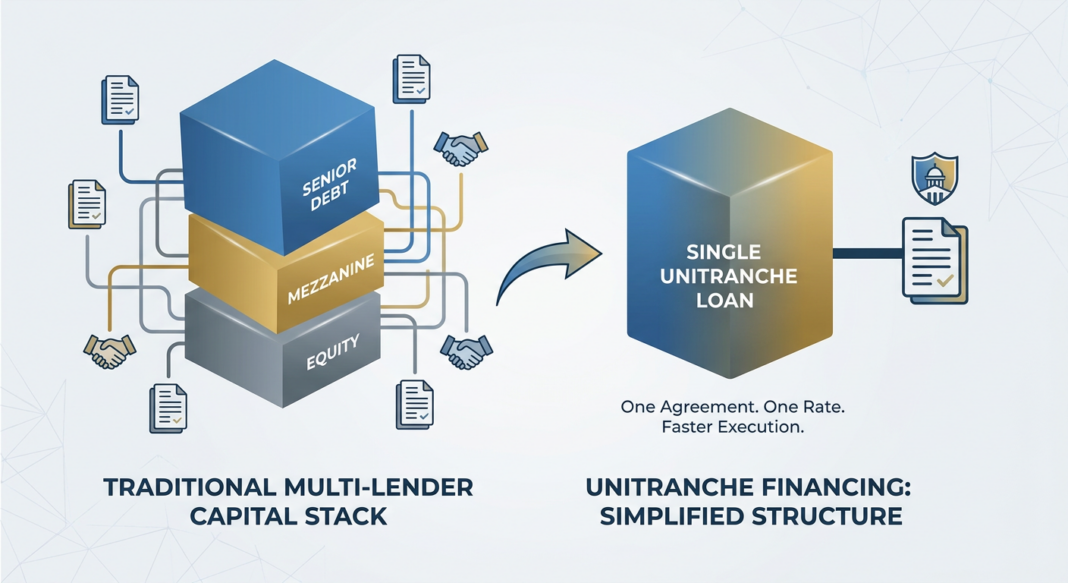
What Happens When You Collapse the Capital Stack Into a Single Loan?
In a traditional leveraged buyout, a business owner or private equity sponsor negotiates with multiple lenders: a senior secured bank for the cheapest tranche, a mezzanine fund for the subordinated layer, and sometimes a preferred equity provider to fill the remaining gap. Each relationship means separate counsel, separate covenants, separate intercreditor negotiations, and a transaction process that can stretch well past 90 days.
Unitranche financing eliminates that complexity. A single private credit lender (or a small club) provides the entire debt package in one credit agreement, at one blended rate, with one set of documents. For middle-market companies with enterprise values between roughly $25 million and $200 million, unitranche has become the dominant acquisition financing structure. Understanding how it works (and what it actually costs) is essential for both investors evaluating private credit funds and operators raising growth capital.
In today’s market, where bank lending standards have tightened and private credit has grown into a $3+ trillion asset class, the unitranche is no longer a niche product. It is the backbone of middle-market deal finance.
The Mechanism: One Loan, Two Risk Layers Hidden Inside
Unitranche debt is a hybrid loan structure that combines senior secured debt and subordinated debt into a single instrument, documented in one credit agreement and priced at one blended interest rate. According to M&A Pedia (June 2026), instead of a borrower negotiating a senior loan and a separate mezzanine tranche with different lenders, a unitranche delivers the whole debt package in one instrument, typically from a single private credit lender or a small club.
The borrower’s experience is simple: one loan, one rate, one counterparty. But behind that simplicity, lenders often re-create the traditional senior/junior split among themselves. According to Baker Donelson, this structure, also known as first out/last out, or FOLO: is particularly common in private equity sponsor-backed middle-market transactions.
The mechanism works through an Agreement Among Lenders (AAL). According to Mary Taylor & Associates (April 2026), the AAL governs: payment waterfalls, voting thresholds for amendments, enforcement rights in default scenarios, and procedures for sharing recoveries if the borrower becomes insolvent, all invisible to the borrower.
Inside the AAL, the facility is divided into two economic positions:
- First-Out Tranche: Receives priority in payment waterfalls and recovery scenarios. Commands lower pricing to reflect its reduced risk.
- Last-Out Tranche: Absorbs initial losses and receives higher compensation for its subordinated positioning.
The borrower pays one blended rate that sits between what pure senior debt and mezzanine would each cost separately. As M&A Pedia notes, the borrower pays more than pure senior but less than a senior-plus-mezz blend’s headline mezzanine rate, in exchange for simplicity and execution speed.
How It Works: A Concrete Middle-Market Example
Consider a manufacturing company with $10 million in EBITDA being acquired for $100 million (a 10x multiple). The buyer wants to put in $50 million of equity and borrow $50 million of debt.
Traditional Two-Tranche Structure:
- Senior secured bank loan: $30 million at SOFR + ~400 bps (approximately 7.7% all-in)
- Mezzanine debt: $20 million at 12%–13% cash pay
- Two sets of counsel, two intercreditor negotiations, two covenant packages
- Estimated time to close: 90–150 days
- Blended cost of debt: approximately 9.5%–10.5%
Unitranche Structure (2026 terms):
- Single unitranche term loan: $50 million at SOFR + 600 bps
- Three-month Term SOFR as of Q2 2026: approximately 3.69% (per Valuation Research Corp., Q2 2026)
- All-in interest rate: approximately 9.69%
- Plus 2% original issue discount (OID) amortized over the loan life: ~33 bps of annualized yield
- One credit agreement, one administrative agent, one covenant package
- Estimated time to close: 45–90 days (per CTA Acquisitions, July 2026)
According to CTA Acquisitions (July 2026), on a five-year hold, the total interest cost difference between the two structures is often less than $1 million, while the unitranche saves $200,000–$400,000 in legal and closing costs. The true premium for choosing unitranche over the traditional two-tranche structure often comes to $600,000–$800,000 over the hold period, a modest price for materially simpler execution.
For operators raising capital, this math is instructive: the cost of convenience is real but manageable. For investors in private credit funds holding unitranche positions, the blended rate structure means first-out and last-out positions produce different risk/return profiles within a seemingly uniform portfolio.
Current Market Reality: Unitranche in a Higher-for-Longer Environment
The 2026 lending environment has reinforced unitranche’s structural advantages. Bank lending standards have tightened meaningfully. According to the Federal Reserve’s April 2026 Senior Loan Officer Opinion Survey (SLOOS), survey respondents reported tighter lending standards for commercial and industrial (C&I) loans to firms of all sizes in Q1 2026, with banks also reporting higher premiums on riskier loans, stricter covenants, shorter maturities, and lower maximum credit line sizes.
As banks pull back, private credit has stepped into the gap, and unitranche structures continue to dominate new issuance. Key data points as of mid-2026:
| Metric | Current Level | Source |
|---|---|---|
| US Unitranche All-In Yield Range | ~9.00%–9.75% | VRC, Q2 2026 |
| Unitranche Coupon Spreads (new issuance) | 475–550 bps over SOFR | VRC, Q2 2026 |
| 3-Month Term SOFR (June 2026) | 3.69% | VRC, Q2 2026 |
| LMM Unitranche Spread Range (typical) | 500–700 bps over SOFR | CTA Acquisitions, July 2026 |
| Global Private Credit AUM | ~$3.2 trillion | PIMCO, 2026 |
According to Valuation Research Corp.’s Q2 2026 Private Markets Update, unitranche structures continue to dominate new issuance, with coupon spreads ranging from 4.75% to 5.50%, approximately 25 basis points higher than year-end 2025 levels. Current all-in yields of 9.00%–9.75% represent a decline of roughly 250 basis points from the late 2023 peak but remain well above pre-2022 historical ranges of approximately 7%–8%.
According to Lord Abbett’s 2026 Midyear Outlook (June 2026), private credit has entered a more lender-friendly environment: spreads are wider by roughly 50–100 basis points since late 2025, and new loans are increasingly structured with less leverage, more covenants, and tighter documentation, a favorable development for disciplined lenders.
According to PwC’s Global Private Credit Survey 2026, private credit now exceeds $2 trillion in AUM with a base case forecast to reach $3.4 trillion by 2030, fueled in part by ongoing bank retrenchment and borrower preference for bespoke, flexible structures, exactly what unitranche delivers.
Decision Framework: Investors and Operators
For Investors Evaluating Private Credit Funds
When a fund’s portfolio is described as holding "unitranche positions," investors consider the following questions to assess the actual risk profile:
- First-Out or Last-Out? The fund may hold either position inside the AAL. Last-out positions carry subordinated risk despite appearing as a single senior-secured line item. Investors evaluate whether a fund clearly discloses which tranche it holds.
- Leverage Multiple: According to CTA Acquisitions (July 2026), typical unitranche leverage in 2026 ranges from 4x to 6x EBITDA. Higher leverage multiples compress the equity cushion protecting lenders in a downside scenario.
- Covenant Protection: A shift back toward maintenance covenants (rather than incurrence-only) strengthens lender protections. According to Lord Abbett, covenant quality has been improving in 2026, investors evaluate whether a manager is capturing these structural improvements.
- Sector Concentration: According to Hamilton Lane’s 2026 Private Credit Focus, durable cash flows and lower loan-to-value ratios are key to delivering downside protection in the current cycle. Technology-heavy unitranche books face elevated scrutiny given AI disruption risks.
For Operators and Business Owners Considering Unitranche
Unitranche tends to be the right tool when:
- The company’s enterprise value falls in the $25 million–$200 million range and execution certainty matters as much as pricing
- The transaction involves a competitive auction where closing speed is a differentiator
- The operator wants a single, flexible lender relationship for future add-on acquisitions (accordion features are standard in 2026 unitranche documents)
- The cost premium versus traditional senior-plus-mezz is offset by lower legal fees and faster close timeline
Unitranche is typically less competitive when an operator has substantial time, strong bank relationships, and a plain-vanilla credit profile that qualifies for full bank financing, generally below $25 million in enterprise value, where bank senior debt and SBA products dominate on cost.
Key Takeaways
- One loan, two risk layers: Unitranche presents a single credit agreement to the borrower while lenders privately allocate first-out (senior-equivalent) and last-out (subordinated) positions through an Agreement Among Lenders. Investors should understand which position a fund actually holds.
- Current pricing in 2026: US middle-market unitranche all-in yields range from approximately 9.00%–9.75%, with new issuance coupon spreads at 475–550 basis points over Term SOFR, according to Valuation Research Corp.’s Q2 2026 data.
- Bank retrenchment widens the opportunity: The Federal Reserve’s April 2026 SLOOS confirms continued tightening of C&I lending standards at commercial banks, a structural tailwind that directs more middle-market borrowers toward private credit unitranche solutions.
- The cost of simplicity is quantifiable: For a typical $50 million middle-market deal, the unitranche premium over a traditional senior-plus-mezz structure is often less than $1 million over a five-year hold: offset partially by $200,000–$400,000 in legal cost savings.
- Lender-friendly terms are improving in 2026: According to Lord Abbett’s midyear outlook, new unitranche loans are coming with tighter documentation, more covenants, and less leverage than deals originated in 2022–2024, making today’s origination vintage potentially more attractive for disciplined lenders than the prior cycle.


