
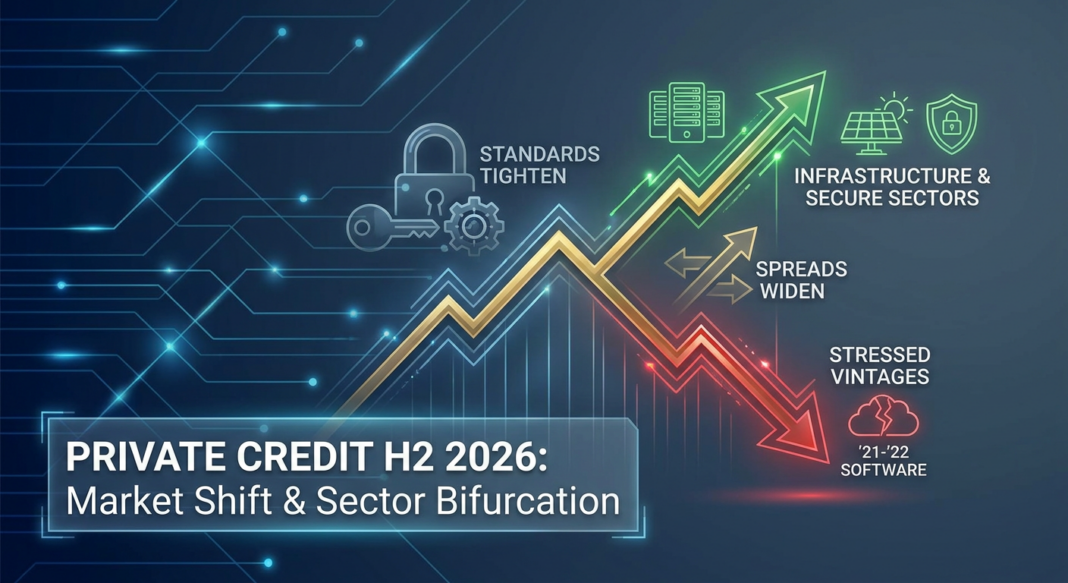
Private Credit’s Lender-Friendly Reset: Spreads Widen, Standards Tighten, and Dispersion Defines H2 2026
Bond Capital | Market & Sector Intelligence | July 8, 2026
I. MARKET HEADLINE: The Credit Cycle Has Turned, And Disciplined Lenders Are in the Driver’s Seat
The mid-2026 private credit market is undergoing a structural reset that is both quantifiable and consequential. After an extended borrower-friendly cycle in 2024–2025 (when abundant dry powder, compressed spreads, and relaxed documentation favored issuers) the pendulum has shifted. As Lord Abbett’s midyear intelligence notes, spreads have widened by roughly 50 to 100 basis points since late 2025 (per PitchBook data), while covenant quality and documentation are measurably improving, a more favorable structural entry point for new originations than conditions prevailing just six months ago.
This shift is being driven by a convergence of macro and micro forces: a higher-for-longer rate environment anchored by geopolitical volatility in the Middle East, AI-related disruption eroding confidence in software-heavy portfolios, and a Federal Reserve that has signaled caution on easing. VRC’s Q1 2026 analysis confirmed that heightened macro uncertainty pushed credit markets back into price discovery mode, with primary market activity decelerating sharply and secondary spreads widening, particularly for technology and software-exposed credits. By Q2 2026, direct lending conditions had stabilized, though selectivity remained elevated and deployment was uneven across sectors.
The macro-to-micro transmission is clear: bank commercial lending standards have tightened for C&I borrowers across all firm sizes (April 2026 SLOOS), creating both a financing gap and a structural advantage for private credit lenders with dry powder and origination discipline. Hamilton Lane observed that private credit spreads have re-entered the SOFR+500 bps context, up from the mid-400 bps levels that prevailed during the 2024–2025 borrower-friendly cycle, a yield-enhancing development for disciplined new entrants.
The key forward dynamic: the second half of 2026 is likely to be defined by dispersion. Macro headlines mask the reality that well-structured senior secured credits in infrastructure, healthcare, and defense are performing well, while 2021–2022 software vintages face mounting restructuring pressure. Institutional operators and lenders who parse sector-level dynamics, rather than treating private credit as a monolithic asset class, hold the decisive advantage.
II. QUANTITATIVE MARKET SNAPSHOT
Key Market Metrics: As of July 8, 2026
| Metric | Current Value | Prior Period | Change | Source |
|---|---|---|---|---|
| Unitranche Spreads (Middle Market) | SOFR + 475–550 bps | SOFR + 450–500 bps (YE 2025) | +25–50 bps | VRC Q2 2026 |
| Direct First-Lien Loan Yields (All-In) | ~8.0%–8.5% | ~8.5%–9.0% (mid-2025) | Compressed ~50 bps YoY | Morgan Stanley IM |
| Software Sector Secondary Spreads vs. B-rated Index | +229 bps premium | At index (YE 2025) | +245 bps vs. YE 2025 | VRC / PitchBook LCD (June 19, 2026) |
| High Yield (HY) OAS, Broad Market | ~285 bps | ~270 bps (Nov 2025) | Modestly wider | InvestmentGrade.com / ICE BofA |
| Fed SLOOS, Net % Banks Tightening C&I Standards (Large/Mid Firms) | +8.1% net tightening | Broadly unchanged Q4 2025 | ↑ Tighter | Fed SLOOS / FRED Q2 2026 |
| Private Credit Default Rate (Proskauer Index) | 2.73% (Q1 2026) | 1.84% (Q3 2025) | +89 bps | Forbes / Proskauer Index |
| 3-Month Term SOFR | 3.68%–3.69% | ~3.0% (YE 2025 forward curve) | +~68 bps | VRC Q2 2026 |
| Private Credit CLO Issuance (YTD through mid-June 2026) | $17.3 billion | ~$17.3B same period 2025 | Flat YoY | Benzinga / PitchBook |
Note: All-in yields and spreads reflect first-lien senior secured direct lending unless otherwise stated. SOFR-based metrics use 3-month Term SOFR. Sources cited as of their most recent available publication dates.
Rates & KPI Context
Five-year U.S. Treasury yields reached approximately 4.23% in June 2026, up from 3.92% in March, reinforcing a higher-for-longer posture and sustaining attractive all-in private credit yields despite modest spread compression from 2025 peaks. The forward SOFR curve now implies rates stabilizing near 4%, roughly 100 basis points above late 2025 market expectations, a direct headwind to borrower Fixed Charge Coverage Ratios (FCCR). With leveraged buyout capital structures typically deployed at 6–7x debt-to-EBITDA (per Forbes/Moody’s analysis), and with the FSB’s May 2026 Vulnerabilities report flagging that 10% of middle-market CLO borrowers lack sufficient cash flow to cover interest payments at current rates, FCCR maintenance testing has become the defining underwriting pressure point for mid-2026 loan structuring.
III. SECTOR ANALYSIS: Hot Sectors, Cold Sectors, and the Structural Divide
🟢 High-Lender-Appetite Sectors
Infrastructure, Energy & Digital: Paul, Weiss’s 2026 outlook identifies energy infrastructure, digital infrastructure, defense and national security, and next-generation manufacturing as priority sectors, all requiring patient institutional capital. McKinsey notes that infrastructure credit has emerged as a particularly fast-growing segment of asset-backed finance, driven by the enormous capital needs of the AI buildout: including data centers, fiber networks, and power generation. Meta’s private financing of a $29 billion Louisiana data center illustrates the scale and deal-level relevance of this trend. The spread premium for private credit over comparable bank financing in this sector typically runs 100 to 300 basis points, depending on asset type, credit quality, and deal structure, a meaningful cost of capital implication for CFOs modeling project-level IRRs.
Healthcare: Healthcare led all sectors in 2025 direct lending activity, accounting for 19% of deals (Octus Data) and was the only major sector not to see significant year-over-year price tightening, with spreads averaging approximately SOFR+500 bps in Q4 2025. However, Morgan Stanley IM maintains a significant underweight to healthcare in new commitments, citing the sector’s leadership in non-accrual rates over the past year, a divergence that highlights the critical importance of subsector and vintage-level underwriting within this broadly attractive category.
Asset-Backed Finance (ABF): BlackRock identifies ABF as an area of profound opportunity in 2026, driven by heightened demand and bank balance sheet de-risking. ABF fundraising totaled $70 billion in 2025 alone, while the total U.S. addressable market for private credit (including ABF, infrastructure, residential mortgages, and CRE) could exceed $30 trillion as bank assets migrate to non-bank lenders.
🔴 Stressed / Lower-Appetite Sectors
Software & Technology Services: Software sector secondary spreads are approximately 245 basis points wider than year-end 2025 levels and roughly 229 basis points above the broader B-rated loan index (PitchBook LCD, June 19, 2026), reflecting continued AI-driven disruption concerns. Nearly 50% of software loans maturing through 2030 (representing approximately $30 billion in directly originated loans and $75 billion in leveraged loans) come due by 2028, concentrating refinancing pressure in mid-2027 and creating a structural watch point for credit teams. The software sector’s disproportionate concentration in BDC portfolios, approximately 20% of private credit AUM, has been a primary driver of elevated Q1 2026 BDC redemption requests, particularly in wealth-oriented vehicles.
2021–2022 Vintage Leveraged Buyouts: Stress is concentrated in 2021–2022 vintages and software-related exposures, where higher borrowing costs, weaker fundamentals, and AI-related disruption are contributing to increased use of restructurings and liability management strategies. Fitch Ratings’ broader methodology found the true U.S. private credit default rate reached 5.8% for the twelve months through January 2026, the highest since Fitch began tracking the figure, with 60% of those defaults involving interest payment deferrals or conversion to payment-in-kind (PIK) arrangements rather than outright missed payments.
Structural Shifts in Underwriting Standards
New loans are increasingly structured with less leverage, more covenants, fewer PIK requests, and tighter documentation, a structural improvement over the 2024 borrower-friendly environment. Leverage-based maintenance covenants continue to anchor private credit structures, functioning as early-warning mechanisms and pricing drivers rather than merely enforcement triggers: with leverage ratios commonly determining margin step-ups, excess cash flow sweep percentages, and amendment negotiation frameworks. The December 2025 rescission of the OCC/FDIC Interagency Guidance on Leveraged Lending has expanded private lenders’ definitional and underwriting flexibility, potentially allowing more competitive mandates at deeper leverage levels previously constrained under prior supervisory guidance.
IV. IMPLICATIONS FOR INSTITUTIONAL INVESTORS AND OPERATORS
For Borrowers and Operators
Recalibrate cost of capital assumptions. With unitranche spreads now ranging from SOFR+475 to SOFR+550 bps and 3-month Term SOFR at 3.68%–3.69%, all-in borrowing costs for middle market credits are running approximately 8.45%–9.2%. A project that cleared a return threshold at bank financing rates may not clear it at private credit rates, operators must perform explicit IRR recalibrations before committing to capital plans. The 100–300 bps spread premium of private credit over bank financing must be treated as a project-level input, not a treasury-level assumption.
FCCR pressure is real and structural. 10% of middle-market CLO borrowers currently lack sufficient cash flow to cover interest payments, and that proportion rises further when tax obligations and working capital needs are incorporated. Operators carrying 6–7x leverage at current SOFR levels face materially compressed FCCR headroom. Proactive covenant management, not just compliance, should be treated as a board-level risk item in H2 2026.
Relationship capital has pricing value. Organizations accessing the best private credit terms in 2026 established lender relationships before a specific financing need existed. Private credit managers price relationship history into their terms, and that premium is measurable in basis points for companies approaching the market without established dialogue.
For Institutional Investors and Lenders
Selectivity has become the primary return driver. Private credit is entering a new normal defined by greater bifurcation and wider dispersion of returns. Investors should focus on where managers are lending, how loans are structured, how much free cash flow borrowers generate, and whether portfolios have the right balance of income, downside mitigation, and selectivity. Asset-class beta is insufficient; the alpha gap between top-quartile and median managers is widening.
Redemption risk is differentiated by capital channel. Q1 2026 redemption requests ran nearly five times above the prior four-quarter average, concentrated in wealth-oriented vehicles representing approximately 19% of the U.S. private credit market. Institutional capital, by contrast, has remained stable and in some cases increased as market dislocations created more attractive entry points. Vehicles designed around institutional capital structures and buy-and-hold mandates carry meaningfully lower redemption risk profiles than semi-liquid retail vehicles.
Regulatory scrutiny is accelerating. The rapid growth of private credit and increased participation of retail and insurance capital is raising the level of regulatory oversight globally. The FSB’s May 2026 Vulnerabilities report identified four key risk clusters: bank interconnections, borrower credit quality and valuation opacity, concentration and liquidity mismatches, and data gaps, with candid acknowledgment that the lack of harmonized definitions makes market-wide risk assessment genuinely difficult. Investors relying on manager-reported NAV without independent valuation verification carry unquantified tail risk.
V. FORWARD-LOOKING VIEW: LIQUIDITY AND LENDING DYNAMICS, H2 2026 AND BEYOND
Market expectations reflect a higher-for-longer rate environment, with the forward SOFR curve broadly flat as of June 2026, meaning the floating-rate tailwind that defined 2022–2024 private credit income has largely normalized. Morgan Stanley IM anticipates that new deal demand combined with a large refinancing wave will gradually overtake private credit supply, creating an imbalance that allows lenders to preserve discipline, strengthen terms, and capture the illiquidity premium to public markets.
Middle market private equity deal value increased approximately 10.7% year-over-year, and exit activity rose 14% (PitchBook), signaling a gradual normalization in transaction activity that will generate incremental direct lending demand into H2 2026. Banks have begun to re-enter the upper middle market in June 2026, contributing to increased competition and alleviating some upward spread pressure at the larger end, but the core middle market remains a structurally advantaged arena for private lenders where borrowers lack viable liquid market alternatives.
Moody’s baseline GDP forecast of approximately 1.5% growth, described as just above historical “stall speed” below which defaults tend to accelerate, defines the macro margin of safety. Even a modest confidence shock could surface stress quickly in less liquid pockets of credit. For the structurally prepared (lenders with dry powder, disciplined origination, and covenanted documentation) that fragility represents the most compelling vintage opportunity since 2020.
KEY MARKET INSIGHTS: BOND CAPITAL TAKEAWAYS
- Spread reset is real and selective. Middle market unitranche spreads have widened 25–50 bps from year-end 2025 levels (VRC Q2 2026), while software secondary spreads are 245 bps wider than year-end, the widest bifurcation in the post-2020 cycle. New originations in non-software sectors today carry structurally better economics than loans closed 6–12 months ago.
- FCCR and leverage covenant maintenance is the operating KPI of H2 2026. With 10% of middle-market CLO borrowers unable to cover interest at current rates (FSB, May 2026) and the Proskauer default index rising to 2.73% in Q1 2026 from 1.84% two quarters earlier, operators and lenders must treat leverage covenant headroom, not EBITDA trajectory, as the primary near-term credit risk signal.
- Infrastructure, defense, and digital are the sector consensus. Energy infrastructure, digital infrastructure (data centers), defense, and next-generation manufacturing represent the highest-conviction lending categories across institutional surveys (PwC, Paul Weiss, BlackRock, McKinsey). The private credit illiquidity premium over public comparables in these sectors remains structurally durable given bank balance sheet constraints.
- The public/private boundary is dissolving, but unevenly. Middle market direct lending is now roughly the same size as the broadly syndicated loan and high-yield bond markets (Wellington Management), and refinancing flows between markets approached near-parity in 2025 ($37B BSL→DL vs. $34B DL→BSL per McKinsey/PitchBook LCD). However, lower middle market credits, without public market access, remain structurally captive to private lenders, sustaining pricing discipline in that segment.
- Regulatory and redemption risk demand structural discipline in vehicle selection. The FSB’s May 2026 report, the Bank of England’s system-wide stress test, and the Federal Reserve’s formal queries to major banks on private credit exposure confirm that the regulatory environment is shifting from observation to oversight. Institutional investors should prioritize vehicles with transparent valuation practices, independent marks, and capital bases aligned with underlying asset liquidity, not retail-channel semi-liquid structures that have demonstrated vulnerability to sentiment-driven redemption waves.


