
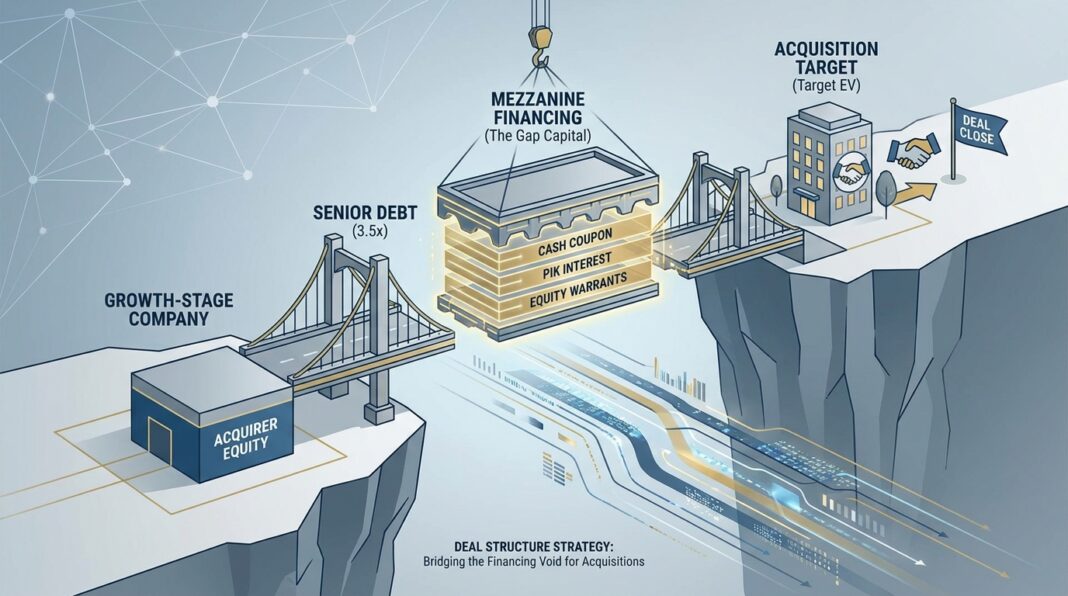
The Financing Challenge at the Growth Stage: You Have a Target, But Not a Clean Stack
You have a signed LOI. You have a thesis. You have a management team ready to integrate. What you do not have is a financing path that closes cleanly, and on time.
This is the defining capital challenge of the growth stage. The business has outgrown venture equity terms but has not yet earned its way into the broadly syndicated leveraged finance market. Senior bank lenders will extend credit, but not far enough. The equity cost of filling the remaining gap is punishing at current valuations. And the exclusivity clock on your deal is already running.
The instrument designed to solve exactly this problem is mezzanine financing: subordinated, hybrid-return capital that sits between senior debt and equity in the capital stack, provides the leverage quantum that banks will not, and preserves equity upside that a full equity raise would permanently dilute away.
But mezzanine is not a single product. It is a family of structures: each with a distinct pricing layer, covenant posture, equity kicker design, and negotiation dynamic. Used correctly, it amplifies acquisition capacity and stretches equity. Used without precision, it traps the business in a debt-service spiral and hands lenders governance leverage at exactly the wrong moment.
This article is the structural playbook. We map the cost of capital spectrum from senior bank debt to growth equity, show where mezzanine lives in that range and why, walk through a detailed example with term sheet elements, compare the structure against the unitranche alternative, and close with a tactical negotiation guide for operators and their advisors.
Structure Breakdown: Mezzanine Financing, Components, Mechanics, and a Worked Example
What Mezzanine Is and Where It Sits
Mezzanine debt is a hybrid financing solution positioned between senior debt and equity, offering growth capital with flexible terms and equity kickers. It fills the gap between the amount a traditional bank will lend, the senior debt capacity, and the firm’s total capital need. It is typically unsecured or second-lien, interest-only, and structured with both a cash coupon and a payment-in-kind (PIK) component.
The structural components of a mezzanine facility are:
- Cash interest: A current pay coupon, typically 8–12%, paid quarterly in cash.
- PIK interest: Non-cash interest that accrues to the outstanding principal balance rather than being paid in cash. The interest amount is added to the total loan balance, causing the principal to grow over time, a compounding effect that feels manageable in Year 1 but can materially increase the exit obligation by Year 5.
- Equity kicker: Warrants, conversion rights, or direct equity co-investment that allow the mezzanine lender to participate in the company’s upside. This is the component that makes mezzanine genuinely dilutive despite being structured as debt.
- Origination fees: Typically 1–3% of the facility, paid at close.
- Bullet maturity: Mezzanine loans typically mature in 5 to 7 years, often aligning with expected exit timelines, with repayment structured as a single bullet at maturity.
2026 Pricing Reference
In 2026, mezzanine all-in cost is 10–14%, comprising a cash coupon of 8–11% plus PIK of 2–4% plus warrants, targeting a 16–22% all-in IRR for the lender. Mezzanine debt for a performing company is expected to yield 12.5–14% to the lender. Top providers in the current market include middle-market BDCs such as Ares Capital and Blue Owl, and specialty funds including Audax Mezzanine, Madison Capital, and Twin Brook.
Worked Example: $60M Acquisition of a $120M EV Business Services Platform
Scenario: A growth-stage acquirer is purchasing a B2B business services company with $8M EBITDA at a 7.5x multiple, implying a $60M purchase price. The acquirer has $18M in equity available and a senior bank willing to lend up to 3.5x EBITDA, a $28M senior facility. The math produces a $14M gap.
| Layer | Amount | Leverage Multiple | Rate / Terms | Priority |
|---|---|---|---|---|
| Senior Bank Facility | $28M | 3.5x EBITDA | SOFR + 325 bps (~8.6% all-in) | First lien, secured |
| Mezzanine Tranche | $14M | 1.75x EBITDA (incremental) | 10% cash + 3% PIK + warrants for 3% equity | Second lien / unsecured, subordinated |
| Equity | $18M | – | – | Junior, common or rollover |
| Total | $60M | 5.25x EBITDA | Blended ~9.5% cash, ~11.7% all-in | – |
Key term sheet elements for the mezzanine tranche in this example:
- PIK toggle: Borrower may elect PIK for the first 24 months, subject to minimum liquidity of $3M. PIK interest is commonly structured as a toggle, meaning the borrower can decide whether and when to use PIK, typically at a step-up premium over the cash rate.
- Warrant coverage: Warrants covering 3% of fully diluted equity, exercisable at a strike price equal to the implied equity value at close. Equity kickers commonly include warrants or options to buy between 1% and 5% of the borrower’s equity.
- Covenant package: Single maintenance covenant: maximum total leverage of 6.0x, tested quarterly, with a 25% cushion over base case. Equity cure right: one cure per year, two cures over the life of the facility.
- Call protection: Non-call 2, then declining prepayment premium: 3% / 2% / 1% in years 3–5. Call protection often discourages early repayment, with declining premiums over the first few years of the loan.
- Maturity: 6 years (12-month back-stop versus senior facility).
- Intercreditor agreement: Subordination agreement limiting mezzanine enforcement rights during a senior standstill period of 180 days.
The PIK Compounding Problem: Run the Math First
PIK does not feel expensive until you see it capitalized year after year. On the $14M example above, a 3% PIK rate capitalizing annually grows the mezzanine principal to approximately $15.9M by Year 4. When the equity kicker is added, the lender’s actual IRR (measured across cash interest, capitalized PIK, and warrant value) reaches the 16–20% range even at a moderate exit valuation. A mezzanine facility advertised at 14% interest is not a 14% cost of capital. Every operator should model the full exit-year cash outflow (principal, accumulated PIK, call premium, and warrant dilution) before signing a term sheet.
Mezzanine vs. Unitranche: How the Two Structures Compete for the Same Capital Gap
For any growth-stage acquirer running a gap capital process, the primary structural question is whether to fill the senior/equity gap with a mezzanine layer or a unitranche that stretches the entire debt capital into a single facility. The two instruments address the same problem differently.
The Unitranche Alternative
A unitranche facility combines senior and subordinated debt into a single credit agreement, offering a blended interest rate and a unified set of loan documents, simplifying the capital stack and reducing documentation costs. Typical unitranche spreads are SOFR plus 550–700 basis points, which in the current SOFR environment translates to approximately 10–12% all-in. The lender provides total leverage that can reach 5–6x EBITDA in a single facility, compared to 3–4x that a senior-only lender would typically provide.
For the $60M acquisition example above, a unitranche alternative would consolidate the $28M senior and $14M mezzanine into a single $42M term loan at approximately SOFR + 600 bps (~11.6% all-in), with no warrant dilution, a single maintenance covenant, and one lender relationship to manage. Unitranche deals can close 30–45 days faster than syndicated alternatives, a material advantage when exclusivity periods are tight.
Side-by-Side Comparison
| Dimension | Senior + Mezzanine | Unitranche |
|---|---|---|
| All-in cost | Blended ~11–13% including PIK | ~10–12%, no PIK in most cases |
| Equity dilution | Yes, warrants on mezzanine tranche | No equity component typical |
| Structural complexity | High, intercreditor, two sets of docs | Low, one credit agreement |
| Speed to close | 60–90 days typical | 30–45 days faster than syndicated |
| Leverage quantum | Up to 5.5–6.0x with mezz | 5–6x in a single facility |
| Covenant posture | Two covenant packages to manage | Single maintenance covenant |
| Best fit | Larger deals, cost-sensitive sponsors, existing senior facilities | Time-sensitive M&A, single-lender preference |
When Mezzanine Wins
When deal timing is the primary constraint and the borrower can absorb the blended pricing, the unitranche wins on simplicity. When the senior bank relationship is entrenched, the existing facility is cheap, and the gap is relatively modest, mezzanine fills that specific layer at lower cost than repricing the entire stack.
Current Market Terms: What the Data Shows in 2025–2026
The private credit market has reached significant scale, and its documentation standards have matured accordingly. Here are five data points that define the current environment:
- Private credit AUM: ~$2.1 trillion (2025). Global private credit assets under management reached about $2.1 trillion in 2025, up from $1.5 trillion a year earlier. The scale of the asset class has intensified lender competition, creating marginally better terms for repeat sponsors and established platforms.
- Mezzanine all-in cost in 2026: 10–14%. In 2026, all-in mezzanine cost is 10–14% (cash coupon 8–11% + PIK 2–4% + warrants), targeting 16–22% lender IRRs, consistent with the prior two years but now reflecting a more competitive provider market.
- PIK prevalence rising. In 2025, public BDCs received an average of 8% of their investment income through PIK interest, reflecting the growing prevalence of PIK structures across the private credit market. This signals that more borrowers are electing non-cash interest to preserve liquidity post-acquisition.
- Maintenance covenants remain the private credit standard. In the broadly syndicated loan market, approximately 90% of new loans in 2024 remained covenant-lite, but private credit lenders have maintained firmer positions on covenant inclusion, particularly for mid-market transactions. Operators financing acquisitions through private credit should assume at least one quarterly-tested leverage covenant.
- Covenant cushion standard: 25–35%. The financial covenant is typically a single net first-lien or total net leverage covenant with an initial cushion of 25 to 35 percent over the base case plan, stepping down as cash flow grows. Borrowers negotiating covenant headroom should pressure-test cushion levels against downside revenue scenarios, not base cases.
Covenant Architecture: Maintenance vs. Incurrence
Understanding the difference between covenant types is non-negotiable for any acquisition borrower. A maintenance covenant is a recurring financial test, usually quarterly, that a borrower must pass whether or not it has taken any new action. An incurrence covenant is a permissioning test triggered only when a borrower proposes a specified transaction. In plain terms, maintenance covenants are lender-monitoring tools; incurrence covenants are transaction-gating tools.
For growth-stage acquirers integrating a new platform, the maintenance covenant is the primary ongoing risk. A revenue shortfall in quarters 2–4 post-close, even while cash interest is being paid on time, can breach the leverage test and give lenders an amendment negotiation. Borrowers pay amendment fees, agree to tighter covenants, provide additional security, or accept other modifications in these scenarios. Negotiating equity cure rights, typically one to two per year, is a critical protection that operators should not trade away.
The Gap Capital Playbook: Quantify, Prepare, Run the Process, and Negotiate
Step 1: Quantify the Need Precisely
Before approaching any capital provider, build a clean sources-and-uses table anchored to three scenarios: base, downside, and integration-stress. The gap is not the residual from senior debt capacity. It is the minimum capital required to close the deal, fund day-one working capital, cover transaction fees, and maintain a minimum liquidity buffer of 3–6 months of cash interest service. Map each use-of-proceeds line item to the financing layer that should fund it. Senior debt should fund stabilized recurring cash flow coverage. Mezzanine should fund the incremental leverage supported by growth projections. Equity should fund the deal premium and integration risk. Any layer used to cover a different layer’s intended use is a structural mismatch, and lenders will identify it.
Step 2: Prepare the Lender Package
Mezzanine lenders evaluate four things in sequence: cash flow quality, management depth, integration risk, and exit optionality. Mezzanine debt providers evaluate your historical and projected cash flow, growth potential, and ability to service both existing senior debt and the new mezzanine layer: reviewing EBITDA, coverage ratios, and management track record.
Prepare a lender presentation that leads with: (1) a normalized trailing-twelve-months EBITDA bridge with defensible add-backs, (2) a pro forma debt service coverage ratio tested in a downside scenario, (3) a clear integration plan with milestone-based cash flow projections, and (4) a defined exit path (whether strategic sale, recapitalization, or refinancing) within the mezzanine tenor. Lenders lend to the exit, not just the entry.
Step 3: Run a Competitive Process
Approach three to five mezzanine providers simultaneously. Use an investment banker or debt advisor to run the process if the deal exceeds $10M. The provider landscape includes BDCs (Ares Capital, Blue Owl, Main Street), specialty mezz funds (Audax Mezzanine, Madison Capital, Antares, Maranon), and family office mezzanine pools. Create a comparison matrix across: all-in cost, PIK structure, warrant coverage and strike, covenant package, equity cure terms, and call protection schedule. The underwriting process typically runs 60–90 days from term sheet to close, which means the process should launch within two weeks of LOI execution.
Step 4: Negotiate the Structure
The five highest-value negotiation points in a mezzanine term sheet are:
- PIK toggle conditions: Push for borrower-controlled PIK election with no lender consent required, subject only to a minimum liquidity test. Resist triggers that convert PIK to mandatory cash-pay upon any covenant breach; this creates a liquidity spiral precisely when the business is under stress.
- Warrant strike price and dilution mechanics: Negotiate the strike at the deal’s implied equity value, not at a discount. Resist conversion features and preference for warrants with fixed-share coverage and defined expiration. Coordinate valuation mechanics with prepayment terms to avoid double-counting economics.
- Covenant headroom: Negotiate the initial leverage covenant test at 35%, not 25%, above the base case. For integration periods, push for a step-up in the covenant threshold for the first four quarters post-close, reverting to the standard test thereafter.
- Call protection structure: Seek a non-call 2 rather than non-call 3, with declining premiums (3/2/1%) in years three through five. Any make-whole provision on the warrant component in the event of early prepayment should be resisted; it creates a hidden exit cost.
- EBITDA definition and add-backs: Common add-backs that are more highly negotiated include restructuring and integration costs, transaction expenses, and pro forma synergies, with lenders frequently imposing caps as a percentage of EBITDA. Push for uncapped transaction and integration cost add-backs in the first two fiscal years post-acquisition.
Key Takeaways
- Mezzanine fills the leverage gap that senior banks will not cross. In the current market, senior facilities typically extend to 3.5–4.0x EBITDA; mezzanine adds an incremental 1.5–2.0x, bringing total debt to 5.25–6.0x, the range required for most middle-market acquisition financings.
- The real cost of mezzanine is not the headline rate. Cash coupon + PIK compounding + warrant dilution + origination fees + call protection together define the true cost. Model the exit-year cash obligation, including accumulated PIK, before signing any term sheet.
- Unitranche is the structural competitor, and speed is its primary advantage. When deal timing is the constraint and blended pricing is acceptable, a single unitranche facility eliminates the intercreditor complexity and closes materially faster than a bifurcated senior/mezz stack.
- Maintenance covenants are the operative risk in private credit. Unlike broadly syndicated markets where 90% of loans remain cov-lite, private credit lenders require quarterly-tested leverage covenants. Negotiate covenant cushion at 35% above the downside case, not the base case, and secure equity cure rights before closing.
- Process discipline determines pricing outcome. Running a competitive process across three to five mezzanine providers, starting within two weeks of LOI execution, is the single highest-leverage action a borrower can take to tighten warrant coverage, reduce PIK premiums, and negotiate stronger equity cure protections.


