
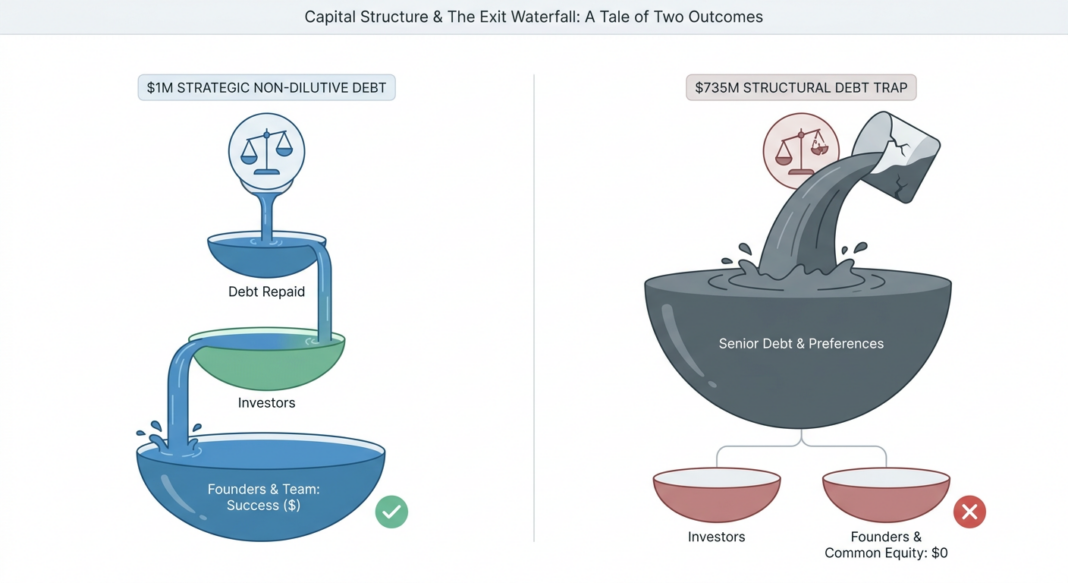
The Story: A Father, a Son, and a $1 Million Bet on Debt
In September 2022, Greg Holifield (a decorated military veteran and serial entrepreneur) faced a capital decision that would define his fourth company exit. SafePointe, the AI-based weapons detection startup he’d built alongside his son Timothy, had something most early-stage companies would envy: real government contracts, a working product installed in workplaces, museums, schools, and hospitals, and a recurring revenue model with strong retention. What it didn’t have was the working capital to fulfill the hardware-embedded SaaS contracts already on its books.
The business model created a familiar squeeze. Winning new public safety contracts required financing the upfront cost of physical detection hardware, but accounts receivable were bloated, and traditional bank lenders couldn’t parse the hybrid model. soundthinking.com would later describe SafePointe’s technology as offering “highly secure, frictionless access in a low-profile form factor”, but in the fall of 2022, the Holifields needed cash to keep fulfilling orders, not just accolades for the product.
They had options. Venture capital was available. The public safety technology market was hot, ir.soundthinking.com would later note a $20 billion global weapons detection total addressable market. A Series A round could have been raised, diluting the cap table in exchange for growth runway. Greg Holifield, having built and sold three prior companies, had seen that movie before. He chose a different path.
Now contrast that scene with Divvy Homes in October 2021. The rent-to-own proptech darling had just closed a $200 million Series D at a $2.3 billion peak valuation, and then layered in approximately $735 million in debt financing to fund home acquisitions at scale. The math looked clean in a zero-interest-rate world. Three years later, that same capital structure would erase every dollar of value that founders, employees, and common shareholders had built.
Same era. Different decisions. Incomparable outcomes.
The Decision: What Did They Actually Choose?
SafePointe: Warrant-Free, Board-Free, Ownership-Intact
Greg Holifield turned to TIMIA Capital for a $1 million non-dilutive debt facility, structured against SafePointe’s recurring government contract revenue. The facility carried no equity warrants, surrendered no board seats, and imposed no governance changes. It was sized to what the business could realistically service, and, critically, sized to what a future exit would easily clear. The capital went directly into hardware fulfillment for new contracts.
His reflection on the instrument was unambiguous: “When there are no warrants associated with debt, it is truly fantastic money, and much cheaper than equity. I love this class of debt.” Equity investors who came alongside TIMIA at the same time made 10x their money in nine months. TIMIA’s debt cost a fraction of that in real economic terms.
Divvy Homes: The Wrong Debt for the Wrong Model
Divvy’s capital structure decisions looked rational at each individual inflection point. techcrunch.com reported that the company raised more than $700 million in combined debt and equity from investors including Tiger Global, GGV Capital, and Andreessen Horowitz. The $735 million debt tranche in October 2021 was used to purchase residential homes, the core asset of a rent-to-own model. In a low-rate environment, the cost of carry was manageable. The flaw wasn’t the size of the debt in isolation; it was structural. The business model was fundamentally interest-rate sensitive, and the entire operating thesis required cheap capital to remain viable.
One instrument was additive, a working capital multiplier layered onto an already-functioning business. The other was transformative, without it, the core model couldn’t operate. That is the distinction that undoes founders at exit.
The Outcome: The Waterfall Decides Everything
SafePointe: $37.1 Million Exit, 12 Months After the Debt
Within twelve months of drawing down the TIMIA facility, SafePointe had tripled its monthly recurring revenue. On August 18, 2023, less than a year after the debt facility was put in place, SoundThinking, Inc. (Nasdaq: SSTI) acquired SafePointe for a total consideration of up to $37.1 million, including $11.4 million in cash, $11.2 million in SSTI stock, and a contingent earnout valued at $3 million at acquisition date, per marketscreener.com. The $1 million debt facility sat well inside that exit waterfall. Every stakeholder (founders, team, investors) received proceeds. SoundThinking’s CFO Alan Stewart called SafePointe’s SaaS model “another stream of predictable high-margin revenue,” per the official SoundThinking press release. The Holifields completed their fourth successful exit.
The Myagi story runs the same playbook. Simon Turner, co-founder of the retail sales enablement platform, deployed a $2.5 million non-dilutive TIMIA facility in early 2021 after his planned equity round evaporated when COVID-19 hit. Annual recurring revenue climbed from $2.4 million to $4.4 million, an 83% increase. Rallyware acquired Myagi on May 2, 2023, with the founding team’s equity largely intact. Turner’s post-exit reflection was pointed: “Venture capitalists will challenge you to grow at all costs. One thing venture capital doesn’t take into account is that many businesses have a natural cadence at which they grow. For many companies, growing too fast can be detrimental.”
Divvy Homes: $1 Billion Exit, $0 for Founders
When interest rates surged in 2022, Divvy’s model fractured. saastr.com documented what followed: three rounds of layoffs, a full pause on new home acquisitions by 2023, and a January 2025 acquisition by Brookfield Properties for approximately $1 billion, a steep discount to the $2.3 billion peak valuation. The headline number looked like a win. The waterfall told a different story.
therealdeal.com reported that common shareholders and holders of Series FF preferred stock, typically issued to founders, were not expected to receive any proceeds. CEO Adena Hefets confirmed in a letter to shareholders that after repaying outstanding debt, covering transaction costs, and satisfying liquidation preferences for preferred shareholders, neither common shareholders nor founders’ preferred stock would receive any proceeds. As Hefets wrote: “While I am not proud of the financial outcome, I am proud of the impact we had on our customers’ lives.” A billion-dollar exit. A mission genuinely fulfilled. Zero dollars distributed to the people who built it.
The Lessons: A Framework for Founders Facing the Same Fork
The distance between Greg Holifield’s outcome and Adena Hefets’s outcome is not a story about talent, product quality, or market size. Divvy helped over 2,000 families access homeownership. SafePointe was a smaller, less celebrated company. The difference was architectural; it lived entirely in the capital structure each team chose, and what that structure did to the payout waterfall when the exit arrived.
Three principles emerge cleanly from these two cases:
1. Additive vs. Transformative Debt
SafePointe’s $1 million facility accelerated a business that already worked. It multiplied existing momentum without changing the fundamental risk profile of the company. Divvy’s $735 million in debt financing was structurally required for the model to function at all, without it, there was no business. Founders must ask honestly: is this debt a multiplier on what already works, or a prerequisite for what doesn’t yet? The answer determines whether debt is a tool or a trap.
2. Size Debt to the Exit, Not the Opportunity
The Holifields sized $1 million against a hardware-enabled SaaS business with visible government contract revenue and a credible acquirer pool. At any plausible exit price, the debt cleared easily. Divvy’s $735 million in debt set a minimum viable exit price that the company could never realistically clear unless the housing market and interest rate environment remained permanently favorable. Sizing debt against the opportunity, rather than against the business, is the arithmetic error that destroys cap tables.
3. Model the Waterfall Before You Sign
At every plausible exit price, what do you actually receive after debt repayment, transaction costs, and liquidation preferences are satisfied? Lenders and institutional investors run this model before they issue term sheets. Founders who don’t run it themselves are operating blind. The SafePointe founders understood their waterfall. The Divvy waterfall, as constructed, made a founder-positive outcome mathematically near-impossible without a sale well above $2 billion, an outcome that never materialized.
4. Non-Dilutive Doesn’t Mean Free: It Means Senior
Revenue-based and non-dilutive facilities preserve your ownership percentage on paper. They do not preserve your outcome if the exit price falls below the debt obligation. The distinction that saved the SafePointe founders (and the one Divvy’s structure violated) is that non-dilutive debt must be sized to clear easily at the most probable exit, not the most optimistic one. Debt is always senior. It always gets paid first. Build that reality into your plan before you celebrate the term sheet.
Key Insights
- The instrument must match the model. Non-dilutive revenue financing works when a business already generates predictable recurring cash flows. Debt that is structurally required to fund core operations is a categorically different risk instrument, and founders should price it accordingly.
- $1M sized to the business beats $735M sized to the opportunity. SafePointe’s facility was modest, well-structured, and cleared comfortably at exit. Divvy’s debt load raised the minimum viable exit far above any realistic outcome once macro conditions shifted. Capital discipline is not timidity; it is strategy.
- Equity dilution is a compounding loss, not a one-time cost. Every percentage point surrendered to a VC in a growth round is a permanent claim on every dollar of value created thereafter, including the exit multiple. Structured debt has a fixed, finite cost. Equity does not.
- The waterfall is the real story. A billion-dollar headline exit means nothing if the capital structure consumes the proceeds before founders reach the queue. Model your waterfall at multiple exit scenarios (conservative, base, optimistic) before signing any financing instrument.
- Velocity matters more than size when capital is well-matched. SafePointe tripled MRR in 12 months on $1 million. Myagi grew ARR 83% in under 18 months on $2.5 million. Neither outcome required venture-scale capital; they required capital that was precisely matched to the business’s growth mechanism and exit trajectory.


