
The Financing Gap That Kills Otherwise Good Deals
You have identified the acquisition target. The enterprise value is $60 million. Your senior lender (a regional bank or a direct lending fund) will go to 3.5x EBITDA. That gets you $17.5 million on a $5 million EBITDA business. You have $15 million in equity. The math leaves a $27.5 million gap between what senior debt and your equity can cover and what you actually need to close.
This is the growth-stage acquisition problem in its sharpest form: a company too large for SBA financing, too cash-generative to justify giving away equity at a growth multiple, and not yet scaled enough to access the broadly syndicated loan market. The capital stack has a hole in it, and that hole is where mezzanine financing lives.
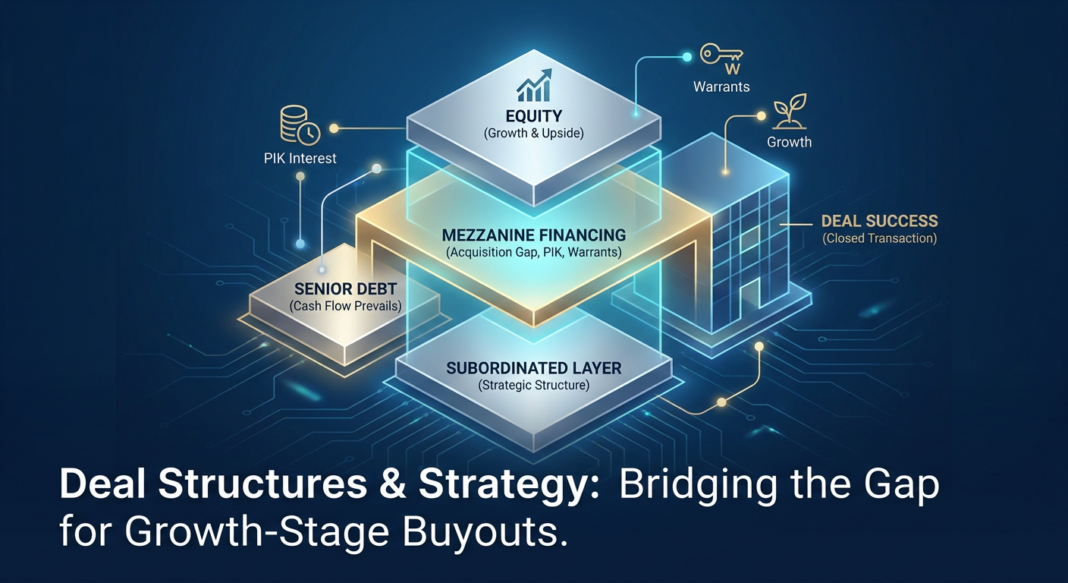
Mezzanine debt is the subordinated layer of the capital structure (sitting below senior debt and above common equity) that closes the gap between what first-lien lenders will advance and what operators, sponsors, and owners actually need to execute. Understanding when it works, what it costs, and how to negotiate its terms is one of the highest-leverage competencies in middle-market deal structuring.
Structure Breakdown: The Three Components of Mezzanine Capital
Mezzanine financing has three defining structural features that separate it from every other instrument in the stack. First, it is subordinated and typically unsecured, sitting below all senior creditors in the payment waterfall, which is precisely why it commands a premium yield. Second, it carries a hybrid interest structure built around cash-pay coupons and Payment-in-Kind (PIK) components. Third, it almost always includes an equity kicker, usually in the form of stock warrants, that lets the lender participate in the company’s upside if a sale or refinancing event occurs.
Component 1: Cash-Pay Coupon
The cash interest portion of a mezzanine note requires current payment, typically monthly or quarterly. In 2026, cash coupons on performing middle-market mezzanine notes run 8–11%, reflecting the subordination risk premium above senior debt but preserving some current income for the lender.
Component 2: PIK Interest
Payment-in-Kind interest is accrued rather than paid in cash, the interest amount is added to the outstanding principal balance, causing the note to compound over time. Most mezzanine structures use a partial PIK: the lender still receives some cash-pay interest each period while the PIK portion accrues separately. The trade-off is explicit: the borrower preserves near-term liquidity at the cost of increased principal obligations and a higher all-in IRR measured at exit.
PIK does not feel expensive in the early periods. It becomes expensive when it compounds. A $10 million note with a 3% PIK component grows to approximately $11.6 million of PIK principal alone over five years, before accounting for the base cash coupon. Structuring PIK with a toggle mechanism (borrower elects PIK at closing, steps down to partial cash-pay after Year 2) is both market standard and borrower-protective.
Component 3: Equity Kicker, The Warrant
Nearly every mezzanine deal includes equity warrants, options to purchase common stock at a nominal strike price, often as low as $0.01 per share. The warrant compensates the lender for subordination risk that the cash coupon alone does not fully price. If the company exits at a high multiple, the warrants convert into meaningful equity proceeds, lifting the lender’s blended IRR from the coupon range into their target return range of 15–20%.
Warrant coverage, expressed as a percentage of the principal amount, typically runs 3–8% of the fully diluted equity in growth-stage middle-market deals. A $15 million mezzanine note with 5% warrant coverage on a $60 million enterprise value represents a meaningful equity dilution event if the company doubles in value at exit.
A Worked Example: $60M Acquisition of a B2B Services Company
Assume a $60 million enterprise value acquisition of a B2B services company with $5 million in EBITDA, 20% EBITDA margins, and strong recurring revenue. The capital stack is structured as follows:
- Senior Unitranche: $25 million at SOFR + 575 bps (approximately 10.5% all-in), 5.0x leverage, single maintenance covenant (Total Leverage ≤ 6.5x), 6-year term, 1% annual amortization with bullet at maturity.
- Mezzanine Note: $15 million at 12% all-in (9% cash + 3% PIK, toggling to 11% cash / 1% PIK after Year 2), plus warrants covering 4% of fully diluted equity at $0.01 strike, 7-year term, bullet repayment, 2% OID, call protection at 103/102/101/par declining annually.
- Sponsor Equity: $20 million common equity, representing 33.3% of total capitalization.
Total deal leverage: 8.0x EBITDA. Debt service in Year 1 (cash-pay only): approximately $3.4 million against $5 million EBITDA, manageable at 1.47x DSCR, with PIK deferral preserving operational cash flow during integration.
Mezzanine vs. the Alternatives: Where Each Structure Wins
The central financing question for any growth-stage acquisition is not whether to use mezzanine; it is whether mezzanine is the right instrument for the specific gap, or whether a competing structure serves the borrower better.
Mezzanine vs. Unitranche (Stretch Senior)
The unitranche has displaced a substantial portion of the traditional senior-plus-mezzanine market for mid-market acquisitions. A unitranche combines senior and subordinated debt into a single tranche from one direct lender, eliminating the need for an intercreditor agreement and simplifying ongoing lender management. For the $25–$200 million enterprise value range, the unitranche wins on speed and structural simplicity.
But the unitranche has a leverage ceiling. Direct lenders will typically advance 4.5–6.0x EBITDA on a unitranche for a quality credit, and in a tighter credit environment, underwriters are pricing new deals at the lower end of that range. If the acquisition requires 7–8x total leverage to work at current equity prices, the unitranche alone cannot get there. That is where a mezzanine tranche, layered above the senior facility, unlocks the quantum of capital needed without requiring the sponsor to write a larger equity check or reprice the deal.
Mezzanine vs. Preferred Equity
Preferred equity sits in the same structural neighborhood as mezzanine but has different remedy mechanics and tax treatment. Preferred equity holders exercise through equity-ownership remedies; mezzanine holders enforce through debt covenants and acceleration rights. Preferred equity is typically more expensive on an all-in basis, less tax-deductible to the issuer, and preferred by lenders who want governance rights rather than debt remedies. For operators seeking to minimize dilution and maximize leverage efficiency, mezzanine debt, with its deductible interest expense, is almost always more structurally attractive than preferred equity at equivalent proceeds levels.
Mezzanine vs. Second-Lien Debt
Second-lien loans are secured instruments; they hold a second lien on the company’s assets, which gives them meaningfully higher recovery rates in distress than unsecured mezzanine. Second-lien debt tends to price inside mezzanine (SOFR + 800–950 bps vs. 1,100–1,400 bps all-in for mezzanine) but comes without a PIK toggle option and typically without equity upside. For cash-generative businesses with strong asset coverage, second-lien may offer a cheaper subordinated layer. For growth businesses with lighter asset bases, mezzanine with PIK optionality is frequently more practical.
Current Market Terms: What Mezzanine Looks Like in July 2026
The private credit market has been through a structural repricing since 2022. Mezzanine is not immune. Here is what current market terms actually look like for growth-stage and acquisition financing as of mid-2026:
Pricing and Return Targets
- All-in cost (borrower perspective): 10–14%, comprising a cash coupon of 8–11% plus PIK of 2–4% plus the economic cost of warrants. Cash coupons on the cash-pay component have risen approximately 200–300 basis points since 2022 as SOFR-based pricing normalized.
- Lender IRR target: 15–22% blended, with the equity kicker carrying warrants into the upper end of that range on high-growth exits. Mezzanine funds target gross returns of 15–20%, positioning above pure senior direct lending strategies.
- Maturity: 5–7 years, typically aligning with PE hold periods and expected exit timelines. Repayment is almost always a single bullet at maturity.
- OID and fees: 1–2% OID at close, plus 1–2% upfront arrangement fee, economically equivalent to a 200–400 basis point yield premium on a 5-year hold, which borrowers frequently underestimate when comparing term sheets.
- Call protection: Market standard is declining premium over the first 3–4 years: 103/102/101/par. Make-whole provisions for mandatory calls and change-of-control events. PIK structures require specific language governing whether call premiums apply to capitalized PIK balances, a source of post-closing disputes when left ambiguous.
Covenant Architecture
Mezzanine covenants in 2026 are structured as a hybrid: maintenance covenants on core financial ratios (typically total leverage and minimum fixed charge coverage, tested quarterly) alongside incurrence covenants that gate specific credit-negative actions: additional debt, dividends, and acquisitions. This diverges sharply from the broadly syndicated loan market, where approximately 90% of new institutional loans in 2024 remained covenant-lite with no recurring maintenance tests. Private credit mezzanine lenders have held firm on maintenance covenants as a monitoring and early-intervention tool, particularly for sub-$50 million EBITDA borrowers where information asymmetry is highest.
The practical distinction matters: a maintenance covenant fires automatically when financial performance deteriorates below a threshold, forcing a negotiated amendment or waiver before the borrower reaches payment default. An incurrence covenant only fires when the borrower proposes a specific action. For borrowers, the negotiation is about covenant headroom, cushion above closing leverage, not covenant existence. A well-negotiated mezzanine package includes at least 25–30% headroom above the closing leverage ratio on day one.
Lender Landscape
The mezzanine market has consolidated around several distinct provider categories. Publicly traded BDCs (Ares Capital, Blue Owl (formerly Owl Rock), and Golub Capital BDC) are major providers of subordinated and mezzanine financing, with BDCs receiving approximately 8% of their investment income through PIK interest in 2025, reflecting the growing prevalence of PIK structures across private credit. Specialty mezzanine funds (Audax Mezzanine, NewSpring Capital, Madison Capital) focus on lower middle-market credits ($5–30 million EBITDA), while family offices increasingly participate in direct mezzanine deals below $10 million. Traditional mezzanine funds remain relevant particularly in situations where a deal is too large for a unitranche provider to cover the full quantum, where sponsors prefer the traditional senior-plus-subordinated structure, or where portfolio company add-on financings restrict additional senior debt under existing credit agreements.
The Gap Capital Playbook: Quantify, Prepare, Run, Negotiate
The most common mistake operators make with mezzanine financing is treating it as a last resort, a bridge accessed when senior debt falls short at the term sheet stage. Practitioners who execute well treat mezzanine as a planned layer of the capital structure, sized deliberately to meet the use-of-proceeds requirement at the lowest all-in cost achievable.
Step 1: Quantify the Gap Precisely
Start with the total sources and uses. Map your enterprise value, transaction costs (typically 3–5% of deal value for advisory, legal, and financing fees), and minimum equity contribution. Subtract the maximum senior debt capacity at a conservative leverage multiple (assume 3.5–4.0x for a first-lien bank; 4.5–5.0x for a unitranche direct lender). The residual, net of available equity, is your mezzanine requirement. Sizing the mezzanine tranche below 20% of total capitalization keeps the cost of capital manageable and avoids triggering senior lender covenant restrictions on subordinated debt.
Step 2: Prepare the Mezzanine Package
Mezzanine lenders underwrite cash flow, not assets. The information package must tell a clear story across five dimensions: (1) historical EBITDA with three years of audited or reviewed financials; (2) EBITDA quality (adjustments, add-backs, and revenue concentration risks are scrutinized aggressively; (3) free cash flow after capex and working capital, which determines real debt service capacity; (4) management track record and operational depth; and (5) the exit thesis) mezzanine lenders want to know how they get repaid, whether through a sale, refinancing, or organic debt paydown. A clear deleveraging schedule showing total leverage declining from closing to maturity, with the mezzanine repaid at bullet, is the structural narrative every mezzanine lender is evaluating.
Step 3: Run a Competitive Process
Do not accept the first mezzanine term sheet you receive. The spread between best and worst mezzanine proposals on a $15 million tranche can exceed 200 basis points on the cash coupon and 2–3 percentage points on warrant coverage, a difference that compounds dramatically over a 5-year hold period. A disciplined process involves approaching 5–8 mezzanine providers simultaneously, requiring initial term sheets within 3 weeks, and narrowing to 2–3 finalists for full diligence and final documentation. Leverage competition on both price (cash coupon, OID, PIK split) and structure (warrant coverage percentage, strike price, call protection terms, covenant headroom).
Step 4: Model the True All-In Cost
Every mezzanine term sheet must be evaluated on IRR to the lender, not nominal coupon. Build a complete cash flow model from the lender’s perspective: initial outflow at funding, annual cash interest inflows, PIK principal compounding, exit-year principal repayment, call premiums if applicable, and warrant value under base/upside/downside exit scenarios. The instrument that appears cheapest on its cash coupon can carry a materially higher lender IRR once OID, PIK compounding, and warrant upside are fully modeled. This is where most borrowers make pricing mistakes, comparing cash coupons in isolation rather than total economic outcomes.
Negotiation Guidance: Where Borrowers Win, and Where They Concede
Mezzanine negotiations have well-defined battlegrounds. Experienced operators know which terms move and which ones are structural necessities for the lender’s own economics. Negotiating everything equally signals inexperience; knowing where to push signals deal sophistication.
For Operators and Borrowers
Fight hard on warrant coverage. Warrant coverage percentage is the single highest-leverage negotiating point in a mezzanine term sheet. The difference between 3% and 6% warrant coverage at a $0.01 strike is worth millions at a strong exit. Run the warrant dilution model under multiple exit scenarios before countering. Propose a warrant coverage step-down tied to early repayment: if you repay the mezzanine in Year 3, warrants vest at 50%; in Year 4, 75%; at maturity, 100%.
Negotiate PIK toggle terms carefully. PIK interest that can be elected freely by the borrower is cash-flow protective. PIK that is elected only with lender consent or triggered by a financial ratio breach is far less valuable. The timing and mechanics of the PIK step-down (from full PIK to partial cash-pay) should be negotiated at close, not left to future amendment discussions. Ensure prepayment premium mechanics explicitly address whether capitalized PIK balances carry the same call protection as original principal, failure to define this is a common post-closing dispute trigger.
Negotiate covenant cushion, not covenant elimination. In the private credit mezzanine market in 2026, maintenance covenants are not negotiable away for most middle-market borrowers. What is negotiable is the headroom above closing leverage. A lender proposing a maximum total leverage covenant set at 0.5x above closing day leverage leaves almost no operating room. Negotiate 0.75–1.0x cushion on total leverage and no less than 1.15x on fixed charge coverage for a business with any revenue seasonality or integration risk.
Protect your clean-up and add-on rights. If you plan to use the acquired platform for add-on acquisitions, the most common growth strategy for lower middle-market PE sponsors, your mezzanine agreement must explicitly permit add-on acquisitions meeting defined criteria (size, leverage pro forma, industry adjacency). Mezzanine lenders with incurrence covenants may gate add-ons behind leverage tests; ensure those tests are achievable given your near-term integration plan.
For Investors and Lenders
The equity kicker is not free upside; it is structural compensation for subordination risk that the cash coupon alone does not price. Ensure warrant coverage is documented with a clear valuation methodology, defined strike price, and an anti-dilution provision protecting against senior equity issuances that would otherwise dilute the warrant’s economic value at exit. Coordinate warrant valuation mechanics with prepayment terms explicitly at close to avoid double-counting conflicts during a sale process.
Key Takeaways
- Mezzanine fills a structural gap that senior debt alone cannot close. For acquisitions requiring 7–8x leverage, or where equity capacity is constrained, mezzanine bridges the capital gap without requiring equity issuance at an expensive implied valuation.
- The all-in cost is higher than the cash coupon. PIK compounding, OID amortization, and equity kicker dilution combine to push mezzanine all-in costs to 10–14% for borrowers and 15–22% IRR for lenders. Model the full economics, not just the stated rate.
- Warrant coverage is the highest-leverage negotiating point. A 2–3 percentage point reduction in warrant coverage on a $60 million deal can be worth $1–3 million in founder/sponsor retained equity at a strong exit. Fight here first.
- Covenant design has shifted, maintenance covenants are standard in private credit mezzanine. Unlike the broadly syndicated market where over 90% of new loans are covenant-lite, middle-market mezzanine lenders retain quarterly maintenance tests. Negotiate headroom, not elimination.
- Run a competitive process. The spread between mezzanine term sheets on a $15 million tranche (in cash coupon, OID, PIK structure, warrant coverage, and call protection) is wide enough that a 3-week competitive process routinely recovers more value than months of post-term-sheet negotiation with a single lender.


