
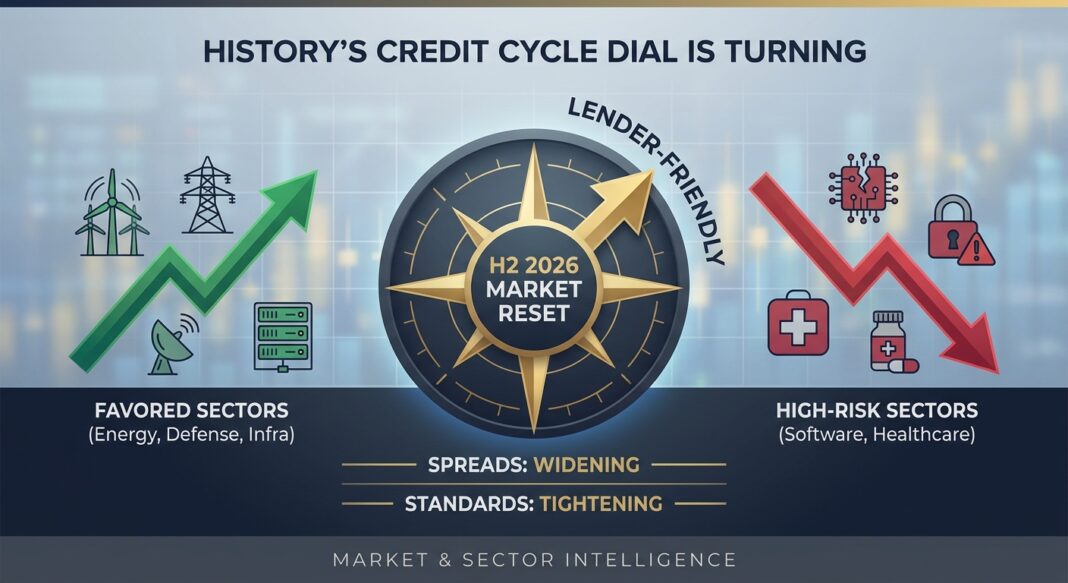
Bond Capital, Market & Sector Intelligence | July 3, 2026
Private Credit’s Lender-Friendly Reset: Spreads, Standards, and the Sector Divergence Defining H2 2026
As the Fed holds rates at 3.50–3.75%, private credit spreads have widened 50–100 bps since late 2025, underwriting discipline is tightening, and a sharp sector divide (favoring energy infrastructure and defense over software and healthcare) is reshaping lender appetite heading into the second half of 2026.
Market Headline: The Cycle Has Turned, Toward Lenders
After years in which abundant capital supply handed borrowers the upper hand (driving spreads to compressed levels, inflating leverage, and loosening documentation) the private credit market has undergone a meaningful structural reset in the first half of 2026. Three converging forces drove the shift: the outbreak of the U.S.-Iran military conflict in late February, an accelerating AI-driven reassessment of software credit quality, and a wave of redemption requests that exposed structural vulnerabilities in retail-oriented private credit vehicles.
The result is a market that Lord Abbett describes as having “reset in a more lender-friendly direction”: one characterized by wider spreads, tighter covenants, and sharply increased selectivity. The Federal Reserve’s April 2026 SLOOS confirms the macro signal: banks reported tighter lending standards for C&I loans across firms of all sizes in Q1 2026, while also tightening standards across all non-depository financial institution (NDFI) loan categories. The January 2026 SLOOS further revealed that banks are more likely to approve loans to firms benefiting from AI exposure and less likely to lend to those adversely affected by it, a bifurcation that now pervades the entire leveraged finance landscape.
For institutional investors and operators, the H2 2026 market is not uniformly restrictive; it is discriminating. Disciplined lenders with dry powder, sector expertise, and covenant protections are positioned to capture a more attractive risk-adjusted return profile than was available at any point in 2024 or early 2025. The critical variable is no longer availability of capital; it is quality of underwriting.
Quantitative Market Snapshot
Data as of late June / early July 2026. All spreads quoted over SOFR unless otherwise noted.
| Metric | Current Value (Q2 2026) | Prior Period (YE 2025) | Change | Source |
|---|---|---|---|---|
| Middle Market Unitranche Spread (SOFR+) | S+475–550 bps | S+450–525 bps | +~25 bps | VRC Q2 2026 |
| Broader Private Credit Spread (SOFR+) | ~S+500 bps | ~S+450 bps (mid) | +50–100 bps | Hamilton Lane; Lord Abbett / PitchBook |
| 3-Month SOFR (Term) | 3.68% | ~3.67% | +1 bp QoQ | VRC Q2 2026 |
| 5-Year U.S. Treasury Yield | ~4.23% | 3.92% | +31 bps | VRC Q2 2026 |
| Private Credit All-In Yield (First Lien Direct Lending) | ~8.0–9.5% | ~8.0–8.5% | +~50 bps QoQ | VRC; Morgan Stanley |
| Private Credit Yield Premium vs. Public High Yield | ~300 bps (gross); ~150–200 bps (risk-adj.) | ~350 bps (2019 peak) | Compressed from peak | HedgeCo; Owners.pe |
| Secondary B-Rated Loan Spread (vs. YE 2025) | +43 bps wider YTD | Baseline (YE 2025) | Wider; ~20 bps off Q1 peak | PitchBook LCD via VRC |
| Software Sector Secondary Spread Premium (vs. B-rated index) | +229 bps above B-rated index; +245 bps vs. YE 2025 | Baseline (YE 2025) | Significantly wider | PitchBook LCD as of June 19, 2026 |
| Private Credit Default Rate (Proskauer Index, Q1 2026) | 2.73% | 1.84% (two qtrs. prior) | +89 bps | Proskauer via Forbes |
| “True” Private Credit Default Rate (incl. LMEs, PIK; Fitch) | ~5.8% (12M through Jan. 2026) | Below 2% (headline only) | Record high per Fitch | Fitch via Forbes |
| Private Debt Issuance YTD (through May 2026) | ~$87.2B | Same period 2025: higher by ~$33B | −24.6% YoY | VRC Q2 2026 |
| Middle Market Total Debt / EBITDA (typical LBO range) | 4.0x–5.5x (standard); ≤6.0x (premium) | 6.0x+ (2021–2022 peak) | More conservative | Capstone Partners / PGIM |
| Interest Coverage Ratio (% of borrowers sub-1.0x EBITDA/interest) | ~14% (Q4 2025, improving) | 21–23% (2023–early 2024) | Improved materially | Partners Group, Q4 2025 data |
Note: VRC = Valuation Research Corp. Unitranche spreads sourced from VRC Q2 2026 report. LBO leverage multiples sourced from Capstone Partners Q1 2026 and PGIM benchmarks. Default data from Proskauer Private Credit Default Index (697 loans, $189.2B tracked) and Fitch Ratings broader methodology. The Federal Reserve maintained its target rate range at 3.50%–3.75% at its June 2026 meeting.
Macro & Regulatory Forces Shaping the Lending Environment
The macro backdrop entering H2 2026 is defined by a higher-for-longer rate regime with a hawkish tilt. The Fed held its target range at 3.50–3.75% at its June 2026 meeting, with the forward SOFR curve now implying rates stabilizing near 4% over the long run, roughly 100 basis points above late-2025 expectations, according to VRC. The geopolitical shock from the U.S.-Iran conflict in February reinforced the higher-for-longer view: elevated energy prices raise inflation expectations while slowing growth, compressing the Fed’s room to cut. Hamilton Lane notes that war conditions are unlikely to prompt Fed rate reductions, supporting continued yield elevation in private credit.
On the regulatory front, the April 2026 SLOOS delivered a notable new data point: banks reported tightening standards across all non-depository financial institution (NDFI) loan categories over the prior year (including business credit intermediaries, consumer credit intermediaries, and private equity funds) with the most widely cited changes being higher risk premiums, stricter covenants, shorter maturities, and tighter collateralization. This is consequential: banks are the critical backstop of private credit fund liquidity, providing subscription credit lines, warehouse facilities, and NAV-based leverage. By October 2025, Moody’s estimated U.S. banks had extended nearly $300 billion in credit to private credit funds, BDCs, and CLOs, per Forbes reporting. Tightening bank standards at the fund level propagates through to borrower-level credit availability, a second-order tightening effect that rarely appears in headline spread data.
The Financial Stability Board’s May 2026 vulnerability report identified four systemic risk clusters in private credit: bank interconnections, borrower credit quality and valuation opacity, concentration and liquidity mismatches, and data gaps. Critically, the FSB flagged that EBITDA adjustments may result in reported leverage being materially understated, estimating the “true” debt-to-EBITDA in private credit may be closer to 7x once structural adjustments are stripped out. For underwriters and portfolio managers relying on headline leverage ratios and FCCR thresholds, this caveat is operationally significant and demands stress-testing against adjusted EBITDA, not sponsor-reported figures.
KPI Benchmarks: What Lenders Are Requiring Now
The shift in lender posture is most visible in the KPI thresholds being applied to new transactions. Based on current market data, here are the operative benchmarks:
- Debt / EBITDA (Total Leverage): The market standard for mid-market LBOs has recalibrated to 4.0x–5.5x, with the lower end applied to smaller or cyclically exposed borrowers, and the upper end reserved for high-quality, recurring-revenue businesses, per Capstone Partners and PGIM. Anything above 5.5x now requires exceptional credit strength or creative structuring. This compares to 6.0x+ during the 2021–2022 peak leverage cycle.
- Fixed Charge Coverage Ratio (FCCR): Senior lenders are broadly requiring minimum FCCR covenants of 1.20x–1.25x, per standard term sheet language reported by Sidley Austin. Premium borrowers with FCCRs of 3.0x–4.0x command materially better pricing, covenant flex, and documentation. Lenders are increasingly stress-testing FCCR under scenarios where EBITDA declines 10–15% and rates increase 50–100 bps, a material change from 2024 underwriting norms.
- EBITDA Coverage / Interest: As of Q4 2025, approximately 14% of private credit borrowers carried sub-1.0x interest coverage, down from 21–23% during 2023–early 2024, according to Partners Group. This improvement is real but concentrated in higher-quality vintages; stressed 2021–2022 vintage borrowers continue to exhibit compression, with VRC’s proprietary cohort data indicating leverage has risen ~0.9x while adjusted cash interest coverage has declined ~0.4x since origination.
- Equity Contributions: PE sponsors contributed approximately 50% equity in mid-market buyouts as of 2025–2026, up from ~35% in pre-pandemic deal norms, reflecting the direct consequence of compressed debt availability and lender scrutiny of loan-to-value, per Capstone Partners.
- Unitranche Coupon Spreads (Q2 2026): Standard unitranche transactions are pricing at SOFR+475–550 bps, approximately 25 bps above year-end 2025 levels, with original issue discounts holding at 98.75–99.25 for standard credits, per VRC.
Covenant design is becoming more rigorous. New loans are increasingly structured with maintenance covenants rather than incurrence-only tests, fewer PIK toggle options, and tighter EBITDA add-back caps, reversing several years of documentation erosion, per Lord Abbett.
Sector Analysis: Hot, Cold, and Structurally Shifting
🔴 Restricted / Elevated Risk Premium
Software & Technology Services: The most consequential sector story of 2026. Software now represents approximately 20% of private credit market exposure, versus ~13% in the liquid leveraged loan market, per PitchBook and Lord Abbett. Secondary spreads for software credits are approximately 245 bps wider than year-end 2025 levels and roughly 229 bps above the broader B-rated loan index as of June 19, 2026, per PitchBook LCD via VRC. Lenders are now pricing new software direct lending transactions at 75–100 bps above VRC’s standard range. Critically, lenders are shifting underwriting from ARR-based to EBITDA-based frameworks, as pre-profitability ARR models are now viewed as insufficient collateral support in a higher-rate, AI-disrupted environment. Nearly 50% of software loans maturing through 2030 come due by 2028, representing $30B in directly originated and $75B in leveraged loans, per Partners Group, a refinancing wall now firmly on lenders’ watch lists.
Healthcare: Morgan Stanley Investment Management maintains a significant underweight to healthcare, which has led all sectors in loans placed on non-accrual status over the prior year. PwC’s 2026 Private Credit Survey confirms stress is concentrated in “weaker credits and more challenged sectors or subsectors within software, healthcare and consumer markets,” per PwC. Healthcare roll-up structures and services businesses with high leverage inherited from 2021–2022 vintages face particular pressure as coverage ratios deteriorate.
Energy-Intensive Industrials & Manufacturing: The Iran conflict-driven energy price surge has prompted lenders to tighten underwriting for businesses whose leverage was predicated on stable input costs, per Capstone Partners Q1 2026. Lenders are factoring ongoing oil price volatility into deal structures for energy-intensive borrowers.
🟢 Active / Preferred Lending Targets
Energy Infrastructure, Digital Infrastructure & Defense: Paul Weiss identifies energy infrastructure, digital infrastructure (including data centers), defense and national security, and next-generation manufacturing as the priority sectors for institutional capital in 2026, all requiring patient, long-duration commitments that banks are structurally ill-suited to provide. BlackRock’s 2026 Private Markets Outlook similarly identifies asset-based financing as an area of “profound increase in opportunities,” with data centers and power generation as key infrastructure investment targets.
Non-Cyclical Business Services & Profitable Software: Lenders are actively differentiating within software: favoring profitable, cash-generative, mission-critical software businesses over pre-profitability ARR borrowers and companies with potential AI substitution risk, per Lord Abbett. Business services with stable, recurring free cash flow and durable competitive advantages remain well-bid by direct lenders.
Asset-Based Finance: Capital is structurally rotating toward specialist strategies including asset-backed finance, non-sponsor lending, and bespoke hybrid structures, per PwC’s 2026 survey of 120+ credit portfolio managers. Sectors such as music royalties, sports franchise receivables, and specialty real estate are attracting fresh institutional interest as alternatives to traditional corporate direct lending, offering long-duration, inflation-resistant cash flows with lower correlation to the leveraged finance cycle.
Implications for Institutional Investors & Operators
For Borrowers & Operators
The era of frictionless capital access at aggressive leverage is over, at least for mid-cycle credits. Operators seeking new debt capital in H2 2026 should expect: (1) meaningful spread premiums on any AI- or software-adjacent business model without demonstrated EBITDA profitability; (2) heightened scrutiny of EBITDA add-backs, with lenders imposing caps and verifying cash flow conversion independently; (3) stronger covenant packages with maintenance tests rather than incurrence-only structures; and (4) lender requirements for higher equity contribution in leveraged transactions. Borrowers with strong FCCR metrics (ideally 1.5x or above) and demonstrated free cash flow generation will command materially better pricing and structural flexibility than the market average.
For operators in energy-intensive sectors, pricing submissions must now include sensitivity tables for energy cost escalation; lenders will require it as a standard underwriting input. For software businesses, the migration from ARR-to EBITDA-based covenants is not optional, refinancing into the current market on an ARR framework will be extremely difficult absent special circumstances.
For Institutional Investors & Lenders
The Q2 2026 market presents a structurally more attractive entry point for disciplined deployers of new capital. Wider spreads, improved covenant packages, and more conservative leverage, combined with a higher base rate, create an all-in yield environment that is materially better than the mid-2025 window. Partners Group notes that institutional capital has remained stable or increased during the recent dislocation, while retail-oriented vehicles experienced redemption pressure, a divergence that creates a competitive advantage for institutional platforms.
However, the manager dispersion theme is critical: Partners Group estimates nearly 50% of direct lending managers were formed post-COVID and close to 70% within the past decade, meaning the majority have not been tested through a full credit cycle. Portfolio quality will diverge materially between managers with disciplined origination and those that deployed aggressively into 2021–2022 vintage software and healthcare. Non-accruals, PIK usage, and vintage concentration should be leading indicators for allocator due diligence heading into H2 2026.
Forward-Looking View: Next 3–6 Months
The H2 2026 credit cycle is best characterized as mid-to-late cycle with elevated idiosyncratic risk: not systemic crisis, but meaningful sector-specific stress with rising default rates from a low base. Moody’s baseline GDP forecast of ~1.5% sits at historical “stall speed,” meaning a modest growth miss could accelerate defaults quickly, per Moody’s. VRC expects rating agencies’ default forecasts, currently ranging 2.5%–5.0%, to remain elevated through year-end. Refinancing risk is the medium-term variable to watch: leveraged loan issuance through June 2026 is 3.88% below the same period in 2025, monthly issuance has been highly volatile (from $77.2B in March to $17.1B in April to $72.6B in May), and the software refinancing wall is a 2027–2028 issue that lenders must begin pricing into credit assessments today.
On the upside, VRC confirms that banks have begun gradually re-entering the upper middle market in Q2, alleviating some spread pressure in larger deals, though this benefits large borrowers more than the core middle market. Middle market PE deal value increased approximately 10.7% year-over-year and exit activity rose 14% in Q2, signaling gradual normalization of transaction activity. New deal demand, combined with an approaching refinancing wave, should over time create a supply-demand imbalance that favors lenders, extending the lender-friendly reset into 2027, per Morgan Stanley.
Key Market Insights: 5 Actionable Takeaways
- Spread widening of 50–100 bps since late 2025 represents a genuine entry-point improvement for new lenders. Unitranche spreads at SOFR+475–550 bps, combined with 3-month SOFR at 3.68% and a higher forward curve, are delivering all-in yields of ~8.0–9.5%, materially above the Morgan Stanley 2026 floor estimate, with improved structural protections versus 12 months ago.
- The “true” default rate is not 2%; it is closer to 5–6%. The Fitch broad-methodology rate of 5.8% (through January 2026) and the Proskauer rate of 2.73% (Q1 2026, 697 loans tracked) diverge because LMEs, PIK elections, and distressed exchanges are excluded from headline figures. Portfolio stress-testing and covenant monitoring must account for the full spectrum of credit impairment, not only formal payment defaults.
- Software is now a binary underwriting exercise, not a sector. Profitable, mission-critical, EBITDA-positive software businesses remain financeable at premiums; pre-profitability ARR borrowers and AI-disruption-exposed models face lender avoidance or highly punitive spreads (+75–100 bps vs. standard). The ARR-to-EBITDA underwriting migration is accelerating and should be reflected in all new credit memos for software-adjacent borrowers.
- The FSB’s 7x “true leverage” warning demands a new EBITDA add-back discipline. With the FSB flagging that structural EBITDA adjustments may result in reported leverage being understated by 1–2x debt-to-EBITDA turns, lenders and investors must independently verify cash EBITDA versus adjusted EBITDA in all new originations, particularly for 2021–2022 vintage re-financings approaching maturity.
- Infrastructure, defense, and asset-based finance are the rotation targets for disciplined capital. With direct lending spreads compressed and corporate credit stress elevated, the structural alpha opportunity is shifting toward energy infrastructure, digital infrastructure, defense-adjacent lending, and bespoke asset-backed structures: sectors where bank retrenchment is most acute, institutional capital horizons align with asset duration, and capital supply has not yet crowded out yield.


