
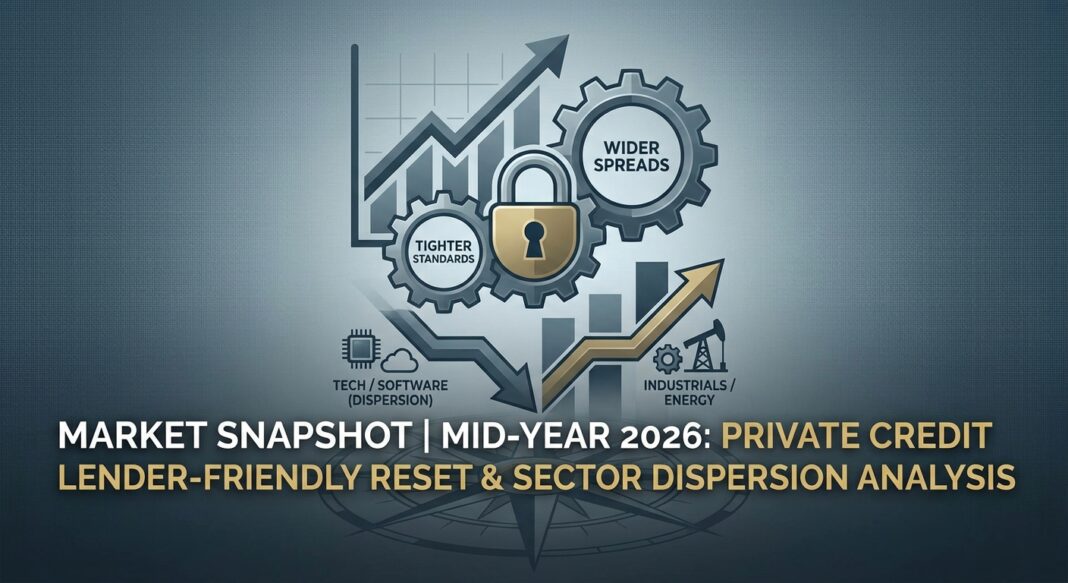
Private Credit’s Lender-Friendly Reset: Spreads Widen, Standards Tighten, and Sector Dispersion Deepens at Mid-Year 2026
The Reset Is Real, and It Is Lender-Friendly
After two years of borrower-dominated conditions (tightening spreads, rising leverage multiples, and increasingly permissive loan documentation) the private credit market has snapped back with unusual speed in the first half of 2026. Three convergent shocks drove the reset: (1) a global AI-driven repricing of software-sector credit risk following the release of Anthropic’s Claude Cowork model; (2) the outbreak of a U.S.–Iran military conflict in February 2026, which disrupted M&A pipelines and elevated macro uncertainty; and (3) a wave of semi-liquid fund redemption requests that exposed structural liquidity mismatches within retail-oriented private credit vehicles.
The result is a credit market in active recalibration. According to Lord Abbett’s 2026 Midyear Investment Outlook, spreads have widened by roughly 50 to 100 basis points since late 2025, while new loans are increasingly coming with better credit structures, less leverage, more covenants, fewer payment-in-kind (PIK) requests, and tighter documentation. PitchBook LCD’s Q2 2026 Private Credit Wrap confirms the shift: lenders describe a market reset with spreads widening, leverage pulling back, and deal terms improving. On plain-vanilla deals, a loan that priced at S+450 late last year would likely come at S+500 today, with slightly more original issue discount (OID).
The macro credit cycle signal is unambiguous. The Federal Reserve’s April 2026 Senior Loan Officer Opinion Survey (SLOOS) reported that, on balance, banks tightened lending standards for commercial and industrial (C&I) loans to firms of all sizes during Q1 2026, while simultaneously reporting tighter standards for all categories of non-depository financial institution (NDFI) loans, a direct signal of tightening credit conditions at the institutional wholesale level. The most widely cited tightening measures included higher premiums on riskier loans, stricter covenants, shorter maturities, stricter collateralization requirements, and lower maximum credit line sizes.
This is not a credit crisis; it is a credit cycle correction. Headline issues remain largely company-specific rather than systemic, and disciplined lenders with dry powder are positioned to deploy capital into an increasingly favorable risk/return environment in H2 2026.
Quantitative Market Snapshot: Key Credit Metrics as of July 2, 2026
| Metric | Current Level (Q2 2026) | Prior Period | Change | Source |
|---|---|---|---|---|
| Direct Lending Spreads (plain-vanilla LBOs) | S+500–S+509 bps avg. | S+450 (late 2025) / S+474 (Q1 2026) | +50–100 bps since late 2025 | PitchBook LCD, June 2026 |
| Software Sector Secondary Spreads | ~245 bps wider than YE 2025; ~229 bps above broader B-rated index | Near B-rated loan index at YE 2025 | Severe widening; risk-off repricing | VRC / PitchBook LCD, June 19, 2026 |
| B-Rated Secondary Loan Spreads | ~43 bps wider than YE 2025; ~20 bps tighter than Q1 peak | YE 2025 baseline; Q1 2026 peak | Broader market stabilizing in Q2 | VRC / PitchBook LCD, June 2026 |
| Direct Lending All-In Yields (new-issue, 2025) | ~9.3% (2025 avg.) | ~10.5% (2024) | −120 bps YoY on declining base rates | McKinsey / Kroll StepStone Benchmarks |
| New-Issue Median Leverage (Debt/EBITDA) | 4.9x (2025); 5.0–6.0x for high-quality deals in H1 2026 | 5.0x (2024); 5.2x (2023) | Modestly declining; tightening post-March | McKinsey / Kroll StepStone; VRC Q2 2026 |
| Leveraged Loan LTM Default Rate (by issuer count) | 1.36% (Feb. 2026); 3.54% incl. distressed exchanges | 4.24% incl. distressed exchanges (2025 avg.) | Below long-term averages; distressed ratio rising to 8.89% | Hamilton Lane / LCD, Feb. 2026 |
| Q2 2026 Direct Lending Volume (LCD) | $29.2B / 138 transactions (through June 22) | $74.1B / 217 deals in Q1 2026 | −61% by volume vs. Q1 | PitchBook LCD, Q2 2026 |
| 3-Month Term SOFR | 3.68%–3.69% (June 2026) | ~4.35% avg. (2025); ~5.27% avg. (2024) | Higher-for-longer; forward curve flat ~4.0% | VRC / Chatham Financial, June 2026 |
| H1 2026 Private Credit Fundraising | $262B raised in H1 2026 | ~$202B H1 2025 (est.) | +30% YoY; driven entirely by Q2 | The Credit Crunch, July 2026 |
KPI Underwriting Standards: What Lenders Are Demanding Now
The shift in underwriting standards reflects a market recalibrating KPI thresholds after a period of covenant erosion. VRC’s Q2 2026 Private Markets Report notes that interest coverage ratios have moved back above 2.0x on recent transactions, supported in part by the decline of approximately 170 basis points in SOFR since September 2023, a meaningful improvement from the near-1.0x FCCR stress conditions witnessed in 2023. Through mid-2026, competitive dynamics still support leverage in the 5.0x–6.0x range for high-quality transactions, but underwriting standards have tightened meaningfully post-March amid expectations for higher base rates and constrained M&A volumes.
Critically, Lincoln International has observed that lenders are now underwriting to a forward-looking Fixed Charge Coverage Ratio (FCCR) that incorporates interest rate expectations, constraining the total debt load a company can support. This is directly depressing leverage multiples and forcing re-examination of acquisition prices across the M&A market. Practitioners note that an FCCR stress test (running a 100 bps rate shock on floating debt and reclassifying 25% of planned capex as maintenance) is becoming standard practice; if FCCR falls below 1.1x under stress, lenders are treating the covenant as insufficient early warning.
Sector Analysis: Where Capital Is Flowing, and Where It Is Retreating
🟥 Software & Technology Services: Significant Repricing, Elevated Scrutiny
Software is the epicenter of the 2026 private credit dislocation. Lord Abbett notes that private leveraged finance markets carry approximately 20% allocation to software versus roughly 13% in liquid leveraged finance markets, making the sector’s repricing disproportionately impactful. VRC’s Q1 2026 update shows that technology and software services loans continue to price at wider-than-average premiums given risk-off conditions and lower implied enterprise values, which have driven higher loan-to-value ratios. Lenders are evaluating AI-impacted borrowers on a case-by-case basis. Hamilton Lane draws the critical distinction: cash flow-based lenders focused on deeply entrenched, mission-critical software with long-term contracts and lower LTVs are better positioned; general software models and seat-based models with AI substitution risk are at greatest stress. The operative underwriting question is now free cash flow generation, not ARR multiples.
🟢 Industrials, Utilities & Hard Assets: Capital Rotation Accelerating
The rotation away from “asset-light” information businesses and toward “hard economy” sectors is the most significant structural shift in lender appetite this cycle. Carlyle’s Q2 2026 Global Private Markets Quarterly reports that hard industries including utilities, energy, chemicals, and machinery made up 46% of transaction volumes in Q1 2026, compared to just 13% a year ago, a dramatic three-fold share gain in a single year. Lenders view these sectors as offering stable cash flows, tangible collateral, and lower AI disruption risk, exactly the profile that satisfies tightening FCCR and debt service coverage ratio (DSCR) requirements in the current rate environment.
🟡 Healthcare: Stable but Bifurcating
Per Octus data, healthcare led all sectors for private credit deal volume in 2025, accounting for 19% of all direct lending deals, and was the only major industry to not see significant year-over-year price tightening, with spreads holding near SOFR+500 bps in Q4 2025. However, Morgan Stanley Investment Management has maintained a significant underweight to healthcare, citing its position as the leading sector for loans placed on non-accrual status over the past year. Subsectors including healthcare technology are under additional pressure, with public equities in the category down approximately 33.8% year-to-date as of June 2026.
🔵 Aerospace, Defense & Energy-Related Infrastructure: Benefiting From Geopolitical Tailwinds
The Iran conflict has had a net positive effect on defense and aerospace credit demand. Capstone Partners’ Q1 2026 Leveraged Finance Update highlights active M&A sale processes across defense engineering, metals processing, and aerospace supply-chain businesses backed by major sponsors. Energy infrastructure, however, presents a bifurcated picture: while upstream beneficiaries of elevated oil pricing are attracting capital, energy-intensive industrial borrowers whose leverage was predicated on stable energy costs are facing tighter underwriting standards.
Structural Shift: Bank Retrenchment Creates Private Credit White Space
The April 2026 SLOOS confirms a significant net share of banks tightened standards across all NDFI loan categories (including credit intermediaries, private equity funds, and consumer credit intermediaries) over the past year. The most impactful tightening measures were higher risk premiums, stricter covenants, shorter maturities, and lower maximum credit line sizes. Hamilton Lane notes that bank retrenchment during periods of volatility typically makes way for better private credit pricing and structure. Banks are also gradually returning to the upper middle market in Q2, as noted by VRC, contributing to increased competition and alleviating some upward spread pressure, but the core and lower middle markets remain predominantly private credit territory.
Strategic & Operational Implications
For Borrowers
The borrower-favorable environment of 2023–2025 has materially shifted. Operators seeking new financing or refinancing should expect: (1) spreads 50–100 bps wider than late-2025 terms; (2) more stringent FCCR and debt-to-EBITDA maintenance covenants, with lenders stress-testing forward-looking coverage ratios rather than relying on trailing EBITDA; (3) tighter loan documentation with fewer PIK toggle options and more restricted EBITDA add-back baskets; and (4) sector-specific gatekeeping, particularly for any business with material software-as-a-service revenue, AI substitution exposure, or energy cost sensitivity.
Operators with durable free cash flow, mission-critical product positioning, and moderate leverage (<5.0x) remain well-served by the private credit market. PitchBook’s Q1 2026 survey data indicates 84.4% of new-issue LBO spreads in direct lending still priced below S+550, but the tightening trend means operators seeking covenant relief or PIK flexibility will face significant pushback. Importantly, PitchBook LCD notes that the BSL market has taken the majority of LBO financing volume in 2026, a reversal from prior years, meaning large, well-rated borrowers now have public market alternatives that can apply competitive pressure on private lender terms.
For Institutional Investors & Lenders
The supply-demand balance has shifted in favor of disciplined lenders with dry powder. Lord Abbett’s midyear analysis frames the opportunity clearly: more transactions to finance, less capital competing aggressively for each deal, and greater ability to negotiate price and structure. Institutional investors should closely monitor non-accrual rates, PIK usage, 2021–2022 vintage exposure, and software sector concentration as leading indicators of portfolio quality divergence in H2 2026. PwC’s 2026 Global Private Credit Survey, capturing 120+ credit portfolio managers globally, confirms four in five managers expect allocations to increase over the next 12 months, with 44% expecting increases above 20%.
Redemption dynamics warrant close monitoring: PitchBook LCD reported that BCRED Q2 redemption demand climbed to 10% of NAV (from 7% in Q1), and Apollo Debt Solutions received requests to repurchase 17% of outstanding shares. While redemption caps are functioning as designed, investors in semi-liquid structures should evaluate the secondary market liquidity of their positions as private credit secondaries volume has surged to new highs in 2026.
Forward-Looking View: H2 2026 Liquidity & Lending Dynamics
The second half of 2026 will be defined by dispersion. The macro backdrop (higher-for-longer SOFR near 3.68%, forward rates expected to stabilize around 4.0%, geopolitical uncertainty, and an AI-driven sectoral reassessment) will continue to weigh on M&A-driven deal origination. VRC projects that a more challenging PE exit environment and extended hold periods will persist in the near term, though substantial dry powder remains available and a stabilization in geopolitical conditions could reopen the pipeline rapidly.
KBRA projects the annualized private credit default rate will rise from 1.5% in 2025 to 2.0% by year-end 2026, a modest increase that remains below long-term averages, but the distressed ratio of 8.89% as of February 2026 (a leading default indicator) is a trend line demanding vigilance. The true default rate, when incorporating selective defaults and liability management exercises, is estimated at closer to 5% per Within Intelligence.
On the structural side, H1 2026 fundraising of $262 billion, 30% above the prior year, confirms the asset class retains investor confidence, even as capital concentrates among mega-managers. Credit secondaries fundraising is up 6x year-on-year, with Ares’ $7 billion raise leading a market that is becoming a critical liquidity mechanism for the asset class. Regulatory scrutiny is increasing: the Financial Stability Board published its full vulnerabilities assessment on private credit in May 2026, flagging EBITDA add-back practices, valuation subjectivity, and interconnections between banks and private credit funds as priority concerns for global financial stability monitoring.
Key Market Insights: Actionable Takeaways
- Spreads Have Reset, Not Spiked: Direct lending spreads have moved from S+450 (late 2025) to S+500–S+509 bps on plain-vanilla deals, a disciplined 50–100 bps widening, not a systemic blowout. Disciplined lenders with dry powder now face an improved risk/return entry point for new commitments in H2 2026.
- FCCR and Free Cash Flow Are the New North Star: In a higher-for-longer SOFR environment (~3.68%), lenders are underwriting to forward-looking FCCR thresholds and stress-testing 100 bps rate shocks. Borrowers with FCCR below 1.2x (or with leverage exceeding 5.0x) should expect reduced credit availability and more restrictive covenants. Free cash flow generation, not EBITDA multiples, is now the primary underwriting lens.
- Sector Rotation Is the Trade of 2026: Hard-asset sectors (industrials, utilities, energy, defense) absorbed 46% of Q1 2026 buyout deal volumes vs. 13% a year ago. Software’s secondary spreads are 245 bps wider than year-end and 229 bps above the broader B-rated loan index. Operators and investors with concentrated software/tech exposure face meaningful refinancing and valuation risk in the 2021–2022 vintage cohort.
- Bank Credit Standards Are Tightening Across the Board: The April 2026 SLOOS confirms tighter C&I standards for all firm sizes and tighter NDFI standards for all categories, including private equity fund financing. Operators relying on revolving credit facilities or bank-sourced bridge financing should assess alternative private credit structures proactively, as credit line sizes and maximum maturities are contracting.
- Manager Selection Is Now the Primary Return Driver: With redemption rates at 10–17% of NAV across leading BDCs and semi-liquid vehicles, and the distressed ratio at 8.89%, the gap between top-quartile and median managers is widening rapidly. Institutional investors should scrutinize non-accrual rates, PIK income as a percentage of total income (public BDCs now averaging 8% PIK), vintage-year concentration (particularly 2021–2022), and the robustness of workout/restructuring capabilities before increasing allocations.


