
The Concept That Governs Every Private Credit Deal
Before a single basis point of yield is discussed, before covenants are negotiated, before a term sheet is signed, one question defines the entire risk-and-return logic of a private credit investment: where does this loan sit in the capital stack?
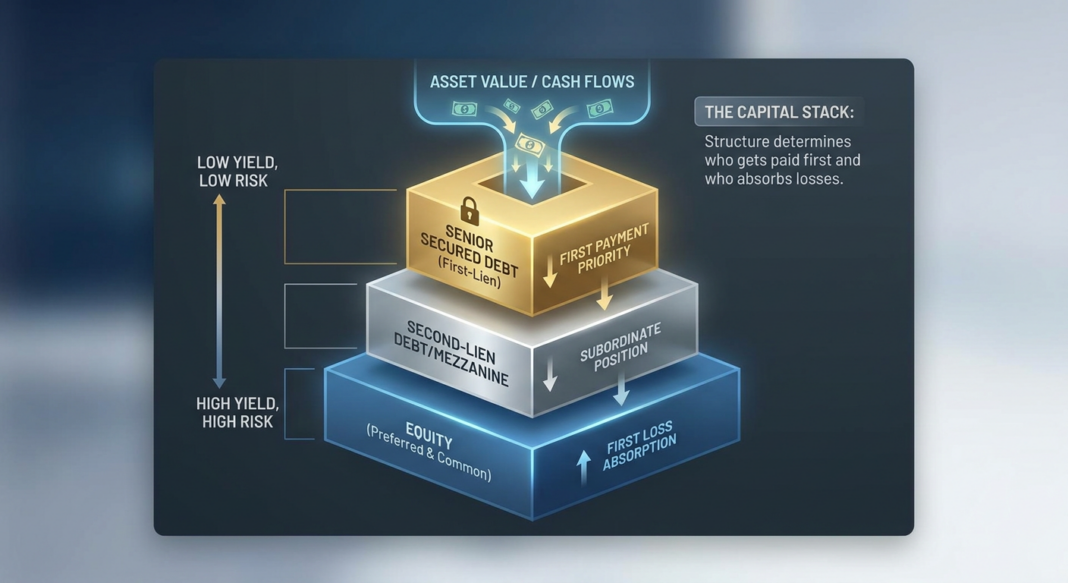
The capital stack is the ordered hierarchy of all capital claims on a business or asset. It determines two things simultaneously: who gets paid first when cash flows are healthy, and who absorbs losses first when they are not. Every private credit instrument, from a senior secured first-lien loan to mezzanine debt, occupies a specific rung on this ladder. Understanding that rung is the starting point for evaluating any credit opportunity, whether you are an institutional investor allocating to a direct lending fund or a business owner structuring your next financing round.
This concept is not abstract. It has direct, quantifiable consequences on yield, recovery rates, covenant strength, and the size of the equity cushion protecting your position. And in a mid-2026 market shaped by persistent bank tightening and a shift of corporate lending toward non-bank capital providers, it has never been more operationally relevant.
How the Capital Stack Works: Structure, Priority, and Risk
A company’s capital structure typically contains several layers of financing, stacked from the safest (top) to the riskiest (bottom). Each layer is defined by its seniority: its legal claim priority in the event of default or liquidation.
The most common layers, from senior to junior, are:
- Senior Secured First-Lien Debt: The highest-priority long-term creditor claim, backed by collateral. In a liquidation, senior secured lenders are first in line to recover their capital from the company’s assets. This position carries the lowest yield and the lowest risk.
- Senior Secured Second-Lien Debt: Also collateralized, but subordinate to the first lien. Recoveries are paid only after first-lien holders are made whole. Higher yield compensates for this subordination.
- Mezzanine / Subordinated Debt: Sits between senior debt and equity. As Longangle’s Private Credit Guide describes, mezzanine debt is “paid after senior debt and before equity in a default or liquidation scenario”, its name literally means “middle floor.” It often carries equity warrants and higher interest rates to compensate for the elevated risk.
- Preferred Equity: Has priority over common equity but is subordinate to all debt claims. It often carries a fixed dividend but limited upside.
- Common Equity: The residual claimant. Equity holders receive what remains after all creditors are paid, and they absorb the first dollar of loss. Hamilton Lane summarizes the inverse relationship concisely: “As you move further down the capital structure to more junior debt, yields increase while protections decrease.”
The critical insight is that subordination is not just about payment order; it is about loss absorption order. In any stress scenario, equity is wiped out before mezzanine takes a loss, and mezzanine is impaired before senior debt is touched. This layered loss-absorption structure is what makes senior secured positions so defensible.
A Concrete Example: The $20M Middle-Market LBO
Consider a private equity sponsor acquiring a manufacturing business for $20 million, financed as follows:
- Senior Secured First-Lien Loan (Direct Lender): $10M-50% of enterprise value
- Mezzanine Debt: $4M-20% of enterprise value
- Sponsor Equity: $6M-30% of enterprise value
Now model two scenarios:
Scenario A, Stress, Not Failure: Business conditions deteriorate and the company is sold at distress for $14M. The first-lien lender recovers their full $10M. The mezzanine lender recovers $4M. The equity sponsor loses their entire $6M investment. The first-lien lender suffered zero loss on a 30% decline in enterprise value.
Scenario B, Severe Stress: The company sells for $8M in liquidation. The first-lien lender recovers $8M out of $10M, a 20% loss. The mezzanine lender recovers nothing. Equity is zeroed. Even under a 60% decline in enterprise value, the first-lien lender retains significant recovery.
This is the equity cushion at work, the combined junior capital (equity plus mezzanine) that must be erased before a senior lender takes a dollar of loss. In this example, the equity cushion protecting the first-lien position is $10M, or 50% of enterprise value. That is the structural protection embedded in position, not just yield.
It is worth noting that leverage ratios provide a complementary lens. As Accredited Insight points out, “leverage tells you how many years of earnings it would take to repay the debt if all free cash flows were directed toward repayment”, a metric rooted in operating performance, not just asset values.
Current Market Relevance: Stack Position in a Tightening Environment
The capital stack is not just an academic framework; it is the operating logic behind a profound structural shift in corporate lending that has accelerated since 2022. Consider the current market context:
| Metric | Data Point | Source |
|---|---|---|
| Private Credit Global AUM | $2.1 trillion (2024); ~$644B North American direct lending alone | PIMCO / Preqin, Dec 2025 |
| Bank C&I Lending Standards (Q1 2026) | Tighter for firms of all sizes; major net shares cited uncertain economic outlook & reduced risk tolerance | Federal Reserve SLOOS, April 2026 |
| Direct Lending All-In First-Lien Yield (2026 Est.) | 8.0%–8.5% on newly originated first-lien loans | Morgan Stanley Investment Management, Dec 2025 |
| Cliffwater Direct Lending Index, 2025 Total Return | 9.3% total return; 10.4% interest income; 20-year average 9.5% | Angel Investors Network / Cliffwater, 2026 |
| Private Credit Annualized Return vs. Public Credit (40-qtr) | Direct lending: 9.0%; High yield: 5.2%; Investment grade: 2.4% | J.P. Morgan Private Bank, Feb 2026 |
| Spread Widening (Q4 2025 to Q1 2026) | New direct lending loans priced ~25bps higher; BSL/HY widened 15–30bps | Northleaf Capital Q1 2026 Market Update |
What does this data tell us about stack position today? Banks have tightened standards across all business sizes for multiple consecutive quarters, according to the Federal Reserve’s April 2026 SLOOS, citing a less favorable economic outlook, worsening industry-specific problems, and reduced risk tolerance as primary reasons. Longangle’s 2026 Private Credit Guide notes that traditional bank lending as a share of U.S. GDP has declined from 59% in Q4 2008 to 44% as of Q1 2025, and private capital has stepped in to fill the void.
At the same time, the quality of new loan structures is improving for disciplined senior lenders. According to Lord Abbett’s 2026 Midyear Outlook, spreads have widened roughly 50 to 100 basis points since late 2025, and new loans are increasingly featuring better credit structures: “less leverage, more covenants, fewer PIK requests, and tighter documentation”, a meaningful reset in lender terms.
Northleaf Capital’s Q4 2025 update highlights that the core mid-market (EBITDA of $20M–$80M) continues to deliver stronger risk-adjusted returns precisely because of its deal structure: maintenance covenants, prudent leverage, and meaningful equity cushions that provide strong downside management, the structural attributes that map directly to superior capital stack position.
Decision Framework: Two Audiences, One Concept
For Investors Evaluating Private Credit
Stack position should be the first filter, not the last, in any private credit evaluation. Investors consider:
- Lien Position: Is the loan first-lien or second-lien? First-lien senior secured positions, the core of direct lending, sit at the top of the repayment waterfall and carry first claim on collateral. As Lord Abbett notes, these loans are “first in line to get paid back in the case of a default.”
- Equity Cushion Size: How much junior capital sits below the loan before losses reach it? A meaningful equity cushion, typically at least 30–40% of enterprise value, is a primary structural protection for senior lenders.
- Yield vs. Position Trade-off: A higher headline yield on a mezzanine or second-lien position reflects real subordination risk. Investors evaluate whether that extra spread adequately compensates for the loss of priority.
- Covenant Package: Senior secured private credit loans can carry maintenance covenants that require borrowers to meet ongoing financial tests, providing early warning and intervention rights that are not available in the broadly syndicated loan market.
- Manager Discipline: Longangle notes the interquartile spread in private credit performance is roughly 8%, meaning manager skill in origination and structuring is itself a critical variable, not just the asset class.
For Operators and Business Owners Seeking Capital
Understanding how lenders think about stack position enables more effective capital conversations:
- More senior = lower cost, more covenants. Senior secured debt carries a lower interest rate but typically requires adherence to financial maintenance covenants (e.g., leverage ratios, interest coverage). Operators evaluate whether their business can consistently meet those tests under a range of scenarios.
- More junior = higher cost, more flexibility. Mezzanine or subordinated debt carries a higher coupon but fewer restrictive covenants and may include equity participation. This can be appropriate for companies with lumpy cash flows or near-term growth capital needs.
- Equity cushion signals creditworthiness. A larger equity contribution from a sponsor or owner signals commitment to lenders and supports better loan terms. The more equity sits below a lender’s position, the more protected they are, and the more favorably they are likely to price the deal.
- Bank pullback creates opportunity. In the current environment where banks are tightening standards across all business sizes, private credit lenders are actively filling the gap. Paul Weiss’s 2025 review notes that non-bank institutional investors now provide extended-maturity commitments matched to asset durations, offering terms that deposit-funded banks increasingly cannot or will not provide.
Key Takeaways
- Stack position determines loss-absorption order, not just payment order. Senior secured first-lien lenders are protected by every layer of junior capital below them before they take a loss; this structural protection is the defining feature of direct lending.
- Yield and risk move together through the stack. Higher yields in private credit always reflect lower position in the hierarchy. Investors evaluate whether the additional spread on junior instruments adequately compensates for the loss of priority and recovery prospects.
- The equity cushion is your first line of defense. A meaningful equity contribution (typically 30–40% or more of enterprise value) is the practical buffer that protects senior lenders in stress scenarios. Monitoring that cushion over the life of a loan is active risk management.
- Bank tightening has structurally expanded private credit’s role. The Federal Reserve’s SLOOS has recorded tighter C&I lending standards across consecutive quarters into 2026, reinforcing the structural demand for private lenders to fill capital gaps, especially in the middle market.
- Mid-market senior secured remains the most disciplined segment. With first-lien yields in the 8.0%–8.5% range for 2026, combined with improving covenant structures and conservative deal terms, the core middle market offers a risk-adjusted proposition that investors and operators alike benefit from understanding at the structural level.


