
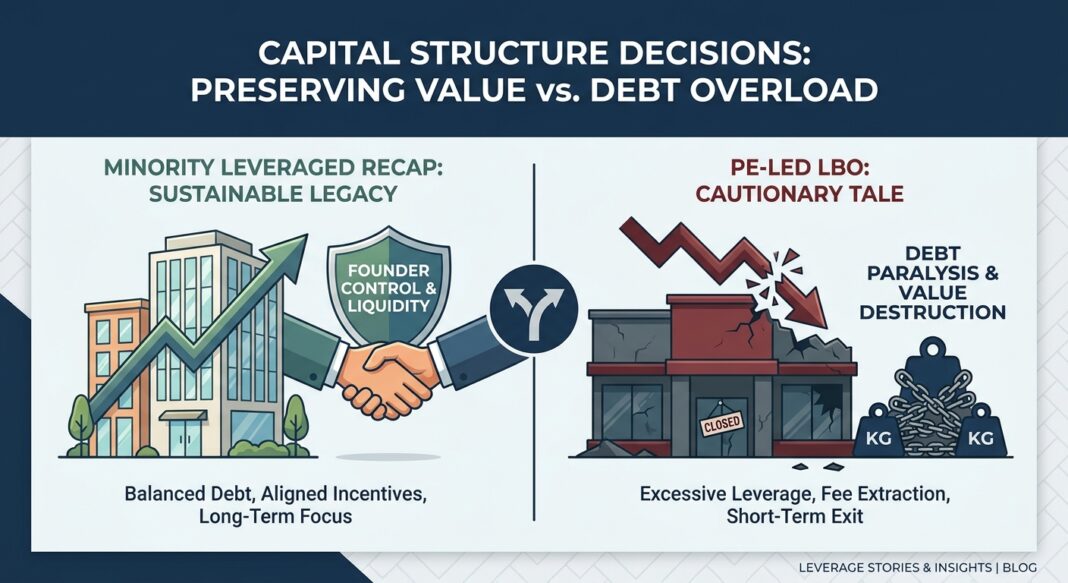
The Story: Two Businesses, One Crossroads
Picture two founders sitting across the table from their advisors, each holding a business worth tens of millions of dollars. Each has spent decades building something real: employees, customers, a reputation. Each needs capital: one to provide personal liquidity before passing the baton to the next generation, the other to fund a transformation in a rapidly changing market. Both reach for the same lever: debt. But the structures they choose (and who controls the terms) will separate a legacy from a cautionary tale.
The first founder is John Biles, Sr., co-founder of J&J Services, a mid-market business services company. The second is not a single person but a board and a PE consortium: KKR, Bain Capital, and Vornado Realty Trust, who in July 2005 took Toys “R” Us private in what was then one of the most celebrated leveraged buyouts of the era.
By the time both stories end, one family has achieved liquidity, retained control, and positioned the company for a second act. The other has presided over the liquidation of 33,000 jobs, the closure of an 80-year-old brand, and a complete equity wipeout for the fund’s limited partners.
The difference was not talent. It was not timing. It was capital structure: specifically, who the debt served, how much of it there was, and whether it left any oxygen for the business to breathe.
The Decision: Minority Recap vs. Leveraged Buyout
J&J Services: The Minority Recap Path
When John Biles, Sr. retired from J&J Services and handed day-to-day management to his son, John Biles, Jr., the family faced a classic founder dilemma. The bulk of their wealth was tied up in the company. They needed liquidity, but a full sale would mean surrendering the business that Biles, Jr. was actively growing and leading.
The family had received majority recapitalization and full-sale proposals from other financial parties. But then they encountered a third option they hadn’t fully considered: a minority recapitalization structured through Main Street Capital Corporation. Main Street’s investment consisted of a senior secured term loan combined with a minority equity stake, a blended debt-and-equity structure that provided 100% of the capital needed to fund the recapitalization without requiring the family to surrender operating control.
The structure accomplished three things simultaneously: it provided personal liquidity to John Biles, Sr.; it allowed John Biles, Jr. to retain financial and operational control of the company; and it gave the business a long-term capital partner with the resources to fund future acquisitions and growth initiatives. The Biles family had been previously unaware that a minority recapitalization option even existed in the marketplace to meet their transaction objectives.
The capital structure was sized to what the business could actually service. The debt was disciplined. The equity ownership remained with the family. And critically, the incentives between the family and their capital partner were aligned: both parties needed the company to grow.
Toys “R” Us: The PE LBO Path
The Toys “R” Us transaction was structured entirely differently. In 2005, KKR, Bain Capital, and Vornado completed a $6.6 billion leveraged buyout, placing the debt directly onto the retailer’s balance sheet. The structure created a $5 billion-plus anchor of long-term debt and, crucially, saddled the company with over $400 million in annual interest payments.
At entry, the sponsors paid approximately 12x EBITDA, a full multiple for a specialty retailer, on the implicit assumption that earnings would grow or at least hold. At close, net leverage was approximately 7x EBITDA. A growing-EBITDA world might absorb that. A declining one cannot.
The failure was not purely external. The capital structure pre-committed the company’s cash flow to debt service and left zero margin for the strategic pivot the business actually needed. When Amazon’s e-commerce dominance began compressing toy retail margins, every dollar that could have gone into logistics, web infrastructure, or store experience went to lenders instead.
The debt didn’t just burden the company. It paralyzed it.
The Outcome: Numbers That Tell the Full Story
J&J Services: Liquidity, Control, and a Growth Partnership
Following the minority recap with Main Street, J&J Services continued operating under John Biles, Jr.’s leadership. The transaction delivered exactly what was promised: personal liquidity for the retiring founder, an unbroken management structure for the operating founder, and an institutional capital partner positioned to support acquisitions.
The family retained majority equity, meaning they still owned the upside in any future exit. The capital partner was a minority holder with a long-term investment horizon, not a PE sponsor racing toward a three-to-five year exit window. The structure aligned incentives rather than creating the tension between GP cash extraction and LP equity returns that defines so many leveraged buyouts.
This outcome illustrates a broader principle: a minority recapitalization allows founders to sell a portion of their equity to a partner while retaining majority control, taking meaningful personal liquidity, and continuing to run the business with a growth-oriented partner, with the full eventual exit as a second, potentially larger liquidity event.
Toys “R” Us: A $5 Billion Anchor and a Complete Wipeout
The Toys “R” Us Chapter 11 petition, filed in September 2017, cited the $5.3 billion debt load explicitly as the reason the company couldn’t compete; it couldn’t fund the price investments and e-commerce build-out that Amazon and Walmart were making, because its cash was committed to interest. The last stores closed in June 2018.
The final tally for fund limited partners was a complete equity wipeout, $1.3 billion of sponsor equity went to zero, a 0.0x MOIC. Meanwhile, over the 12-year hold, the sponsors extracted an estimated $470 million in management fees and dividend recapitalizations, even as the equity marched toward zero. The people running the deal had a path to positive cash regardless of how the company ended, while the LPs’ return was strictly tied to the equity.
It is worth noting: the Toys “R” Us failure was not caused by external competition alone. Even at the time of bankruptcy, the company was responsible for roughly 1 in every 5 toys sold in the United States. It was the debt structure, not the brand, that failed.
The Lessons: What This Actually Teaches Us
1. Debt Serves Different Masters Depending on Who Structures It
In the J&J Services transaction, the debt served the founder’s goals: liquidity, continuity, and growth. The structure was sized to the business’s cash flow capacity, with a partner whose returns depended on the company’s long-term success. In the Toys “R” Us LBO, the debt served the sponsors’ deal mechanics; it was the financial engineering that made the headline acquisition price possible. Once placed on the company’s balance sheet, it became a permanent tax on operating cash flow.
This is the core distinction that founders often miss when evaluating capital options: the question is not just how much debt, but whose interests does the debt structure serve?
2. Coverage Is the Binding Constraint: Not the Leverage Multiple
A healthy LBO typically maintains a debt-to-EBITDA ratio between 3x and 6x, ensuring the target company can service its obligations without breaching lender covenants. Toys “R” Us entered at approximately 7x EBITDA, structurally stressed from day one. A minority recap, by contrast, is sized to what the business can realistically service, because the lender’s return depends on repayment, not on extracting management fees regardless of performance.
3. Founder Control Is a Quantifiable Asset: Not Just a Preference
Founders often accept the framing that liquidity requires control dilution. The minority recap disproves this. By retaining majority ownership, John Biles, Jr. preserved not just his decision-making authority but his economic ownership of all future value creation. Any subsequent growth (whether organic or through acquisitions funded by the new capital partner) accrues to the family’s retained equity stake. That second liquidity event, when it comes, is the larger payday.
4. Misaligned Incentives Are a Structural Problem, Not a Personnel Problem
The Toys “R” Us story is sometimes told as a tale of bad management or bad luck. The more accurate reading is that it is a story of structural misalignment. The sponsors extracted management fees and dividend recapitalizations from a deteriorating company because the structure permitted (and in fact incentivized) exactly that behavior. The LPs, whose capital bore the equity risk, had no equivalent mechanism to protect themselves. When evaluating any leveraged transaction, the question to ask is: who gets paid if this goes badly? If the answer is “the people managing the capital,” that is a warning signal embedded in the structure itself.
5. The Market Has Validated the Minority Recap Model
The current private credit market supports founders pursuing this path. Recapitalization activity more than doubled relative to earlier quarters in Q4 2025, with full-year U.S. direct lending volumes reaching $380 billion. Private debt accounted for 77% of global leveraged buyout financing in 2024, its highest annual share since at least 2015: demonstrating that non-bank capital is abundant, competitive, and increasingly accessible to founder-owned businesses at the middle-market level. All-in new-issue yields on direct lending declined to approximately 9.3% in 2025, down from 10.5% in 2024, meaning the cost of disciplined leverage is meaningfully lower than it was two years ago.
For founders with businesses generating consistent EBITDA, the tools to engineer a minority recap (senior secured debt, mezzanine financing, or a blended debt-and-equity structure) are available and well-tested.
A Framework for Founders Facing This Decision
If you are a founder evaluating capital options (whether for liquidity, succession, or growth) here is the question sequence that separates a minority recap from a full-sale or PE buyout path:
- What do you actually want? Partial liquidity now plus full upside later is a different goal than a clean exit. Be precise about your objective before engaging with advisors who have incentives to push you toward a full transaction.
- Can the business service the debt without compromising operations? Size the debt to free cash flow, not to the maximum leverage a lender will offer. Coverage discipline is the difference between a debt that works for you and one that works against you.
- What are your capital partner’s incentives post-close? A minority partner whose returns depend on the company’s long-term performance is structurally different from a majority sponsor managing toward a three-to-five year exit. Ask directly: what happens to your returns if we don’t exit in five years?
- Have you explored all three options? Full sale, majority recap, and minority recap have meaningfully different outcomes for founders. Most advisors representing companies for sale have financial incentives tied to transaction size, which means minority recaps are systematically underrepresented in the deal options founders see.
- What does the second liquidity event look like? Minority recap math works because the founder’s retained equity compounds on the growth funded by the first transaction. Model the second exit explicitly; that is where the thesis is validated or broken.
Key Insights
- Debt structure determines who it serves: A minority recap structures debt to serve the founder’s liquidity and control goals. A PE-led LBO structures debt to serve deal mechanics and management fee extraction, often at the operating company’s expense.
- Coverage is the binding constraint: The Toys “R” Us deal entered at ~7x EBITDA leverage; disciplined recap structures are sized to free cash flow, leaving room for operational setbacks and strategic pivots. A company that cannot invest in its own future because of interest obligations is not just stressed; it is structurally prevented from surviving disruption.
- Retained equity compounds: By keeping majority ownership in a minority recap, founders preserve participation in the second liquidity event, which is typically the larger one. Selling control to get liquidity is a permanent transaction; structuring debt for liquidity is not.
- Incentive alignment is quantifiable: When evaluating a capital partner, identify the specific mechanism by which they profit if the company underperforms. If a path to GP income exists independently of equity value creation, the incentives are misaligned by design.
- The market is accessible: Full-year U.S. direct lending volumes reached $380 billion in 2025, with recapitalization activity accelerating sharply in Q4. Founder-owned businesses with consistent EBITDA are well-positioned to access structured debt on competitive terms, without surrendering control to do it.


