
Mezzanine Financing for Growth-Stage Acquisitions: How to Structure the Capital Stack When Senior Debt Runs Out
When a growth-stage operator exhausts senior debt capacity but refuses to dilute equity at current valuations, mezzanine financing fills the critical gap. Here is how to price it, structure it, and negotiate it, with current 2026 market terms and a full gap capital playbook.
The Growth-Stage Financing Problem: The Gap Nobody Talks About
You have $8–12M in EBITDA. You have identified a bolt-on acquisition that would add $5–6M more. The deal is $50M enterprise value. Your senior bank lender will finance $30M, roughly 4x EBITDA on the combined business. That leaves a $12–15M funding gap between the senior debt ceiling and the equity check you are willing to write. You have three options: abandon the deal, dilute your equity aggressively with a growth round, or fill the gap with mezzanine financing.
This is the capital stack problem that defines the growth stage. It is the moment when a company has moved beyond the operating proof required for senior credit but has not yet achieved the scale or exit optionality that makes equity dilution cost-effective. The gap is structural, not incidental, and mezzanine debt exists precisely to bridge it.
Understanding mezzanine is not simply understanding another loan product. It is understanding a specific position in the cost-of-capital spectrum (one that sits between the relative safety of senior secured credit and the return expectations of equity) and knowing exactly when deploying it serves the operator’s strategy versus when it becomes a debt service trap that constrains the business it was meant to accelerate.
This article maps the full structure: what mezzanine is, how it prices in today’s market, when it outperforms the alternatives, and how to run the process from quantifying the need to signing the term sheet.
Structure Breakdown: Components, Mechanics, and a Worked Example
What Mezzanine Actually Is in the Capital Stack
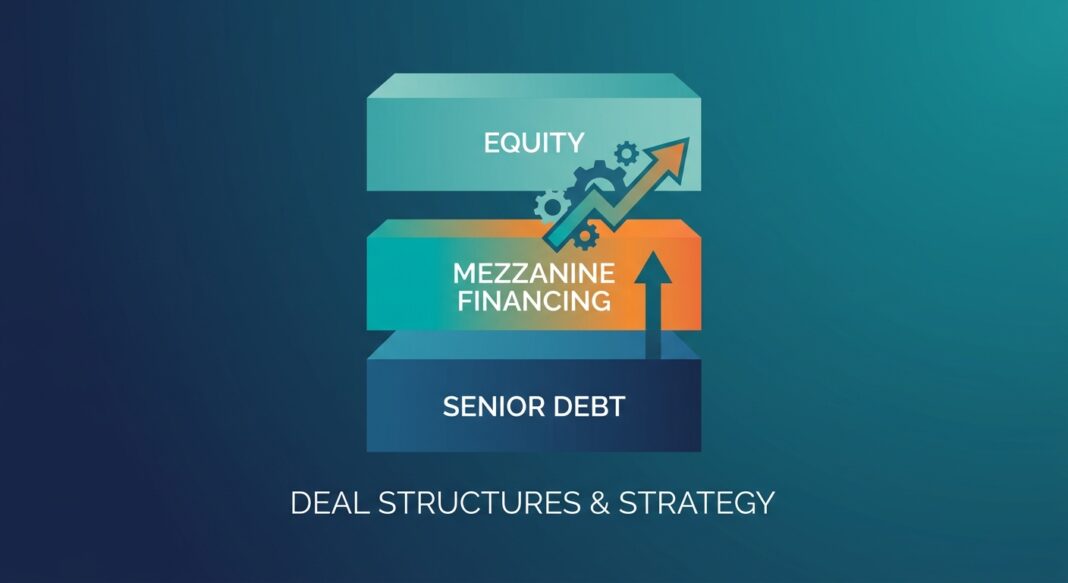
Mezzanine debt is a hybrid financing instrument that occupies the layer of the capital stack between senior secured debt and equity. It is subordinated to all senior obligations, meaning senior lenders are repaid first in any liquidation or default event. Because of this subordination, mezzanine providers command a material premium over senior pricing, and compensate themselves for the additional risk through a three-part return structure: cash interest, payment-in-kind (PIK) interest, and an equity kicker.
The three components work as follows:
1. Cash Interest
The periodic, cash-pay coupon on the instrument. This is the component the borrower services from operating cash flow every month or quarter. In 2026, cash coupons on mezzanine instruments for lower middle-market acquisitions typically run 8–12% per annum, depending on credit quality, leverage multiple, and sector risk profile.
2. Payment-in-Kind (PIK) Interest
Rather than paying cash, PIK interest is added to the outstanding principal balance, compounding over the loan term. PIK mechanics allow a borrower to preserve near-term liquidity during integration periods, capital expenditure cycles, or periods of constrained cash flow. However, the trade-off is explicit: the compounding principal increases total repayment obligations at maturity, and the all-in cost of capital rises materially versus the stated cash coupon alone. A 2% annual PIK component on a $15M facility running for five years adds approximately $1.6M to the principal repaid at maturity, before factoring in the equity kicker.
3. Equity Kicker (Warrants or Conversion Rights)
Mezzanine providers routinely pair the debt instrument with warrants, rights to purchase equity in the borrowing entity at a predetermined strike price, or with co-investment rights alongside the controlling sponsor. Warrant coverage typically targets 1–5% of the fully diluted equity capitalization of the business, priced at closing valuation. This is the component that elevates the lender’s effective internal rate of return (IRR) from 12–15% on a cash-pay basis to the 16–22% all-in return mezzanine funds target. It is also the component most frequently underestimated by borrowers during term sheet negotiations.
Worked Example: A $50M Acquisition for a $100M Enterprise Value Manufacturing Business
Consider a lower middle-market industrial manufacturer with $10M in EBITDA seeking to acquire a regional competitor for $50M (5.0x EBITDA). The combined business would generate $16M in EBITDA on a pro forma basis, creating a platform with $160M enterprise value at an unchanged multiple.
Illustrative Capital Stack: $50M Acquisition
| Layer | Amount | % of Structure | Pricing (Indicative) | Provider Type |
|---|---|---|---|---|
| Senior Unitranche / Term Loan | $32M | 64% | SOFR + 550–650 bps (~10.0–11.0% all-in) | Direct Lender / BDC |
| Mezzanine Debt | $10M | 20% | 10% cash + 3% PIK + 3% warrant coverage | Mezzanine Fund / BDC |
| Equity (Sponsor / Operator) | $8M | 16% | Target IRR: 25–35%+ | Operator / PE Sponsor |
| Total | $50M | 100% | – | – |
Note: Illustrative only. Actual terms depend on credit quality, sector, lender appetite, and prevailing market conditions at time of execution. SOFR as of June 2026.
Key Term Sheet Elements for the Mezzanine Tranche
- Facility Size: $10M subordinated term note
- Maturity: 5–6 years (bullet repayment at maturity)
- Cash Interest: 10.0% per annum, paid quarterly
- PIK Toggle: 3.0% per annum, accruing to principal; toggle to cash at borrower election with 50 bps step-up
- Warrant Coverage: Warrants to purchase 3.0% of fully diluted equity at closing valuation ($100M equity value = $3M face value of warrants)
- OID / Origination Fee: 2.0% upfront ($200K at close)
- Call Protection: 3% / 2% / 1% declining prepayment premium over first three years; par thereafter
- Covenants: Total leverage maintenance covenant (quarterly tested); minimum liquidity covenant; PIK election subject to leverage compliance
- Intercreditor: Subordination agreement with senior lender; 90–180 day standstill on enforcement following senior default
How Mezzanine Compares to Alternatives: Trade-Offs Across the Capital Stack
The capital stack for a growth-stage acquisition does not have a single right answer. Mezzanine is one tool in a spectrum that runs from the cheapest (senior bank debt) to the most expensive (equity). Understanding where it sits relative to alternatives (and when each option wins) is the practitioner’s core judgment call.
Senior Bank Debt
Cost: SOFR + 350–475 bps (7–9% all-in for quality credits)
Advantage: Cheapest cost of capital. Maintenance covenants may be more flexible than perceived. No equity dilution.
Limitation: Leverage ceiling. Traditional bank lenders typically underwrite to 3–4x EBITDA on senior secured basis. For acquisitions requiring 5–6x total leverage, senior debt alone cannot fill the stack.
When it wins: Smaller acquisitions where total leverage requirements fall within bank appetite, or when the business has strong hard asset coverage for an asset-based lending structure.
Unitranche (Direct Lending)
Cost: SOFR + 500–700 bps (9.5–11% all-in in the lower middle-market in 2026)
Advantage: One lender, one credit agreement, one covenant package, no intercreditor complexity. Can close 30–45 days faster than a bifurcated structure. Leverage up to 5–6x EBITDA for quality credits.
Limitation: For deals requiring more than 6x total leverage, unitranche alone may not fill the stack. Higher pricing than traditional senior debt. No PIK optionality in most base structures.
When it wins: Sponsor-led acquisitions in the $25–200M enterprise value range where execution certainty and speed are worth a 50–100 bps pricing premium over a bifurcated structure.
Mezzanine Debt
Cost: 10–14% cash interest + 2–4% PIK + warrants (16–22% all-in IRR to lender)
Advantage: Fills the gap above senior debt ceiling without requiring an equity raise. PIK mechanics preserve near-term cash flow. Retains operator ownership and board control.
Limitation: Most expensive debt instrument in the stack. Equity kicker is dilutive in exit scenarios. Intercreditor negotiation adds complexity and legal cost. Covenant package typically includes maintenance tests that require active management.
When it wins: Deal size exceeds senior debt capacity; equity markets are unfavorable (high dilution, low valuation multiples); target generates predictable free cash flow with 8%+ growth trajectory; borrower has a clear 5–7 year exit path that monetizes the warrant.
Preferred Equity / Growth Equity
Cost: 20–30%+ IRR target (minority equity), often with liquidation preferences and pro-rata rights
Advantage: No fixed cash interest obligation. Patient capital. Strategic value-add from institutional sponsor.
Limitation: Most expensive capital on the spectrum when calculated correctly over a 3–5 year hold. Dilutive. Preferred liquidation preferences can significantly erode founder/operator economics in moderate-exit scenarios. Board seats and governance rights shift control dynamics.
When it wins: Business cannot service fixed debt charges; growth is non-linear and capital-intensive; operator values strategic partnership over capital cost optimization.
The Key Insight: Mezzanine wins the cost-of-capital comparison against equity not because it is cheap, it is not, but because in a scenario with strong exit multiples, the dilution cost of a growth equity round at a compressed valuation consistently exceeds the all-in IRR that a mezzanine lender extracts through cash interest, PIK, and warrant participation. Run the math explicitly before signing either term sheet.
Current Market Terms: What the Data Shows in Mid-2026
The private credit market has undergone a meaningful recalibration since the 2021–2022 peak. The following data points reflect current structural norms for mezzanine and subordinated credit in the lower and core middle market as of mid-2026:
All-in mezzanine cash coupon range for lower middle-market acquisitions in 2026, with quality credits at the lower bound and higher-leverage or cyclical-sector deals approaching the ceiling. Lenders target 16–22% gross IRR inclusive of warrants and fees.
Share of total investment income derived from PIK terms reported by Goldman Sachs Private Middle Market Credit II as of Q4 2025, illustrating how PIK has become a mainstream, institutionally accepted structural feature rather than a distress indicator.
Prevailing pricing range for unitranche facilities in the lower middle market in 2026, implying 9.5–11% all-in cost. This compares to traditional senior + mezzanine structures at 9–10.5% blended, only marginally cheaper, but with materially greater execution complexity. For many deals, unitranche has effectively replaced the senior/mezz bifurcation below $200M enterprise value.
Typical warrant coverage range in 2026 mezzanine structures, expressed as a percentage of fully diluted equity. Standard market practice pairs warrants with a strike price set at the closing equity value of the business, with a 5–7 year exercise window aligning with expected exit timelines. Detachable warrants may be classified as equity or liabilities under applicable accounting standards, adding complexity to financial reporting.
Covenant cushion above closing leverage that is now standard in private credit maintenance covenant packages, per Secured Research / ABF Journal analysis of 2025 documentation. Interest coverage covenants are averaging 2.3x in 2025, near record lows, but maintenance testing (typically quarterly leverage ratio tests) remains the norm in core middle-market private credit, unlike the broadly syndicated market where over 90% of new loans remain covenant-lite.
Global private credit AUM as of 2025, reflecting the scale and deployment capacity of the direct lending ecosystem that provides both unitranche and mezzanine capital to middle-market borrowers. Record dry powder levels mean competitive lender dynamics persist even as structures have tightened from 2021 highs.
The Covenant Divide: What It Means for Mezzanine Borrowers
The distinction between maintenance and incurrence covenants carries operational implications that go beyond legal documentation. Maintenance covenants require periodic, typically quarterly, compliance with specified financial metrics, testing leverage and coverage ratios regardless of borrower actions. Incurrence covenants are triggered only when a borrower takes a specific action, such as incurring additional debt or paying a dividend.
In the broadly syndicated loan market, the vast majority of new institutional loans now carry incurrence-only covenants, effectively covenant-lite structures. But in private credit, particularly below $50M EBITDA, maintenance covenants remain standard. For mezzanine borrowers specifically, the covenant package typically includes at minimum: a total leverage maintenance test, a minimum liquidity floor, and PIK election conditions tied to covenant compliance. Operators who model covenant headroom conservatively (30%+ cushion to the test level at close, stepping down in line with deleveraging) preserve the flexibility to navigate integration variance without triggering lender intervention rights.
The Gap Capital Playbook: Quantify, Prepare, Run the Process
Understanding mezzanine structure is necessary but insufficient. The practitioner’s advantage is in running the process correctly, from identifying the gap to closing the instrument. Here is the four-step playbook:
Quantify the Gap Precisely
Before approaching any lender, build a waterfall model that answers four questions: (1) What is the total acquisition cost inclusive of transaction fees and initial integration capex? (2) What is the maximum senior debt capacity at a leverage multiple your cash flow can sustainably service, maintaining 2.0x+ interest coverage on forward projections? (3) What is the equity check the operator is willing to write, capped at the level that preserves acceptable dilution and IRR on the equity invested? (4) What is the residual gap between total need and available senior + equity capital?
This gap is the mezzanine need. It should be modeled at 1.0–1.5x coverage specifically, not conflated with a general “we need more capital” narrative. Lenders underwrite to specific debt service capacity, and a borrower who arrives with a precisely quantified gap and a credible coverage analysis closes faster and negotiates from a stronger position.
Prepare the Materials Package
Mezzanine lenders underwrite the full capital stack, not just their own tranche. The information package should include: three years of audited financials plus trailing twelve months; a management-prepared information memorandum with company overview, sector dynamics, and acquisition rationale; a pro forma financial model showing combined entity EBITDA, free cash flow, and debt service coverage across base, downside, and stress scenarios; a complete sources-and-uses table showing the full acquisition financing structure; and a management team profile with relevant track record.
A weak information package is the single fastest way to receive a declined term sheet or an aggressively priced one. Mezzanine providers operate at 60–90 days from term sheet to close, longer than unitranche, shorter than equity. Arriving with organized, auditable materials at day one compresses that timeline materially.
Run a Competitive Process
The mezzanine market in 2026 includes BDCs (Ares Capital, Blue Owl/Owl Rock, Main Street Capital, FS KKR), specialty mezzanine funds (Audax Mezzanine, Madison Capital, Maranon, NewSpring), and family office mezz pools operating in the $5–25M facility range. Running simultaneous term sheet processes across three to five providers is standard practice, and the competitive dynamic materially influences warrant coverage, PIK terms, and covenant cushions.
The most negotiable structural elements are: (1) warrant coverage percentage (push from 3–5% toward 1–2% on strong credits); (2) PIK mechanics, specifically the trigger conditions and the cash-pay step-down schedule; (3) call protection period and premium; and (4) the definition of EBITDA in covenant calculations, particularly the treatment of pro forma add-backs and integration costs. Each of these has a quantifiable impact on the total cost of capital that compounds over a 5-year hold.
Coordinate Intercreditor Dynamics Before Signing
In a bifurcated senior + mezzanine structure, the intercreditor agreement governs the relationship between your senior lender and your mezzanine provider. Key intercreditor terms that affect borrower flexibility post-close include: the standstill period (typically 90–180 days) during which the mezzanine lender cannot enforce remedies following a senior default; the payment blockage mechanism governing whether senior lender can block subordinated interest payments during a default period; and the permitted payment conditions that define when the borrower can service mezzanine cash interest. Resolve these dynamics before closing, not during an amendment process when leverage has shifted to the lenders.
Structuring Guidance: Negotiation Points for Operators and Investors
For Operators: How to Reduce the True Cost of Mezzanine Capital
- Price the warrant correctly at term sheet. Warrant coverage is quoted as a percentage of equity, but its economic value scales directly with exit multiple. A 3% warrant on a business you plan to sell at 7x EBITDA in five years is fundamentally different from a 3% warrant on a business you expect to exit at 10x. Model the full warrant economics, including the impact on equity proceeds at exit, before accepting any warrant percentage.
- Negotiate PIK triggers carefully. PIK election should be at borrower discretion, not lender-imposed. Resist structures where PIK is mandatory regardless of cash flow availability. The preferred structure is a PIK toggle at borrower election, with a cash-pay step-up of 25–50 bps to disincentivize over-reliance on PIK, but preserving the optionality for integration periods.
- Push for EBITDA add-back flexibility in covenant definitions. Integration costs, management team build-out expenses, and one-time restructuring charges should be explicitly addable in the covenant EBITDA definition, with a clear cap (typically 20–25% of reported EBITDA). This preserves covenant headroom during the exact period, post-acquisition integration, when operational performance is most variable.
- Understand call protection before you model the exit. A 3% / 2% / 1% prepayment premium on a $10M mezzanine tranche means a year-two refinancing costs $200–300K in premiums above par repayment of the accreted PIK balance. If your base case assumes refinancing the mezz as part of a recapitalization at year two or three, build this cost explicitly into your returns model.
For Investors and Lenders: What to Look for in Structure Quality
- Coverage at close, not just at underwriting. Mezzanine instruments subordinated to a 4–5x senior tranche need explicit debt service coverage analysis showing that combined cash interest obligations on the full stack can be serviced from operating cash flow at underwriting EBITDA, not only pro forma EBITDA with aggressive synergy assumptions.
- Warrant valuation mechanics should be observable. Warrants priced at closing equity value with a defined valuation methodology (EBITDA multiple to enterprise value, less net debt) create less post-closing dispute risk than warrants with undefined or formula-based strike prices. Coordinate valuation mechanics with prepayment terms upfront.
- Monitor the covenant cushion, not just the covenant level. A 30% cushion set at a 5.5x leverage covenant means the business can run to 7.15x before triggering the test. That is significant headroom in the early post-acquisition period. Monitor trajectory, not just point-in-time compliance.
Key Takeaways
- Mezzanine fills a specific structural gap: it is the layer between senior debt capacity (4–5x EBITDA) and the equity check the operator is willing to write, allowing acquisitions to close that would otherwise require full equity financing at significantly greater dilution.
- The true cost is not the stated coupon. A facility advertised at 10–12% cash interest carries an all-in IRR to the lender of 16–22% once PIK compounding, warrant participation, and origination fees are modeled correctly. Operators must run the full economics, not just the headline rate, before accepting any mezzanine term sheet.
- PIK mechanics are a cash flow tool, not a free option. PIK interest defers cash outflow at the cost of compounding principal. Over a five-year hold, a 3% PIK component increases total principal repayment by approximately 16% relative to cash-pay, a meaningful drag on exit proceeds if not modeled explicitly.
- Covenant design determines operational flexibility post-close. In private credit mezzanine, maintenance covenants with quarterly leverage testing are market standard, unlike the broadly syndicated market where covenant-lite structures dominate. Building 30%+ headroom into covenant levels at closing is non-negotiable for operators managing integration risk.
- Run a competitive term sheet process. The mezzanine market in 2026 has meaningful lender competition across BDCs, specialty mezzanine funds, and family office pools. Simultaneous processes across three to five providers consistently produce better warrant coverage, more favorable PIK terms, and wider covenant cushions than single-source negotiations, with minimal additional execution risk when managed correctly.


