
Why Borrowers Are Choosing One Loan Over Many
When a private equity sponsor wants to acquire a middle-market company, the traditional financing playbook involves stacking multiple debt instruments: a bank revolving credit facility, a first lien term loan, perhaps a second lien, and sometimes mezzanine debt. Each layer requires its own credit agreement, its own covenant package, its own legal counsel, and its own negotiation timeline. The process can take months and introduce significant deal uncertainty.
The unitranche loan cuts through that complexity. It is a single credit facility that combines senior and subordinated debt into one instrument, one agreement, and one blended interest rate. For borrowers, it looks and feels like dealing with a single lender. Behind the scenes, the economics are carefully divided between providers carrying different levels of risk. This structural innovation, born out of the post-2008 gap left by retreating banks, has become the flagship product of the private credit market.
Understanding how unitranche financing works is no longer optional knowledge for operators seeking capital or investors evaluating private credit funds. As bank lending standards have tightened across multiple consecutive quarters, demand for unitranche structures has accelerated, and the deals are getting bigger.
The Concept: One Loan, Two Risk Profiles
At its core, a unitranche loan solves a structural problem: borrowers need more leverage than conservative senior lenders will provide, but they do not want the complexity, time, and cost of negotiating two separate debt facilities with separate intercreditor agreements.
The solution is elegant. A unitranche facility combines senior and subordinated debt into a single credit agreement, offering a blended interest rate and a unified set of loan documents. This simplifies the capital stack, reduces documentation costs, and streamlines negotiations for the borrower.
There are two primary forms of unitranche structures:
- Stretch Unitranche: A single senior secured loan that extends leverage beyond what a traditional bank would provide, functioning like a broadly syndicated Term Loan B but with a higher leverage ceiling. All lenders share economics on a ratable basis.
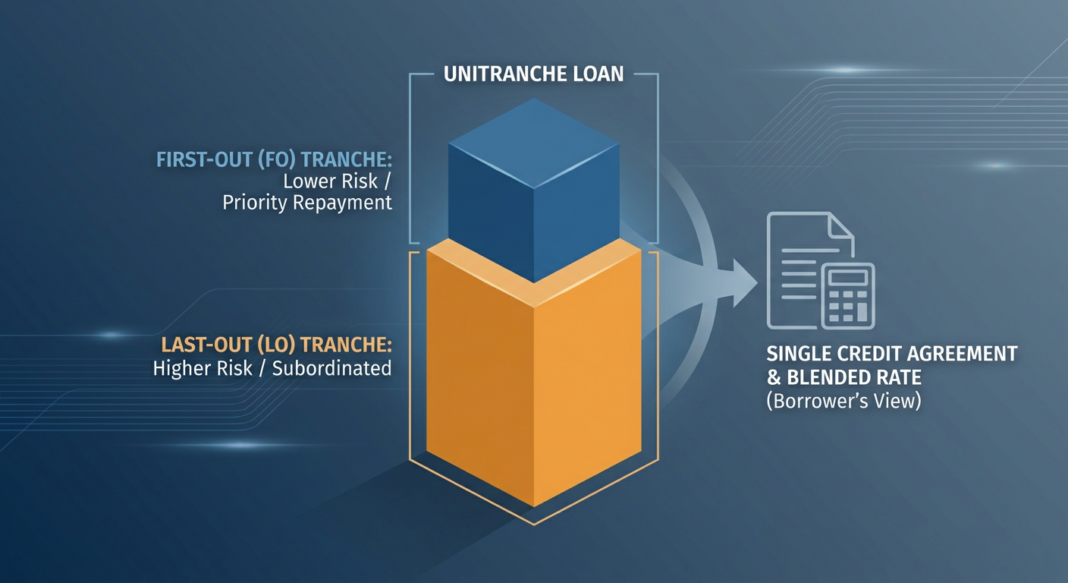
- Bifurcated Unitranche (First-Out / Last-Out): The loan is split internally into two tranches. The first-out (FO) tranche, often a revolving credit facility held by a bank, carries lower risk and a lower interest rate because it has priority on repayment. The last-out (LO) tranche, typically the larger term loan held by a private credit fund, sits behind it in the payment queue but earns a higher rate to compensate for that subordinated risk.
The borrower sees none of this internal division. They have one lender of record, one set of reporting requirements, and one interest payment. The risk-sharing arrangement between FO and LO lenders is governed by a private Agreement Among Lenders (AAL): a document that establishes payment waterfalls, voting rights, lien priorities, and enforcement rules between the lenders. The borrower is typically not even a party to the AAL.
How It Works: A Concrete Example
Consider a private equity firm acquiring a software business with $50 million of EBITDA at a 14x multiple, a $700 million enterprise value. The sponsor plans to fund $300 million with equity and needs $400 million of debt.
Here is why a traditional bank loan falls short and a unitranche fills the gap:
- Bank-only option: A traditional bank will typically lend up to roughly 4x EBITDA on a senior secured basis, approximately $200 million. That leaves a $200 million financing gap. Filling it requires a separate second lien or mezzanine tranche, its own credit agreement, its own legal process, and an intercreditor agreement between the two lenders. Timeline: potentially three to four months.
- Unitranche option: A private credit fund working alongside a bank structures a single $400 million unitranche at, say, SOFR + 5.25%. Internally, $100 million is the bank’s first-out revolving tranche at SOFR + 3.75%; the remaining $300 million is the private credit fund’s last-out term loan at a higher spread that, when blended with the FO economics, produces the overall facility rate. From the borrower’s perspective: one loan, one set of documents. Timeline: potentially four to six weeks.
The pricing sits between traditional senior debt and standalone mezzanine rates, reflecting the blended risk profile. The borrower pays a modest premium for the convenience, speed, and certainty. The sponsors gain deal closure confidence. The bank receives a lower-risk FO position. The private credit fund earns a higher yield on its larger LO position.
The AAL governs everything the borrower does not see: specifically, the payment waterfall in a downside scenario. If cash flows deteriorate and the borrower cannot service the full debt, first-out lenders receive payments first. Last-out lenders absorb losses first, which is exactly why they demand higher compensation.
Current Market Relevance
The structural forces driving unitranche adoption have not just held; they have intensified in 2025 and into 2026.
Bank credit access continues to tighten. According to the Federal Reserve’s April 2026 SLOOS, survey respondents reported, on balance, tighter lending standards for C&I loans to firms of all sizes in Q1 2026. The same survey found that banks tightened all terms on loans to non-depository financial institutions, including higher premiums on riskier loans and stricter collateralization requirements. This persistent tightening cycle, documented across every SLOOS release since mid-2024, structurally redirects borrowers toward private credit channels.
Private credit has scaled to meet that demand. According to PIMCO citing Preqin (March 2026), total AUM in North American direct lending portfolios reached approximately $644 billion by year-end 2025, up roughly sevenfold from $93 billion in 2015. Preqin projects private credit AUM to reach $4.5 trillion globally by 2030.
Unitranche deal volume has surged dramatically in large-cap markets. Per Global Legal Insights (January 2026), unitranche loan activity for large-cap borrowers reached $210 billion in 2024, more than double the $94 billion recorded in 2023. Jumbo unitranche facilities exceeding $1 billion have become increasingly common, a segment that barely existed five years ago.
Spreads have stabilized. According to Credit Crunch (January 2026), median direct lending spreads held steady at S+475 in Q4 2025, unchanged from Q3, as market competition balanced against tighter credit conditions.
Covenant evolution is reshaping lender protections. McKinsey’s 2025 Global Private Markets Report notes that covenant-lite structures rose to 21% of direct lending deals in 2025, up from just 4% in 2023, reflecting increased competition and borrower negotiating leverage at the upper end of the market.
| Metric | Data Point | Source |
|---|---|---|
| N. American Direct Lending AUM (YE 2025) | ~$644 billion | Preqin via PIMCO, Mar 2026 |
| Large-Cap Unitranche Volume (2024) | $210 billion (+123% YoY) | Global Legal Insights, Jan 2026 |
| Median Direct Lending Spread (Q4 2025) | S+475 bps | Credit Crunch, Jan 2026 |
| Covenant-Lite Share of Direct Lending (2025) | 21% (vs. 4% in 2023) | McKinsey / PitchBook, Apr 2026 |
| Bank C&I Lending Standards (Q1 2026) | Tighter, all firm sizes | Federal Reserve SLOOS, Apr 2026 |
Decision Framework
For Investors Evaluating Private Credit Funds
Understanding what type of unitranche position a fund holds materially affects its risk/return profile. Investors consider the following distinctions:
- First-Out vs. Last-Out exposure: A fund holding primarily first-out positions carries lower yield but higher recovery priority in a default. Last-out positions offer higher spreads but absorb initial losses, important context when benchmarking fund returns against one another.
- AAL enforceability: The Agreement Among Lenders is a private contract that has limited bankruptcy case precedent compared to traditional intercreditor agreements. Sophisticated investors assess whether a manager’s legal documentation has been stress-tested through actual credit events.
- Covenant quality: Given that covenant-lite structures reached 21% of direct lending deals in 2025, investors evaluate whether the fund retains meaningful maintenance covenants that provide early warning of borrower stress, or whether documentation trends leave lenders with fewer intervention levers.
- Concentration in unitranche vs. other structures: Some BDCs hold upward of 60% of their portfolios in unitranche loans. Understanding the blended FO/LO composition of those holdings is essential to accurate risk assessment.
For Business Operators Evaluating Capital Options
Unitranche financing is not automatically the right choice for every company. Operators evaluate:
- Speed and certainty requirements: If a deal timeline is compressed (an auction process, a competitive acquisition) unitranche offers execution certainty that a multi-lender syndicated structure cannot match. The absence of a syndication process can reduce execution time significantly.
- Cost vs. complexity trade-off: The all-in rate on a unitranche is typically higher than senior-only bank debt. Operators weigh the premium against the cost of legal fees, time, and intercreditor complexity required for multi-tranche alternatives.
- Flexibility needs: Unitranche facilities commonly incorporate accordion features for bolt-on acquisitions, delayed draw mechanisms, and PIK toggle options, structural tools that can preserve cash flow for growth-stage companies.
- Company size fit: Unitranche is primarily suited to middle-market companies and increasingly large-cap borrowers. Very small businesses requiring loans under $20 million will generally find unitranche pricing and structures economically misaligned with their needs.
Key Takeaways
- One loan, two risk layers: A unitranche appears to borrowers as a single facility, but internally divides economics between first-out lenders (senior, lower rate, priority repayment) and last-out lenders (subordinated, higher rate, first-loss position) via a private Agreement Among Lenders.
- Speed is a structural advantage: Eliminating multi-party intercreditor negotiations allows unitranche deals to close in weeks rather than months, a decisive factor in competitive acquisition processes.
- Bank tightening drives demand: Four consecutive Federal Reserve SLOOS surveys through Q1 2026 have documented tighter C&I lending standards, reinforcing the structural demand for private credit unitranche solutions.
- The market is scaling rapidly: Large-cap unitranche volume more than doubled from 2023 to 2024, reaching $210 billion, evidence that this structure has grown far beyond its middle-market origins.
- Investors must look beyond the label: Not all unitranche exposure is equal. First-out and last-out positions carry meaningfully different risk profiles, and the rise of covenant-lite documentation in 2025 makes careful due diligence on lender protections more important than ever.


