
The Story: Twenty Years of Equity, One Phone Call Away From Selling
Marcus had spent twenty-two years building a regional environmental consulting firm in the Southeast. Started from a single contract with a municipal water authority, the business now employed 140 people, served Fortune 500 clients, and posted roughly $6.2M in annual EBITDA. He owned 100% of the equity. He had never taken on a dollar of outside capital. And by 2024, he was 58 years old and his net worth was almost entirely trapped inside one company.
The call came from a PE firm that had been tracking his firm for two years. Their opening offer: a full acquisition at 7.5x EBITDA, valuing the business at approximately $46.5M. It was real money. Generational money. But the terms required Marcus to exit day-to-day operations within 18 months, accept a three-year earnout tied to revenue retention, and watch a new management team absorb the culture he had painstakingly built.
He hung up the phone and called his M&A advisor instead. The question he asked was not “Should I sell?” It was something more precise and more powerful: “How much of my equity value can I unlock right now, without giving anyone a seat at my table?”
The answer would come in the form of a leveraged recapitalization, a transaction that would change his personal financial picture completely, while leaving his name on the door and his hand on the wheel.
The Decision: Debt vs. Dilution, A Structured Choice
Marcus had three realistic paths in front of him.
Path 1: Full Sale. Accept the PE offer at 7.5x EBITDA ($46.5M pre-tax proceeds). Clean exit, maximum liquidity, but complete loss of operational control, exposure to earnout risk, and the end of a business identity he had no desire to surrender.
Path 2: Minority Equity Recap (PE-Backed). Sell a 30–40% stake to a growth equity partner. This would generate $14M–$18M in immediate liquidity but bring in an outside shareholder with board rights, governance expectations, and a defined exit timeline typically ranging from four to seven years. Marcus would eventually face another transaction on someone else’s schedule.
Path 3: Pure Leveraged Recap via Private Credit. A leveraged recapitalization (in which the company takes on new debt and distributes the proceeds to shareholders) would allow Marcus to extract cash without selling to a third party, while the company assumed a higher debt-to-equity ratio and accepted the ongoing interest burden. No new equity owner. No board seat conceded. No exit clock.
His advisor structured the transaction as follows:
- Debt raised: $18.5M unitranche facility (approximately 3.0x EBITDA)
- Lender: Private credit fund providing a single blended senior/subordinated tranche
- All-in interest rate: SOFR + 475bps (approximately 9.5% in mid-2024 conditions)
- Annual debt service: ~$1.76M (interest only, year one)
- Dividend to Marcus: $17.2M after fees and transaction costs
- Equity retained: 100%
- Covenants: Minimum EBITDA coverage ratio of 2.0x; no change of control without lender consent
According to the Pepperdine Private Capital Markets Report (2024), lower middle market leveraged recapitalizations typically close at 3x to 5x EBITDA in total debt, with pricing tied to prevailing senior secured rates plus a risk-based margin. Marcus’s deal landed conservatively at 3.0x, leaving meaningful capacity on the table for a future acquisition or a second distribution event if performance warranted.
The business generated $6.2M in EBITDA. At 3.0x leverage, the annual interest burden consumed less than 28 cents of every dollar of operating profit. The math worked. The risk was manageable. And most importantly, the decision was his to make, on his timeline.
The Outcome: $17M in the Bank, 100% Ownership Intact
Eighteen months after closing, the picture looked like this:
Marcus had $17.2M in diversified, investable assets outside the business, de-risked across a financial portfolio for the first time in his career. His firm had continued to grow, adding two municipal contracts and posting EBITDA of $6.9M in the first full year post-recap, comfortably above the debt coverage covenant. The loan was on schedule. No governance interference. No quarterly board calls with outside investors questioning his hiring decisions.
Now consider the counterfactual. Had Marcus taken the PE acquisition offer at 7.5x EBITDA and exited cleanly, he would have received approximately $46.5M gross: subject to capital gains tax and the loss of any future upside in a business that, under his continued leadership, was still growing at 10%+ annually. If the firm grows to $9M EBITDA over the next five years (a conservative trajectory), it would be worth north of $60M at the same multiple. Marcus still owns all of that upside.
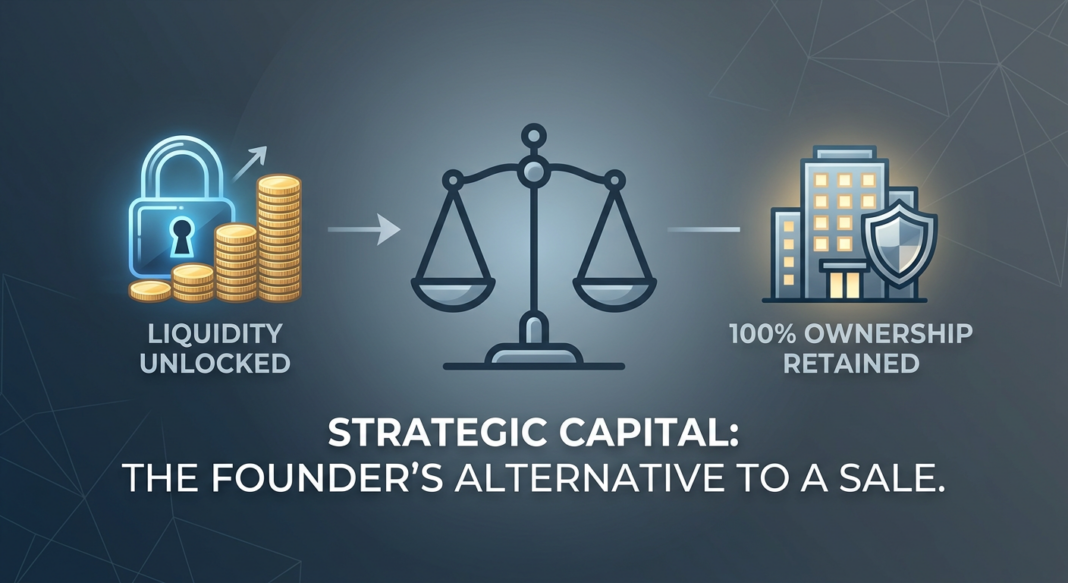
The leveraged recap gave him both outcomes simultaneously: immediate personal liquidity and full participation in the company’s future value creation. The founder remains the controlling shareholder after the leveraged recapitalization and continues to lead the company until a full exit event, on terms and timing entirely of his choosing.
This is not an isolated story. The market data confirms it is a pattern accelerating across the industry. Leveraged loan issuance tied to sponsored dividend recaps grew 11% year-over-year to $74.3 billion in 2025, after rising 326% year-over-year in 2024, according to PitchBook’s U.S. April 2026 Interactive Leveraged Loan Volume Report, reflecting continued lender appetite and urgency to return capital across all ownership structures. Even at the sub-institutional level, private equity sponsors are increasingly using dividend recapitalizations to return capital to investors amid challenging exit environments, and founder-owned companies are following suit with the same mechanics.
The Lessons: What This Story Teaches About Capital, Control, and Timing
1. Liquidity and ownership are not mutually exclusive.
The most persistent myth in private business finance is that you must choose between personal liquidity and continued ownership. A leveraged recapitalization provides partial liquidity without forcing a complete exit or company sale, and allows investors to diversify their wealth while maintaining upside exposure. For a founder whose entire net worth sits in one company, this is not a financial strategy; it is a risk management imperative.
2. Equity sold early is permanently expensive.
Founders often underestimate the true cost of giving up equity, particularly at lower valuations. One analysis showed that raising $1.5 million at a $3 million valuation cost a founder $4 million more in ownership value at exit compared to using non-dilutive debt. At Marcus’s scale, selling 30% to a minority PE partner at a $46M valuation would have permanently transferred $13.9M in upside, plus board influence, in exchange for liquidity he could have accessed through debt alone.
3. Private credit has fundamentally expanded access.
This strategy is no longer reserved for large-cap companies or PE-sponsored borrowers. The growth of private credit funds has expanded access to financing for leveraged recaps, offering flexible, customized debt solutions beyond traditional bank syndicates and providing unitranche facilities blending senior and subordinated loans into single structures. For a $6M EBITDA business, deals that were structurally unavailable a decade ago are now efficiently executable.
4. The exit clock belongs to the founder: if they structure it that way.
A PE minority partner arrives with a fund lifecycle. Their exit is mathematically certain, typically within five to seven years. A leveraged recap introduces no such external clock. The founder decides when (and whether) to sell next. That optionality has enormous, often unquantified value.
5. Know the conditions where this does not work.
The leveraged recap is not a universal solution. The decision hinges on free cash flow stability, lender appetite, and the owner’s tolerance for operating under covenant-heavy debt. Businesses with cyclical revenues, customer concentration, or margin compression should model downside scenarios rigorously before layering debt onto their balance sheet. The same tool that creates freedom for a healthy business can accelerate distress for a fragile one. If a firm cannot make its debt payments, meet its loan covenants, or rollover its debt, it enters financial distress which often leads to bankruptcy.
Key Insights
- The leveraged recap is a founder’s most underused liquidity tool. It extracts real wealth from a business without triggering a sale, diluting the cap table, or inviting external governance, making it uniquely powerful for owner-operators who want to de-risk personally while staying operationally in control.
- Private credit has democratized the transaction. Unitranche structures from private credit lenders now routinely serve lower middle market businesses at 3x–5x EBITDA, making this strategy accessible to companies well below the institutional radar that PE firms traditionally target.
- Lender appetite remains robust even in 2026. Despite geopolitical headwinds slowing Q1 2026 volumes, leveraged loan issuance tied to dividend recaps hit $74.3B in full-year 2025, a market signal that capital is available and the mechanics are proven across business cycles.
- The cost of equity is almost always underestimated at the point of the decision. Founders who model dilution only in percentage terms rarely account for the compounding effect on exit proceeds. Every point of equity sold at today’s valuation is a claim on significantly larger future value: debt, by contrast, has a fixed, finite cost.
- The right capital structure is the one that matches the founder’s actual goals. Not every founder wants to maximize proceeds at the earliest possible exit. For operators who want to continue building, a leveraged recap creates the personal financial security to make long-term decisions free from the pressure of a fully concentrated, illiquid balance sheet.
Note: The story of “Marcus” is a hypothetical case study constructed to illustrate real transaction mechanics, market-rate pricing, and documented structural dynamics. All financial figures (EBITDA levels, debt multiples, interest rates, and proceeds) are calibrated to publicly reported lower middle market benchmarks cited in this article. This is editorial content intended to educate through example, not financial advice.


