
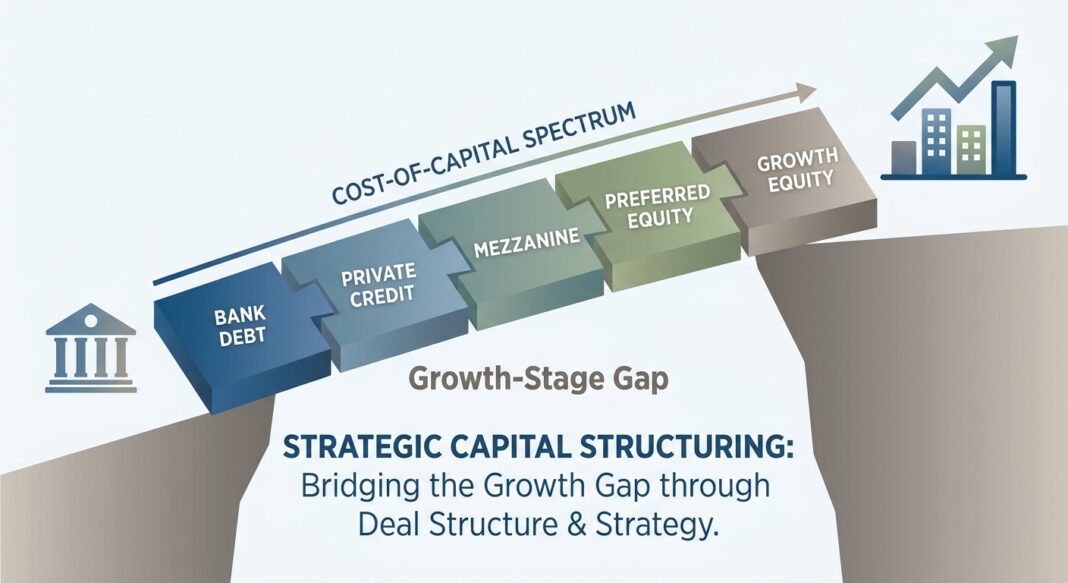
The Financing Challenge: Growth-Stage Companies and the Capital Gap
A profitable, fast-growing software or professional-services business (call it $8M EBITDA, $40M in revenue, and a clear acquisition pipeline) occupies one of the most awkward positions in capital markets. It is too large for an SBA loan and too small for a broadly syndicated deal. Its sponsors or founders have already taken dilution in prior equity rounds and want to avoid giving up more ownership just to fund one bolt-on acquisition. Yet the company’s cash flow alone will not close a $25–40M deal without leverage.
This is the growth-stage capital gap: the zone between what a bank will comfortably underwrite on a cash-flow basis (typically 2.5–3.0x EBITDA) and what the full capital structure actually requires to close the transaction and fund the integration. The gap is real, it is structural, and filling it incorrectly (with the wrong instrument, at the wrong cost, under the wrong covenant package) can cap future optionality or, in a stress scenario, accelerate a lender’s call at exactly the wrong moment.
The size of the market that serves this gap has grown enormously. Global private credit assets under management reached approximately $2.1 trillion in 2025, up from $1.5 trillion a year earlier. The private credit market is projected to expand from $1.75 trillion in 2025 to $3.48 trillion by 2031 at a 12.13% CAGR, reflecting the shift from an alternative asset class to a mainstream financing channel. For growth-stage companies navigating this landscape, understanding precisely where on the cost-of-capital spectrum each dollar of need should be funded is now a genuine competitive advantage.
Mapping the Spectrum: Banks → Private Credit → Mezzanine → Preferred → Equity
Every capital structure decision is fundamentally a question of access versus cost. The spectrum below runs from lowest cost (and highest security) to highest cost (and highest flexibility). Each layer carries different pricing, structural features, covenant demands, and dilution implications.
1. Senior Bank Revolving Credit Facility (RCF) + Term Loan A
Banks remain the cheapest source of debt for companies with tangible assets, predictable cash flow, and modest leverage. A regulated bank lender will typically underwrite 2.5–3.5x EBITDA on a senior secured basis, price at SOFR plus 200–375 bps, and impose a full maintenance covenant package: quarterly leverage tests, minimum fixed-charge coverage, and restrictions on distributions. For working capital needs, M&A earnouts, or modest bolt-ons, a bank RCF plus a term loan is the correct first instrument. The limitation is capacity: most regional and middle-market banks will not stretch beyond 3.5x leverage, and they will not close a competitively bid acquisition in 45 days.
2. Unitranche Direct Lending
For acquisitions in the $25–200M enterprise value range, unitranche has become the dominant structure. Unitranche debt is a single-tranche acquisition loan that combines what would otherwise be senior debt and mezzanine or subordinated debt into one instrument with one lender and one credit agreement, with total leverage typically at 4–6x EBITDA and a blended interest rate of 8–11% (SOFR + 500–700 bps in 2026). The structure’s core advantage is execution speed: in the $25–200M EV range, unitranche wins on speed, a 45–90 day close versus 90–150 days for broadly syndicated loans, and structural simplicity.
After peaking at 716 basis points in March 2023, global new-issue direct loan median spreads fell to 666 bps at year-end 2023, 596 bps at year-end 2024, and 544 bps at year-end 2025, according to Kroll StepStone Private Credit Benchmarks, a meaningful compression for borrowers willing to run a competitive process. Together with declining base rates (three-month SOFR averaged 4.35% in 2025, down from 5.27% in 2024), these shifts pushed all-in new-issue yields in 2025 down to approximately 9.3%, a decline from 10.5% in 2024.
3. Mezzanine Financing
Positioned between senior debt and pure equity in the capital stack, mezzanine financing operates in a nuanced middle ground, offering lenders substantial yields (typically 12–20%) while providing borrowers with flexible, non-dilutive growth capital. Mezzanine is most relevant when senior or unitranche capacity is exhausted but the borrower wants to avoid equity dilution to close the full capital need. Structurally, mezzanine typically includes a cash interest component (8–12%), an optional PIK toggle to preserve cash flow, equity warrants or conversion rights providing equity upside (typically 3–8% of loan amount), subordination ranking behind senior debt, and a longer tenor of 5–7 years versus 3–5 years for senior debt.
It is worth noting that the market landscape for standalone mezzanine has shifted. Increased competition has compressed mezzanine spreads (a decade ago, cash-plus-PIK rates ran 14–16%; today they run 12–14%) but unitranche convergence has absorbed a meaningful share of what was formerly the mezzanine market.
4. Preferred Equity
Preferred equity sits below all debt in the capital stack but above common. It carries no covenant package and no fixed repayment obligation, making it attractive for companies with strong growth profiles but temporary cash-flow constraints. The compression of mezzanine opportunities has forced many traditional mezzanine providers to pivot toward preferred equity structures sitting behind unitranche debt. Cost: typically 14–18% with PIK optionality and sometimes a liquidation preference or conversion feature.
5. Growth Equity and Venture Capital
Equity is the most expensive and most dilutive form of capital. According to Carta’s State of Private Markets data, median dilution in 2025 sits at approximately 19.5% for seed rounds and 18% for Series A rounds, and those figures are higher than the peak of 2021. When equity issuance becomes difficult (due to valuation sensitivity, signaling concerns, or lack of stakeholder alignment) debt often becomes the most viable path forward; unlike equity, debt does not require broad agreement on valuation or ownership dilution. Equity is the right instrument for companies with no meaningful EBITDA or cash flow base, or those pursuing transformational capital that warrants giving up governance rights.
Structure Breakdown: A $50M Acquisition for an $80M EV Software Company
Consider a software-enabled services company with $8M EBITDA, $40M in revenue, and a target acquisition that would bring combined EBITDA to $13M post-close. Enterprise value at closing: $80M. Total capital need: $55M (acquisition price $48M + transaction costs $4M + integration reserve $3M).
Illustrative Capital Structure
- Existing equity rollover: $15M (founding team + PE minority investor)
- Bank RCF ($5M drawn at close): SOFR + 250 bps, secured, working capital facility
- Unitranche term loan ($35M): SOFR + 575 bps (roughly 9.75–10.25% all-in at current rates), 5-year term, bullet maturity, 1% per annum cash amortization, one maintenance covenant (maximum total leverage ratio), 2% OID, 101 soft call protection in year one
- Equity gap filled by seller note ($5M): 7% PIK, 5-year maturity, subordinated to unitranche, no cash pay, a common bridge between seller price expectations and what the debt stack will support
Total leverage at close: $40M debt / $13M pro forma EBITDA = 3.1x net. All-in cost of debt: approximately 9.6% blended. Equity dilution from this round: zero (no new equity issued).
This structure is deliberately sized below the unitranche market’s upper leverage capacity. Average total leverage in sponsored middle-market unitranche deals hovered around 5.0x EBITDA in mid-2024 as lenders focused on free cash flow and covenant headroom. Staying at 3.1x creates meaningful cushion against a revenue miss and gives the borrower headroom to draw incremental capacity for future add-ons, a deliberate structuring choice, not a limitation.
Key Term-Sheet Elements to Negotiate
| Term | Lender Starting Position | Borrower Target |
|---|---|---|
| Pricing (credit spread) | SOFR + 625–650 bps | SOFR + 550–575 bps with step-down at 3.0x leverage |
| OID | 3% | 2% or 97 OID with no additional fees |
| Call protection | 102/101/par | 101/par or none after month 18 |
| Maintenance covenant | Maximum leverage ratio tested quarterly at 4.5x | Set at 5.25x with 35% EBITDA cure right for two consecutive quarters |
| Incremental facility | $5M grower basket, incurrence-tested | Greater of $10M or 1.0x EBITDA, available for add-on acquisitions |
| PIK toggle option | Not offered | 6-month PIK toggle on 50% of interest, available once with 25 bps PIK premium |
Covenant Design: Maintenance vs. Incurrence in 2026
The covenant package is often the most consequential (and least understood) element of a growth-stage financing. Getting it wrong creates an unexpected trip wire; getting it right preserves operating flexibility and avoids expensive consent requests during integration periods.
Maintenance covenants require borrowers to pass financial tests every quarter regardless of any action taken, while incurrence covenants only apply when the borrower takes a specific action like incurring new debt or paying a dividend. Most syndicated leveraged loans today are covenant-lite (incurrence only), though private credit deals typically retain maintenance covenants for earlier lender intervention.
The divergence between markets is sharp and growing. In the broadly syndicated loan market, approximately 90% of new loans in 2024 remained covenant-lite, continuing borrower-friendly documentation trends; however, private credit lenders have maintained firmer positions on covenant inclusion, particularly for mid-market transactions. Notably, lender behavior in 2026 appears to be tightening: the portion of U.S. respondents in Proskauer’s annual survey who say they will not do deals without financial maintenance covenants grew dramatically to 46%, climbing 11 percentage points from 2025, pointing to an increased desire on the part of lenders to seek credit deterioration protection.
However, competition has created a middle ground. Many private credit funds are now swapping higher protections for higher portfolio values and are providing “covenant loose” terms: structures that technically include at least one maintenance financial covenant, such as a quarterly tested leverage ratio, but where the cushions set are so generous that it would be unlikely to ever be triggered.
For borrowers, the negotiating objective is not to eliminate covenants; it is to set headroom at a realistic level and build in an equity cure mechanism. A standard cure right allows a sponsor or founder to inject equity equal to the shortfall amount (typically capped at two cures in any rolling four-quarter period), preventing a technical default from becoming an acceleration event.
The Gap Capital Playbook: Quantify, Prepare, Run the Process, Negotiate
Step 1: Quantify the Gap
Before approaching any lender, a CFO or financial sponsor must define three numbers with precision:
- Maximum senior debt capacity: Apply the lender’s most likely underwriting multiple (3.0–4.0x for banks; 4.5–5.5x for direct lenders) to LTM and NTM EBITDA. Use the lower of the two. Account for integration risk, most lenders will haircut proforma synergies by 25–50%.
- Total capital need: Acquisition price + fees + integration reserve + minimum liquidity. Do not undersize the integration reserve; post-close surprises are the most common cause of covenant stress in years one through two.
- The gap: Total capital need minus senior debt capacity minus available equity. This is the number that determines whether mezzanine, preferred equity, seller financing, or an additional equity round is required, and in what amount.
Step 2: Prepare the Materials
Direct lenders underwrite fundamentally differently from equity investors. Venture capitalists bet on team, market size, and total addressable market; growth capital lenders bet on cash flow and unit economics. A well-prepared credit package includes:
- Three-year audited financials plus trailing twelve months unaudited, with EBITDA bridge from reported to adjusted
- Three-scenario financial model: base, downside (15% revenue miss), and stress (25% revenue miss). Show debt service coverage and leverage ratio in each scenario against proposed covenant levels.
- Use-of-proceeds waterfall: exact allocation of every dollar, including escrow requirements and working capital reserve
- Customer concentration analysis: top 10 customers as percentage of revenue, contract duration, renewal history
- Management team profiles emphasizing operational depth, not just sales track record
Step 3: Run a Competitive Process
Running a dual-track or multi-lender process, even for a single unitranche facility, is the most reliable way to tighten pricing by 25–75 bps and improve structural terms. The process should include:
- Week 1–2: Distribute teaser and NDA to 4–6 lenders across bank, direct lending, and BDC channels
- Week 3–4: Distribute CIM and financial model; hold management presentations
- Week 5–6: Collect indicative term sheets; run side-by-side comparison across pricing, leverage, covenants, call protection, and incremental capacity
- Week 7: Select preferred lender; begin formal diligence and documentation. Maintain a backup lender through the LOI stage.
If unitranche financing can close 30–45 days faster than a syndicated alternative, sponsors often justify 50–100 basis points of extra spread by avoiding financing gaps, broken syndications, or delayed closings that jeopardize purchase agreements. Speed is a real economic variable, factor it into your cost-of-capital analysis.
Step 4: Negotiate the Structure
The five most impactful negotiating levers in a growth-stage acquisition financing, ranked by economic value:
- Credit spread step-down: A 25–50 bps reduction triggered at a leverage milestone (e.g., <3.5x net leverage) directly reduces annual interest cost without requiring a refinancing event.
- Covenant headroom and cure mechanics: Seek 35–40% cushion above LTM EBITDA for the leverage covenant test level, plus a two-quarter equity cure right. This is the single most valuable protection in a business with integration risk.
- Incremental facility sizing: Negotiate the incremental or accordion capacity up front. An accordion of greater of $10M or 1.0x EBITDA, tested on an incurrence basis, allows future add-ons without a full refinancing.
- Call protection duration: Minimize to 12–18 months. If the company hits its integration targets, refinancing at lower cost in years two to three should remain an option. Mandatory amortization is relatively rare on unitranche debt; prepayment penalties are either zero or minimal, giving the borrower more flexibility for refinancing.
- PIK toggle option: Even a one-time, six-month PIK toggle on 30–50% of interest provides critical optionality if the integration period overlaps with a revenue trough. The cost, typically a 25 bps PIK premium, is cheap insurance. PIK is increasingly appearing in senior secured loan documentation, though many managers argue for a distinction between “good” and “bad” PIK based on whether the toggle is elected by a healthy borrower for cash management or by a distressed borrower to defer inevitable problems.
When Each Structure Wins: A Decision Framework
| Scenario | Optimal Structure | Why |
|---|---|---|
| Bolt-on acquisition, <3.0x leverage post-close, existing bank relationship | Bank term loan + RCF | Cheapest cost of capital; bank already knows credit; no OID or call protection |
| Competitive auction, 45-day close required, 4.0–5.0x leverage | Unitranche (direct lender) | Speed and certainty; single lender; no intercreditor negotiation |
| Senior capacity exhausted at 4.5x; 1.5x more leverage needed; founder wants to avoid equity dilution | Unitranche + mezzanine or preferred equity | Fills gap without equity; mezzanine warrants less dilutive than equity round at this stage |
| Pre-revenue or early ARR ($2–5M) SaaS company, Series A bridge needed | Venture debt + equity round | Venture debt is typically structured as a senior secured loan with interest-only payments and a small tranche of warrants; unlike traditional bank lending, it does not require hard assets as collateral or strict covenant packages. |
| Large platform acquisition (>$200M EV), investment-grade trajectory | Broadly syndicated loan (BSL) | Above $200M EV, broadly syndicated loans become competitive on price and the unitranche premium is not justified. |
Key Takeaways
- Define the gap before choosing the instrument. Identify the delta between maximum senior debt capacity and total capital need. That number, not an arbitrary preference for one structure, should dictate whether you use mezzanine, preferred equity, or seller paper.
- Spread compression is real and negotiable. Direct loan median spreads fell from 716 bps in early 2023 to 544 bps at year-end 2025. Borrowers who run competitive, multi-lender processes are capturing these savings; those who approach a single lender are not.
- Covenants are the most important non-price term. In a private credit unitranche, the maintenance covenant level and equity cure mechanics define how much operational flexibility you have during integration. Negotiate headroom explicitly, do not accept a lender’s default level.
- Speed is a calculable economic variable. A 30–45 day faster close may justify 50–100 bps of incremental spread if a delayed financing would risk losing the acquisition or triggering a price renegotiation. Always model the cost of a broken deal against the cost of the speed premium.
- Structure the incremental facility now, not later. Accordion capacity, the right to draw additional debt for future acquisitions on an incurrence-tested basis, should be negotiated at origination when lender competition is highest. Reopening a credit agreement post-close is expensive and time-consuming.


