
Why Position in the Stack Is the Most Important Decision in Private Credit
When a company borrows money, not all lenders are created equal. Some stand at the front of the repayment line. Others wait, and sometimes walk away empty-handed. This hierarchy of claims on a company’s assets and cash flows is called the capital stack, and understanding it is the single most important concept in private credit investing.
Whether you are an institutional allocator evaluating a direct lending fund, or a business owner structuring a leveraged buyout, the question is always the same: Where in the line am I standing? The answer determines your yield, your protection, and your risk of loss. As the private credit market surpasses $2.1 trillion in assets under management and evolves into one of the dominant forces in corporate finance, this foundational concept has never mattered more.
What the Capital Stack Actually Is
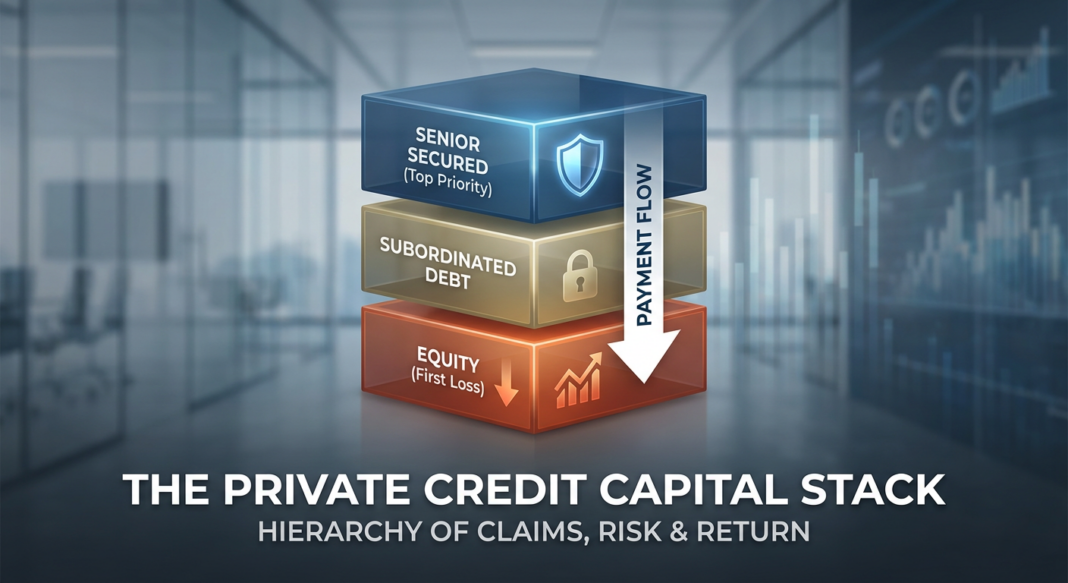
The capital stack is the ordered hierarchy of all financial claims on a business, from the most protected at the top to the most exposed at the bottom. Each layer reflects a different combination of seniority, collateral, and return expectation. From top to bottom, the layers typically look like this:
- Working Capital / Senior Secured Debt: First in line. Backed by collateral: cash, receivables, equipment, real property. Repaid before anyone else in a default or liquidation.
- Asset-Based Lending: Loans secured against specific collateral such as equipment or inventory. If the borrower defaults, the lender claims those assets directly.
- Subordinated / Mezzanine Debt: Repaid only after all senior lenders have been made whole. Higher yields compensate for the lower-priority position.
- Preferred Equity: Ownership with priority over common shareholders for dividends and liquidation proceeds. Carries more risk than any form of debt.
- Common Equity: Last in line for everything: distributions, liquidation proceeds, and recovery. Absorbs the first dollar of loss, but captures all residual upside if the company succeeds.
As BIP Wealth summarizes it: think of the capital stack as a line at a bank. Senior secured lenders are at the front and get paid no matter what. Common equity holders stand at the back and only receive proceeds after every other claim has been satisfied. The further back you stand, the more you might earn for your patience, but the greater the chance you walk away with nothing.
How It Works: A Concrete Example
Imagine a private equity firm acquires a mid-market software company for $100 million. The deal is financed with the following capital structure:
- Senior Secured Term Loan: $55 million, first-lien on substantially all assets, priced at SOFR + ~500 bps
- Mezzanine Debt: $15 million: unsecured or lightly secured, subordinated, higher coupon often with equity warrants
- Common Equity (PE Sponsor): $30 million: last in line, unlimited upside, first to absorb loss
Now assume the business deteriorates and the company is liquidated for $60 million: a 40% write-down from the purchase price.
The senior secured lender recovers their full $55 million. They are made whole. The remaining $5 million flows to the mezzanine lender, who recovers only $5 million of their $15 million, a 67% loss. The equity sponsor loses their entire $30 million investment.
This is subordination in action: the structure legally determines who absorbs losses first. The equity cushion of $30 million effectively protected the senior lender, the company had to lose more than 30% of its value before the senior lender took any impairment at all. This is why direct lending focused on senior secured positions, combined with meaningful equity cushions beneath them, represents a foundational risk management structure for private credit investors.
According to PitchBook’s Private Credit Primer, the core product in direct lending is a senior secured term loan with a first lien on substantially all assets, priced at approximately SOFR + 500–650 bps for middle market transactions, with maintenance covenants providing ongoing lender protections.
Current Market Relevance
The capital stack framework is not merely academic; it is playing out in real time across the private credit market in 2025 and 2026.
Bank withdrawal creates structural opportunity at the top of the stack. According to Long Angle’s Private Credit Guide, bank lending as a share of U.S. GDP has declined from 59% in Q4 2008 to 44% as of Q1 2025. This retreat has left a persistent gap that private credit funds have systematically filled, particularly in senior secured positions where banks once dominated. The Federal Reserve’s April 2026 SLOOS confirmed the trend is ongoing: banks reported tighter standards for C&I loans across all firm sizes in Q1 2026, with major net shares citing reduced risk tolerance and a less favorable economic outlook as key drivers.
Senior secured direct lending has scaled dramatically. According to Preqin data cited by PIMCO, North American direct lending AUM grew roughly sevenfold over the past decade, from $93 billion in 2015 to approximately $644 billion by year-end 2025. The overwhelming majority of this capital targets senior secured positions at the top of the capital stack.
Spread compression is narrowing the risk premium between stack positions. Octus data shows middle market direct lending spreads averaged approximately SOFR + 500 bps in Q4 2025, down meaningfully from the SOFR + 600–650 bps range observed in 2022–2023. This compression matters because it reduces the incremental compensation investors receive for moving down the capital stack, making seniority more valuable relative to the additional yield offered by subordinated positions.
Returns at the senior level remain historically compelling. Morgan Stanley Investment Management estimates that asset yields on directly originated first-lien loans are likely to trough in the 8.0%–8.5% range in 2026, even after factoring in spread compression, a level that remains in the upper half of the 12-year historical range. The Cliffwater Direct Lending Index reported 9.3% total returns in 2025, with a trailing 12-month default rate of 1.45%.
Institutional conviction in senior secured structures remains strong. McKinsey’s January 2026 LP Survey found that 40% of institutional limited partners plan to increase their private credit allocations over the next 12 months, citing senior position in the capital structure and predictable income profile as primary attractions, versus only 26% planning to decrease allocations.
| Capital Stack Layer | Approximate Yield (Mid-2026) | Source |
|---|---|---|
| Senior Secured (First Lien Direct Lending) | ~8.0%–10.0% all-in | Morgan Stanley IM, Dec 2025 |
| BSL (Broadly Syndicated Loans) | ~SOFR + 300 bps (Q4 2025) | Octus, Jan 2026 |
| Middle Market Direct Lending (1L) | ~SOFR + 500 bps (Q4 2025) | Octus, Jan 2026 |
| Mezzanine / Subordinated Debt | Higher spread + warrants/equity kicker | Long Angle, 2025 |
Decision Framework
For Investors Evaluating Private Credit Funds
Before committing capital to any private credit strategy, investors consider the following capital stack questions:
- Where exactly is the fund investing? A fund labeled “private credit” could be investing anywhere from first-lien senior secured loans to subordinated mezzanine, two very different risk profiles. Clarifying lien position and seniority is the starting point of any evaluation.
- What is the equity cushion beneath the loan? The larger the equity layer beneath a senior loan, the more the enterprise value can decline before the lender takes impairment. Investors commonly assess loan-to-value ratios, Blue Owl Capital notes that current commercial real estate lending is occurring at 60–65% LTV, implying meaningful equity cushions compared to the 70%+ levels seen in prior cycles.
- Are covenants present? Maintenance covenants (such as leverage ratio and interest coverage tests) require borrowers to maintain financial health on an ongoing basis, giving lenders an early warning system. McKinsey reports that covenant-lite transactions rose to 21% of direct lending deals in 2025, up from just 4% in 2023, a trend worth monitoring carefully at the senior level.
- Is the yield premium worth the stack position? At today’s spread compression, investors evaluate whether moving from senior secured into subordinated positions is being adequately compensated, particularly given the disproportionate loss absorption that subordinated debt faces in liquidation scenarios.
For Business Operators Choosing a Capital Structure
- Senior debt is cheaper but comes with conditions. Senior secured loans priced at SOFR + 500 bps carry covenant obligations, collateral requirements, and lender oversight. Operators evaluate whether their cash flows can comfortably service the debt and meet maintenance tests before drawing the line.
- Subordinated debt preserves equity but costs more. Mezzanine financing avoids equity dilution, but the higher coupon (and often equity warrants attached) can be costly. Operators use it when they want to maintain ownership control and believe the business will grow beyond the cost of mezzanine capital.
- More equity in the stack means more lender comfort. A larger equity contribution from the sponsor reduces lender risk and can result in better loan terms, lower pricing, or fewer restrictive covenants. Operators and sponsors weigh this tradeoff on every deal.
Key Takeaways
- Position in the capital stack is the primary determinant of risk and return in private credit. Senior secured lenders are first to be repaid from collateral; equity holders are last, and first to absorb losses.
- The equity cushion beneath a senior loan functions as a loss-absorbing buffer. In a liquidation scenario, the enterprise value must decline past the entire equity layer before the senior lender takes any impairment.
- Yield moves inversely with seniority, but that premium is compressing. Middle market direct lending spreads have tightened from ~SOFR + 625 bps in 2022–2023 to approximately SOFR + 500 bps in Q4 2025, according to Octus data.
- Bank withdrawal from C&I lending is structural, not cyclical. The Federal Reserve’s April 2026 SLOOS confirmed that banks continued tightening C&I lending standards in Q1 2026, reinforcing the long-term opportunity for private credit funds at the senior secured level of the capital stack.
- Investors and operators should ask the same question before any transaction: Where in the repayment line am I standing, and is the compensation appropriate for that position? Everything else in private credit analysis flows from the answer.


