
The Financing Challenge: When the Acquisition Price Exceeds What Banks Will Lend
A growth-stage company generating $8M in EBITDA identifies a strategic acquisition target priced at $60M, a 7.5x multiple. The company’s senior lender offers 3.5x leverage: $28M. Equity available from sponsors is $15M. That leaves a $17M gap sitting between the debt ceiling and the equity floor. This is the gap capital problem, and it is one of the most consequential structuring decisions any management team or sponsor will face.
The gap capital question is not simply about finding more money. It is about which layer of the capital stack fills that gap, at what cost, under what covenants, and with what exit flexibility. Get it right, and the deal closes on terms that preserve future optionality. Get it wrong, and the company enters the transaction burdened by covenant restrictions, cash-pay obligations that erode operating headroom, or equity dilution that punishes future exits.
This piece focuses on the growth-stage acquisition financing challenge: specifically how operators and sponsors should navigate the full capital stack, from senior secured debt to mezzanine and preferred equity, to fund a strategic acquisition without sacrificing the balance sheet flexibility needed to execute post-close.
The Cost of Capital Spectrum: From Banks to Equity
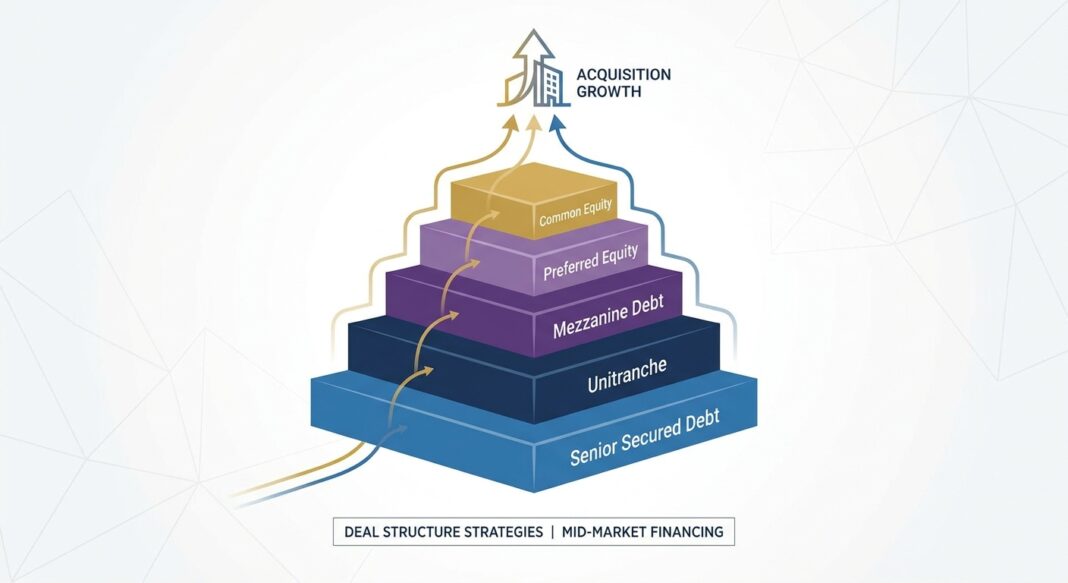
Every acquisition capital structure sits on a spectrum running from lowest-cost, highest-security capital at the top of the stack to highest-cost, lowest-security capital at the bottom. Understanding where each instrument lives on this spectrum (and what it demands in return) is the foundation of disciplined deal structuring.
| Layer | Instrument | 2026 Pricing | Typical Leverage | Key Feature |
|---|---|---|---|---|
| Senior Secured | Bank / Direct Lending TL | SOFR + 450–650 bps | 3.5x–4.5x EBITDA | First lien, lowest cost |
| Unitranche | Single-facility direct loan | SOFR + 500–700 bps | 4.0x–6.0x EBITDA | Speed, single lender |
| Mezzanine / Sub Debt | Subordinated term loan | 11%–14% (cash + PIK) | Up to 6.5x–7.0x EBITDA | PIK toggle, equity kicker |
| Preferred Equity | Preferred shares / structured equity | 12%–16% effective return | Non-leverage constraining | No debt covenants; dilutive |
| Common Equity | PE / Family Office / Founder | 20%+ IRR target | Residual | Highest cost, highest upside |
The pricing data above reflects current mid-2026 market conditions. Senior direct lending spreads dropped to approximately SOFR+480–500 bps for middle-market credits in Q4 2025, per Octus data, as competition between private credit and the broadly syndicated loan market intensified. Mezzanine remains priced at 11%–14% all-in (cash plus PIK components), consistent with frameworks cited by practitioners across the acquisition financing market.
Structure Breakdown: Building the Capital Stack for a $60M Acquisition
Return to the scenario: $60M purchase price, $8M EBITDA, $15M equity available. Here is how a disciplined sponsor would layer the capital stack from top to bottom.
Layer 1, Unitranche Term Loan: $36M (4.5x EBITDA)
Rather than bifurcating into a traditional senior and second lien structure, the sponsor opts for a unitranche, a single-facility direct loan that collapses senior and subordinated debt into one instrument with one credit agreement. The market for acquisitions in the $25M–$200M enterprise value range has moved decisively toward this structure.
The unitranche eliminates the intercreditor agreement that would otherwise govern the relationship between a first-lien and second-lien lender, one of the most complex and contentious documents in any leveraged financing. With a single lender or small club, there is one negotiation, one closing process, and one counterparty to manage post-close for amendments, add-on acquisitions, and covenant modifications.
Illustrative unitranche term sheet elements (2026):
- Facility Size: $36M (4.5x EBITDA)
- Pricing: SOFR + 575 bps (floating, with 50–100 bps SOFR floor)
- Tenor: 6 years, bullet maturity
- Amortization: 1% per annum (minimal, protecting cash flow)
- OID: 2.0% of funded principal
- Prepayment: 2% in year 1, 1% in year 2, 0% thereafter
- Revolver: $5M super-senior revolving credit facility for working capital
- Covenants: Maintenance-tested maximum total leverage ratio (5.25x stepping to 4.75x) and minimum fixed charge coverage (1.10x)
- Accordion: $20–25M of incremental capacity for add-on acquisitions
Layer 2, Mezzanine / Subordinated Debt: $9M (bridging to 6.6x EBITDA)
The remaining $9M gap (between the $36M unitranche and the $15M equity) is filled by mezzanine financing, the hybrid instrument that sits subordinate to senior debt but senior to common equity. Mezzanine lenders compensate for their junior position through a combination of current cash interest, PIK interest (which accretes to the principal balance and preserves near-term cash flow for the borrower), and an equity kicker in the form of warrants or a co-investment right.
Illustrative mezzanine term sheet elements (2026):
- Facility Size: $9M
- Pricing: 8% cash interest + 4% PIK = 12% all-in coupon
- Tenor: 7 years, bullet maturity (12 months inside unitranche)
- Warrants: 3%–5% fully diluted equity warrant coverage at a fixed strike price
- Prepayment: Non-call 2 years, then at par
- Subordination: Governed by an intercreditor agreement with the unitranche lender
- Covenants: Incurrence-based (triggered at specific actions, not ongoing testing)
The PIK feature is strategically important here. Rather than requiring full cash interest service on the mezzanine tranche, which would compress the company’s free cash flow during the integration period, the PIK toggle allows management to defer a portion of interest, accreting it to the principal balance until the business is past the post-close growth inflection point.
Layer 3, Common Equity: $15M (25% of capital structure)
The sponsor’s equity contribution sits at the bottom of the stack: the first dollar of loss, the last dollar of recovery, and the highest-returning position in a successful exit. At 25% of the total capital structure, this equity cushion is meaningful, and maintaining it above ~20% is typically a prerequisite for mezzanine lenders providing subordinated capital at the pricing levels described above.
How This Structure Compares: Unitranche + Mezz vs. The Alternatives
Alternative A: Pure Unitranche at Higher Leverage
Rather than layering mezzanine beneath the unitranche, some sponsors will instead push the direct lender to provide a higher unitranche, stretching to 5.5x or 6.0x EBITDA within a single facility. This is structurally simpler: no intercreditor, no second lender, one covenant package. The tradeoff is cost. A stretch unitranche at 6.0x typically prices 50–75 bps wider than a 4.5x unitranche, and the higher leverage creates more covenant headroom pressure. Additionally, many direct lenders are reluctant to underwrite beyond 5.5x–6.0x EBITDA without exceptional business quality, limiting the universe of potential lenders.
Alternative B: Traditional Senior / Second Lien Split
The pre-unitranche structure (first-lien term loan from one lender group, second-lien term loan from another) still exists for larger transactions, particularly above $200M enterprise value. Below that threshold, it introduces a complex intercreditor agreement, two separate covenant packages, two sets of lender counsel, and the risk of negotiating between competing creditor groups during any post-close amendment. The pricing difference between this structure and a unitranche has narrowed materially. A traditional 50/50 senior/sub split prices only marginally cheaper than a unitranche, with substantially more execution complexity.
Alternative C: Preferred Equity Instead of Mezzanine
Preferred equity sits outside the debt capital structure; it does not count toward leverage ratios, carries no debt covenants, and does not trigger cross-default provisions. For a company already at the upper limit of debt leverage, this is its primary appeal. The cost, however, is higher: preferred equity investors typically target 12%–16% effective returns, often through a combination of a preferred dividend and a participation feature in the common equity upside. For a company confident in strong near-term cash flows, mezzanine debt with a PIK toggle will almost always produce a lower total cost of capital than preferred equity.
The Decision Matrix
- Choose unitranche + mezz when: speed matters, leverage gap is 1.5x–2.0x EBITDA, and cash flow can service both layers within 18–24 months.
- Choose stretch unitranche when: execution certainty is the primary driver and the incremental cost is justified by eliminating the subordinated lender relationship.
- Choose preferred equity when: the company is already at senior debt capacity and additional leverage covenants would impair operating flexibility.
- Choose traditional senior/second lien when: deal size exceeds $200M EV and broadly syndicated pricing becomes competitive with direct lending.
Current Market Terms: What the Data Shows in Mid-2026
The mid-market debt financing environment in mid-2026 reflects the convergence of two powerful forces: sustained direct lending capital deployment competing against a recovering broadly syndicated loan market. For borrowers, the result is the most favorable terms seen since 2021, but with important nuances at different points in the credit quality and leverage spectrum.
Five Key Data Points
- Unitranche spreads have compressed to SOFR+500–700 bps for the mid-market in 2026, down from a 2023 peak. For upper middle-market sponsored transactions, unitranche facilities were pricing at SOFR+425–475 bps by Winter 2025 according to Capstone Partners’ Leveraged Finance Report, with core middle market credits commanding 50–100 bps higher. All-in yields for typical 5x leverage deals sit in the 9.5%–11% blended range as of mid-2026.
- Mezzanine debt prices at 11%–14% all-in (cash plus PIK) for acquisition financing, consistent with a senior subordinated structure behind a unitranche facility. Junior capital in the form of mezzanine, second lien debt, and preferred equity often includes equity kickers that provide incentives supporting attractive total returns, often on par with equities, while maintaining a debt position in the payment waterfall.
- Covenant-lite is rising even in direct lending, but maintenance covenants remain the middle-market standard. Covenant-lite transactions rose to 21% of direct lending deals in 2025, up from just 4% in 2023, according to McKinsey citing Proskauer data. However, most middle-market unitranche facilities still retain at least one financial maintenance covenant, typically a maximum leverage ratio, compared to the broadly syndicated loan market where over 90% of senior syndicated loans carry no meaningful maintenance covenants.
- PIK usage is rising across private credit portfolios. Public BDCs were receiving an average of 8% of investment income via PIK as of recent reporting. PIK has moved beyond its traditional mezzanine and subordinated debt home and is increasingly appearing in senior secured loan documentation, a dynamic that practitioners have flagged as a potential leading indicator of credit stress for some vintage cohorts.
- Average total leverage in sponsored middle-market unitranche deals hovered around 5.0x EBITDA in mid-2024, with total leverage in the 4x–6x range standard for the lower middle market in 2026. The private credit market, which reached approximately $3 trillion in assets under management at the start of 2025 per Morgan Stanley, continues to provide the dominant source of mid-market buyout debt capital.
The Gap Capital Playbook: Quantifying, Preparing, Running the Process
Step 1: Quantify the Gap
Before approaching any capital provider, the management team or sponsor must precisely define the gap. This requires three inputs: (i) the purchase price and enterprise value; (ii) the maximum senior debt capacity, typically 3.5x–4.5x EBITDA for a unitranche from a direct lender, based on trailing twelve-month EBITDA with limited or no adjustments for sub-scale companies; and (iii) available equity. The difference is the gap. In the example above: $60M purchase price − $36M senior debt − $15M equity = $9M gap. That is the mezzanine sizing target.
Critically, the gap must be sized against adjusted EBITDA that a credit committee will accept, not management’s optimistic projection. EBITDA adjustments rebounded to 10.88% in Q1 2025 M&A deals, the highest since 2021. Lenders are scrutinizing add-backs with increasing rigor, and the difference between accepted and rejected adjustments can shift leverage ratios by 0.5x–1.0x, meaningfully changing both the quantum of available debt and the covenant compliance trajectory post-close.
Step 2: Prepare the Materials
Mezzanine and subordinated debt providers conduct more rigorous due diligence than senior lenders; they are underwriting to a subordinated position and need confidence that cash flows survive a downside scenario before their recovery kicks in. The information package should include: three years of audited financials plus TTM; a quality of earnings analysis (QoE); a detailed model showing base, upside, and downside EBITDA scenarios; a debt service coverage analysis at each leverage layer; a use-of-proceeds table mapping each capital tranche to specific closing sources and uses; and a management presentation covering the strategic rationale and integration plan.
For mezzanine providers evaluating warrant or equity kicker terms, a cap table model showing pre- and post-transaction ownership, including the warrant’s dilutive impact at various exit multiples, is essential. Lenders will model their warrant returns at 5x, 7x, and 9x EBITDA exit multiples to size coverage levels.
Step 3: Run the Process
For a $9M mezzanine tranche, a tight, competitive process with 5–8 mezzanine providers over 60–90 days is typical. Term sheets from multiple providers give the borrower comparative leverage on warrant coverage, cash-pay vs. PIK split, prepayment terms, and covenant stringency. Buyers often share 3–5 indicative term sheets across providers to identify best fit across both pricing and structural terms. Mezzanine closes simultaneously with the senior debt and equity, typically on the same day as the acquisition closing, so process timing must be coordinated with the senior lender’s diligence and documentation timeline.
Structuring Guidance: Negotiating the Terms That Matter
For Operators and Borrowers
Covenants are where you protect optionality. The distinction between maintenance and incurrence covenants is the most consequential structural choice in any credit agreement. Maintenance covenants are tested quarterly regardless of borrower action, even an EBITDA miss that reflects no operational wrongdoing can trigger a technical default and shift negotiating power to the lender. Incurrence covenants only apply when the borrower takes a specific action such as incurring additional debt, making acquisitions, or paying dividends. Push for incurrence-only covenants where possible, or negotiate meaningful covenant headroom, at least 25%–30%, above your base case projections. Equity cure rights, which allow sponsors to inject equity to remedy a covenant breach, should be negotiated explicitly, with at least two or three cure rights available over the life of the facility.
The accordion facility is your future M&A currency. For growth-stage companies with an acquisition strategy, the accordion (or incremental facility) must be sized generously and structured to minimize consent requirements for future drawdowns. A standard 2026 accordion provides $20–50M of incremental capacity, priced at then-current market rates and subject to pro-forma covenant compliance. Negotiate for a larger accordion pre-approved at a fixed spread with no lender consent required if the company is in compliance at the time of the drawdown.
On mezzanine warrant coverage, the negotiable range is wide. Warrant coverage typically runs 3%–8% of fully diluted equity at a fixed strike price equal to the current enterprise value divided by fully diluted shares. Borrowers should push for: (i) lower coverage percentages; (ii) a strike price set at a premium to current enterprise value; (iii) a cash settlement option at the lender’s election (allowing the borrower to buy out warrants at exit without issuing equity to the lender); and (iv) anti-dilution protection for the lender only on a narrow, defined basis.
For Investors and Lenders
From the capital provider’s perspective, the critical structural question is cash flow coverage in a downside scenario. Median interest coverage for private borrowers sat at approximately 1.85x in Q1 2025, historically low and well below public market borrowers. At 6.0x+ total leverage, the cushion between operating cash flows and total debt service narrows rapidly. Structural protections that matter: a maintenance leverage covenant with no greater than 0.5x headroom above closing leverage; a minimum EBITDA floor covenant; PIK optionality at the borrower’s election (not mandatory) to preserve a cash-pay signal during stress; and intercreditor terms that give senior lenders a meaningful standstill period before subordinated lenders can accelerate or enforce.
Key Takeaways
- The gap capital problem is structural, not exceptional. Every acquisition where purchase price exceeds senior debt capacity will require a subordinated layer: mezzanine, preferred equity, seller notes, or stretch unitranche. Identifying the gap precisely before approaching lenders is the foundation of a credible process.
- Unitranche dominates mid-market acquisition financing in 2026, pricing at SOFR+500–700 bps and closing 45–90 days faster than traditional bifurcated structures. The speed premium is real and often justifies 50–100 bps of incremental cost.
- Mezzanine fills the leverage gap between the senior ceiling and required equity. The PIK toggle is the key operational feature; it preserves cash flow during integration while allowing the lender to earn a full return via principal accretion. Warrant coverage is the price borrowers pay for that flexibility.
- Covenant design is as important as pricing. Incurrence covenants protect management’s operational flexibility; maintenance covenants protect lenders’ early warning rights. The negotiation between these positions defines how much operating headroom the business retains post-close. With covenant-lite rising to 21% of direct lending deals in 2025, well-capitalized borrowers have increasing leverage to negotiate covenant-light terms.
- The accordion facility and equity cure rights are the two most negotiation-worthy structural provisions for growth-stage acquirors. Both protect future strategic flexibility, the accordion by pre-clearing add-on debt capacity, cure rights by providing a backstop against temporary EBITDA volatility triggering a full-blown default process.


