
The Problem That Created a $200 Billion Solution
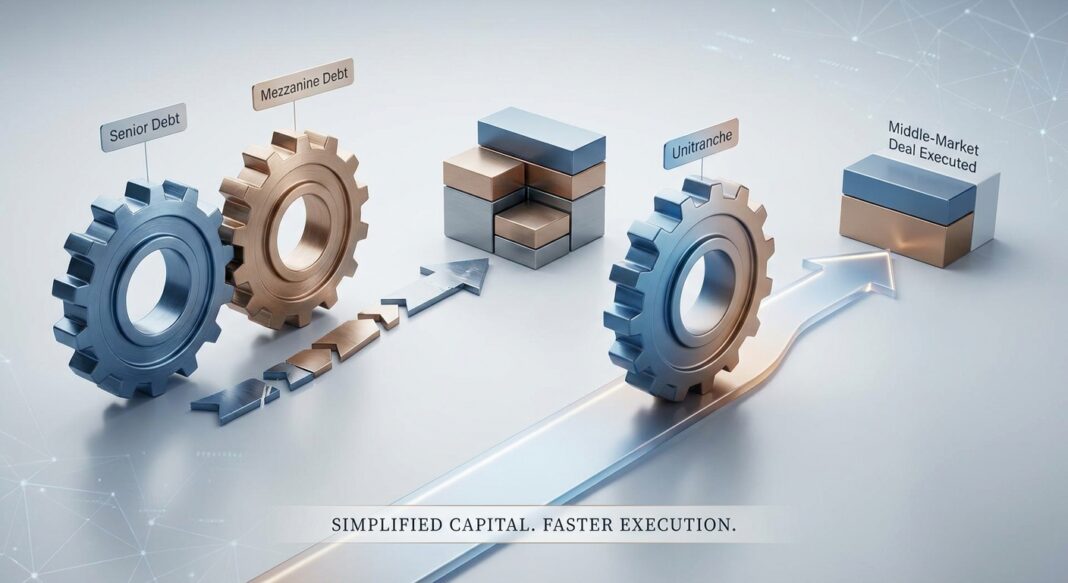
Imagine closing an acquisition in 45 days instead of 120. No senior lender standoff with a mezzanine provider. No inter-creditor agreement battles. No syndication risk that blows up your deal at the finish line. That is the core promise of unitranche debt, and it has become the dominant financing structure for middle-market acquisitions in 2026.
For business owners evaluating how to finance a buyout, recapitalization, or growth initiative, and for investors trying to understand where private credit actually sits in the capital structure, unitranche is a concept that demands a clear-eyed explanation. It is not just a product. It is a structural innovation that fundamentally changed how private credit competes with banks, and why it won.
According to CT Acquisitions (May 2026), the unitranche market grew from roughly $20 billion in annual issuance in 2015 to over $200 billion in 2025 as direct lenders displaced traditional bank syndication for sub-$1 billion EBITDA borrowers. Understanding this shift is foundational to understanding modern private credit.
What Unitranche Debt Actually Is
Unitranche debt is a single-tranche term loan that combines what would otherwise be a senior secured loan and a subordinated or mezzanine loan into one instrument, governed by one credit agreement, with one lender, or one lead lender managing a small club. As Corporate Finance Institute defines it: the borrower pays a blended interest rate that sits between what pure senior debt would cost and what subordinated debt would cost.
The structural elegance is in what disappears. In a traditional capital structure, a borrower negotiating a leveraged buyout might layer a 4.0x senior bank loan on top of a 2.0x mezzanine tranche, creating two separate lenders, two sets of covenants, two closing processes, and an inter-creditor agreement governing who gets paid first in a default. That complexity creates execution risk, and in a competitive M&A environment, execution risk is deal risk.
Unitranche collapses that complexity. CFI notes that unitranche debt comes with a single interest rate and a maturity term typically between five and seven years, with a lump-sum repayment at maturity. There is minimal mandatory amortization, a structural feature that preserves the borrower’s cash flow during the hold period.
Behind the scenes, when multiple private credit funds participate, they govern their relative economics through a confidential Agreement Among Lenders (AAL). The AAL creates a first-out and last-out waterfall among lenders, but the borrower sees none of it. From the borrower’s vantage point, there is one loan, one lender relationship, and one set of terms to manage. As Wall Street Prep explains, the AAL establishes the waterfall payment schedule and allocation of fees and interest to the lender group, functioning similarly to an inter-creditor agreement, but kept confidential from the borrower.
How It Works: A Concrete Example With Real Numbers
Consider a private equity sponsor acquiring a software services business with $10 million in EBITDA for a purchase price of $60 million (6.0x EBITDA). The sponsor contributes $24 million in equity (40% of the purchase price) and needs to finance the remaining $36 million.
Traditional Structure (Senior + Mezzanine):
- Senior bank debt: $25 million at 4.0x EBITDA, pricing at SOFR + 300 bps (~8.3% all-in)
- Mezzanine tranche: $11 million at 5.1x total leverage, pricing at 14–16% (often with equity warrants)
- Two lenders. Two closings. 90–120 days. Inter-creditor agreement required.
- Blended cost of debt: approximately 10.5–11%
Unitranche Structure:
- Single unitranche facility: $36 million at 3.6x EBITDA, pricing at SOFR + 550 bps (~9.8% all-in, per current market)
- One lender. One credit agreement. One set of covenants. 45–60 days to close.
- No inter-creditor friction on future add-on acquisitions.
- All-in cost of debt: approximately 9.8%
The borrower pays roughly 50–130 basis points more in headline rate versus the senior-only tranche, but substantially less than the mezzanine layer would have cost. More critically, the sponsor avoids the execution risk of a two-tranche syndication. According to Private Equity Bro, if a unitranche can close 30 to 45 days faster than a syndicated alternative, sponsors often justify 50 to 100 basis points of extra spread by avoiding financing gaps, broken syndications, or delayed closings that jeopardize purchase agreements.
For the investor sitting in that unitranche position, the blended yield compensates for holding both senior and subordinated risk simultaneously, earning a spread premium over a pure first-lien position without requiring a separate subordinated fund structure.
Current Market Relevance: Where Unitranche Stands in Mid-2026
The unitranche structure is not just theoretically sound; it now dominates an entire segment of the credit market with measurable, real-time data to back it.
| Metric | Data Point | Source |
|---|---|---|
| Unitranche annual issuance (2025) | >$200 billion | CT Acquisitions, May 2026 |
| Middle-market deals using unitranche ($25M–$200M EV) | ~70–80% of transactions | CT Acquisitions, May 2026 |
| Upper middle-market unitranche pricing (Q4 2025) | ~SOFR + 500 bps | Octus, May 2026 |
| Direct lending spread compression (peak-to-2025) | 716 bps (Mar 2023) → 544 bps (Dec 2025) | McKinsey Global Private Markets Report, 2026 |
| Spread widening since late 2025 (lender-friendly reset) | +50 to 100 bps on new issues | Lord Abbett / PitchBook, June 2026 |
| Bank C&I lending standards (Q1 2026) | Tightened for all firm sizes | Federal Reserve April 2026 SLOOS |
| Covenant-lite share of direct lending deals (2025) | 21% (up from 4% in 2023) | McKinsey / Proskauer, February 2026 |
The backdrop for these numbers matters. The Federal Reserve’s April 2026 SLOOS confirmed that banks tightened lending standards for commercial and industrial loans across all firm sizes in Q1 2026, and separately reported tighter standards for non-depository financial institution (NDFI) loans, including higher risk premiums, stricter covenants, and shorter maturities. When bank credit tightens, the structural gap that unitranche fills widens.
Simultaneously, the competitive dynamics of the unitranche market itself are shifting. According to Lord Abbett’s June 2026 midyear outlook, new loans are increasingly coming with better credit structures: less leverage, more covenants, fewer PIK requests, and tighter documentation, a meaningful improvement for lenders after a period of borrower-favorable conditions. Direct lending spreads have also widened by roughly 50 to 100 basis points since late 2025, per PitchBook data cited in the same report, making the current vintage potentially more attractive for disciplined lenders than the compressed-spread environment of mid-2024 through mid-2025.
Decision Framework: Investors and Operators
For Investors Evaluating Unitranche Exposure
Investors assessing a private credit fund or BDC with unitranche exposure consider several structural factors beyond the headline yield:
- Blended yield vs. attachment point: Unitranche lenders earn a premium over pure first-lien positions, but they absorb subordinated risk. Investors evaluate whether the blended spread adequately compensates for holding the last-out portion of the capital structure.
- Covenant quality: As McKinsey (2026) notes, covenant-lite transactions rose to 21% of direct lending deals in 2025. Investors consider what maintenance covenant protections survive in any given unitranche facility, particularly the leverage ratio test, as early warning mechanisms for credit deterioration.
- Manager scale and AAL enforcement capability: In a restructuring, the AAL determines how lender economics are divided. McKinsey (2026) observes that the top 25 private credit managers accounted for approximately 72% of total fundraising, reflecting the premium the market places on managers with workout capability.
- Vintage and rate environment: Unitranche facilities originated in the 2021–2022 low-rate environment were underwritten at rates that now look insufficient given today’s SOFR base. Investors evaluate whether current portfolio marks reflect that reality.
For Operators Evaluating Whether Unitranche Is the Right Structure
Business owners and private equity sponsors consider unitranche when the following conditions align:
- Deal size: CT Acquisitions (2026) identifies the sweet spot as $25M–$200M enterprise value. Below $25M, SBA financing typically wins on cost. Above $300M, broadly syndicated loans often price 100–200 bps cheaper.
- Speed premium: When a purchase agreement has tight closing timelines, the 45–60 day unitranche close versus a 90–150 day syndicated process is often decisive.
- Platform acquisition strategy: Operators running roll-up or add-on strategies benefit from a single lender relationship that can quickly approve incremental debt for bolt-on acquisitions within the existing facility structure.
- Cash flow profile: Unitranche works best for cash flow-generating businesses. The minimal amortization schedule preserves operating capital, but lenders will stress-test coverage ratios, typically expecting interest coverage above 2.0x on forward projections.
Key Takeaways
- Unitranche is a blended structure, not just a senior loan. The pricing reflects senior and subordinated risk in a single instrument, investors should evaluate the blended yield against the full risk profile, not just the senior attachment.
- Speed and certainty are the structural advantage. The 45–90 day close versus 90–150 days for traditional syndicated structures creates real economic value in competitive acquisitions, often justifying a 50–100 bps spread premium.
- The AAL is invisible to the borrower but critical for lenders. In any restructuring scenario, the Agreement Among Lenders governs who gets paid what, making manager expertise in workout situations a key due diligence factor for investors.
- The current environment is a lender reset. Spreads have widened 50–100 bps since late 2025, covenants are tightening, and bank lending standards remain elevated, creating a structurally more attractive entry point for unitranche lenders than the borrower-friendly conditions of 2024.
- Scale matters for both sides. Operators benefit from lenders large enough to hold the full facility without syndication risk. Investors benefit from managers large enough to enforce the AAL and manage workout scenarios in a rising default environment.


