
Where You Stand in Line Determines Everything
Imagine a company with $10 million in assets files for bankruptcy. There are five creditors in the room. One walks out whole. One recovers most of their money. Two recover a fraction. One recovers nothing. What separated them? Not the interest rate they charged. Not the size of their check. It was their position in the capital stack.
This is the foundational reality of private credit, and yet it is the concept most frequently glossed over in fund marketing materials. When someone says they “invest in private credit,” that phrase alone tells you almost nothing. As BIP Wealth notes, a subordinated debt fund and a senior secured direct lending fund are both technically private credit, but they occupy entirely different positions in the repayment line, with entirely different risk profiles to match.
Understanding where in the capital stack a loan sits (and what that means for recovery in a stress scenario) is the single most important question any investor or borrower should ask before engaging with a private credit structure.
What the Capital Stack Actually Is
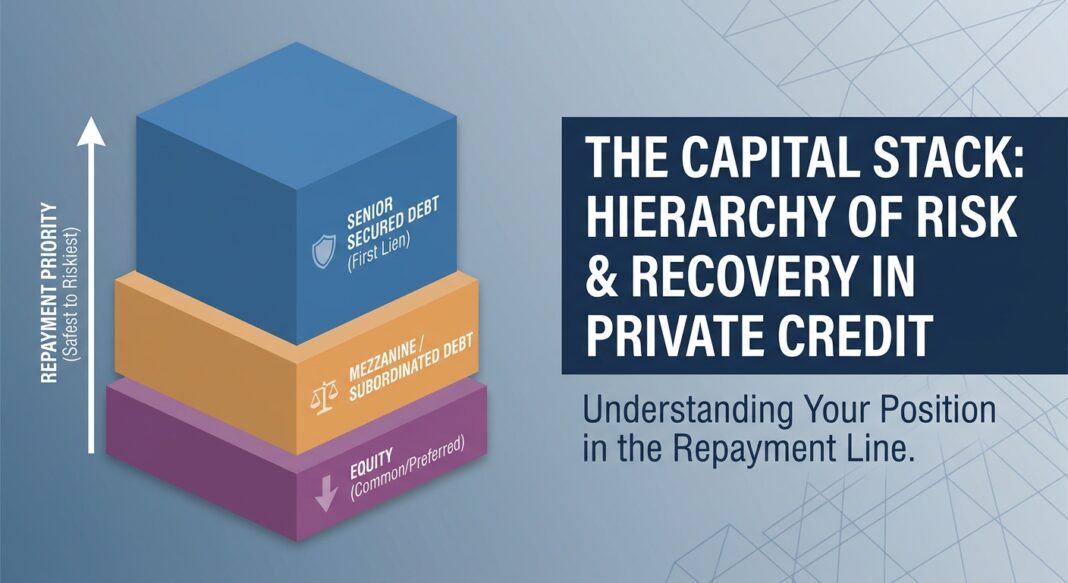
The capital stack is the hierarchy of all financial claims on a company’s assets and cash flows. It is not a metaphor. It is a legal framework that determines who gets paid first (and who absorbs losses first) when a borrower runs into trouble.
Reading the stack from top (safest) to bottom (riskiest), the typical layers are:
- Senior Secured Debt (First Lien): The highest-priority claim. Backed by collateral (often the company’s assets, receivables, or intellectual property) and legally entitled to be repaid before all other creditors in a default or liquidation. This is where most direct lending funds operate.
- Second Lien / Unitranche Debt: Sits below first-lien debt. In a unitranche structure, first-lien and second-lien economics are blended into a single instrument, simplifying execution but with layered internal priority agreements.
- Mezzanine / Subordinated Debt: Junior capital that ranks below senior secured lenders. Earns a higher coupon to compensate for accepting more risk and a longer wait in the recovery queue.
- Preferred Equity: Has priority over common equity but ranks behind all debt in liquidation. Often used in hybrid capital structures.
- Common Equity: The last to be paid and the first to absorb losses. Equity holders own the upside, but carry the most downside exposure of any capital provider.
As BIP Wealth explains, senior secured debt’s position at the top of the capital stack is not a marketing description; it is a legal right, enforced through a defined statutory process. That distinction is worth repeating: the protections are structural, not discretionary.
How It Works: A Concrete Example
Consider a private equity-sponsored middle-market company, call it Acme Distribution, with a total enterprise value of $100 million. Its capital structure at close looks like this:
- Senior Secured Term Loan (First Lien): $55 million, provided by a direct lending fund at SOFR + 500 bps
- Mezzanine Debt: $15 million, provided by a mezzanine fund at a fixed 13%
- Sponsor Equity: $30 million, provided by the private equity firm
The loan-to-value (LTV) for the senior secured lender is 55% ($55M loan ÷ $100M enterprise value). That means the company’s value would need to fall by more than 45% before the senior lender’s principal is at risk. The $30 million equity cushion beneath them absorbs losses first. The mezzanine lender has a higher LTV exposure, since they are repaid after the senior lender. The equity sponsor has no debt cushion below them at all; they are entirely first-loss.
Now assume Acme struggles. Its enterprise value drops to $60 million. The senior lender, owed $55 million, recovers roughly 92 cents on the dollar. The mezzanine lender, whose $15 million claim sits behind $55 million of senior debt, faces meaningful impairment. The equity sponsor is wiped out entirely. Same company, same decline, dramatically different outcomes, determined entirely by stack position.
This is why LBC Capital notes that the yield premium over public fixed income in senior secured private lending, typically 3–4% above investment-grade bonds, reflects illiquidity and complexity, not elevated credit risk. The premium compensates for what the structure is, not for what could go wrong.
Current Market Relevance
Stack positioning is not just an academic framework; it is an active variable in today’s market. Several data points make this clear:
Bank retreat is structural, not cyclical. The Federal Reserve’s April 2026 SLOOS reported that banks, on balance, continued to tighten lending standards for C&I loans to firms of all sizes in Q1 2026, reinforcing the multi-year trend of banks pulling back from leveraged lending. This is not a temporary dislocation; it is a structural reshaping of who occupies the senior secured layer of the stack.
Private credit has stepped into the gap at scale. According to PwC’s 2026 Mid-Year Outlook (citing Preqin), private credit AUM now exceeds $2.2 trillion and is projected to reach $4.5 trillion by 2030. That growth is concentrated in senior secured, first-lien direct lending, the top of the stack.
First-lien all-in yields remain elevated. NEPC’s Q1 2026 Private Markets Report found that average all-in yields for middle-market direct lending deals were approximately 9.13% in Q1 2026, with first-lien spreads averaging 498 basis points over SOFR. The yield premium for direct lending over broadly syndicated loans widened to 228 basis points, meaning investors in senior secured positions are being compensated meaningfully more than in liquid markets for comparable credit quality.
Spreads are widening, not compressing. Lord Abbett’s 2026 Midyear Outlook reports that spreads widened roughly 50 to 100 basis points since late 2025, while defensive loan terms improved. The market has shifted from borrower-friendly to lender-friendly, meaning those at the top of the stack are now negotiating from a position of greater strength.
Leverage levels are rising, increasing the importance of stack discipline. According to NEPC (citing LSEG LPC data), average leverage levels for companies generating over $40 million in EBITDA reached 5.66x in Q1 2026, up from 4.88x for full-year 2025. Higher leverage means thinner equity cushions beneath senior lenders: reinforcing why understanding stack position, and not just yield, is critical.
| Metric | Data Point | Source |
|---|---|---|
| Middle Market Direct Lending All-In Yield (Q1 2026) | ~9.13% | NEPC Q1 2026 |
| First-Lien Direct Lending Spread (Q1 2026) | ~498 bps over SOFR | NEPC Q1 2026 |
| Yield Premium vs. Broadly Syndicated Loans | +228 bps | NEPC Q1 2026 |
| Private Credit Global AUM | >$2.2 trillion | PwC / Preqin, 2026 |
| Avg. Leverage (EBITDA >$40M), Q1 2026 | 5.66x | NEPC / LSEG LPC, Q1 2026 |
Decision Framework
For Investors Evaluating Private Credit Funds
Stack position should be the first filter when evaluating any private credit allocation: before yield, before manager brand, before strategy label. Consider the following questions:
- Where in the stack does this fund lend? First-lien senior secured funds carry fundamentally different risk profiles than mezzanine or subordinated debt funds. Both are private credit. They are not equivalent.
- What is the average LTV or loan-to-EBITDA across the portfolio? This determines how much value erosion the collateral can absorb before principal is impaired. A 50% LTV senior secured loan carries far more cushion than a 70% LTV position.
- Is the yield premium commensurate with the stack position? Senior secured private lending has historically earned a 3–4% premium over investment-grade bonds, compensating for illiquidity rather than credit risk. If a fund is offering substantially higher yields without a clearly articulated reason, it is likely taking subordination risk, not just illiquidity risk.
- How does the manager enforce their position? Senior secured status is a legal right, but it must be actively enforced. Investors should evaluate managers’ track records in workout and restructuring scenarios, not just origination volume.
For Operators & Business Owners Seeking Capital
Understanding stack mechanics helps operators negotiate more effectively and structure capital raises that align with their business stage:
- Senior secured debt is the cheapest non-equity capital available. Lenders at the top of the stack accept lower returns in exchange for priority. Operators who can offer strong collateral, consistent cash flows, and manageable leverage will access capital at significantly lower cost than those who cannot.
- Equity cushion matters to your lender. Private credit lenders focus intensely on how much equity sits beneath their loan. The larger the sponsor or owner equity contribution as a percentage of total enterprise value, the more likely a lender is to offer favorable terms, and the more runway the business has before any covenant pressure materializes.
- Stack complexity has a cost. Multi-tranche structures (first lien + mezzanine) introduce intercreditor complexity and potential conflicts between lender groups in stress scenarios. Unitranche structures, a single blended loan from one lender, eliminate this friction and often provide faster execution, though the all-in cost may differ.
Key Takeaways
- “Private credit” is not a single risk level. Senior secured first-lien lending and mezzanine subordinated debt are both private credit, but they occupy fundamentally different positions in the repayment hierarchy and carry proportionally different risk profiles.
- Stack position determines loss exposure in a downside scenario. In a liquidation, the senior secured lender is first in line to recover capital from the company’s assets. Subordinated lenders and equity holders absorb losses before the senior lender is impaired.
- The equity cushion below a loan is a critical risk metric. The thicker the equity layer beneath a senior secured loan, the more enterprise value can erode before the lender’s principal is at risk. Investors should examine LTV or leverage multiples alongside yield when evaluating any fund.
- Bank retrenchment has made senior secured private credit more structurally relevant. With banks tightening C&I lending standards across consecutive SLOOS surveys, private credit funds occupy the senior secured layer of the stack for an expanding share of middle-market borrowers, a structural shift, not a temporary one.
- The 2026 market environment is shifting toward lenders. Wider spreads, tighter loan terms, and rising leverage multiples mean that senior secured lenders entering new transactions today are doing so with better structural protections and higher yields than in recent borrower-friendly vintages, but stack discipline remains the non-negotiable foundation.


