
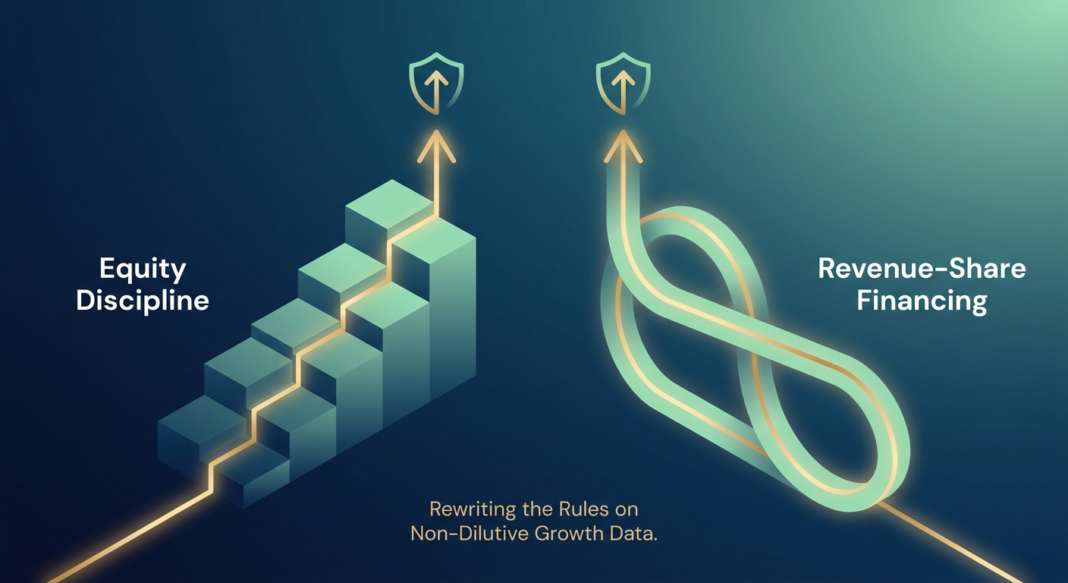
The Story: Two Founders. Two Sectors. One Shared Conviction.
In March 2026, Danone announced the acquisition of UK nutrition brand Huel for approximately €1 billion, and founder Julian Hearn walked away with roughly £400 million personally. That figure alone is remarkable. What makes it extraordinary is the context: Hearn owned just under half of the business at exit, despite the company having raised institutional capital across multiple rounds.
Six weeks later, and five thousand miles away, a quieter but equally instructive story landed in the business press. Musely, a direct-to-consumer telemedicine platform specialising in prescription skincare, hair, and menopause care, secured more than $360 million in non-dilutive capital from General Catalyst’s Customer Value Fund (CVF), without surrendering a single share.
These are not abstract case studies. They are two real, publicly documented events from 2026 that illuminate the same core principle from different angles: the most expensive capital is not always the capital with the highest interest rate. Sometimes, the most expensive capital is the equity you give away when you don’t have to.
Together, Huel and Musely form a masterclass in what capital discipline actually looks like, and what it pays out at the other end.
The Decision: Minimise Dilution, Maximise Optionality
Huel: Raise Late, Raise Small, Negotiate From Strength
Huel was founded in 2015 by Julian Hearn and nutritionist James Collier. The premise was simple and polarising: nutritionally complete, plant-based food for people who wanted convenience without compromise. For several years, Hearn built the business primarily from its own revenue before approaching institutional investors, a sequencing decision that would define the entire financial outcome a decade later.
By the time Huel reached institutional scale, the business was generating £214 million in annual revenue, growing at 16% year-on-year, with a gross margin of 59% and adjusted EBITDA of £18.2 million. These were not projections being pitched to a sceptical seed investor; they were audited figures from a proven operation. That distinction fundamentally shifts negotiating leverage toward the founder.
When Hearn did raise, he raised what the business needed rather than what the market was willing to deploy. Huel raised $27 million in December 2022 in a growth round led by Highland Europe, bringing total disclosed funding to approximately $59 million. For a business generating nine-figure revenues, that is a modest amount of outside capital, and the cap table reflected it. Hearn retained a near-50% ownership stake all the way to exit.
The counterfactual is instructive. Most DTC consumer brands raising $59 million across multiple institutional rounds arrive at exit with a founder ownership stake in the 15–25% range, as dilution compounds through each round. Hearn owned just under half of the business, an outcome that required deliberate, sustained discipline over ten years.
Musely: Non-Dilutive Revenue Capital as a Structural Alternative to VC
Musely’s story runs in parallel. Founded in 2014 as a wellness community and pivoting to prescription skincare in 2019, Musely had been cash flow positive for years and had raised only $20 million in equity at founding. CEO Jack Jia consistently turned away venture capital approaches because he did not want to dilute his ownership.
The capital problem Musely faced was not survival; it was scale. The company was growing revenue at an average of 50% year-over-year and had served over 1.2 million patients, but customer acquisition costs in the direct-to-consumer healthcare sector are structurally demanding. Jia described the arithmetic plainly: the capital required to grow scales proportionally with revenue, and most DTC businesses burn through equity financing trying to bridge that gap.
General Catalyst’s Customer Value Fund offered a different instrument. Rather than taking an equity stake, CVF structures its deployment as a capped revenue-share agreement: capital is advanced and repaid through a fixed, capped percentage of the revenue generated by that capital. No equity changes hands. No board seat is granted. No dilution occurs.
After raising $20 million in 2014, Musely had not raised a single dollar of equity capital in the decade that followed, and the $360 million CVF facility preserved that ownership structure entirely.
The Outcome: What Capital Discipline Actually Pays
Huel: A £400M Personal Exit From Near-50% Ownership
Danone’s acquisition of Huel was announced in March 2026, valued at approximately €1 billion. Hearn is expected to receive just over £400 million from the transaction.
The valuation multiple deserves attention. Danone paid approximately 20x or more of current EBITDA for Huel despite revenue growth having moderated to around 16–17%, a premium multiple that Barclays analyst Warren Ackerman described as “full price versus peers.” That premium reflects the quality of what Hearn built: strong gross margins, a digitally native customer base, omnichannel distribution across more than 25,000 stores globally, and clean unit economics that a strategic acquirer could immediately leverage.
Critically, Huel will operate as an autonomous unit reporting into Danone’s European division, with CEO James McMaster remaining in post. The brand’s identity and operating model, the very things Hearn built without having to redesign them for short-term PE exit timelines, were preserved as conditions of the deal.
Compare this to a conventional dilution scenario. A founder who raised the same $59 million but across earlier-stage rounds at lower valuations could plausibly have arrived at exit with 20% ownership. At a €1 billion exit, that is a £170–175 million outcome versus Hearn’s £400 million. The difference, more than £225 million, is entirely attributable to ownership percentage, not business performance. The business was the same either way.
Musely: $360M In Growth Capital, Zero Dilution
Musely’s $360 million CVF facility is one of the largest non-dilutive financing rounds in the DTC healthcare sector on record. The capital is directed specifically at customer acquisition, the highest-leverage use in a subscription-oriented telehealth model where patient lifetime value compounds over time.
The Musely transaction follows the same structural pattern General Catalyst used with Grammarly in 2025, when the writing platform raised $1 billion in non-dilutive financing on a revenue-repayment basis. CVF is institutionalising a model that has historically been the province of smaller revenue-based finance shops, bringing it to nine-figure deal sizes for the first time.
The alignment of incentives is notable. General Catalyst’s return depends on the revenue performance of the capital it deployed, not on a marked-up equity exit at a specific time. That is fundamentally different from the incentive structure of a traditional venture round, where the fund’s carry is tied to a liquidity event that may or may not align with the business’s optimal moment to transact.
The Lessons: A Framework for Founders Facing Capital Decisions
Huel and Musely are not identical stories, but they share a common architecture: both founders identified the point at which traditional equity capital would impose costs (in dilution, in governance, in exit timing pressure) that exceeded its benefits, and both found or created alternatives.
The lessons that emerge are structural, not circumstantial.
1. Bootstrapping Is Not Ideology: It Is Negotiating Leverage
Hearn’s decision to build Huel to £18 million in revenue before approaching institutional investors was not anti-capital purism. It was a strategy to negotiate from demonstrated performance rather than projected potential. Investors who fund a proven business pay for proven performance; investors who fund a hypothesis demand a price for the uncertainty they absorb. The founder who waits for the inflection point keeps that premium.
2. Non-Dilutive Structures Are No Longer Niche
The Musely-CVF deal signals something important: institutional-scale non-dilutive capital is increasingly available to profitable businesses with predictable revenue. Musely joins a CVF portfolio that includes Grammarly, Lemonade, and Ro, a roster that signals this is a repeatable model, not a one-off. Founders of cash-flow-positive businesses should treat revenue-share and non-dilutive facilities as a first option, not a last resort.
3. The True Cost of Equity Is Compounding
Dilution is not a one-time cost paid at the round. It is a compounding loss that accumulates across every subsequent year of growth. A founder who gives away 20% in a Series A does not simply give away 20% of the value at that moment; they give away 20% of every future dollar of value created by their own continued effort. Hearn’s £400 million outcome makes the arithmetic viscerally clear.
4. Incentive Alignment Matters More Than Capital Cost
The structural difference between a revenue-share lender and a venture equity investor is not just financial; it is motivational. A lender whose return depends on the ongoing performance of the business has aligned incentives with the operator. A venture fund whose return depends on a marked-up exit has incentives that are only partially correlated with what is best for the business at any given moment.
5. This Framework Works Best When the Business Is Proven
Neither of these strategies is available at the pre-revenue stage. They both require a business with demonstrated cash flow, defensible margins, and predictable revenue, the very characteristics that make non-dilutive capital safe for lenders and leverage unnecessary for founders. The framework is not universal; it is the reward for building a real business before seeking capital to scale it.
Key Insights
- Ownership at exit is the product of ownership decisions made years earlier. Hearn’s ~49% stake at a €1 billion exit was not luck; it was the accumulated result of a decade of disciplined round sizing and late-stage fundraising.
- Non-dilutive, revenue-linked capital has crossed into institutional territory. Musely’s $360 million CVF facility, alongside Grammarly’s $1 billion in 2025, signals that this structure is now available at scale for profitable, high-growth businesses.
- The cost of equity is not just the dilution percentage; it is the compounding loss of future value. Every year a founder operates and grows, the value of equity they didn’t give away compounds in their favour.
- Strategic acquirers pay premiums for clean, founder-built operating models. Danone paid 20x+ EBITDA for Huel in part because the business was built for longevity, not for a PE exit timeline. Capital structure shapes business behaviour, which shapes exit multiples.
- Incentive alignment, not just cost of capital, should drive financing decisions. Revenue-share lenders and private credit facilities are aligned with the operator’s continued success; venture equity investors are aligned with a liquidity event. For founders who intend to run their businesses for the long term, that distinction is material.


