
The Story: Eighteen Years of Equity, One Impossible Question
Marcus had spent eighteen years building a specialty industrial distribution company in the Midwest. His business generated $3.2 million in EBITDA on $22 million in revenue, ran with a lean team of 41, and had never missed a debt payment. He had no outside investors. No board to answer to. No preferred shareholders diluting his ownership. Just him, his management team, and a company he had built from the ground up.
Then his co-founder asked to be bought out.
His co-founder owned a 35% stake, worth roughly $5.6 million at the prevailing 5x EBITDA market multiple, and wanted liquidity. His options, as presented by his accountant, were blunt: sell the whole company, find a PE buyer to acquire the co-founder's stake directly, or take on debt to fund the buyout himself.
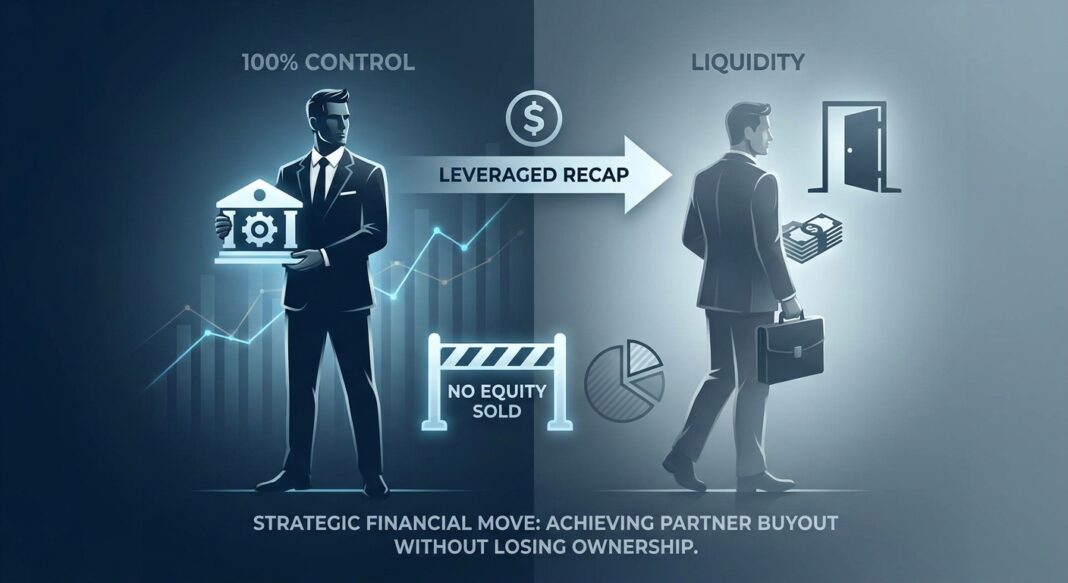
A full sale would have meant handing over the keys to a business he had no intention of leaving. A PE minority sale would have handed a third party a 35% stake, a board seat, and a clock on his autonomy. Neither felt right. But the third option, a leveraged recapitalization, gave Marcus something the other two could not: liquidity for his co-founder, full control for himself, and zero dilution of his equity.
Note: This scenario is a composite hypothetical case study constructed to illustrate real leveraged recapitalization mechanics. Financial figures are illustrative and grounded in current market benchmarks.
The Decision: Debt vs. Dilution, Running the Numbers
Marcus and his advisors mapped out three paths side by side. The numbers told a clear story.
Option A: Full Sale
At 5x EBITDA, the business was worth approximately $16 million. After taxes, transaction costs, and the split with his co-founder, Marcus would walk away with roughly $8.5 million. He would lose the business entirely, along with $3.2 million in annual EBITDA that was still growing at 12% per year.
Option B: PE Minority Stake (Sell 35% to a Financial Sponsor)
A regional PE firm offered to purchase the co-founder's 35% stake at a slight discount, plus a small growth equity tranche. Marcus would retain 65% ownership, but the PE firm would require board representation, management fee rights, an information covenant package, and a drag-along provision that forced a sale within five years. He would trade permanent control for a five-year clock.
Option C: Leveraged Recapitalization (Chosen Path)
Marcus worked with a debt advisor to structure a unitranche credit facility of $5.6 million, approximately 1.75x EBITDA, from a direct lender, at a blended rate of 8.75%. The proceeds funded the full buyout of his co-founder's stake. Post-transaction, Marcus owned 100% of the business. His annual debt service was approximately $490,000, roughly 15% of EBITDA, well within the business's free cash flow capacity.
The structure was clean. No new equity investors. No board dilution. No exit timeline. Just a lender with a senior secured position, a five-year amortization schedule, and a fixed-charge coverage covenant requiring EBITDA to stay above 1.25x annual debt service, a level the business had cleared comfortably for the prior six years.
According to the Pepperdine Private Capital Markets Report (2024), lower middle market leveraged recapitalizations typically close at 3x to 5x EBITDA in total debt. Marcus's 1.75x structure was deliberately conservative, sized to preserve maximum financial flexibility while still delivering full liquidity to the departing co-founder.
The Outcome: What Control Is Actually Worth
Three years after the recap, Marcus's business had grown EBITDA to $4.1 million, a 28% increase from the $3.2 million at transaction close. He had paid down approximately $1.7 million of the original facility, leaving $3.9 million in remaining debt against a business now worth roughly $20.5 million at the same 5x multiple.
His equity value: approximately $16.6 million, net of remaining debt.
Compare that to Option A. Had Marcus sold the business outright at the time of his co-founder's exit, he would have netted approximately $8.5 million after taxes and split. Under the recap path, his equity grew to $16.6 million over three years, nearly double, while his co-founder received full liquidity at closing.
The counterfactual matters. The PE minority path (Option B) would have created a forced-exit dynamic. By 2026, PE holding periods had reached record highs, with managers under increasing pressure from LPs demanding distributions. That pressure tends to flow downstream, into portfolio companies, in the form of pressure to sell at the first available window rather than the optimal one. Marcus would have faced that pressure at exactly the moment his growth trajectory was strongest.
Instead, he controls the timeline. He controls the exit. And he controls whether there is an exit at all.
The annual cost of that control was $490,000 in debt service. The three-year value of retaining it: over $8 million in additional equity creation.
The Lessons: A Framework for Founders Facing Similar Decisions
Marcus's story illustrates a principle that shows up repeatedly in lower and middle market capital structures: equity is the most expensive currency you own, and debt, used precisely, is the cheapest tool for preserving it.
There are conditions that make a leveraged recap the right instrument, and conditions that make it dangerous. Understanding both is the entire discipline.
When the Recap Works
- Stable, predictable cash flows. The thesis depends entirely on the business's ability to service debt through a full economic cycle. A business with recurring revenue, low customer concentration, and durable margins is a natural fit. A cyclical business with lumpy revenue is not.
- Conservative leverage sizing. The data is clear: total debt of 3x to 6x EBITDA is the operative range for lower middle market recaps, according to market benchmarks. Deals sized at 1.5x to 2.5x leave meaningful buffer. Deals pushed to 5x or 6x leave almost none.
- A specific, bounded liquidity need. The recap works best when there is a defined purpose: a co-founder buyout, an estate liquidity event, a retiring partner. Vague liquidity goals tend to result in over-levering for the sake of it.
- The owner wants to keep operating. This is not a transaction for founders who are emotionally ready to exit. It is for founders who want the cash event, but not the exit.
When It Backfires
The risk is not theoretical. Higher debt service reduces operating flexibility, and a downturn in EBITDA can trigger covenant violations and force restructuring. The Federal Reserve Senior Loan Officer Opinion Survey (2024) documented that bank lending standards for leveraged transactions tighten materially during periods of economic uncertainty, meaning the capital is most constrained exactly when you need flexibility most. Recapitalizations that pile debt on fragile or declining businesses are not capital structure optimization; they are deferred crises.
The Broader Principle
The VC and PE ecosystems are built around one outcome: the exit. Their instruments (preferred shares, board seats, drag-along rights, five-year fund cycles) are all optimized for an eventual sale. That alignment is powerful if the founder's goal is also an exit. But for the founder who has spent a decade building something they want to continue building, those instruments are fundamentally misaligned. A leveraged recap, sized correctly on a cash-generative business, gives the founder the economic event without the loss of the operational one. The debt is serviced. The equity compounds. The founder stays.
The current market supports this approach. According to the Pepperdine 2025 Private Capital Markets Report, private equity valuations for lower middle market companies now average approximately 5.5x EBITDA for businesses with $10 million in earnings, a level that prices healthy businesses attractively. Founders who understand their valuation, their debt capacity, and their coverage ratios are entering conversations with lenders from a position of genuine strength.
Key Insights
- A leveraged recapitalization is a liquidity event without an exit. The founder receives cash, the business takes on debt, and ownership remains intact, structurally separating the liquidity question from the control question.
- Sizing discipline is everything. Lower middle market recaps typically close at 3x to 5x EBITDA in total debt. Conservative structures at 1.5x to 2.5x preserve operational flexibility; aggressive structures above 4x compress the margin for error to nearly zero.
- The cost of equity dilution compounds invisibly. Selling a 35% stake to a PE firm in exchange for partner liquidity creates a five-year exit clock, board dilution, and a misaligned incentive structure, costs that are real but rarely modeled against the simpler cost of debt service.
- The counterfactual is the most important number. The correct comparison is not "what does this recap cost me?" but "what does forfeiting compounding equity ownership cost me over the hold period?" In Marcus's case, three years of retained equity creation was worth more than $8 million in additional value relative to a full sale.
- Cash flow coverage is the single most important underwriting variable. The fixed-charge coverage covenant, typically requiring EBITDA to cover annual debt service at 1.2x to 1.5x, is the lever that separates a well-structured recap from a distressed situation waiting to happen. Founders should stress-test coverage at 20% EBITDA haircuts before signing any term sheet.


