
The Story: A Founder Who Refused to Play by Venture Capital’s Rules
In the spring of 2026, Danone completed a €1 billion acquisition of Huel, a UK-based complete nutrition brand that began life as powdered food mixed in a Northamptonshire kitchen. When the proceeds cleared, founder Julian Hearn walked away with £420 million personally. His ownership stake at exit: 49.3%.
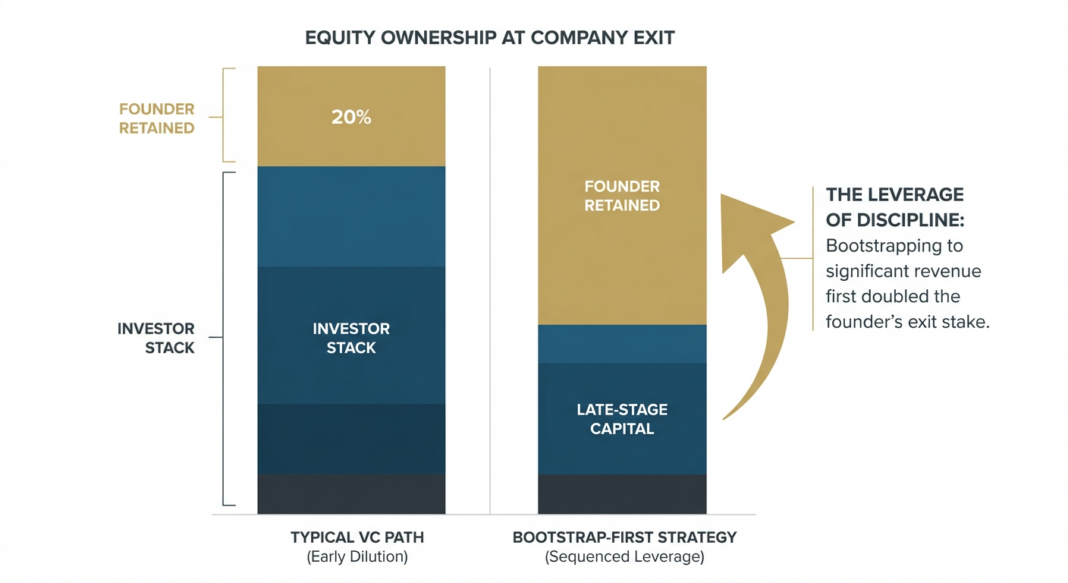
To put that in context, most DTC founders who raise $184 million across three institutional rounds arrive at an exit owning somewhere between 15% and 25% of their company. The rest has been systematically diluted away (round by round, preference stack by preference stack) until the exit multiple that once seemed life-changing barely clears the liquidation preferences sitting above the founder’s equity.
Hearn avoided that fate entirely. Not by refusing capital, Huel took $184 million across three rounds, but by controlling the sequence, the timing, and the terms of every dollar that came in. He didn’t play the venture capital game. He rewrote the rules of engagement before investors even sat down at the table.
The foundation of that negotiating power? He didn’t raise a single pound of institutional money until Huel had already reached £18 million in annual revenue. By the time Series A investors arrived, they were not funding a hypothesis. They were buying into a proven, cash-generating operation. That distinction, demonstrated performance versus projected potential, is worth, in Hearn’s case, the difference between £420 million and something closer to £80 million.
The Decision: Raise Minimally, Raise Late, Raise at Your Terms
When Huel finally approached institutional capital, Hearn had already done the hard work of proving the model. The brand had demonstrated consistent revenue growth, improving gross margins, and what analysts would later describe as exceptional unit economics for the DTC nutrition category. Public reporting indicates Danone ultimately paid 17–20× EBITDA for Huel despite revenue growth having moderated to approximately 17% in the period preceding the deal, a premium multiple almost entirely attributable to the margin quality Hearn built through years of capital discipline, including vertical integration of manufacturing that expanded contribution margins while competitors spent their way through VC-funded customer acquisition budgets.
The strategic logic Hearn employed is straightforward but rarely executed: money raised before product-market fit buys runway at the cost of ownership. Money raised after product-market fit buys acceleration at terms the founder controls. Most founders raise too early because they are afraid of running out of cash. Hearn accepted that discomfort long enough to flip the power dynamic entirely.
When he did raise, he raised what the business needed, not what the market was willing to give him. That discipline is its own form of leverage. Every dollar of unnecessary capital is a negotiation you lose before it begins.
The Outcome: Premium Multiple Meets Preserved Ownership
The Danone acquisition confirmed what Hearn’s cap table had been quietly promising for years: when you preserve ownership through disciplined sequencing, every improvement in exit multiple flows through to you at full force.
At 17–20× EBITDA, Danone was not paying for Huel’s recent growth rate; it was paying for the quality of the cash flows, the strength of the brand, and the durability of the unit economics underneath it. Those qualities were, in large part, the product of not having raised venture capital too early and too aggressively. Companies that raise large equity rounds early tend to grow by buying revenue (paid acquisition at negative or marginal contribution margins) because their investors require growth at a pace the underlying economics cannot yet sustainably support. Huel’s model, forged in capital scarcity, built the opposite habit.
Notably, the investors who backed Hearn also generated strong returns. This is not a story about founders winning at the expense of investors. It is a story about what happens when the founder retains enough equity that their incentives and the business’s long-term health remain perfectly aligned, a condition that benefits every party in the capital structure, including the institutional money that came in late and at fair terms.
The Broader Principle: Sequencing Is Leverage
Hearn’s outcome illustrates a principle that applies far beyond consumer brands. The timing of when you accept external capital (and on whose terms) is itself a form of financial engineering. It is leverage in the negotiating sense: the more you have proven before you raise, the more favorable the terms you can extract, and the less dilution you absorb per dollar of growth funded.
This framework runs directly counter to the conventional venture capital narrative, which encourages founders to raise early and raise large on the grounds that speed of growth is the only defensible moat. That narrative serves investors whose return model depends on a small number of outsized exits across a broad portfolio. It does not necessarily serve founders, whose return depends on one exit, their own.
The comparison to the leveraged dividend recapitalization tool is instructive here. Both strategies (Hearn’s bootstrap-then-raise discipline and the structured recap available to profitable middle-market operators) share the same underlying logic: the founder who controls the timing and terms of capital decisions retains the compounding value of their own equity. Whether you are extracting personal liquidity through a unitranche facility sized to existing cash flows, or building to £18 million in revenue before allowing institutional investors through the door, the principle is identical. Delay the dilution event until your negotiating position is strongest. Then transact on your terms.
A Framework for Founders Facing the Raise-or-Bootstrap Decision
Before approaching institutional capital, operators should honestly answer four questions:
- Can the business reach the next meaningful inflection point without external equity? If the answer is yes, the cost of raising now is almost certainly too high relative to the valuation you will command later.
- Is the capital need driven by the business or by investor expectations? Raising to satisfy a growth rate that impresses future investors, rather than to fund a specific operational need, is the fastest path to unnecessary dilution.
- Are there non-dilutive alternatives available? Structures like revenue-based financing, private credit facilities, and leveraged recapitalizations serve different moments in a company’s life cycle, but they share one feature: they do not permanently reduce the founder’s ownership in exchange for temporary capital.
- What does the cap table look like at the exit multiple you realistically expect? Work the math backward. The answer to this question changes which path is correct, and most founders never run it.
Key Insights
- Bootstrap discipline is its own form of leverage: Hearn’s decision to reach £18M in revenue before raising institutional capital transformed the power dynamic of every subsequent negotiation, investors were buying performance, not funding a bet.
- Dilution compounds against you: Every equity round absorbed early is a permanent reduction in the founder’s share of a compounding asset. The cost is not the percentage given away today; it is the terminal value of that percentage at exit.
- Premium multiples reward margin quality, not just growth: Danone paid 17–20× EBITDA for Huel despite slowing revenue growth, because the unit economics built through capital discipline commanded a strategic premium that VC-funded revenue buying cannot replicate.
- Founder returns and investor returns are not zero-sum: Hearn’s investors generated strong returns alongside his £420M personal exit, proving that equity preservation is not about denying capital its return; it is about ensuring the founder captures the value they created.
- The raise-or-bootstrap decision has a right answer, but only if you run the math: The correct capital path depends on the exit multiple you expect, the dilution you can afford to absorb, and whether non-dilutive alternatives exist at your current stage. Most founders never model it. The ones who do make structurally better decisions.


