
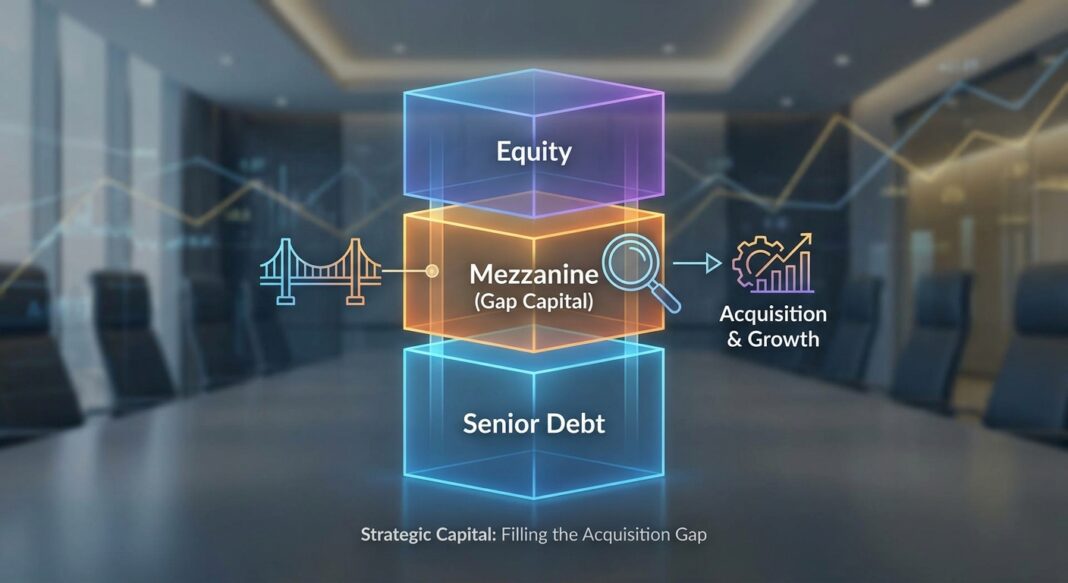
The Growth-Stage Acquisition Problem
You have built a profitable business. EBITDA is real, the customer base is sticky, and you have identified a target that accelerates your strategy by three to five years. The acquisition price is set. The returns are clear. The problem is the gap between what your senior lender will provide and what the deal actually requires.
This is the defining financing challenge for growth-stage operators moving from organic expansion into acquisition mode. Senior debt covers the bankable layer. Equity dilutes the upside. Between those two instruments sits a structural gap — and the capital that fills it is mezzanine. Understanding how to size it, source it, price it, and negotiate it determines whether the acquisition creates or destroys value for the founders and sponsors at the table.
This article maps the full capital stack for a growth-stage acquisition, walks through the use-of-proceeds logic at each layer, and delivers a tactical playbook for closing the gap intelligently.
Mapping the Capital Stack: Cost, Access, and Structural Expectations by Layer
In a growth-stage acquisition, the capital stack typically runs three to four layers deep. Each carries a different cost, a different set of structural expectations, and a different risk tolerance. Moving from most senior to most junior, the architecture looks like this:
Layer 1 — Senior Secured Debt (Bank or Direct Lending)
This is the cheapest layer in cost-of-capital terms. Senior secured lenders — whether a chartered bank or a direct lending fund — underwrite against the target’s EBITDA on a first-lien basis. Leverage multiples at the senior level for profitable, recurring-revenue businesses currently range from 2.5x to 4.0x EBITDA, depending on sector, margin profile, and lender appetite. Pricing is tightest here: floating-rate structures over SOFR or a base rate, with spreads that reflect first-lien priority and covenant protection. Maintenance covenants — tested quarterly against leverage, coverage, and sometimes a minimum liquidity threshold — are standard at the senior level.
The constraint is also real. Senior lenders do not fill the stack. They provide the foundation. For a business with $6M of EBITDA being acquired at a 7x multiple, the enterprise value is $42M. A senior lender at 3.5x leverage provides $21M. The remaining $21M must come from somewhere else.
Layer 2 — Mezzanine / Subordinated Debt (The Gap Capital Layer)
Mezzanine sits subordinate to the senior lender but senior to all equity. It fills the gap between what senior debt covers and what the equity sponsor is prepared to commit. All-in pricing for mezzanine currently ranges from 13% to 18%, typically structured as a combination of a cash-pay coupon and a PIK (payment-in-kind) component that accretes to principal rather than requiring immediate cash outflow. Warrant coverage — granting the mezz provider the right to acquire a percentage of fully diluted equity — typically runs from 1% to 5%, depending on the risk profile of the transaction and the leverage being taken, as outlined in Bond Capital’s acquisition financing framework at bondtv.vaultai.ca.
Covenant packages at the mezz layer are negotiated rather than standardised. Some mezzanine providers accept incurrence-only covenants — triggered only when the borrower takes a defined action such as incurring additional debt or making a restricted payment. Others require quarterly maintenance tests. The difference matters operationally: maintenance covenants constrain management’s flexibility in a downturn; incurrence covenants do not.
Layer 3 — Preferred Equity or Structured Equity
Where mezzanine debt ends, preferred equity begins. Preferred instruments carry no fixed cash coupon obligation, trade covenant restriction for liquidation preference, and typically sit above common equity in any exit waterfall. The cost is higher than mezz in dilution terms, but lower in cash-service terms — making preferred a strategic alternative when the business cannot comfortably service a mezz coupon in the integration period.
Layer 4 — Common Equity (Sponsor, Rollover, or Management)
Equity is the most expensive layer in dilution terms and the residual after all debt capacity has been deployed. The structuring objective is to minimise equity contribution without over-levering the operating business. Every dollar replaced by mezzanine is a dollar that remains in the equity upside pool.
A Worked Example: $42M Acquisition, $6M EBITDA, 7x Purchase Multiple
To make the stack concrete, consider a $42M acquisition of a regional professional services business with $6M of stabilised EBITDA and a demonstrated track record of organic growth. The buyer is a founder-owned platform with an existing banking relationship.
- Senior secured debt: $21M at 3.5x EBITDA. Floating rate, 5-year term, quarterly maintenance covenants on leverage and interest coverage. Transaction fees and closing costs roll into the facility for a total senior draw of $22.5M.
- Mezzanine: $12M at a blended 15% all-in rate (9% cash pay + 6% PIK), 6-year maturity, with 3% warrant coverage on fully diluted equity. Incurrence-only covenants. The PIK toggle right — the ability to elect PIK rather than cash pay in years one and two — is negotiated explicitly to protect integration-period cash flow.
- Equity (sponsor and management rollover): $7.5M, representing approximately 18% of the total purchase price. Management retains meaningful equity through a rollover structure, aligning incentives post-close.
Total sources: $42M. Total uses: $42M acquisition price. The use-of-proceeds memo maps every dollar. The senior facility services operating working capital needs post-close. The mezz PIK toggle preserves cash during the integration window. The equity layer retains upside for the founders who built the platform.
The Gap Capital Playbook: Quantify, Prepare, Run the Process
Step 1 — Quantify the Gap with Precision
Before approaching any mezzanine provider, the operator must quantify the gap with documentary precision. That means a one-page use-of-proceeds schedule that maps every dollar from sources to uses, a three-year integrated financial model with sensitivity tables on revenue growth rate and EBITDA margin compression, and a clear articulation of how much structure degradation the business can absorb before cash runs short or covenants trip. Lenders are underwriting your downside, not your base case.
Step 2 — Prepare a Structured Management Presentation
Mezzanine providers hold for five to seven years. They are not short-cycle lenders. The management presentation must address strategic rationale, competitive moat, customer concentration risk, and a credible exit pathway — whether through refinancing, a secondary transaction, or a full sale. A mezz provider who cannot underwrite your eventual refinancing will not underwrite your current deal.
Step 3 — Run a Competitive Process
Approach four to six mezzanine providers simultaneously. Issue a structured term sheet request with a defined 10-to-15 business day response window. Require each provider to specify: all-in pricing, PIK versus cash-pay split, warrant coverage percentage and strike price, covenant package (maintenance versus incurrence), and any prepayment restrictions or make-whole provisions. Evaluate across all five dimensions simultaneously — not just on headline rate, as detailed in Bond Capital’s gap capital framework at bondtv.vaultai.ca.
Step 4 — Compare Total Cost of Constraint, Not Total Cost of Coupon
A 14% all-in mezz facility with 3% warrant coverage and quarterly maintenance covenants can be structurally more constraining than a 16% instrument with incurrence-only covenants and a PIK toggle. The coupon is the visible cost. The covenant package is the invisible one. Evaluate both.
Five Negotiation Points That Move the Most Value
- PIK toggle flexibility: Negotiate the right — not the obligation — to PIK interest in years one and two. This preserves cash during the integration period without triggering a default event. A mandatory cash-pay structure in a year-one integration is a structural risk, not just a cost.
- Warrant coverage and strike price: Warrant coverage compensates the mezz provider for subordination risk. Push for a clearly defined strike price based on current enterprise value, not a floating formula tied to future valuation. A fixed-price warrant is economically predictable; a formula warrant is not.
- Covenant package — incurrence versus maintenance: Where possible, negotiate incurrence-only covenants at the mezz layer. If a maintenance package is unavoidable, negotiate headroom of at least 20–25% above projected ratios, and build in a cure mechanism before a technical breach becomes an event of default.
- Prepayment flexibility: Structure a declining prepayment premium — sometimes called a make-whole — that expires by year three. This preserves the ability to refinance into cheaper senior debt if the business performs ahead of plan and credit markets improve.
- Information rights and board observer seats: Mezz providers increasingly request board observer rights, particularly in smaller transactions. Negotiate to limit this to an observer seat — not a director seat — and tie the right to a minimum outstanding balance threshold so it extinguishes automatically as the loan amortises.
Where the Market Sits in Mid-2026
The broader financing environment in mid-2026 reflects a meaningful rotation in how capital is being deployed across the stack. As noted by scalesignals.substack.com, priced equity has narrowed to a concentrated band of AI infrastructure and large model lab transactions, while venture debt, revenue-based finance, and structured private credit have each moved up the capital formation hierarchy for the rest of the market. For non-AI software and services businesses in particular, the questions lenders ask have changed — and the terms they will write are tighter than twelve months ago.
For growth-stage operators pursuing acquisitions, this means the mezzanine market remains active but increasingly selective. Providers are underwriting recurring revenue quality with greater scrutiny, particularly where AI disruption risk to the underlying SaaS or recurring revenue base is plausible. Businesses with physical or defensible recurring revenue — professional services, infrastructure-adjacent, regulated sectors — are finding mezzanine terms more accessible than pure-play software targets at equivalent EBITDA multiples.
Key Takeaways
- The gap is structural, not incidental. Senior debt will not fill the acquisition stack. Quantify the gap before approaching any provider, and build your use-of-proceeds schedule before your pitch narrative.
- All-in mezz pricing of 13%–18% is the current market range. Warrant coverage of 1%–5% is standard. The spread within those ranges is determined by business quality, leverage level, and covenant package — not by negotiating harder on the coupon alone.
- The PIK toggle is your integration-period insurance policy. Negotiate the right to elect PIK in early years. A mandatory cash-pay obligation during a post-acquisition integration is a structural risk that can impair the deal thesis entirely.
- Total cost of constraint matters more than total cost of coupon. A tighter covenant package at a lower rate can be structurally more expensive than a looser package at a higher rate. Evaluate the full term sheet, not just the headline number.
- Run a competitive process with a structured response window. Four to six providers, 10 to 15 business days, five defined dimensions of response. Competition on structure — not just on price — is where negotiating leverage is created and value is captured.


