
The Deal That Almost Didn’t Close: Until One Lender Said Yes
Imagine a private equity sponsor racing to close a $200 million leveraged buyout of a regional healthcare services business. The timeline is tight, 30 days to fund or lose the deal. A traditional bank syndicate could offer cheaper debt, but syndication takes 6–8 weeks, and there’s no guarantee the market holds. A second option exists: a single private credit fund offering the entire financing package under one credit agreement, one set of covenants, and a guaranteed close in three weeks.
That second option is a unitranche loan, and it has become the dominant financing instrument for sponsor-backed middle-market transactions in the United States. Understanding how it works, what it costs, and when it makes sense is essential knowledge for both investors allocating to private credit funds and business owners evaluating non-bank capital sources.
What Is a Unitranche Loan?
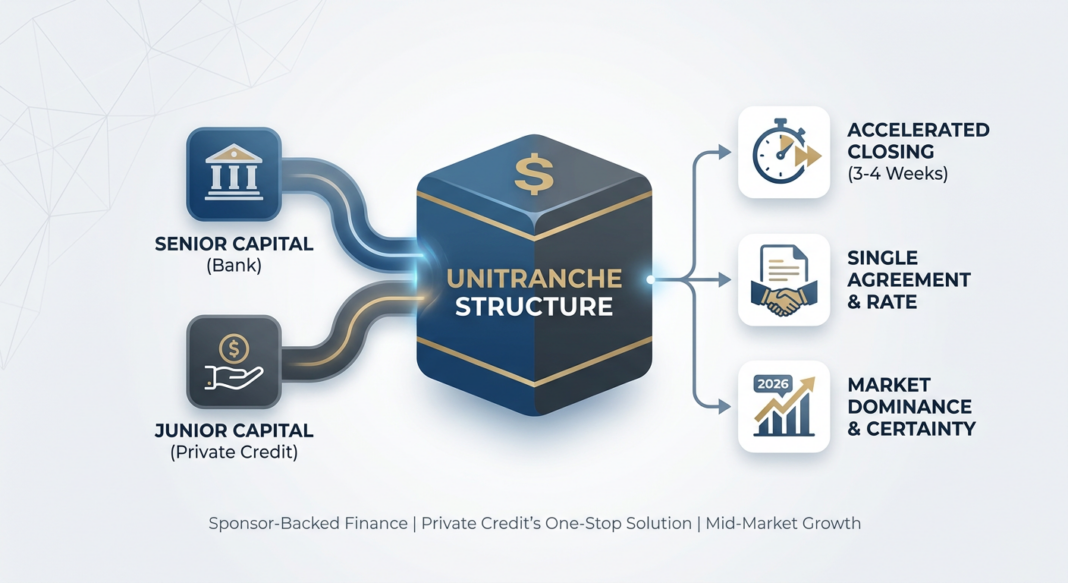
A unitranche loan is a hybrid debt structure that combines senior secured debt and subordinated debt into a single credit facility, governed by one credit agreement, at a single blended interest rate. According to the Corporate Finance Institute, the borrower pays a blended interest rate that falls between what pure senior debt and pure subordinated debt would each cost independently.
From the borrower’s perspective, unitranche debt behaves like a straightforward first-lien term loan; there is a single administrative agent, one covenant package, and one set of reporting obligations. The complexity lives behind the scenes, inside a private document called the Agreement Among Lenders (AAL). The AAL defines how two or more lenders, typically a bank or senior-focused fund as the first-out lender, and a private credit fund as the last-out lender: divide the cash flows, interest, and priority of repayment in a stress or default scenario. As Regions Bank explains, the resulting instrument carries a single interest rate and term, typically five to seven years, even though multiple parties may be providing the capital.
The structure originally emerged in the U.S. in 2005 and gained mainstream traction after the 2008 Global Financial Crisis, as banks retrenched from middle-market cash flow lending. Today, it is the backbone of private credit’s dominance in mid-market buyout finance.
How It Works: A Concrete Example with Numbers
Consider AcquireCo LLC, a private equity-backed business services company with $15 million in EBITDA, being acquired for $120 million (8.0x EBITDA). The sponsor needs $80 million in debt financing (roughly 5.3x leverage) and is contributing $40 million in equity.
Under a traditional two-lien structure, the financing might look like this:
- Senior Term Loan (First Lien): $55 million at SOFR + 375 bps (~9.0% all-in)
- Second Lien or Mezzanine: $25 million at SOFR + 800 bps (~13.0% all-in)
- Two separate credit agreements, two sets of covenants, two closing timelines
- Blended cost: approximately 10.3%, but with weeks of additional execution risk
Under a unitranche structure, the deal looks very different to the borrower:
- Single Unitranche Facility: $80 million at SOFR + 525 bps (~10.5% all-in)
- One credit agreement, one covenant package, one administrative agent
- Close in 3–4 weeks vs. 6–8 weeks for syndication
- Behind the scenes: $50 million first-out (bank, lower yield) / $30 million last-out (private credit fund, higher yield)
The borrower pays approximately 20 basis points more on a blended basis relative to the two-lien structure, but gains deal certainty, speed, and dramatically simplified administration. According to Private Equity Bro, sponsors frequently justify paying 50 to 100 basis points of extra spread over a syndicated alternative when closing 30 to 45 days faster eliminates broken-syndication risk and protects a purchase agreement. As Wall Street Prep notes, a stretch unitranche can also allow a borrower to reach leverage of 6.0x EBITDA in one facility where a traditional senior/junior structure might cap out at 5.0x, a meaningful difference for sponsors seeking to maximize returns.
Current Market Relevance
Unitranche is no longer a niche workaround; it is the defining instrument of a $1.7+ trillion private credit market navigating a pivotal moment in the credit cycle.
According to PIMCO / Preqin (March 2026), North American direct lending AUM has grown roughly sevenfold over the past decade, from $93 billion in 2015 to approximately $644 billion by year-end 2025, with unitranche the dominant structure in that market. Preqin (via Brookfield) projects the broader global private credit market will grow from $1.7 trillion today to $2.64 trillion by 2029.
The bank credit environment is actively pushing borrowers toward private credit channels. The Federal Reserve’s April 2026 SLOOS reported tighter lending standards for C&I loans of all sizes in Q1 2026 and, notably, tighter terms on loans to non-depository financial institutions: including stricter covenants, higher risk premiums, and shorter maturities. In short, banks are not opening the credit spigot for mid-market borrowers.
Meanwhile, the unitranche pricing environment has shifted meaningfully. According to Lord Abbett / PitchBook (June 2026), private credit spreads have widened by approximately 50–100 basis points since late 2025, and new loans are arriving with better credit structures: lower leverage, tighter covenants, and fewer payment-in-kind requests. This represents a “lender-friendly reset” after years of borrower-favorable conditions.
On pricing benchmarks, Private Capital Global / Capstone Partners reported that upper-middle-market unitranche loans were pricing around SOFR + 425–475 bps, implying all-in rates of 9%–10% for top-tier credits, while lower-middle-market loans carry 50–100 bps of additional spread. Separately, Callan (Q2 2025 data) tracked private credit yields compressing from 8.97% in September 2024 to 7.31% by June 2025, reflecting a broad credit rally, though the 2026 spread widening noted by Lord Abbett suggests those lows may have already passed.
| Metric | Data Point | Source |
|---|---|---|
| N. American Direct Lending AUM (YE 2025) | ~$644 billion | PIMCO / Preqin, Mar 2026 |
| Upper-Middle-Market Unitranche All-In Rate | 9%–10% | Private Capital Global / Capstone Partners |
| Spread Widening Since Late 2025 | +50–100 bps | Lord Abbett / PitchBook, Jun 2026 |
| Bank C&I Lending Standards (Q1 2026) | Tighter (all firm sizes) | Federal Reserve SLOOS, Apr 2026 |
| Global Private Credit AUM Forecast (2029) | $2.64 trillion | Preqin / Brookfield, 2025 |
Decision Framework
For Investors Evaluating Private Credit Funds
Investors evaluating funds with significant unitranche exposure consider several structural questions. First-out vs. last-out positioning inside the AAL matters enormously in a stress scenario, a fund holding primarily last-out exposure faces deeper losses in a default waterfall. Investors typically evaluate whether the fund’s stated first-lien label accurately reflects economic priority or merely legal position.
Covenant quality is another key variable. According to McKinsey’s 2026 Global Private Markets Report, covenant-lite structures rose to 21% of direct lending deals in 2025, up from just 4% in 2023, a notable shift toward borrower-friendliness at the upper end of the market. Investors in unitranche-heavy portfolios ask: does this loan contain a maintenance covenant (tested quarterly) or is it cov-lite? A loan without a maintenance covenant removes an early-warning mechanism that might otherwise allow lenders to intervene before value erodes.
Investors also consider the 10-year net IRR benchmark: according to Callan (June 2025), private credit has generated a net IRR of 8.6% over the past decade, outperforming leveraged loans by approximately three percentage points, a spread that validates the illiquidity and complexity premium embedded in unitranche structures.
For Business Owners and Operators Evaluating Financing Options
Operators evaluating unitranche financing weigh cost against certainty. The all-in rate premium over a traditional bank facility is real, often 150–250 basis points, but so are the benefits: one lender relationship, faster closing, no syndication risk, and more flexible covenant structures that allow for add-on acquisitions, management incentive plans, and delayed-draw term loans for future capital expenditures.
Unitranche financing is most compelling for operators when: (1) a transaction timeline is compressed and deal certainty is paramount; (2) the business is below $50 million in EBITDA, a threshold at which traditional bank syndication becomes less available; or (3) a buy-and-build strategy requires pre-committed capital for future acquisitions. As Regions Bank notes, unitranche lenders can provide cash flow-based loans to businesses where banks would typically require hard-asset collateral. Operators should model all-in debt service carefully against projected EBITDA, targeting interest coverage of at least 2.0x–2.5x to maintain adequate headroom on any financial maintenance covenants.
Key Takeaways
- Unitranche = simplicity on the surface, complexity underneath. The borrower sees one loan, one rate, one covenant package. The lenders behind the AAL divide risk and return across first-out and last-out positions invisible to the borrower.
- Speed is the product. The 30–45 day execution advantage over syndicated loans is not incidental; it is the core value proposition, and sponsors consistently pay 50–100 bps of spread to secure it.
- Bank tightening is structural, not cyclical. The Federal Reserve’s April 2026 SLOOS confirms banks continue to tighten C&I lending standards, reinforcing private credit’s structural role as the primary capital source for middle-market borrowers outside the investment-grade universe.
- The lender-friendly reset is real. After years of borrower-favorable conditions, 2026 unitranche deals are arriving with wider spreads (+50–100 bps), lower leverage, and more covenants, a potentially more attractive entry environment for investors deploying new capital.
- Covenant structure determines early-warning power. With covenant-lite structures rising to 21% of direct lending deals in 2025, investors and operators alike should scrutinize whether maintenance covenants are present; they are the mechanism that allows lenders to act before a business reaches default, not after.


