
The Founder Who Controlled the Terms of His Own Capital Story
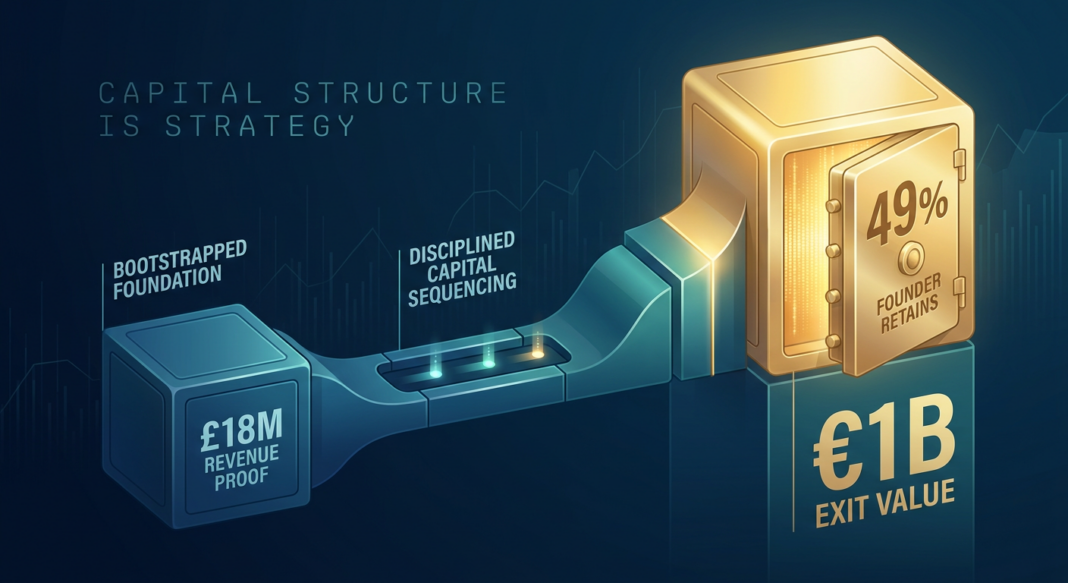
In June 2026, Danone paid €1 billion for Huel, a British complete-nutrition brand that began life as powdered food mixed in a Northamptonshire kitchen. When the distribution waterfall settled, founder Julian Hearn walked away with £420 million personally. That figure represented 49.3% of the total exit proceeds. For a founder who had raised $184 million across three institutional rounds, it was a result that defied almost every convention of how venture-backed consumer brands are supposed to end.
Most founders who raise that volume of capital across three rounds finish with somewhere between 15% and 25% ownership at exit. Hearn finished with nearly half the company. The difference is not luck. It is sequencing, discipline, and a deliberate philosophy about when capital earns the right to enter your business.
The Capital Decision: Bootstrap First, Negotiate From Strength
Huel’s fundraising story is best understood not as a story about raising money, but about choosing when not to. Hearn bootstrapped the company to £18 million in revenue before approaching a single institutional investor. By the time he sat across the table from Series A conversations, he was not pitching a hypothesis. He was presenting a proven operation with demonstrated consumer demand, expanding gross margins, and a direct-to-consumer model that had validated its unit economics without outside capital.
That sequencing is everything. When a founder raises at £500K in revenue, they are selling projected potential at a valuation that reflects how much risk the investor is absorbing. When a founder raises at £18 million in revenue, pricing power shifts. Investors are no longer funding a bet; they are buying into demonstrated performance, and the founder controls the conversation.
Hearn also raised only what was operationally necessary at each stage, resisting the common founder temptation to take the full amount institutional investors were willing to offer. Each round diluted him, but each round was sized against a specific capital need, not against the maximum available market enthusiasm. The result, documented in Companies House filings and analysed by creatorsblueprint.co, was a cap table that arrived at exit with the founder still owning 49.3% after $184 million raised, a structural outcome almost without precedent in consumer DTC at this scale.
The Business Hearn Built While Others Burned Cash
The equity story is only half the picture. The other half is what Huel’s capital discipline enabled operationally. While VC-backed DTC competitors were spending aggressively on paid acquisition to chase growth metrics ahead of their next funding round, Hearn built a business around contribution margin and unit economics. He pursued vertical integration, manufacturing control that expanded gross margins over time rather than eroding them. He pushed into omnichannel retail, reducing dependency on the volatile economics of pure DTC. He built a subscription base that created predictable revenue rather than relying on continuous top-of-funnel spend.
By the time revenue growth had moderated to approximately 17% in the period preceding the Danone deal, something unusual had happened: Huel’s margins had improved. The business was generating real EBITDA. That combination (brand equity, improving margins, and a sticky subscription base) is precisely what strategic acquirers pay premium multiples for. Danone paid approximately 17–20× EBITDA for a company whose growth had slowed, as reported by bondtv.vaultai.ca. That premium is a direct dividend on a decade of capital discipline.
The Counterfactual: What Over-Dilution Would Have Cost
The most instructive way to read Hearn’s outcome is to model the alternative. A founder who raises the same $184 million but on a more conventional VC-backed dilution schedule (earlier, larger, at lower valuations) arrives at exit owning between 15% and 20%. On a €1 billion exit, that is a personal outcome of €150M–€200M. Hearn’s 49.3% produced £420 million. The difference, north of £220 million, is the compounded cost of early, unnecessary dilution. It is not a marginal rounding error. It is the entire difference between generational wealth and genuinely historic wealth.
This is the core principle that too few founders internalise until it is too late: equity dilution is not a one-time transaction cost. It is a compounding loss that multiples with every year the business grows and with every turn of valuation multiple at exit. Every percentage point surrendered in a Series A at a £10M valuation has a present value at exit that is an order of magnitude larger than it appeared at the time.
Capital Structure Is Strategy: Not Just Finance
The broader lesson Hearn’s story surfaces is one that applies beyond DTC consumer brands. As noted in analysis from inthemoneyhq.com, how a business is financed is increasingly as important as what the business does. Founders and operators who treat capital structure as a strategic variable, rather than a necessary administrative task, consistently outperform those who raise reactively or raise to signal momentum.
Hearn’s approach rhymes with what we are seeing more broadly in the market. General Catalyst’s Customer Value Fund recently deployed $360 million into Musely on a non-dilutive revenue-share basis because the founder, having bootstrapped to sustained profitability, refused to trade equity for growth capital he didn’t need to give equity for, as detailed by lazytechtalk.com. The tools are different. The underlying principle is identical: founders with proven cash flows have alternatives to equity dilution, and the ones who know that (and use it) retain dramatically more of what they build.
The Framework for Founders Facing Similar Decisions
Not every founder can bootstrap to £18M before raising. But the sequencing principle is universally applicable. The questions worth asking before any capital raise are: What is the minimum capital required to reach the next inflection point? What is the current cash flow profile of the business, and does it support non-dilutive alternatives? Am I raising equity because it is the right instrument, or because it is the most visible one?
Founders with demonstrated, recurring cash flows have access to non-dilutive structures (revenue-based financing, unitranche debt, leveraged dividend recaps) that the conventional startup narrative largely ignores. The founders who ignore them give away equity they never needed to give. The founders who use them arrive at exit owning the business they built.
Julian Hearn arrived at exit owning 49.3% of his. The market paid €1 billion for it. The maths did the rest.
Key Insights
- Bootstrapping to revenue proof is worth millions at exit: Raising at £18M in revenue instead of £1M shifted pricing power entirely toward Hearn and compressed dilution across every subsequent round.
- Raise what you need, not what you can get: The temptation to maximise a round’s size is a dilution trap. Sizing to operational need rather than market appetite preserved Hearn’s cap table across three rounds.
- Equity dilution compounds inversely to ownership: Every point surrendered early multiples with valuation and exit multiple over time. The cost of over-dilution is not visible at the time of signing; it materialises entirely at exit.
- Margin discipline creates strategic premium at exit: Danone paid 17–20× EBITDA for a brand growing at 17%, because improving margins at scale signal a business that will throw off cash for decades, not just grow quickly for two years.
- Non-dilutive capital is increasingly accessible to profitable founders: From revenue-share structures like General Catalyst’s CVF to unitranche private credit, founders with proven cash flows no longer need to default to equity, if they know where to look.


