
The Underwriting Question Every Credit Agreement Must Answer
A middle-market borrower presents a $10 million EBITDA manufacturing business, three years of audited financials, a credible management team, and a logical acquisition rationale. The deal pencils at 4.5x senior leverage in the base case. The question every credit underwriter must answer before closing is not whether the business can service its debt today; it is whether the lender will receive adequate warning, and adequate structural protection, if the business deteriorates two years from now.
That answer lives in the covenant package. Covenants are the contractual architecture that converts a lender’s underwriting thesis into enforceable rights: the right to demand information, the right to block incremental debt, and critically, the right to act before a payment default occurs. Yet covenant quality has compressed meaningfully across cycles. The rise of covenant-lite structures in the broadly syndicated loan market has gradually influenced documentation expectations in direct lending, making disciplined covenant design a genuine competitive differentiator for lenders who prioritize capital preservation over deal velocity.
This framework walks through how to design, calibrate, and monitor financial maintenance covenants in middle-market credit, from initial structuring through ongoing portfolio surveillance.
The Framework: What a Covenant Package Must Do
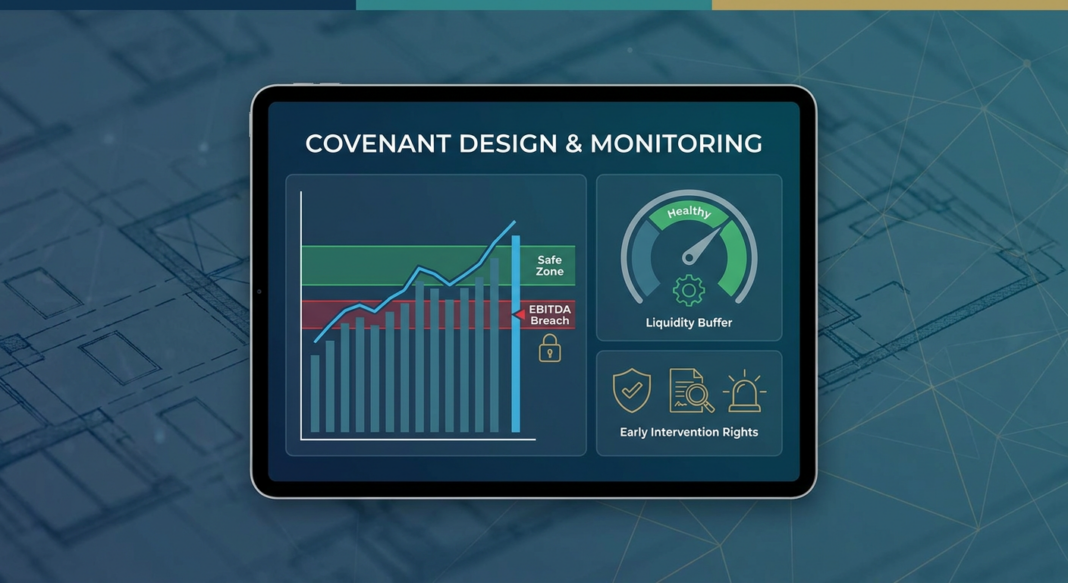
A well-constructed covenant package performs three distinct functions simultaneously. First, it constrains behavior: limiting the borrower’s ability to incur additional debt, make restricted payments, dispose of material assets, or enter into affiliate transactions without lender consent. Second, it generates information: requiring periodic financial reporting, compliance certificates, and notice of material events that would otherwise remain invisible to the lender. Third, and most importantly, it creates an early intervention right: triggering a technical default at a metric threshold that still allows meaningful negotiation and restructuring before liquidity is fully exhausted.
Institutional credit underwriters, as described in OCC guidance on rating credit risk, view sound underwriting as the coordination of repayment with cash flow, covenants, and collateral in a unified structure. Covenants that are set too loosely fail to trigger before a borrower becomes insolvent. Covenants set too tightly create unnecessary technical defaults that damage the lender-borrower relationship without reflecting genuine credit deterioration.
The three covenants most commonly used in middle-market senior secured credit are:
- Maximum Total Leverage (Net Debt / EBITDA): Caps the borrower’s indebtedness relative to cash earnings. Typical closing levels for sponsored middle-market credits range from 4.5x to 5.5x senior, stepping down by 0.25x–0.50x per year.
- Minimum Fixed Charge Coverage Ratio (FCCR): Measures the borrower’s ability to service all fixed obligations (interest, scheduled amortization, capital leases, and sometimes taxes) from operating cash flow. Institutional lenders typically require a minimum of 1.10x to 1.25x.
- Minimum Liquidity: A floor on unrestricted cash or revolver availability, particularly useful in businesses with seasonal working capital swings. Often set at $1–2 million or 10% of the revolving commitment.
For a $10 million EBITDA manufacturing company with $45 million in senior debt, the leverage covenant at close would be set at 4.5x, but the actual opening metric is already 4.5x, which means any EBITDA erosion immediately threatens a breach. This is why headroom calibration is the most consequential covenant decision made at underwriting.
The Analysis: Calibrating Headroom and Running the Stress
Covenant headroom is the percentage buffer between the borrower’s actual metric at close and the covenant trigger level. As noted in Bond Capital’s own stress testing framework, institutional lenders typically require 20–30% headroom in the base case so that normal operating variance does not trigger an immediate breach.
Applying that standard to our example:
Covenant Headroom Calculation: $10M EBITDA Manufacturing Borrower
| Metric | At Close (Actual) | Covenant Trigger | Headroom |
|---|---|---|---|
| Total Leverage (Net Debt / EBITDA) | 4.50x | 5.50x | ~18% EBITDA decline before breach |
| FCCR (Operating CF / Fixed Charges) | 1.45x | 1.15x | ~21% cushion above trigger |
| Minimum Liquidity | $3.2M | $1.0M | $2.2M buffer |
The stress test applies a 20% revenue decline with 200 basis points of margin compression, a plausible cyclical scenario for a capital goods manufacturer. Under that scenario, EBITDA compresses to approximately $7.8 million, pushing leverage to 5.77x, which breaches the 5.50x trigger. This is precisely the outcome the covenant is designed to produce: the lender obtains a technical default and enforcement rights before the borrower exhausts liquidity or misses a cash interest payment.
The critical underwriting lesson: if the stress scenario does not produce a covenant breach, the covenant is set too loosely to be useful as an early warning mechanism. As emphasized in DLP Capital’s analysis of disciplined underwriting, rigorous lenders build structure on the assumption that deterioration will occur, and require detailed downside modeling before committing capital.
Industry Standards: What Institutional Lenders Require
Corporate bond and private credit analysis at the institutional level, as described by CFA practitioners, requires covenant review to assess protective provisions and enforcement mechanisms, particularly for high-yield and below-investment-grade credits where covenant protections vary dramatically between issues. The analytical standard is not merely whether covenants exist, but whether they are set at levels that generate actionable intervention rights in realistic stress scenarios.
Due diligence in bond underwriting, as defined by the Asian Development Bank’s bond market framework, requires a thorough investigation of financial and management status to assess credit risk, a standard that applies equally to covenant design, where the underwriter must understand the business’s operational variability before setting trigger levels.
Common Red Flags in Covenant Structures:
- EBITDA add-back abuse: Covenant compliance calculated on an adjusted EBITDA that includes aggressive run-rate synergies, non-recurring items, or management projections rather than trailing actuals. This artificially widens headroom on paper while masking true credit deterioration.
- Excessive equity cure rights: Cure provisions that allow sponsor equity injections to remedy repeated covenant breaches without addressing the underlying operational problem. Institutional lenders typically limit cures to two per rolling four-quarter period.
- Carve-outs that swallow the rule: Debt incurrence baskets, investment permissions, and restricted payment carve-outs that are so broad they effectively eliminate the protective function of the negative covenants.
- Reporting lag: Compliance certificates that are due 60–90 days after quarter-end, meaning a lender may not learn of a covenant breach until four to five months after the underlying metric deteriorated.
Credit Performance Reference Points
- Middle-market loan default rates have historically ranged from 2% to 6% annually across cycles, with recovery rates on senior secured credits averaging 65–75% in orderly restructurings, according to data tracked by S&P and Moody’s in their annual default and recovery studies.
- Covenant-lite loans, which carry incurrence-only rather than maintenance covenants, have demonstrated materially wider loss-given-default outcomes in distressed cycles, as borrowers can deteriorate further before lenders obtain intervention rights.
- Institutional direct lenders, as surveyed by Cliffwater in its quarterly BDC reporting, consistently cite covenant headroom and documentation quality as primary factors distinguishing performing portfolios from those requiring active restructuring.
The Covenant Underwriting Checklist
Before committing capital, every senior credit underwriter should work through the following diligence points on the covenant package:
- Headroom Verification: Is there at least 20% cushion between the opening metric and each covenant trigger? Has this been verified on a trailing twelve-month basis using audited or quality-of-earnings-adjusted figures, not management projections?
- Stress-Tested Breach: Does the primary downside scenario (15–25% revenue decline, 150–250 bps margin compression) produce a covenant breach before a payment default? If not, the covenant triggers are too loose.
- EBITDA Definition Audit: What add-backs are permitted in the covenant EBITDA definition? Are they time-limited? Are synergies capped as a percentage of actual EBITDA? Are non-recurring items genuinely non-recurring based on historical precedent?
- Equity Cure Limitations: Are cure rights limited in frequency and amount? Does the agreement prohibit curing the same covenant in consecutive periods without structural remedy?
- Reporting Cadence: Are quarterly compliance certificates due within 45 days of period-end? Does the lender receive monthly management accounts for credits at or above 3.5x leverage?
- Negative Covenant Basket Review: Have debt incurrence, investment, and restricted payment baskets been sized against the borrower’s actual balance sheet? Do builder baskets have earnings-based governors that prevent compounding through adverse cycles?
- Cross-Default Provisions: Is there a cross-default to material indebtedness at an appropriate threshold? Does the agreement include a change of control put at par?
Key Takeaways for Credit Underwriters
- Covenants are early warning systems, not payment guarantees. A well-calibrated covenant package gives the lender intervention rights while the borrower still has liquidity to negotiate; this is the primary mechanism for improving recovery outcomes in a restructuring.
- Headroom at close determines covenant utility. Setting triggers too close to the opening metric creates nuisance defaults; setting them too loose eliminates the warning function entirely. The institutional standard of 20–30% cushion reflects decades of credit cycle experience.
- EBITDA definition quality is as important as the trigger level. A 5.50x leverage covenant calculated on aggressively adjusted EBITDA may provide less protection than a 5.00x covenant calculated on conservative trailing actuals.
- Stress testing must be covenant-aware. Every downside scenario should explicitly model the covenant metric, not just free cash flow, so the underwriter knows whether the structure generates an intervention right in the relevant stress environment.
- Monitoring is underwriting continued. Covenant compliance certificates should be reviewed with the same analytical rigor as the original underwriting model, with variance from projections flagged and investigated at every reporting period, not just when a breach is imminent.


