
The Reset Is Real, But It Is Structural, Not Just Cyclical
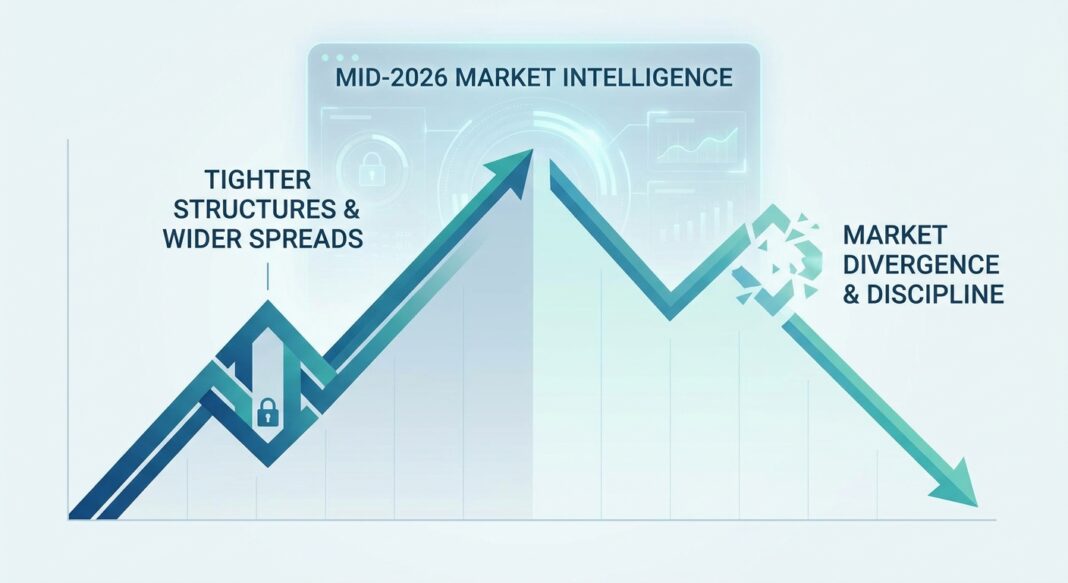
The most consequential development in credit markets at the midpoint of 2026 is not the spread movement alone; it is what the spread movement is signalling beneath the surface. Private credit has entered what practitioners are calling a lender-friendly reset: a regime shift in which capital has become more selective, documentation has tightened, and the balance of negotiating power has pivoted back toward lenders for the first time since the post-pandemic origination surge of 2021–2022.
According to lordabbett.com, middle market private credit spreads have widened by roughly 50 to 100 basis points since late 2025, while new loan structures are arriving with materially stronger credit features: fewer payment-in-kind (PIK) requests, less aggressive leverage, more maintenance covenants, and tighter documentation packages. This is the early-stage signature of a mid-to-late credit cycle adjustment, one in which managers with dry powder and underwriting discipline are positioned to capture better risk-adjusted returns on new originations, while portfolios carrying concentrated 2021–2022 vintage exposure face increasing mark and non-accrual pressure.
Simultaneously, invexhuby.com reports that Federal Reserve enhanced supervisory guidance enacted in Q1 2026 now requires larger bank holding companies to maintain stricter concentration limits on below-investment-grade corporate exposures. The regulatory tightening is not marginal: investment grade spreads have widened to approximately 340 basis points above U.S. Treasuries in mid-2026, versus 220 basis points in early 2025, a 120 bps move that reflects both deteriorating credit conditions and reduced primary dealer appetite. For middle market direct lenders operating outside the bank regulatory perimeter, this retreat creates a structural origination opportunity that extends well beyond any single rate cycle.
Quantitative Market Snapshot: Key Credit KPIs, Mid-2026
| Metric | Current (Q2 2026) | Prior Period | Source |
|---|---|---|---|
| Middle Market Private Credit Spreads | +50 to +100 bps wider | Late 2025 tights | lordabbett.com (PitchBook data) |
| S&P Leveraged Loan Index Spread | ~487 bps | Post-Liberation Day (April 2025) highs | abfjournal.com |
| Investment Grade Spreads vs. UST | ~340 bps | 220 bps (early 2025) | invexhuby.com |
| Private Credit Non-Accrual Rate | 1.4% (Q1 2026) | Below 1% (2023–2024 avg.) | heronfinance.com (Heron Finance Q2 2026) |
| PIK Interest as % of Portfolio | 3.9% (Q1 2026, marginal decrease) | ~4.1–4.3% (Q3–Q4 2025) | heronfinance.com (Heron Finance Q2 2026) |
| Avg. Loan-to-Value (LTV), Private Credit | ~40% (first lien, ~90% of book) | Stable, no material drift (3-yr trend) | heronfinance.com (Heron Finance Q2 2026) |
| Fund-Level Debt/Equity (BDC leverage) | 1.0x | Trending up; 1.2x flagged as stress threshold | heronfinance.com (Heron Finance Q2 2026) |
| IG Secondary Bid-Ask Spread | 8–14 bps | 4–6 bps (early 2025) | invexhuby.com |
Critically, portfolio-level Debt/EBITDA ratios have shown no material upward drift over the past three years, and LTV ratios remain conservative across segments: evidence that the broader private credit complex, whatever the vintage-specific stress, has not yet abandoned underwriting discipline on new originations, per heronfinance.com. Interest coverage ratios (EBITDA/interest) have marginally improved year-over-year due to lower base rates and modest EBITDA growth, though this relief is eroding as the Fed’s higher-for-longer posture reasserts itself against borrowers who underwrote a SOFR path toward 3%.
Sector Lender Appetite: Where Capital Is Moving, and Where It Is Pulling Back
Technology & Software: Selective, Not Shut
Software-related credits, particularly those financed aggressively during the 2021–2022 vintage surge, are under the most direct pressure. lordabbett.com flags that portfolios with older software vintages are showing the earliest signs of non-accrual differentiation. However, wellington.com notes that AI-related disruption fears have over-punished certain technology and software issuers in both high yield and bank loan markets, creating selective entry points for disciplined buyers. Lender appetite remains bifurcated: established SaaS platforms with strong recurring revenue and tight documentation are clearing at improved terms, while growth-stage and leveraged-buyout software credits face materially higher hurdle rates and covenant requirements.
Industrials & Consumer: Restructuring Pipeline Builds
Energy costs and a strained consumer are pressuring the weakest balance sheets in industrial and consumer-facing sectors. abfjournal.com cites the West Marine restructuring as emblematic of a broader consumer-sector stress pattern: floating-rate debt underwritten against an easing scenario now carries heavier-than-projected debt service, and fixed-charge coverage ratios are thinning in the lower middle market. ABL structures with verified collateral are seeing renewed lender interest as a defensive posture in this segment.
High Yield & Broadly Syndicated: Dispersion Widens
Wellington’s mid-2026 credit outlook identifies high yield, emerging markets, convertible bonds, and securitized credit as the most appealing public credit sectors entering H2 2026. Bank loans have shifted from relatively unattractive to more compelling as spreads have widened and dispersion has increased. Critically, wellington.com warns that broad index spreads have largely retraced their earlier widening, meaning the real opportunity lies in sub-index credit selection, particularly in names where market fear has outpaced fundamental deterioration.
Middle Market M&A: Quietly Recovering
Against this backdrop, middle market M&A deal flow is quietly recovering, according to abfjournal.com. This is creating incremental origination volume for direct lenders with committed, locked-up capital, precisely the counterparties sponsors are seeking when the broadly syndicated market is skittish. The CLO machine remains well-stocked after a record $472 billion in full-year 2025 U.S. broadly syndicated CLO issuance, but the buyside is growing more selective, reinforcing the structural advantage of relationship-oriented direct lending at current spreads.
Implications for Institutional Investors and Business Operators
For Institutional Investors
The data supports a view that new capital deployed into private credit today enters a structurally superior environment compared to six to twelve months ago, not primarily because spreads are wider (though they are), but because the underlying loan architecture has improved. Fewer PIK features, tighter covenants, and conservative LTVs (~40%) mean the first-loss cushion on new originations is meaningful. heronfinance.com projects realized losses to remain below the asset class’s approximately 1% annual historical loss rate even as non-accruals tick higher, given the defensive first-lien positioning of roughly 90% of the institutional book. Fund-level leverage at 1.0x warrants monitoring, the 1.2x threshold identified as a stress amplifier should serve as a portfolio-level red line for due diligence purposes.
For Business Operators and Borrowers
The operating environment is unambiguous: the easing scenario is off the table. Borrowers that modeled SOFR drifting toward 3% in H2 2026 are now servicing debt materially above those projections, per abfjournal.com. Fixed-charge coverage ratios will thin across the lower middle market as base rates remain anchored near 4.50%. Refinancings and dividend recaps now carry a higher hurdle, and operators should anticipate covenant headroom compression in floating-rate credit structures. The practical response: prioritize cash flow predictability, maintain conservative leverage metrics, and engage lenders early, before covenant tests tighten rather than after.
Forward-Looking View: H2 2026 Liquidity and Lending Dynamics
The next three to six months will likely be defined by three forces operating simultaneously. First, portfolio differentiation will accelerate: non-accruals, PIK usage, sector concentration, and vintage exposure will increasingly separate top-quartile from bottom-quartile managers, and institutional allocators will begin to price that dispersion into capital allocation decisions. Second, the bank regulatory retreat will deepen: with the Fed, ECB, and Bank of England all signalling continued supervisory tightness through at least late 2027, the structural opportunity for non-bank direct lenders is not a temporary rate-cycle phenomenon; it is a multi-year market share transfer. Third, credit selection, not beta, will drive returns: with broad index spreads having retraced much of their widening in public markets, the marginal dollar of return in both high yield and private credit will come from issuer-level differentiation rather than market-level exposure. As wellington.com summarises, the best opportunities are in credits where fear has moved further than fundamentals, a characterisation that applies equally to selective corners of both public and private credit at mid-year 2026.
Key Market Insights
- Spread widening is the headline; structural improvement is the story. Private credit spreads are 50–100 bps wider since late 2025, but the more durable shift is in loan architecture: fewer PIK features, more covenants, and tighter documentation on new originations signal genuine lender discipline, not just repricing.
- Non-accruals at 1.4% are elevated but manageable, for now. The ~40% average LTV and ~90% first-lien composition of institutional private credit portfolios provide meaningful loss absorption capacity, but lower-middle-market and 2021–2022 vintage software concentrations warrant active monitoring.
- Bank regulatory retreat is structural, not cyclical. Q1 2026 Fed supervisory guidance tightening concentration limits on sub-investment-grade corporate exposure is accelerating direct lender market share gains in a way that will persist regardless of the rate cycle.
- FCCR compression is the borrower-side risk to watch in H2 2026. With SOFR anchored near 4.50% and the easing thesis invalidated, floating-rate borrowers face materially higher debt service than underwriting models projected, covenant headroom will thin, and operators should stress-test coverage ratios at current rates immediately.
- Dispersion, not duration, is the primary credit market theme. Broad index spreads in public credit have largely retraced. Alpha in both high yield and private credit will come from sub-index credit selection, specifically in sectors and issuers where market pricing has over-corrected relative to fundamental credit quality.


