
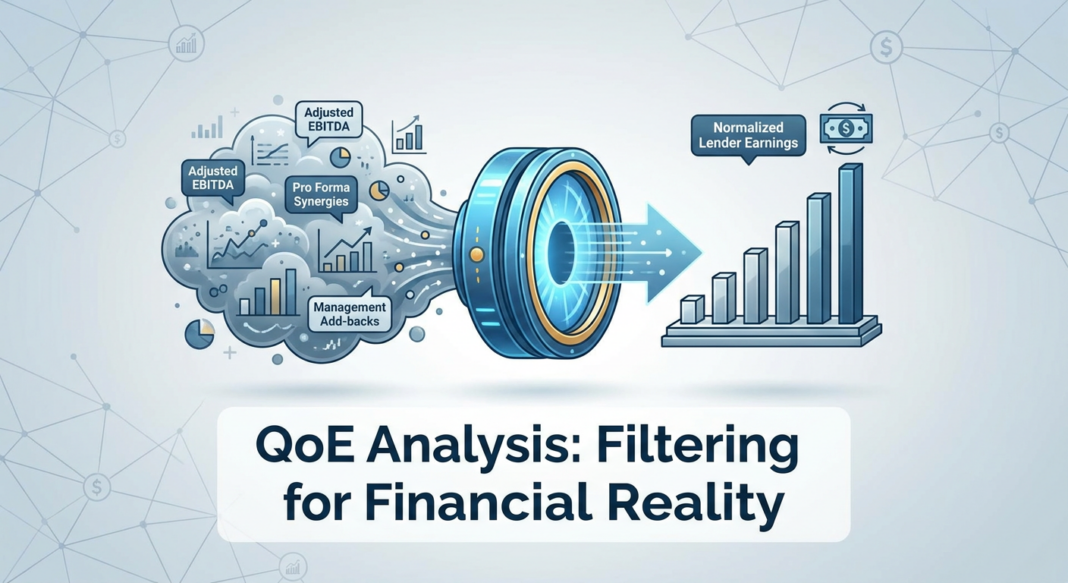
The Underwriting Question Every Credit Analyst Must Answer First
Before a middle-market lender prices a loan, negotiates a covenant, or models a debt service coverage ratio, one foundational question must be answered with precision: Is the EBITDA real?
In private credit, the answer is rarely a clean yes or no. Borrowers (and their sell-side advisors) present Adjusted EBITDA figures that layer in management add-backs, cost synergies, pro forma acquisitions, and one-time expense exclusions. The cumulative effect is often a reported EBITDA that materially overstates the recurring, normalized cash earnings available to service debt. As noted by institutional credit practitioners, structural weaknesses embedded at close, including inflated EBITDA baselines, do not immediately impair performance, but they dramatically increase the probability and severity of future credit problems. As the occ.gov Comptroller’s Handbook on credit risk rating makes clear: sound underwriting coordinates repayment with actual cash flow, and when lenders accept optimistic assumptions under competitive pressure, credit risk silently accumulates.
A Quality of Earnings (QoE) analysis is the mechanism that separates reported EBITDA from lender EBITDA, and it is the first analytical discipline any serious credit team must apply before a loan is sized.
The Analytical Framework: Four Layers of EBITDA Scrutiny
A rigorous QoE analysis does not simply accept or reject management’s adjustments. It dissects earnings across four structural layers, each designed to stress-test a different dimension of reported profitability.
Layer 1: Revenue Quality and Recurrence
The starting point is revenue. Not all revenue is equal. Lenders must identify what share of trailing twelve-month (TTM) revenue is contractually recurring, what share is project-based or non-repeating, and whether any revenue was pulled forward through channel stuffing, extended payment terms, or one-time events. Concentration risk compounds this analysis: if the top three customers represent more than 30% of revenue, the lender is underwriting customer retention as much as financial performance.
Layer 2: EBITDA Add-Back Scrutiny
This is where credit discipline is most frequently tested. Management add-backs typically include restructuring charges, non-cash compensation, litigation costs, and transaction fees. Each requires independent verification. The critical question is not whether a cost was genuinely non-recurring; it is whether the business can actually operate without incurring that cost again. A disciplined lender maps every add-back against the credit agreement’s EBITDA definition and flags any gap exceeding 15–20% of unadjusted EBITDA for credit committee escalation, a threshold supported by structured credit practitioners publishing on covenant design and monitoring at bondtv.vaultai.ca.
Layer 3: Margin Trend and Cost Structure Analysis
EBITDA is a function of both revenue and cost structure. A QoE that validates revenue without examining margin sustainability is incomplete. Lenders should build a three-year monthly bridge of gross margin, EBITDA margin, and SG&A as a percentage of revenue to identify structural cost creep, margin compression cycles, or artificial margin expansion through deferred maintenance. Cost stickiness, the tendency for fixed costs to persist even as revenue contracts, is a central input into downstream cash flow stress testing.
Layer 4: Working Capital Normalization
EBITDA does not equal cash flow. A company that generates $10M of EBITDA but consumes $3M annually in working capital growth delivers meaningfully different debt service capacity than its headline number implies. Lenders must normalize working capital across seasonal peaks and troughs, identify any one-time working capital improvements embedded in the measurement period, and confirm that the net working capital peg in the purchase agreement aligns with historical operating norms.
Walking Through the Numbers: A $10M EBITDA Manufacturing Example
Consider a hypothetical $10M EBITDA industrial manufacturer being underwritten for a $55M senior secured term loan at 5.5x leverage. Management presents Adjusted EBITDA of $10.0M, which includes the following add-backs:
- $800K: Non-recurring facility consolidation costs (two consecutive years)
- $600K: Stock-based compensation (ongoing program)
- $400K: Pro forma synergies from a tuck-in acquisition closed 90 days ago (unverified)
- $300K: Management fees paid to sponsor (ceasing at close)
Applied QoE scrutiny yields the following adjustments:
- Facility consolidation costs: Rejected: two consecutive years of the same cost is not non-recurring. Recast as recurring SG&A. Impact: -$800K.
- Stock-based compensation: Partially accepted: non-cash, but ongoing. Lender EBITDA excludes it from cash flow modeling for DSCR purposes. Impact: -$600K for coverage calculation.
- Pro forma synergies: Rejected: unearned, unverified, and based on management projection with no third-party validation. Impact: -$400K.
- Management fees: Accepted: genuinely ceasing at close and verifiable in the sponsor agreement. Impact: $0 adjustment.
Lender-adjusted EBITDA: $8.2M. At $55M debt, true leverage is 6.7x: not 5.5x. The difference determines whether this is a fundable credit or a pass.
This type of structural gap is precisely why disciplined lenders, as observed by dlpcapital.com, commit to structure rather than relying on management forecasts, and why QoE is a prerequisite, not an afterthought, in credit approval.
Industry Standards and Credit Performance Benchmarks
Institutional credit teams increasingly treat QoE analysis as a gating item, not a confirmatory exercise conducted after term sheets are issued. The evidence for this discipline is structural:
- PGIM’s large-cap private credit analysis, published in January 2026, identified tighter security documentation and more rigorous fundamental underwriting as key differentiators producing lower default rates and higher recovery rates in well-underwritten portfolios. Source: pgim.com.
- Institutional lenders targeting middle-market direct lending typically require a minimum 20–30% covenant headroom at close between the measured metric and the covenant trigger, a buffer that must be calibrated against lender-adjusted EBITDA, not the borrower’s adjusted figure. Source: bondtv.vaultai.ca.
- The OCC’s credit risk rating framework explicitly identifies reliance on optimistic assumptions as a structural underwriting weakness that increases both the probability and severity of future impairment, regardless of near-term performance. Source: occ.gov.
QoE Underwriting Checklist: Before the Credit Memo Is Written
- Obtain three years of audited financials plus trailing twelve-month management accounts. Do not underwrite from a CIM alone.
- Build a monthly revenue bridge identifying contractually recurring vs. project-based revenue. Flag any customer representing more than 15% of TTM revenue.
- Map every EBITDA add-back against the credit agreement’s EBITDA definition. Quantify the delta between reported Adjusted EBITDA and independently derived lender EBITDA.
- Reject unverified pro forma synergies from acquisitions closed within the trailing twelve months unless supported by integration milestones and third-party validation.
- Normalize working capital across at least two full seasonal cycles. Identify and exclude one-time working capital benefits from the measurement period.
- Stress-test margins by applying a 150–300 basis point EBITDA margin compression to reflect cost stickiness in a revenue contraction scenario, consistent with downside modeling standards published at bondtv.vaultai.ca.
- Confirm maintenance capex is fully reflected in free cash flow calculations. Treat it as fixed, not discretionary, in all downside scenarios.
- Size leverage on lender-adjusted EBITDA only. If the gap between management EBITDA and lender EBITDA exceeds 20%, escalate to credit committee before issuing a term sheet.
Key Takeaways
- ✅ EBITDA is a starting point, not a conclusion. Every add-back must be independently verified and tested for genuine non-recurrence before it qualifies for lender credit.
- ✅ Revenue quality is as important as revenue volume. Contractual recurrence, customer concentration, and payment term normalization must precede any earnings analysis.
- ✅ The delta between management EBITDA and lender EBITDA is itself a risk signal. A gap exceeding 15–20% warrants credit committee escalation regardless of overall deal quality.
- ✅ Working capital is a silent cash consumer. QoE that excludes working capital normalization will systematically overstate free cash flow available for debt service.
- ✅ Disciplined underwriting commits to structure over forecasts. As DLP Capital and institutional practitioners consistently demonstrate, lenders that operate conservatively inside cycle norms (and stress-test earnings rigorously at origination) produce more consistent recovery outcomes across market cycles.


