
Bond Capital, Market & Sector Intelligence | June 19, 2026
Private Credit’s Lender-Friendly Reset: Spreads Widen, Standards Tighten, and Sector Divergence Accelerates
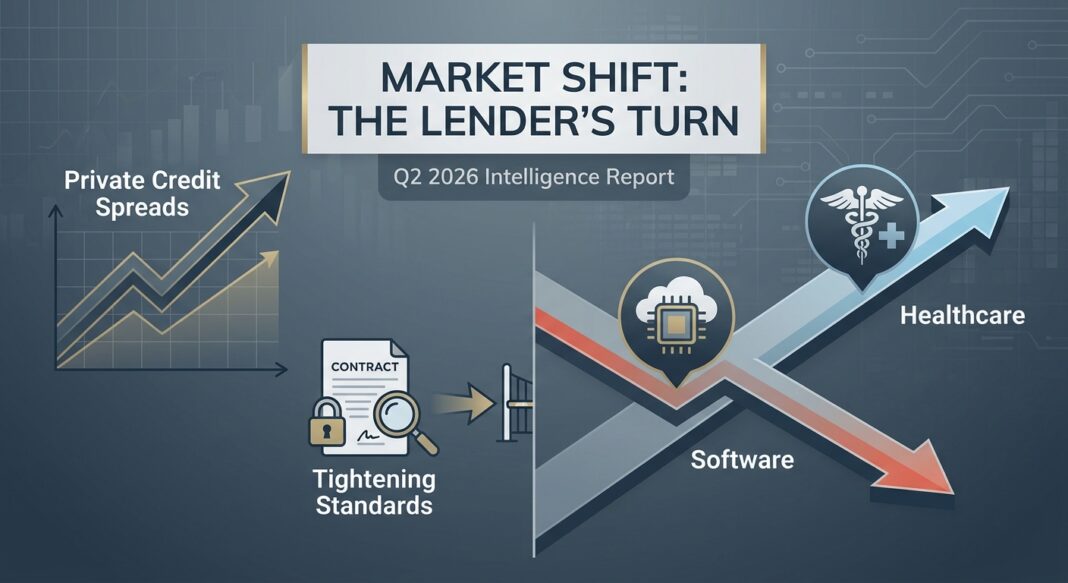
After two years of borrower-friendly compression, the private credit cycle has turned. Bank lending standards are tightening, direct lending spreads are repricing upward, and a wave of PIK stress and BDC redemptions is forcing the market into a new phase of underwriting discipline. For institutional investors and operators, the second half of 2026 will reward preparation and penalize complacency.
Market Headline: The Cycle Has Turned
Private credit entered 2026 at what many institutions described as its most consequential inflection point in years. After a prolonged period where abundant capital chased limited deal flow (compressing spreads, loosening covenants, and inflating leverage multiples) the supply-demand equation has meaningfully shifted. According to Lord Abbett’s 2026 Midyear Investment Outlook, spreads have widened by roughly 50 to 100 basis points since late 2025, while lenders report improving documentation and more conservative leverage terms, a structural reversal from the borrower-friendly conditions that had dominated since 2022.
The catalyst was a convergence of shocks: a sharp AI-driven reassessment of software credit quality, geopolitical disruption from the U.S.-Iran military conflict in late February 2026, and a wave of redemption requests at non-traded business development companies (BDCs) that exposed structural liquidity mismatches in the retail-facing segment of the market. Valuation Research Corporation’s Q1 2026 Middle Market Credit Update noted that primary market activity effectively stalled late in Q1 as these converging forces pushed credit markets back into price discovery mode.
Simultaneously, the Federal Reserve’s April 2026 Senior Loan Officer Opinion Survey (SLOOS) confirmed that bank credit conditions are not loosening to compensate. Tighter bank C&I standards have now persisted across two consecutive survey cycles, leaving middle-market borrowers increasingly dependent on private lenders, at a moment when those lenders are becoming more selective, not less. The result is a market that, as of mid-2026, structurally favors disciplined lenders with available dry powder over borrowers accustomed to favorable terms.
Quantitative Market Snapshot
The data below reflects current conditions as of Q2 2026, sourced from publicly available institutional publications, the Federal Reserve, and major private credit benchmarks. All figures are cited individually.
| Metric | Current Value | Prior Period | Direction | Source |
|---|---|---|---|---|
| Middle Market Direct Lending Unitranche Spreads (typical range) | SOFR + ~475–550 bps | SOFR + ~450–500 bps (Q4 2025) | ▲ Wider | Lord Abbett / PitchBook LCD, June 2026 |
| Broadly Syndicated / High Yield Loan New Issue Spread Change | +15–30 bps on new issues vs. Q4 2025 | Q4 2025 benchmark | ▲ Wider | Northleaf Capital Q1 2026 Market Update |
| US High Yield OAS (ICE BofA Master II) | ~278 bps (June 12, 2026) | Near historic tights | ▲ Monitoring | YCharts / ICE BofA via FRED, June 2026 |
| Net % of Banks Tightening C&I Standards (Large & Mid-Market Firms) | +8.1% net tightening (Q2 2026) | Also tighter in Q1 2026 | ▲ Tighter | Federal Reserve FRED / SLOOS, May 2026 |
| Cliffwater Direct Lending Index (CDLI) Annual Return | 9.3% (FY 2025); 20-yr avg: 9.5% | In-line with historical average | ▶ Stable | Cliffwater, March 2026 |
| PIK Income as % of Total Private Credit Interest Income | ~11% of market (end-2025); “bad PIK” at 6.4% | ~5% in early 2022 | ▲ Rising / Stress Signal | Lincoln International / MEXC, March 2026 |
| Direct Lending Interest Coverage Ratio (FCCR proxy) | ~2.0x (direct lending borrowers) | ~4.0x (public market borrowers) | ▶ Stable but Thin | J.P. Morgan Private Bank / Cliffwater, February 2026 |
Table reflects most recently available public data as of June 19, 2026. Spread ranges are indicative based on cited sources and may vary by deal size, structure, and sponsor quality. This table is for informational purposes only.
Several dynamics stand out. First, Northleaf Capital’s Q1 2026 market update notes that private credit spreads adjust more slowly than public markets, transactions already in process continued closing at pre-agreed terms, but new loans are pricing approximately 25 basis points higher, with direct lending continuing to generate high single-digit unlevered returns that maintain an attractive premium over public credit markets. Second, the FCCR signal deserves operator attention: J.P. Morgan’s February 2026 analysis shows that interest coverage ratios for direct lending borrowers have stabilized at approximately 2.0x, well below the roughly 4.0x typical of public market borrowers, leaving limited headroom for any deterioration in operating cash flow. Lincoln International has flagged that lenders are now underwriting to a forward-looking FCCR that incorporates interest rate expectations, constraining how much debt a given company can support. Third, the rising PIK signal, tracked by Lincoln International and the Financial Stability Board’s May 2026 vulnerability report, which notes PIK is utilized in approximately 12% of loans, is an early-warning indicator that requires monitoring, not dismissal.
Sector Analysis: Where Capital Is Flowing, and Where It Is Retreating
The most consequential sector shift of mid-2026 is the inversion of the software-healthcare dynamic in leveraged finance. PitchBook’s May 2026 US Private Credit Monitor reports that in the broadly syndicated market, software has ceded its long-held issuance lead to healthcare amid AI-disruption fears and scarcer financing, while direct lenders are trimming software exposure rather than filling the gap.
Software & Technology: The AI-driven reassessment of software credit quality is the defining narrative of H1 2026. Public BDC portfolios carry roughly 20.8% in software and an additional 21% in broader tech and business services, according to J.P. Morgan’s February 2026 analysis, a concentration far exceeding that of leveraged loans (13.8%) or high yield (4.7%). Capstone Partners’ Q1 2026 Middle Market Leveraged Finance Update identifies AI risk as the most consequential new variable in leveraged credit underwriting, noting that an AI strategy assessment has emerged as a critical analytical component in both new transactions and ongoing portfolio reviews. Lord Abbett draws an important distinction: profitable, cash-generative software companies with mission-critical products are fundamentally different from pre-profitability ARR borrowers or companies with AI-substitutable products, and lenders are increasingly pricing that difference.
Healthcare: Demographic tailwinds and non-cyclical service models continue to attract lender capital, per Creative Planning’s March 2026 outlook. However, Morgan Stanley Investment Management has flagged healthcare as the sector that led all industries in BDC non-accrual rates over the trailing year, a divergence that underscores how healthcare’s structural appeal does not immunize all subsectors from credit deterioration. Selective underwriting within healthcare remains critical.
Energy-Intensive Industrials & Manufacturing: Capstone Partners notes that lenders have responded to geopolitical-driven energy cost volatility by tightening underwriting standards for energy-intensive industries and businesses whose leverage models were predicated on stable energy pricing. These sectors face meaningful repricing risk on new transactions through at least H2 2026.
Asset-Based Finance, Infrastructure & Digital Infrastructure: The clearest emerging opportunity lies outside traditional corporate direct lending. Brookfield’s February 2026 analysis identifies asset-based finance as a growing and underpenetrated segment of private credit. Lexology’s December 2025 outlook highlights energy infrastructure, digital infrastructure, defense, and next-generation manufacturing as priority sectors requiring patient institutional capital. Freshfields points specifically to data center financing, where private credit has pioneered joint-venture structures that avoid consolidation as accounting debt, as an area expected to see materially increased activity in 2026.
Regulatory Tailwind, Deregulation of Leveraged Lending: A structural market shift with significant medium-term implications: on December 5, 2025, the OCC and FDIC jointly rescinded the 2013 Interagency Guidance on Leveraged Lending, effective immediately. The OCC’s official statement directs banks to manage leveraged lending under general principles for safe and sound lending rather than the prescriptive 2013 framework. As noted by Chambers and Partners’ 2026 Private Credit Guide, this rescission has the potential to allow lenders to make their own determinations of risk appetite, providing private credit institutions greater flexibility to develop institution-specific definitions of leveraged lending and underwrite a broader range of loans. The Federal Reserve has not yet formally withdrawn its parallel guidance, leaving some uncertainty regarding Fed-supervised holding companies.
Implications: What This Means for Borrowers and Investors
For Borrowers and Operators
The era of cheap, covenant-lite private credit on flexible terms is transitioning into a more selective lending environment. The combination of the Fed’s April 2026 SLOOS, which reports tighter bank C&I standards for large and mid-market firms at a net +8.1% tightening and tighter standards across all NDFI loan categories, and rising private credit pricing means that both funding channels are moving in the same direction simultaneously. Lincoln International is clear on the mechanism: lenders are underwriting to forward-looking FCCRs that incorporate rate expectations, directly constraining achievable leverage multiples. Companies with FCCRs at or below 1.5x should treat any refinancing or recapitalization as a near-term priority, before pricing moves further. Operators in AI-adjacent software, energy-intensive industrials, and any sector with high PIK balances should expect lender scrutiny to intensify in Q3 2026 as Q2 filings become available.
For Institutional Investors and Lenders
The supply-demand reset described by Lord Abbett, more transactions to finance, less capital competing aggressively for each, and greater ability to negotiate price and structure, represents a structural improvement in lender economics for those with available dry powder. SG Analytics notes that private credit has historically delivered 200–400 basis points of excess return over liquid credit markets across multiple rate cycles. With direct lending now matching the broadly syndicated loan market at roughly $1.5–2 trillion in size per Cleary Gottlieb’s 2026 outlook, and McKinsey’s Global Private Markets Report noting that the top 25 managers captured approximately 72% of 2025 fundraising, scale and manager selection are now primary performance drivers. The BDC redemption stress, including Moody’s noting Q1 2026 marked the first-ever net outflow from perpetual non-traded BDCs, has exposed liquidity structure risk that institutional investors must assess vehicle by vehicle, not at the asset-class level.
Forward-Looking View: Liquidity and Lending Dynamics, H2 2026
Lord Abbett’s mid-year assessment frames the key question for H2 2026 precisely: not whether there will be stress, but where that stress is concentrated and whether investors are being paid and protected appropriately for the risk. With Intelligence notes that a new cohort of distressed and opportunistic credit funds, which have raised more than $100 billion over the past two years, is positioned to capitalize on resulting volatility.
Several structural trends will define the medium-term landscape. As Europe implements Basel IV, a major shift away from bank lending, currently accounting for approximately 70% of European lending, toward private debt funds is anticipated, opening significant cross-border origination opportunities. Domestically, the rescission of 2013 leveraged lending guidance will take time to translate into bank behavioral changes; Winston & Strawn notes that banks remain constrained by capital requirements, liquidity considerations, and investor appetite, meaning private credit’s structural advantage in middle-market lending is unlikely to be rapidly eroded. The Cliffwater CDLI’s 20-year return average of 9.5% with only one negative year provides a durable baseline, but Lord Abbett is correct that the advantage in H2 2026 will accrue to managers who can combine patience with discipline: more deal flow is only valuable to those with the infrastructure to say no to the wrong transactions.
Key Market Insights
- Spreads have reset materially higher. Direct lending unitranche pricing has moved from SOFR + ~450–500 bps to SOFR + ~475–550 bps on new transactions, with broad syndicated and high yield loans widening 15–30 bps from Q4 2025 to Q1 2026. Lenders with dry powder are in the best negotiating position since 2022. (Northleaf, May 2026; Lord Abbett, June 2026)
- Bank credit tightening is structural, not cyclical. The Fed’s April 2026 SLOOS reports net tightening of C&I standards for large and mid-market firms (+8.1%) and tighter standards across all NDFI loan categories; this is the third consecutive tightening cycle. Middle-market operators cannot rely on bank credit easing to offset private credit repricing. (Federal Reserve SLOOS, May 2026)
- PIK escalation is the primary credit quality leading indicator to watch. PIK income has risen from ~5% to ~11% of the private credit market since 2022, with “bad PIK” (cash-to-PIK conversions) at 6.4%. Q2 2026 BDC filings will provide the next critical read on whether this indicator is stabilizing or continuing to deteriorate. (FSB Vulnerability Report, May 2026)
- Sector selectivity is no longer optional. Healthcare’s issuance leadership in broadly syndicated markets reflects structural capital rotation away from software, but healthcare itself has led BDC non-accruals over the trailing year. Asset-based finance, digital infrastructure, and defense-oriented lending represent the clearest growth-with-discipline opportunities for H2 2026. (PitchBook LCD, May 2026; Morgan Stanley IM, Dec 2025)
- Regulatory deregulation expands the opportunity set but demands internal discipline. The OCC/FDIC rescission of 2013 leveraged lending guidance gives private credit institutions greater flexibility to define leveraged lending on their own terms, but in a market already navigating PIK stress and BDC redemptions, institutions that expand underwriting latitude without commensurately strengthening covenant and monitoring frameworks will be the next cycle’s headline defaults. (OCC, December 2025; Chambers & Partners, March 2026)


