
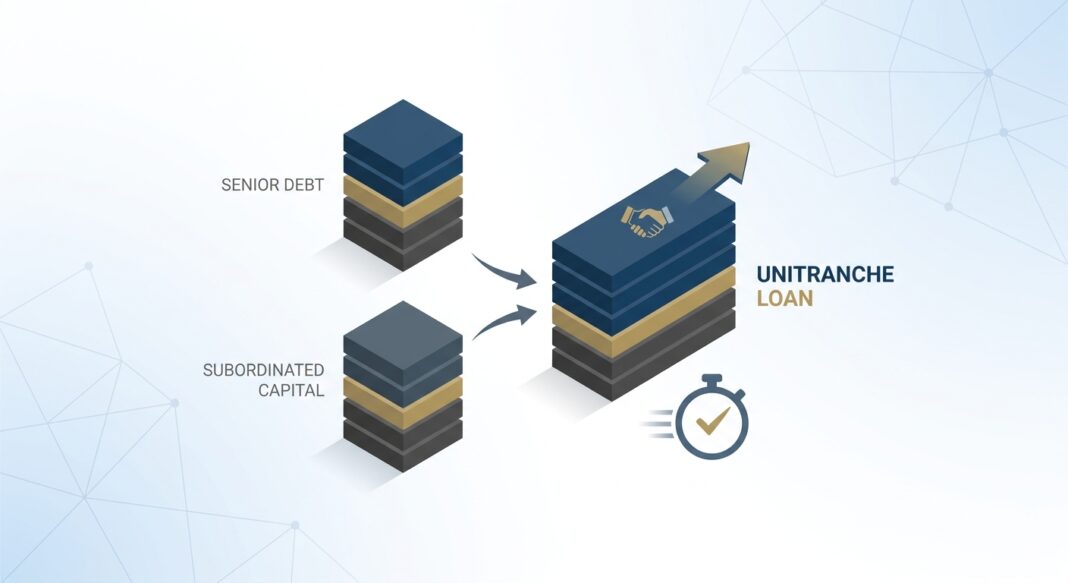
The One-Loan Revolution in Private Credit
Imagine you need $150 million to finance an acquisition. Under the traditional model, you would spend weeks negotiating with a bank for senior debt, then separately approach a mezzanine lender for subordinated capital, haggling over two sets of covenants, two credit agreements, and a contentious intercreditor agreement that sits between them. Deals fell apart in that gap. Timelines stretched. Auctions were lost.
The unitranche loan eliminated that friction. Today, it is the dominant structure in middle-market private credit, and understanding how it works is essential for anyone evaluating private credit as an investor or seeking capital as a business owner.
The timing matters. The Federal Reserve’s April 2026 SLOOS confirmed that banks tightened lending standards for commercial and industrial loans across all firm sizes in Q1 2026, while simultaneously tightening all surveyed terms on loans to non-depository financial institutions: including stricter covenants, shorter maturities, and higher risk premiums. When banks retreat, unitranche advances.
What Is a Unitranche Loan?
A unitranche loan is a single-facility debt structure that combines what would traditionally be separate senior and subordinated debt layers into one loan, governed by one credit agreement, with one interest rate and one lender relationship. The borrower signs a single document, makes a single payment, and manages a single creditor relationship.
Behind the scenes, however, the unitranche structure can involve multiple lenders with different risk appetites. In a bifurcated unitranche, the loan is divided into a first-out tranche (which receives priority of principal and interest payments) and a last-out tranche (which earns a higher rate in exchange for taking subordinated economic risk). The rules governing how those two lenders share economics and exercise rights in a default are spelled out in an Agreement Among Lenders (AAL): a document that the borrower never sees or signs.
To the borrower, the complexity is invisible. There is one rate, one set of covenants, one closing process.
How It Works: A Concrete Example
Consider a private equity sponsor acquiring a manufacturing business with $20 million in EBITDA. The acquisition price is $140 million, a 7x multiple. The sponsor will contribute $56 million in equity (40%) and finance the remaining $84 million with debt (4.2x leverage).
Traditional Structure (two-tranche approach):
- Senior bank term loan: $50 million at SOFR + 275 bps (all-in ~7.5%)
- Mezzanine: $34 million at 12–13% cash + PIK
- Two credit agreements, two sets of covenants, intercreditor negotiation: 10–14 weeks to close
- Blended cost of debt: approximately 9.5–10%
Unitranche Structure (one-tranche approach):
- Single unitranche facility: $84 million at SOFR + 575 bps (all-in ~10%)
- One credit agreement, one set of covenants, one lender relationship: 3–4 weeks to close
- First-out lender (e.g., a bank or senior-focused BDC): ~$50 million at SOFR + 375 bps
- Last-out lender (e.g., a direct lending fund): ~$34 million at SOFR + 825 bps
- Borrower’s blended cost: approximately 10%, with 6–8 weeks saved on execution
The borrower pays a modest premium over the blended two-tranche cost, but gains execution certainty, a single closing, and a relationship lender who has strong incentive to be a constructive partner through the life of the loan. In a competitive auction where a financing contingency could cost the deal, that premium is often the right trade.
According to Private Capital Global (2025), private credit can close within four weeks while bank syndication may require six to eight weeks, a structural advantage that sponsors consistently price into their financing decisions.
Current Market Relevance
The unitranche structure did not emerge in a vacuum. It was born from the post-2008 retreat of banks from cash-flow lending to middle-market companies, and it has been gaining share ever since. The current environment amplifies that dynamic.
Here is what the data shows as of mid-2026:
| Metric | Data Point | Source |
|---|---|---|
| North American direct lending AUM | ~$644 billion (year-end 2025), up from $93 billion in 2015 | PIMCO / Preqin, March 2026 |
| Global new-issue direct loan median spreads | 544 bps at year-end 2025, down from 716 bps peak in March 2023 | McKinsey Global Private Markets Report, June 2026 |
| New direct lending spreads (Q1 2026 reset) | ~25 bps wider than prior quarter as risk-off sentiment repriced new loans | Northleaf Capital Q1 2026 Update |
| Bank C&I lending standards (Q1 2026) | Tighter for all firm sizes; all NDFI loan terms tightened over the past year | Federal Reserve SLOOS, April 2026 |
| Covenant-lite share of direct lending deals | Rose to 21% in 2025, up from 4% in 2023, but still well below BSL market | McKinsey / Proskauer, June 2026 |
The spread data tells a nuanced story. According to Lord Abbett’s 2026 Midyear Outlook, spreads have widened by roughly 50 to 100 basis points since late 2025, while new loans are increasingly coming with better credit structures: less leverage, more covenants, fewer PIK requests, and tighter documentation. That marks a shift from the borrower-friendly 2023–2024 era and represents a more attractive environment for disciplined lenders entering the unitranche market today.
Meanwhile, Northleaf Capital notes that periods of market volatility typically cause banks and liquid credit markets to retrench, which drives private equity sponsors toward private credit for greater execution certainty. That dynamic is playing out in real time.
Decision Framework: For Investors and Operators
For Investors Evaluating Unitranche Strategies:
- First-out vs. last-out positioning matters enormously. First-out lenders receive priority in payment waterfalls and typically price at SOFR + 350–450 bps. Last-out lenders earn SOFR + 750–950 bps but absorb first losses after equity. Understand which position a fund primarily holds before assessing risk-adjusted returns.
- Covenant quality is the hidden variable. According to PipelineRoad (2026), unitranche facilities typically include maintenance covenants, a meaningful structural advantage over broadly syndicated loans where covenant-lite has become standard. Those covenants give lenders an early seat at the table if borrower performance deteriorates.
- Look for lender discipline in the current cycle. The 2021–2023 era of aggressive lending produced stressed vintages. Funds entering the market in 2025–2026 with wider spreads, lower leverage, and tighter covenants are structurally better positioned.
For Business Owners and Operators Evaluating Unitranche Financing:
- Use unitranche when time is the constraint. If you are in a competitive acquisition, a management buyout, or need committed financing within 3–4 weeks, the execution premium of unitranche is often justified by avoiding a broken deal or missed opportunity.
- Evaluate total cost of capital, not just headline rate. The slightly higher rate of a unitranche versus a traditional senior/mezz stack must be weighed against legal fees, coordination costs, time spent, and the risk of a failed syndication. Private Equity Bro (2025) estimates sponsors often justify 50–100 bps of extra spread by avoiding financing gaps and delayed closings.
- Understand the covenant package before you sign. Unitranche lenders typically negotiate maintenance covenants, usually a maximum leverage ratio and minimum fixed charge coverage ratio. Ensure your financial projections provide sufficient cushion above those thresholds.
Key Takeaways
- Unitranche is the dominant middle-market structure because it solves a real operational problem: it eliminates the complexity, time, and risk of coordinating multiple creditor layers in a single financing.
- The borrower pays one blended rate that sits between senior and mezzanine pricing, but behind the curtain, first-out and last-out lenders share economics through an Agreement Among Lenders (AAL) that allocates risk and return invisibly.
- Bank tightening is a structural tailwind for unitranche lenders. As the Federal Reserve’s April 2026 SLOOS confirms, banks are tightening standards across all C&I categories, reinforcing private credit’s role as a consistent capital provider for middle-market borrowers.
- The 2026 environment favors lenders more than 2024 did. Spreads have widened, leverage has moderated, and covenants are improving on new originations, making today’s unitranche deals structurally more attractive for investors than the borrower-friendly terms of two years ago.
- Covenants are the unitranche investor’s early warning system. Maintenance covenants in unitranche agreements provide lenders with proactive remediation rights, a critical protection that covenant-lite broadly syndicated loans do not offer.


