
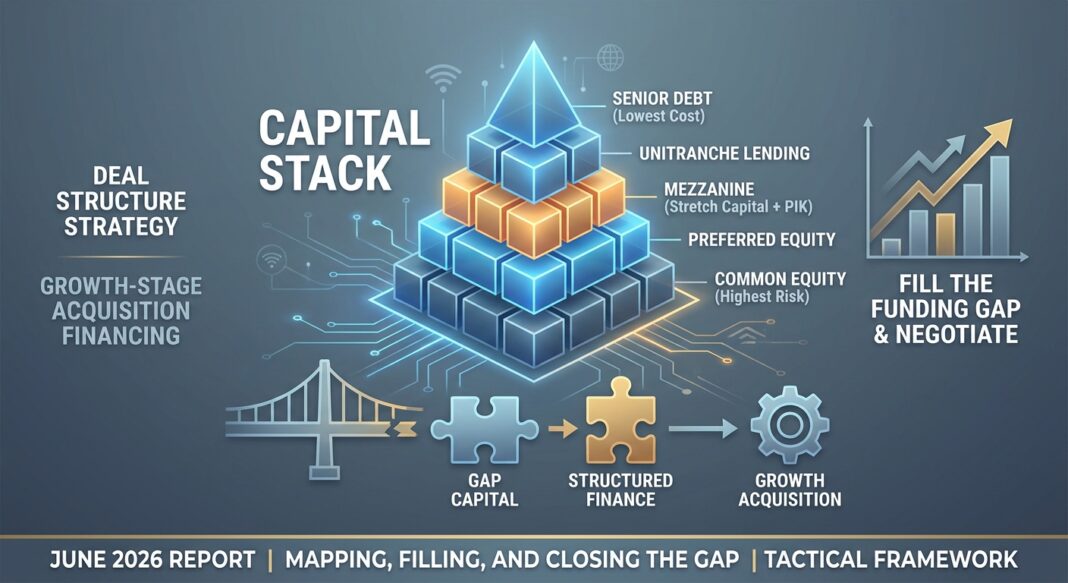
Funding a Growth–Stage Acquisition: How to Map the Capital Stack, Fill the Gap, and Negotiate the Structure
The Financing Challenge at the Growth Stage
You have proven product-market fit, two or three years of compounding revenue, and a bolt-on acquisition on the table that would add meaningful scale. The target is priced at $50 million enterprise value. Your existing senior lender will take you to 3.0× EBITDA. Equity would fill the rest, but at a cost that permanently erodes founder economics. Neither option is clean. What you are really facing is a capital gap: the space between what the cheapest lender will advance and what the deal actually requires.
This gap is structural, not accidental. It appears at every growth-stage inflection point (acquisitions, capacity expansion, management buyouts, and dividend recaps) because the risk profile of these uses of proceeds sits between bank underwriting standards and pure equity risk. The instruments designed to fill it are often misunderstood, over-priced by operators who do not shop them properly, and under-utilised by those who conflate “expensive” with “wrong.”
The following analysis maps the full capital spectrum available to a growth-stage operator pursuing an acquisition, works through a structured example, and provides a tactical playbook for quantifying the gap, preparing the process, and closing on defensible terms.
The Capital Spectrum: From Banks to Equity
Every acquisition financing sits somewhere on a cost-of-capital spectrum. Understanding the layers (and the trade-offs at each) is the first act of any disciplined structuring process.
Layer 1: Senior Debt (Lowest Cost, Highest Priority)
Senior debt is repaid first, carries the lowest interest rates, and imposes the strictest conditions. Bank revolvers and term loans typically require quarterly maintenance covenant testing, hard leverage caps, and personal or corporate guarantees. For most growth-stage companies, senior bank capacity tops out between 2.5× and 3.5× EBITDA before covenant headroom becomes the binding constraint. This layer is the foundation, always maximise it before touching anything more expensive.
Layer 2: Unitranche / Direct Lending (Speed & Certainty)
The unitranche instrument collapses what would otherwise be a senior and a subordinated tranche into one facility with a single lender, one credit agreement, and a blended rate. It has become the dominant financing structure for middle-market acquisitions. According to CT Acquisitions’ 2026 market guide, unitranche pricing in 2026 sits at SOFR + 500–700 bps, with a 2–3% original issue discount (OID) and a 2–3% prepayment fee declining over the first 24 months, producing an all-in blended cost of roughly 9.5–11% on a typical 5.0× leverage deal. Total leverage capacity runs 4.0× to 6.0× EBITDA. The speed premium is real: closing 30–45 days faster than a syndicated alternative regularly justifies 50–100 bps of extra spread when a purchase agreement has a hard deadline.
Layer 3: Mezzanine / Subordinated Debt (Stretch Capital with Equity Features)
Mezzanine debt fills the space between what a senior or unitranche lender will advance and the equity cheque you want to preserve. It carries a higher coupon to compensate for its subordinated position, typically 12.5–14% all-in for a performing middle-market credit, and almost always includes an equity component. The standard toolkit includes:
- Cash-pay interest: Paid quarterly or semi-annually, directly serviced from operating cash flow.
- PIK (Payment-in-Kind) interest: Interest added to the outstanding principal rather than paid in cash, preserving near-term liquidity at the cost of a larger exit obligation. A common split is 4% cash plus 6% PIK on a 10% coupon, or 12% cash plus 2% PIK for a 14% total yield.
- Equity kickers / warrants: Typically rights to purchase 1–5% of the borrower’s equity at a fixed strike price, exercisable at a liquidity event. Warrant coverage compensates the lender for taking subordinated risk and provides upside beyond pure coupon income.
Mezzanine loans typically mature in 5–7 years with a single bullet repayment at maturity, aligning naturally with expected exit or refinancing timelines.
Layer 4: Preferred Equity (Hybrid, Subordinate to All Debt)
Preferred equity sits below all debt but senior to common equity. It offers fixed or accumulated returns (often 8–12%), liquidation preferences, and sometimes participation rights on upside. Venture capital typically enters through preferred stock with liquidation preferences guaranteeing return of capital before common shareholders receive distributions. As rounds stack, earlier preferred series subordinate to later ones, creating a sub-stack that borrowers must model carefully before adding new layers.
Layer 5: Common Equity (Most Expensive, Permanent Dilution)
Common equity is last in the repayment waterfall, highest risk, and highest potential return. It has no repayment obligation, but it is permanently dilutive. The key structuring principle: treat equity as the last dollar in and the most expensive source of capital. Every dollar of mezzanine or preferred that replaces equity reduces long-term dilution, provided the company generates sufficient cash flow to service the additional debt layers.
Structure Breakdown: A $50M Acquisition at 4.5× EBITDA
Consider a growth-stage B2B software company, call it DataBridge Inc., with $11M EBITDA acquiring a complementary platform priced at $50M enterprise value (4.5× EBITDA). The operator has $5M of equity available from the balance sheet and wants to limit further dilution. Here is how a layered capital stack might be constructed:
| Tranche | Amount | % of Capital | Instrument | Pricing / Terms | Covenant Type |
|---|---|---|---|---|---|
| Senior Unitranche | $33M | 66% | Direct Lending Term Loan | SOFR + 575 bps, 2% OID, 5-year bullet | 1 maintenance covenant (max leverage 5.0×) |
| Mezzanine | $12M | 24% | Subordinated Term Note | 12% cash + 2% PIK; warrants = 3% equity; 6-year bullet | Incurrence-based (leverage cap, restricted payments) |
| Equity (Operator) | $5M | 10% | Common Equity / Rollover | N/A | N/A |
| Total | $50M | 100% | – | Blended all-in debt cost: ~13.2% | – |
Pro forma leverage: 4.1× EBITDA ($45M total debt / $11M EBITDA). Pro forma interest coverage: approximately 2.1× on a cash-pay basis (improving to ~2.6× if PIK is excluded from DSCR calculation, as most lenders permit). The warrant coverage grants the mezzanine provider rights to 3% of the equity at a current-value strike price, exercisable only upon a change of control or IPO.
This structure preserves the operator’s common equity at approximately 97% of the post-transaction cap table (excluding option pool) while funding the full $50M purchase price with only $5M of cash equity deployed. The trade-off is explicit: a higher blended debt cost and compounding PIK on the mezzanine tranche over years 1–6.
Unitranche vs. Split Stack: When Each Works
The choice between a pure unitranche and a split senior/mezz structure is not simply a cost question; it is an access, timing, and flexibility question.
Choose Unitranche When:
- Speed is the binding constraint. A single lender group closes 30–45 days faster than a bifurcated structure requiring two separate credit processes and an intercreditor negotiation.
- Leverage need is 4.0×–6.0× EBITDA. Unitranche comfortably occupies this range with a single blended rate and a single covenant package.
- The business is cash-flow generative. Unitranche lenders underwrite to EBITDA; asset-light software, services, and healthcare companies fit this profile best. The market grew from roughly $20 billion in annual issuance in 2015 to over $200 billion in 2025 as direct lenders displaced bank syndication for sub-$1B EBITDA borrowers.
- Operational simplicity post-close matters. One lender means one reporting relationship, one amendment process, and one consent party for add-on acquisitions.
Choose a Split Stack When:
- Leverage requirement exceeds 5.5×–6.0× and the deal economics justify the additional cost and complexity of subordinated debt.
- PIK preservation of cash flow is a deal-critical feature: for example, when the acquired business carries temporary drag before integration savings are realised.
- The operator wants to keep a senior banking relationship intact for revolving credit, treasury, and FX facilities that a direct lender typically does not provide.
- Warrant dilution is manageable relative to the equity preserved by avoiding a larger equity raise.
The current market is clearly tilting toward the unitranche: it now dominates the lower-middle-market direct lending channel, with roughly 70–80% of deals in the $25M–$200M enterprise value range using at least partial unitranche funding. Split structures with a discrete mezzanine tranche are more common above $200M EV where institutional mezzanine funds operate at scale, or in deals where cash flow coverage is tight enough to require a PIK election on the sub debt.
Current Market Terms & Benchmarks (H1 2026)
The following data points reflect observable market conditions as of mid-2026, sourced from practitioner reports and industry publications:
- Unitranche pricing: SOFR + 425–475 bps for sponsored upper-middle-market transactions; core middle-market credits command 50–100 bps higher, per Capstone Partners’ Winter 2025 Leveraged Finance Report. All-in costs on a typical 5.0× leverage deal run 9.5–11% blended.
- OID and fees: Average OID on private credit deals ran approximately 2–3% of funded principal in recent periods, paid at closing and amortised for accounting purposes.
- Mezzanine yields: A performing middle-market credit can expect mezzanine providers to target 12.5–14% all-in yield, combining cash pay, PIK, and warrant accretion.
- PIK prevalence: PIK usage in junior debt layers has increased meaningfully, deals priced in 2024 and 2025 frequently carried forward PIK structures because elevated base rates compressed cash-pay coverage capacity.
- Covenant structure: The market bifurcation is stark. Over 85% of broadly syndicated institutional leveraged loans now carry no meaningful quarterly maintenance covenant testing (incurrence-only or “cov-lite”). By contrast, most middle-market private credit unitranche facilities retain at least one financial maintenance covenant, typically a maximum leverage ratio tested quarterly, giving lenders early intervention rights that the BSL market has largely abandoned.
- Private credit market scale: Global private credit AUM reached approximately $2.1 trillion in 2025. The U.S. market alone expanded from $500 billion to $1.3 trillion over the prior five years, and is projected to continue growing in 2026 as banks apply stricter underwriting standards and private lenders fill the resulting gap.
The Gap Capital Playbook: Quantify, Prepare, Run the Process
Knowing the instruments is necessary but not sufficient. Execution requires a repeatable process: one that quantifies the need before approaching lenders, prepares materials that match each provider’s underwriting framework, and runs a competitive process that produces leverage at the negotiating table.
Step 1: Quantify the Gap
Start from the purchase price and work backwards. Determine the maximum senior debt capacity (typically 2.5×–3.5× EBITDA at a bank, 4.0×–6.0× at a direct lender). Deduct available equity. The residual is your gap. Model three scenarios: (a) fill the gap entirely with senior unitranche; (b) layer a mezzanine tranche to reduce equity; (c) accept more equity to reduce total debt service. Build a DSCR bridge for each scenario in year 1 and year 3, with coverage stress-tested at −15% EBITDA. Deals where the DSCR falls near the 1.15×–1.25× floor are especially vulnerable to covenant breach if post-acquisition integration underperforms.
Step 2: Prepare Materials That Match the Provider
Senior lenders underwrite to historical cash flow and asset coverage. Direct lenders and mezzanine providers underwrite to forward EBITDA and management quality. Your materials must address both, but the emphasis shifts by audience. For private credit, lead with the strategic rationale for the acquisition, the combined entity’s integrated EBITDA bridge, customer retention data, and management track record. Average due diligence processes in 2025 ran 6–8 weeks, well-organised data rooms compress this materially. Prepare audited financials, a clean cap table, EBITDA reconciliation (with adjustments clearly documented), and a 13-week cash flow projection.
Step 3: Run a Competitive Process
Never accept a first term sheet without running at least two to three competing proposals. Private credit lenders operate differentiated underwriting frameworks, one lender’s 4.5× capacity is another’s 5.5× for the same credit, depending on sector expertise and fund mandate. Distribute process letters to five to seven direct lenders simultaneously, with a staged timeline (IOI in week 2, term sheet in week 5). The competitive tension is the single most powerful tool for improving spread, covenant headroom, OID, prepayment terms, and PIK availability. Mezzanine providers, run separately, can be used to pressure senior lenders to stretch leverage rather than cede the deal entirely to a competing unitranche provider.
Negotiation Guidance: For Operators and Investors
For Operators: Five Points to Push
- Covenant headroom: Negotiate at least 25–30% headroom above your maintenance covenant test level. A leverage covenant set too tight eliminates operational flexibility during integration quarters. Request a 6–12 month “holiday” post-close on covenant testing if integration EBITDA is uncertain.
- Equity cure rights: Insist on the right to inject equity to cure a covenant breach, typically capped at two to three cures over the life of the facility. This is a standard negotiating point in private credit and provides a critical safety valve.
- PIK toggle mechanics: If PIK is included, negotiate the toggle trigger carefully. Performance-based triggers (minimum liquidity threshold, maximum leverage, or positive free cash flow) are preferable to discretionary PIK elections, which lenders will price more expensively. Ensure the agreement defines precisely how capitalised PIK interacts with any prepayment premium calculation, ambiguity here is a frequent source of post-closing disputes.
- Warrant coverage and strike price: Negotiate warrant coverage as a percentage of fully diluted post-transaction equity. The strike price should reflect current enterprise value, not a discount. Cap total warrant exposure across all lenders at 5% of equity before dilution becomes structurally material to your cap table.
- Prepayment flexibility: Call protection of 2–3% declining over 24 months is standard market. Push for the ability to prepay the mezzanine at par after year 3 without a make-whole, which aligns with typical refinancing or exit timelines.
For Investors: What to Look for in the Structure
Investors evaluating a growth-stage company that has layered acquisition debt should assess: (1) pro forma DSCR under a downside EBITDA scenario; (2) the quality of EBITDA adjustments, note that EBITDA adjustments rebounded to 10.88% of deal EBITDA in Q1 2025 M&A transactions, the highest level since 2021, increasing the risk that pro forma leverage is understated; (3) intercreditor dynamics, in a bifurcated senior/mezz stack, confirm the intercreditor agreement specifies clearly how enforcement rights, standstill periods, and equity cure rights are allocated; and (4) PIK compounding risk, PIK does not feel expensive until it is capitalised year after year into a materially larger exit obligation than originally modelled.
Key Takeaways
- The capital gap is structural, not a failure. It exists because growth-stage acquisition risk sits between bank and equity underwriting standards. The instruments designed to fill it (unitranche, mezzanine, preferred equity) are features of the market, not workarounds.
- Unitranche dominates sub-$200M EV deals in 2026 for good reason: speed, simplicity, single-lender management, and covenant packages that retain one maintenance test. Blended pricing of 9.5–11% is the current market clearing rate for a 5.0× leverage deal.
- Mezzanine is a dilution-preservation tool, not a last resort. At 12.5–14% all-in with PIK flexibility and a warrant coverage floor of 1–5%, it can be cheaper than a growth equity round when modelled against long-term ownership dilution and exit proceeds.
- Covenant design is a competitive variable. Push for maintenance covenant headroom of 25–30%, equity cure rights, and PIK toggle mechanics tied to performance triggers, not lender discretion. The difference between a tight covenant package and a well-structured one is the difference between a clean hold and an amendment process every two quarters.
- Process creates price. A competitive process across five to seven direct lenders and two to three mezzanine providers is the single highest-return activity in any capital raise. Term sheet competition compresses spread, loosens covenants, reduces OID, and improves PIK availability, all simultaneously.


