
The Story: Two Founders, Two Capital Philosophies, Two Very Different Exits
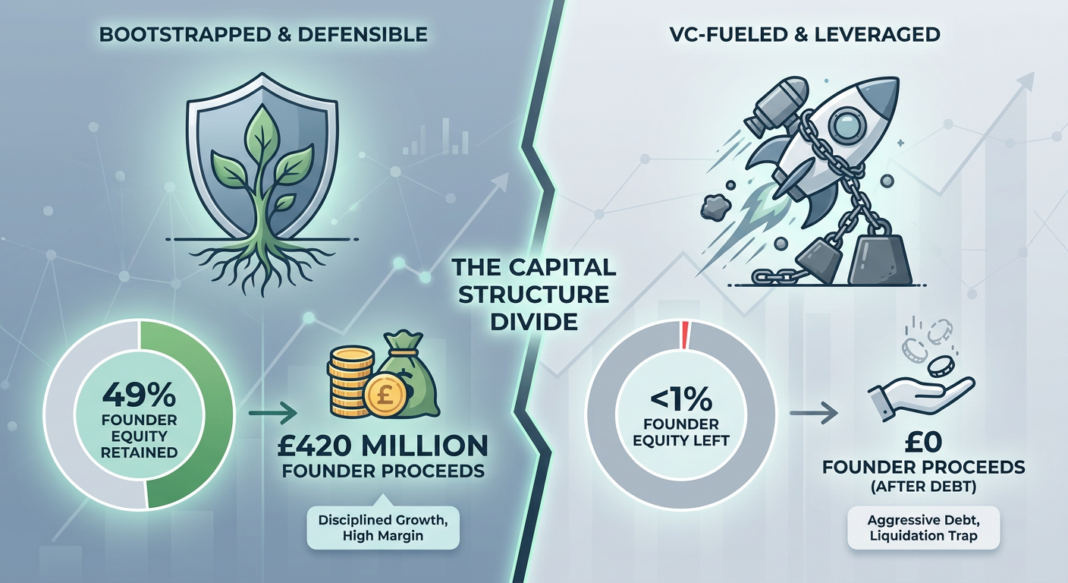
In 2026, Julian Hearn sold Huel, his UK nutrition company, to Danone for €1 billion. He personally walked away with £420 million. That number is striking not because of its size, but because of the ownership percentage it represents: 49.3% of the exit proceeds went to the founder, after raising $184 million across three funding rounds.
In the same era, Adena Hefets built Divvy Homes from nothing into a company with a $2.3 billion peak valuation, raised from marquee investors including a16z and Tiger Global, and ultimately sold to Brookfield Properties for $1 billion. The founder’s proceeds from that billion-dollar exit? Zero. Common shareholders, founders, and most equity holders received nothing after debt repayment, transaction costs, and liquidation preferences consumed the entire sale price, as Hefets herself disclosed in a letter to shareholders.
Both companies sold for roughly €1 billion. Both founders were by every measure talented, driven, and mission-oriented. But the capital structures they chose (or were pushed into) created outcomes separated by £420 million. That gap is the story of leverage, dilution, and the compounding cost of capital decisions made years before any exit.
These are two of the most instructive capital structure stories of the decade, and they deserve to be told side by side.
The Decision: Minimal Dilution vs. Maximum Velocity
Hearn’s approach at Huel was defined by a single discipline: bootstrap as long as possible, then raise only what you need, at the right moment, at a valuation that does not destroy your ownership. According to cap table analysis based on Companies House filings, Hearn reached $18 million in revenue before raising his first institutional round. By the time he came to Series A, he had leverage, not financial leverage, but negotiating leverage. He had proof of concept, unit economics, and margin. Investors came in at his terms, not theirs. Across three rounds totalling $184 million, he retained 49.3% of the company. That is not an accident. It is the arithmetic result of raising at inflection points rather than at desperation points. Each dollar of external capital cost him a fraction of what it would have cost a founder who raised pre-revenue or pre-profitability. As creatorsblueprint.co noted in its analysis of the deal, most DTC founders who raise similar amounts across three rounds end up owning between 15% and 25% at exit, roughly one-third of what Hearn retained.
At Divvy Homes, the capital decision was the opposite: raise aggressively, move fast, and take on substantial debt to fund the balance-sheet-intensive model of purchasing homes. In October 2021, Divvy took on approximately $735 million in debt financing: a structure that made sense when rates were near zero and home prices were appreciating. When the Federal Reserve began its fastest tightening cycle in forty years in 2022, the model broke. The cost of carry on $735 million in debt at higher rates crushed operating cash flow. Layoffs followed. New home acquisitions paused. And when Brookfield acquired the business for $1 billion in early 2025, the debt came first in the waterfall, as it always does, leaving nothing for equity holders, as reported by saastr.com.
The contrast crystallises a principle that is easy to state but difficult to internalise: the type of capital you take shapes the risk profile of your company in ways that will not reveal themselves until the worst possible moment.
The Outcome: Numbers That Tell the Real Story
The mathematics of these two exits are worth sitting with.
At Huel, Danone paid a reported 17–20x EBITDA multiple: a premium valuation, despite revenue growth having slowed to 17% annually. Danone paid up because Huel’s unit economics were exceptional: vertical integration had expanded gross margins, and the business was genuinely profitable. The premium multiple was the direct result of the discipline Hearn applied not just to his cap table but to his cost structure. He did not grow at any price. He grew at a margin-preserving price. The outcome: £420 million to the founder, strong returns to all three investor tranches, and a clean, value-accretive exit for the acquirer.
At Divvy Homes, the assets were real and worth $1 billion, the company was not a fraud or a failure in operational terms. It had housed 2,000 families across 20 cities. But the capital structure created a liability that no asset sale could fully satisfy. A $1B exit produced $0 for equity. The lesson, as saastr.com stated plainly, is that debt is a senior claim on your future: every dollar borrowed is a dollar that gets paid back before you do, in every scenario, regardless of what you built or how hard you worked.
The counterfactual at Divvy is instructive: had the business been funded with proportionally less debt, or had the debt structure included rate hedges or covenant flexibility, the equity waterfall at $1 billion could have produced meaningful proceeds for founders and investors alike. Capital structure is not just a financing decision; it is an options decision about who owns the outcomes under different macro scenarios.
The Lessons: A Framework for Founders Facing Similar Decisions
1. Bootstrap to an inflection point before raising external capital. Every month of profitable, self-funded growth increases your negotiating leverage with investors and reduces the ownership you must surrender per dollar raised. Hearn’s $18M revenue threshold before Series A is not a magic number, but the principle is universal. Raise from strength, not need.
2. Match your capital structure to your business model’s rate sensitivity. Divvy’s model was a balance-sheet intensive, rate-sensitive business financed with floating-rate or rate-exposed debt. That mismatch was tolerable in a zero-rate world and fatal in a normalised one. Before taking on debt, stress-test the model at rates 300–400 basis points higher than current. If the business breaks, the structure is wrong.
3. Debt taken in good times becomes a covenant in bad times. The $735 million Divvy raised in the exuberance of 2021 was not reckless in isolation; it was reckless given the lack of rate protection and the illiquid nature of the underlying assets. Non-dilutive capital is powerful, but only when the debt service is survivable across a full economic cycle.
4. Equity dilution is permanent; debt can be repaid. The founders and operators who preserve the most ownership understand that dilution is a one-way door. Once you sell equity, you have permanently reduced your share of every future outcome. Strategic use of debt (sized appropriately, with manageable covenants) can fund growth while leaving equity intact. The risk is the downside scenario. The mitigation is discipline.
5. Know where you sit in the waterfall before you sign. Preferred liquidation preferences, debt tranches, and transaction costs are abstract concepts during fundraising and very concrete concepts during exits. Founders should model the waterfall at multiple exit valuations, including one lower than they expect, before agreeing to any capital structure. The number that matters is not the valuation. It is what you net after every senior claimant is satisfied.
The private credit market is expanding rapidly, offering founders and operators genuine alternatives to equity dilution. As deals like Wafra’s $1.9 billion acquisition of Navitas Credit from United Community Bank illustrate, sophisticated capital (including dedicated credit facilities from institutions like BofA and Wells Fargo) is now available to fund growth platforms outside the constraints of bank balance sheets, as reported by funderintel.com. The tools are there. The discipline to use them correctly is the differentiator.
Key Insights
- Bootstrapping to revenue creates negotiating leverage: Hearn’s $18M pre-raise threshold let him dictate terms, allowing him to retain 49.3% through $184M in raises, versus the 15–25% typical for comparable DTC fundraises.
- Debt is a senior claim on every future outcome: Divvy’s $735M in debt, not its operations, determined the exit outcome. A $1B sale produced $0 for equity because debt holders are always paid first, in every scenario.
- Capital structure determines optionality under stress: Rate-sensitive balance-sheet models funded with rate-exposed debt create a hidden risk that only materialises in adverse macro conditions, precisely when flexibility is most needed and least available.
- Premium exit multiples are earned through margin discipline, not growth speed: Danone paid 17–20x EBITDA for Huel because the business was genuinely profitable. Growth funded at the expense of unit economics destroys the premium that strategic acquirers pay for.
- Model the waterfall at multiple exit values before you sign: The number that defines founder outcomes is not the valuation headline; it is what remains after debt, preferences, and fees. Every founder should model their net proceeds at 0.5x, 1x, and 2x their current valuation before agreeing to any new capital structure.


