
The Reset Is Real: Private Credit’s Most Consequential Structural Shift Since 2022
Private credit markets entered 2026 on a constructive footing: ample dry powder, tightening spreads, and building M&A momentum inherited from the second half of 2025. That narrative unraveled quickly. By Q1 2026, three compounding shocks had materially reset lender behavior: a sharp AI-driven selloff across software and technology credits, renewed Middle East geopolitical tensions introducing upside inflation risk into an already complicated Federal Reserve policy path, and persistent tariff and trade policy uncertainty that suppressed risk appetite across the capital stack, per Bond Capital’s Q1 2026 Credit Analysis.
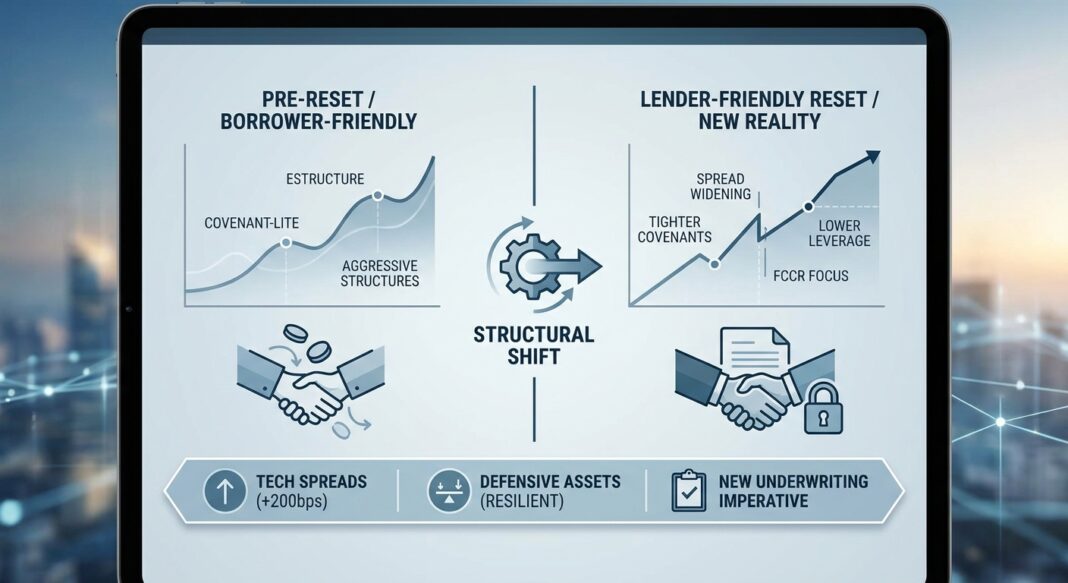
As of mid-June 2026, the reset has deepened into something more durable. According to Lord Abbott’s 2026 Midyear Investment Outlook, new loans are increasingly structured with less leverage, more covenants, fewer payment-in-kind (PIK) requests, and tighter documentation, a structural improvement in credit quality that arguably matters more than the spread movement alone. The era of borrower-friendly, covenant-lite terms is closing. For institutional investors deploying new capital today, the setup is materially better than six months ago. For operators seeking debt financing, the window for aggressive structures has narrowed considerably.
Critically, the macroeconomic backdrop provides no near-term relief. May nonfarm payrolls rose 172,000 (more than double the 80,000 consensus estimate) effectively pushing Federal Reserve rate cuts further out on the calendar, per ABF Journal’s Middle Market Debt Weekly. Base rates anchored near 4.50% compress fixed-charge coverage on floating-rate credits and raise the all-in cost of new leveraged financings just as sponsor deployment pressure builds.
Quantitative Market Snapshot
The following data box consolidates key credit market metrics as of June 2026, sourced from leading market intelligence providers.
| Metric | Current (Q2 2026) | Prior Period | Change | Source |
|---|---|---|---|---|
| Direct Lending 1st Lien Spread (new issue) | ~500–525 bps over SOFR | ~486–497 bps (Oct–Nov 2025) | +25 bps (matrix-wide; more for tech) | Bond Capital / VRC |
| Broad Private Credit Spread Widening (vs. late 2025) | +50 to +100 bps | Late 2025 baseline | Widening across mid-market | Lord Abbott Midyear 2026 |
| S&P Leveraged Loan Index Spread | ~487 bps | Post-Liberation Day lows (Apr 2025) | Near widest since Apr 2025 dislocation | ABF Journal |
| B-Rated Loan Spreads vs. Year-End 2025 | ~67 bps wider | Year-end 2025 | Widening; tech epicenter | Bond Capital Credit Cycle |
| Distressed Loan Ratio (Leveraged Loan Market) | 8.89% (Feb 2026) | Below 6% (mid-2025 est.) | Highest since rate-hiking cycle began | Bond Capital Credit Cycle |
| Leveraged Loan Repricing Target Pool (US) | $47.2B (as of May 8, 2026) | Larger pool early 2026 | Narrowing; skewed to high-quality credits | PitchBook LCD |
The Fed’s April 2026 Senior Loan Officer Opinion Survey (SLOOS) confirmed a tightening in Non-Depository Financial Institution (NDFI) lending standards, including higher premiums on riskier loans, stricter loan covenants, shorter maturities, stricter collateralization requirements, and lower maximum credit lines, per Bond Capital’s Credit Cycle analysis. Lenders are reverting to fundamental cash flow analysis, with the Fixed Charge Coverage Ratio (FCCR), not interest coverage, emerging as the primary underwriting lens.
Sector Analysis: Where Capital Is Flowing, and Where It Isn’t
Software & Technology: Tightest Conditions in the Market
Software and technology credits have become the most challenging segment of the private credit market. Spreads widened approximately 200 basis points from year-end 2025 in this segment alone, with lenders applying an additional AI-risk premium of roughly 75 basis points for borrowers with unresolved AI exposure, per Bond Capital’s Q1 2026 Credit Analysis. Borrowers unable to credibly articulate their AI positioning (either as beneficiaries or as defensively insulated) are effectively shut out of primary markets. Lower implied enterprise values have simultaneously pushed loan-to-value ratios higher, forcing lenders into case-by-case credit review rather than programmatic underwriting. The secondary market reflects this: PitchBook LCD reports new-issue spreads remain roughly 50 basis points wide of January 2026 levels for both BB- and B-rated credits, with the repricing pipeline skewing heavily toward corporates from defensive, non-tech industries.
Defensive Sectors: Infrastructure, Healthcare, and ABL
In sharp contrast, lender appetite remains constructive in sectors offering tangible asset coverage, predictable cash flows, and limited AI disruption exposure. Infrastructure-linked, healthcare services, and asset-based lending (ABL) segments are attracting capital on comparatively favorable terms. According to ABF Journal, direct lenders with committed capital and ABL providers with verified collateral are positioned to take market share from a more skittish syndicated market, particularly for middle-market borrowers where the value of a lender able to hold paper through volatility (rather than rely on syndication) commands a structural premium.
Lower Middle Market: Covenant Headroom Thinning
For lower-middle-market borrowers underwritten on a SOFR-drift-to-3% assumption, the higher-for-longer rate environment creates material debt service pressure. With base rates anchored near 4.50%, fixed-charge coverage ratios are compressing across portfolios, particularly among 2021–2022 vintage loans approaching maturity in 2027–2028, per ABF Journal. EBITDA add-back scrutiny has intensified: restructuring charges, projected cost savings, and acquisition synergies that represent 30% or more of reported EBITDA, once commonplace, are now being challenged aggressively by underwriters, per Bond Capital’s Credit Cycle report.
Implications: What This Means for Borrowers and Investors
For Borrowers and Operators
The window for covenant-lite, high-leverage financing has materially narrowed. Operators entering the credit market today must present clean FCCR metrics, lenders are applying a minimum threshold of approximately 1.2x as table stakes, and must limit reliance on EBITDA adjustments that inflate the coverage numerator. AI-exposed software businesses face the steepest hurdle: until enterprise value floors stabilize, lenders will demand wider spreads, tighter documentation, and lower advance rates. The actionable implication is clear, operators in technology-adjacent sectors should prioritize locking in financing structures before further repricing occurs, per Bond Capital’s Credit Cycle analysis. For borrowers in defensive sectors with strong FCCR and limited AI disruption exposure, the current environment remains competitive, but even here, leverage expectations are compressing.
For Institutional Investors and Lenders
For new capital deployment, the setup is arguably better than at any point in the past 18 months. According to Lord Abbott’s Midyear 2026 Outlook, M&A activity is generating fresh lending opportunities, spreads are wider, covenants are improving, and documentation is tightening, meaning new loans carry both better income potential and stronger structural protection than those originated in 2021–2022. Portfolio differentiation will intensify: non-accruals, PIK usage, sector concentration, and older vintage exposure will become increasingly visible performance differentiators as the distressed ratio (at 8.89% as of February 2026, the highest since the rate-hiking cycle began) signals elevated forward default risk in weaker cohorts.
Forward-Looking View: Next 3–6 Months
Substantial dry powder remains undeployed across private credit platforms, and a stabilization in either AI-related uncertainty or Middle East geopolitical tensions could reopen primary markets quickly, per Bond Capital’s Q1 2026 Credit Analysis. The Fed’s projected average base rate of approximately 3.3% over 2026–2028, roughly 15 basis points higher than previously expected, means all-in yields on senior secured private credit will remain attractive in absolute terms. However, the quality bifurcation will intensify: high-quality borrowers in defensible sectors will continue to access capital on competitive terms, while stressed, AI-exposed, or highly cyclical credits face a materially more restricted primary market. Investors should stress-test portfolios for 2021-vintage loan maturities approaching in 2027–2028, where covenant headroom is thinnest and refinancing conditions are most uncertain.
Key Market Insights
- Spreads Have Structurally Re-Priced: Direct lending first-lien spreads are 500–525 bps over SOFR, up ~25 bps matrix-wide from late 2025, with technology credits seeing far steeper widening of up to 200 bps. New-issue spreads remain approximately 50 bps wide of January 2026 levels for both BB- and B-rated leveraged loans, per PitchBook LCD.
- FCCR Above 1.2x Is Now a Market Entry Standard: With the Fed’s April 2026 SLOOS confirming tighter NDFI lending standards (including stricter covenants and higher premiums on riskier loans) the Fixed Charge Coverage Ratio has replaced interest coverage as the primary underwriting filter. Borrowers with clean FCCR and limited add-backs command materially better terms, per Bond Capital.
- AI Exposure Is a Pricing Event, Not Just a Narrative: Lenders are applying an explicit AI-risk premium of ~75 bps for software borrowers with unresolved AI disruption exposure, with enterprise value uncertainty driving LTV ratios higher and blocking programmatic underwriting in the segment, per Bond Capital Q1 2026.
- The Distressed Ratio Is a Leading Default Indicator: At 8.89% in February 2026, the highest since the rate-hiking cycle began, the distressed loan ratio signals elevated forward default risk even as headline private credit default rates remain below 2%. Adjusted for selective defaults and liability management exercises, the true impairment rate approaches 5%, per Bond Capital.
- Disciplined Direct Lenders Are Taking Syndicated Market Share: Higher base rates, wider syndicated spreads, and a more selective buyside are creating deployment opportunities for direct lenders with committed capital and locked-up structures, particularly in middle-market M&A financing where sponsors need certainty of execution over price optimization, per ABF Journal.


