
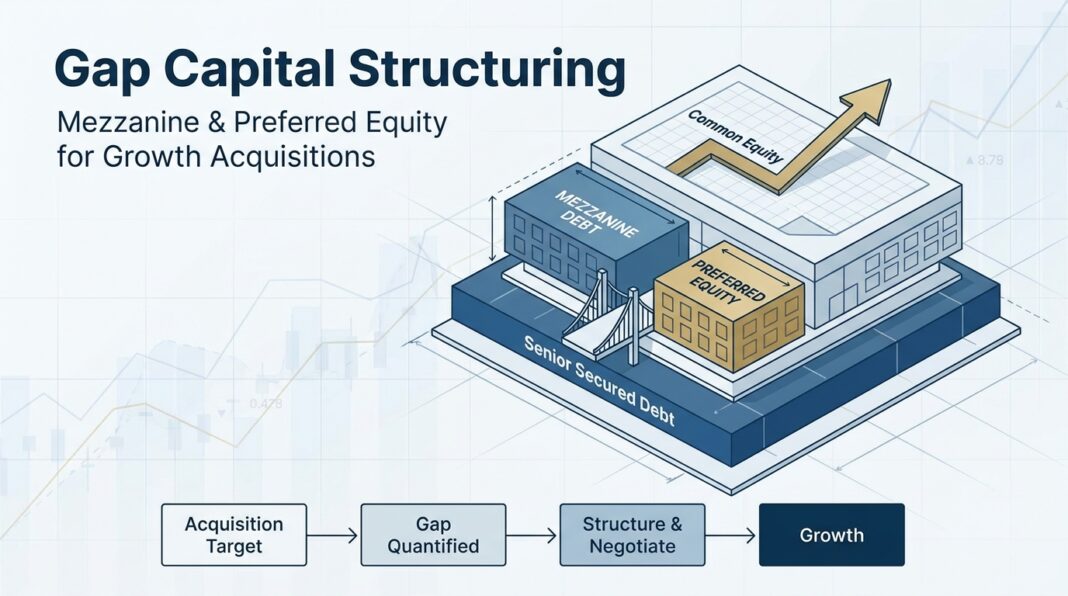
The Stage and the Challenge
The growth-stage acquisition presents one of the most structurally demanding financing problems in the middle market. The business is generating real EBITDA, enough to service senior debt, but not enough to fully fund an acquisition at a target multiple using conventional bank lines alone. At the same time, it is too operationally established to justify pure venture terms, and too early in its institutional journey for broadly syndicated leveraged finance.
This is the gap zone: the purchase price exceeds what senior lenders will advance, and the equity sponsor or founder does not want to dilute ownership to fill the shortfall with a straight equity raise. The financing architecture must bridge that gap deliberately, using instruments that sit between secured senior debt and common equity on the cost-of-capital spectrum.
Consider the prototypical scenario: a founder-led software business with $4M in EBITDA pursuing a $15M bolt-on acquisition. Senior lenders will advance 2.0x–3.0x EBITDA, yielding $8M–$10M in debt capacity. The remaining $5M–$7M is the gap. How that gap is filled determines the post-close capital structure, debt service capacity, equity dilution, and operational flexibility for the next three to five years.
Mapping the Cost-of-Capital Spectrum
Before selecting an instrument, operators must understand where each layer of capital sits on the risk-return spectrum, because each provider underwrites to a fundamentally different thesis.
- Senior secured bank debt (5%–8% all-in): Cheapest cost of capital. Requires hard collateral or strong recurring revenue, maintenance covenants, and clean balance sheet. Maximum advance typically 2.5x–3.5x EBITDA for non-asset-heavy businesses. First in line on liquidation.
- Asset-based credit lines (SOFR + 175–300bps): Revolving facilities secured against receivables and inventory. Useful for working capital swings, not acquisition finance. Borrowing base-constrained.
- Unitranche / private credit (9%–13% all-in): A single blended tranche combining first-lien and second-lien economics into one facility. Increasingly common in the $10M–$75M deal range. Simplifies the lender group but carries higher coupon than bank-only structures.
- Mezzanine debt (13%–18% all-in, often with PIK component): Subordinated to senior debt. Unsecured or second-lien. Typically structured as a blend of cash-pay coupon (8%–12%) and payment-in-kind (PIK) interest (3%–6%), plus equity participation via warrants or a co-investment right. Providers include BDCs, mezzanine funds, and family office credit vehicles.
- Preferred equity (15%–22% IRR target): Sits above common equity but below all debt in the capital structure. No fixed repayment schedule, distributions are cumulative but not legally mandated the way debt service is. Providers accept higher headline cost in exchange for structural subordination risk.
- Common equity / sponsor co-investment: Highest cost, most dilutive, but most flexible. No covenants, no repayment obligation. Appropriate when leverage cannot support additional debt service.
The art of capital stack design is matching each dollar of capital need to the lowest-cost instrument that can realistically be accessed: given the company’s cash flow durability, asset base, and lender appetite at that moment in time. As frameworks from bondtv.vaultai.ca and vcbeast.com note, the goal is not maximum leverage; it is optimal leverage given cash flow durability, lender appetite, and the operating plan.
Structuring the Gap: Mezz vs. Preferred Equity
Once senior capacity is exhausted, the operator faces a binary structural choice: fill the gap with subordinated debt (mezzanine) or with preferred equity. The decision hinges on three variables: debt service coverage, dilution tolerance, and covenant sensitivity.
Mezzanine Debt Structure
A typical growth-stage mezz facility for a $5M gap position might be structured as follows: 10% cash-pay coupon, 4% PIK toggled at the company’s option for the first 24 months, five-year term, warrant coverage of 3%–5% of fully diluted common equity at a strike price reflective of current enterprise value. Total all-in cost lands at approximately 14%–17% including the warrant dilution, depending on exit multiple assumptions.
The PIK toggle is operationally important: in early post-close integration quarters, being able to defer 4% of interest to the back end of the loan significantly reduces cash drain. Lenders will price this option, but it can be the difference between 1.05x and 1.35x debt service coverage in year one.
Preferred Equity Structure
Preferred equity eliminates the repayment schedule entirely. A $5M preferred tranche might carry a 14%–16% cumulative dividend (accruing, not necessarily cash-paid), a liquidation preference at 1.0x–1.5x invested capital, and conversion rights into common at a negotiated cap. The effective cost is higher, but the absence of a debt covenant package and fixed repayment dates provides meaningful downside protection if post-acquisition integration takes longer than modeled.
When Each Makes Sense
Use mezzanine when: post-close FCCR is projected above 1.20x in the base case, the management team is confident in near-term EBITDA accretion, and dilution minimization is the priority. Use preferred equity when: integration carries execution risk, debt service coverage is thin, or the lender market is pricing mezz punitively due to sector or credit concerns. A blended approach ($3M mezz, $2M preferred) is also structurally viable and increasingly common in the $10M–$25M deal range.
The Gap Capital Playbook: Quantify, Prepare, Process, Negotiate
Step 1: Quantify the Gap
Start with the acquisition price and work backward. Total enterprise value of the target: $15M. Senior debt capacity at 2.5x EBITDA: $10M. Sponsor equity contribution: $3M. Seller note (if applicable): $1M. Remaining gap: $1M–$5M depending on deal structure. Model three scenarios: (a) fill the gap with mezz debt only, (b) fill it with preferred equity only, and (c) blend both. For each scenario, stress-test the post-close leverage ratio, annual debt service coverage, and pro-forma dilution. As noted in the Bond Capital growth-stage acquisition framework, the scenario that sustains FCCR above 1.20x while keeping total leverage below 5.0x EBITDA and limiting dilution below 15% of common equity is typically the optimal structure.
Step 2: Prepare the Right Materials
Gap capital providers (mezzanine funds, BDCs, credit opportunity funds, and family offices) underwrite to a different thesis than senior lenders. They are underwriting the equity story as much as the credit story. Required materials include: a use-of-proceeds memo demonstrating EBITDA accretion from the acquisition, a three-year integrated financial model with sensitivity tables on revenue growth and margin compression, a management presentation articulating the competitive moat and exit pathway, and a clean cap table showing pre- and post-transaction ownership. According to alvren.com, a clear capital plan and governance narrative materially shortens due diligence timelines with institutional providers.
Step 3: Run a Competitive Process
Approach four to six gap capital providers simultaneously, not sequentially. Sequential outreach destroys negotiating leverage and extends timelines by months. Issue a structured term sheet request with a defined response deadline (10–14 business days is standard). Require providers to specify: coupon structure and PIK split, warrant coverage or equity participation percentage, covenant package (maintenance vs. incurrence), board observer rights, and any change-of-control provisions. Evaluate all five dimensions together, not just headline price.
Step 4: Negotiate the Structure
The three most negotiable points in a mezz or preferred term sheet are: (1) the PIK toggle window, push for 24–36 months of optionality rather than 12; (2) warrant coverage, the difference between 3% and 7% of fully diluted equity is substantial at exit; and (3) the covenant package, maintenance covenants on leverage and coverage ratios tested quarterly are significantly more restrictive than incurrence-only tests triggered by specific corporate actions. A 14% all-in mezz facility with 5% warrant coverage and quarterly maintenance covenants may be more operationally constraining than a 16% preferred equity instrument with no covenants and no scheduled repayment, as the Bond Capital use-of-proceeds framework highlights. Price is not the only variable that matters, structure and flexibility have real economic value.
Key Takeaways
- Map the full stack before calling a single provider. Quantify senior debt capacity, seller note capacity, and equity contribution before sizing the gap. Knowing the exact quantum prevents over-borrowing and shapes the process.
- Mezzanine and preferred equity solve different problems. Mezz minimizes dilution when cash flow coverage is strong; preferred equity absorbs integration risk when coverage is thin and covenant headroom is uncertain.
- The PIK toggle is a cash flow management tool, not a red flag. Structuring 24–36 months of PIK optionality into a mezz facility can be the difference between 1.05x and 1.35x FCCR in the first post-close year, a material difference in operational flexibility.
- Run a parallel process with four to six providers. Competitive tension is the primary driver of better economics and more borrower-friendly covenant packages. Sequential outreach transfers negotiating leverage to the lender.
- Covenants have real economic value, model them under stress. A maintenance covenant tested quarterly at 4.5x leverage can trigger a technical default in an integration quarter even if the business remains fundamentally healthy. Negotiate for incurrence-based tests wherever possible at the gap capital layer.


