
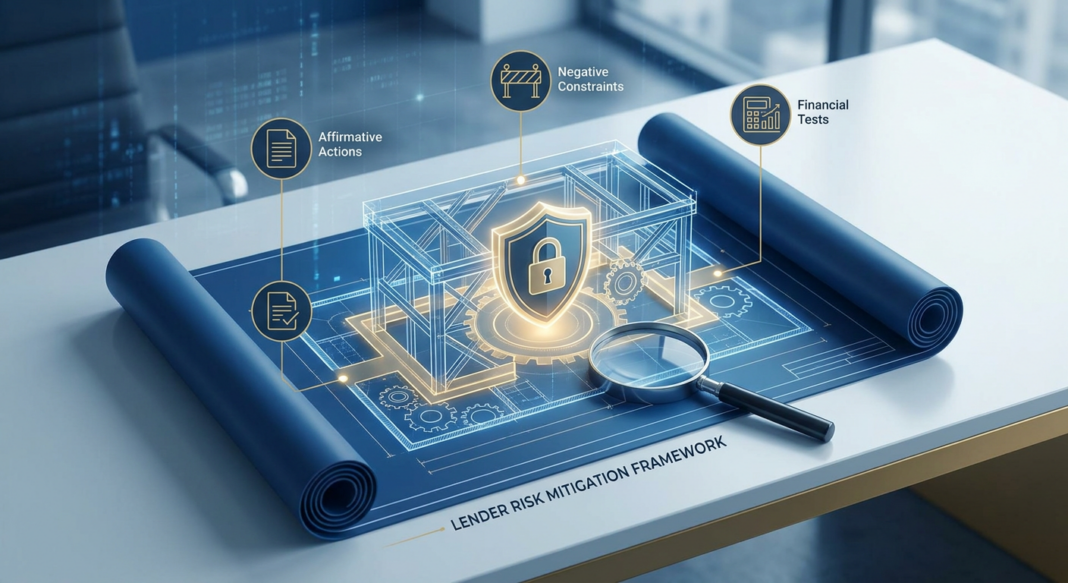
Why Covenants Are the Backbone of Private Credit Lending
When a private credit fund deploys capital into a direct loan, it cannot simply sell its position the next morning if things go wrong. Unlike a publicly traded bond, a direct loan is illiquid, bilateral, and held to maturity. That structural reality makes one thing more important than almost anything else in the deal: the covenant package.
Covenants are the contractual rules embedded in a loan agreement that govern what a borrower can and cannot do while debt is outstanding. They are not bureaucratic fine print; they are the primary risk-management tool a private credit lender has between origination and repayment. Understanding how they work is essential for institutional investors evaluating a fund’s downside protection, and equally important for business owners assessing what obligations they are taking on when they choose private credit over a bank loan.
The Three Types of Covenants: A Clear Breakdown
Private credit loan agreements typically contain three categories of covenant, each serving a distinct protective function.
Affirmative covenants require the borrower to take specific, ongoing actions. These include delivering monthly or quarterly financial statements, maintaining adequate insurance coverage, paying taxes on time, and notifying the lender of any material business change. Think of these as the borrower’s ongoing reporting obligations; they keep the lender informed in real time rather than discovering problems after the fact.
Negative covenants restrict certain borrower behaviors without lender approval. Common restrictions include incurring additional debt beyond an agreed threshold, placing new liens on company assets, making acquisitions above a defined size, paying excessive dividends or distributions to equity holders, and selling material assets. These covenants prevent a borrower from fundamentally changing the risk profile of the business after the loan has been funded.
Financial covenants are quantitative tests that a borrower must pass, typically measured quarterly. The most common include minimum Debt Service Coverage Ratio (DSCR), maximum Total Leverage Ratio (Debt/EBITDA), minimum liquidity thresholds, and minimum Interest Coverage Ratio. A breach of a financial covenant is not an automatic default, but it is a formal trigger that gives the lender the right to accelerate the loan, demand remediation, or renegotiate terms, often well before the business reaches genuine insolvency.
A Concrete Example: Covenants in a $25M Direct Loan
Consider a private equity-sponsored manufacturer with $8M in EBITDA seeking a $25M senior secured term loan from a direct lending fund. The loan closes at a 3.1x Net Debt/EBITDA leverage ratio. The lender structures the following covenant package:
- Maximum Leverage Covenant: Net Debt/EBITDA must not exceed 4.0x, tested quarterly. This gives the borrower a meaningful 0.9x of headroom above closing leverage while still protecting the lender from leverage drift.
- Minimum Interest Coverage: EBITDA must remain at least 2.0x annual interest expense, ensuring debt service capacity is preserved even in a revenue downturn.
- Negative Covenant, Additional Debt: No incremental debt exceeding $2M without lender consent, preventing a second lender from being inserted ahead of or alongside the existing position.
- Affirmative Covenant, Reporting: Monthly management accounts within 30 days of period-end, with a 13-week cash flow forecast if EBITDA declines more than 15% in any quarter.
If the company’s EBITDA falls from $8M to $6.5M during a difficult trading period, Net Debt/EBITDA rises to approximately 3.85x, still inside the 4.0x covenant, but the lender is monitoring closely. If EBITDA drops further to $5.8M, the covenant is breached. The lender now holds formal leverage to demand a cure plan, an equity injection from the sponsor, or amended terms, all before the business has missed a single interest payment.
This is the critical distinction: covenants create early warning rights, not just default remedies.
Current Market Reality: Covenant-Lite vs. Covenant-Heavy Structures
The private credit market in mid-2026 reflects a genuine bifurcation in covenant quality depending on deal size and competitive dynamics.
According to PitchGrade’s 2026 Private Credit Primer, direct lending to middle market borrowers (typically below $500M in EBITDA) now accounts for more than 75% of leveraged buyout financing in that segment, with private credit funds largely replacing bank syndication. This structural dominance gives direct lenders considerable negotiating power on documentation, including covenants.
By contrast, larger “large-cap” private credit deals, where funds are competing directly with broadly syndicated loan (BSL) markets, have seen covenant packages erode toward “covenant-lite” structures, mirroring BSL norms. As noted by Blackstone’s Private Credit Essentials, direct lending’s structural advantage over public fixed income includes precisely this ability to embed stronger protections, an advantage that is more pronounced in the middle market than at the upper end.
According to research published by DeMarche Associates (January 2026), covenant intensity varies materially across borrower credit quality, company size, and whether a deal is sponsor-backed or non-sponsor-backed. Non-sponsor deals, where there is no private equity firm standing behind the borrower, typically carry tighter covenant packages because lenders cannot rely on a sponsor to inject equity in a distress scenario.
Meanwhile, the Long Angle Private Credit Guide 2026 reports that direct lending default rates have remained below 4% since 2021 (per the Proskauer Private Credit Default Index), a performance level that practitioners attribute in part to the early intervention rights that robust covenant packages provide.
Decision Framework: Two Audiences, Two Lenses
For Institutional Investors Evaluating a Private Credit Fund:
- Ask the manager: What percentage of your portfolio carries maintenance financial covenants (tested quarterly) versus incurrence-only covenants (triggered only when the borrower takes a specific action)? Maintenance covenants provide meaningfully earlier intervention rights.
- Request the fund’s covenant breach and waiver history. A manager that has never granted a waiver has either originated pristine credits or has not been tested. Understand which.
- Assess whether tighter covenants are accompanied by lower pricing; this is a genuine trade-off that affects net return, and skilled managers optimize both.
- Evaluate the fund’s covenant monitoring infrastructure: monthly reporting, dedicated portfolio management teams, and defined escalation procedures are operational signals of how seriously a manager treats covenant compliance as a risk tool.
For Business Owners Considering a Private Credit Loan:
- Negotiate financial covenant headroom at origination, not after the fact. A 4.0x leverage covenant on a deal closing at 3.1x is meaningfully more protective of operational flexibility than a 3.5x ceiling on the same deal.
- Understand what happens at breach. Most private credit agreements include a cure period, typically 30 to 60 days, during which the borrower can remedy a financial covenant breach through an equity injection or asset sale. Know this mechanism before signing.
- Evaluate negative covenant restrictions against your growth strategy. If an acquisition is central to the business plan, ensure the loan agreement either permits it above a defined threshold or includes a defined consent process with reasonable timelines.
Key Takeaways
- Covenants are early warning systems, not just default mechanisms. A financial covenant breach triggers lender rights well before cash flow insolvency; this is by design.
- Three covenant types serve three distinct purposes: Affirmative covenants ensure transparency, negative covenants prevent risk escalation, and financial covenants provide quantitative tripwires tied to business performance.
- Covenant strength varies by market segment. Middle market direct lending generally carries tighter maintenance covenants than large-cap or broadly syndicated deals, which is a structural risk-reduction feature for investors in that segment.
- For investors, covenant monitoring infrastructure is as important as the covenant language itself. Protections on paper are only as effective as the manager’s ability to detect and act on breaches quickly.
- For operators, covenant negotiation is a capital structure decision. The headroom above closing leverage, cure provisions, and permitted debt baskets all define how much strategic flexibility a borrower retains over the life of the loan.


