
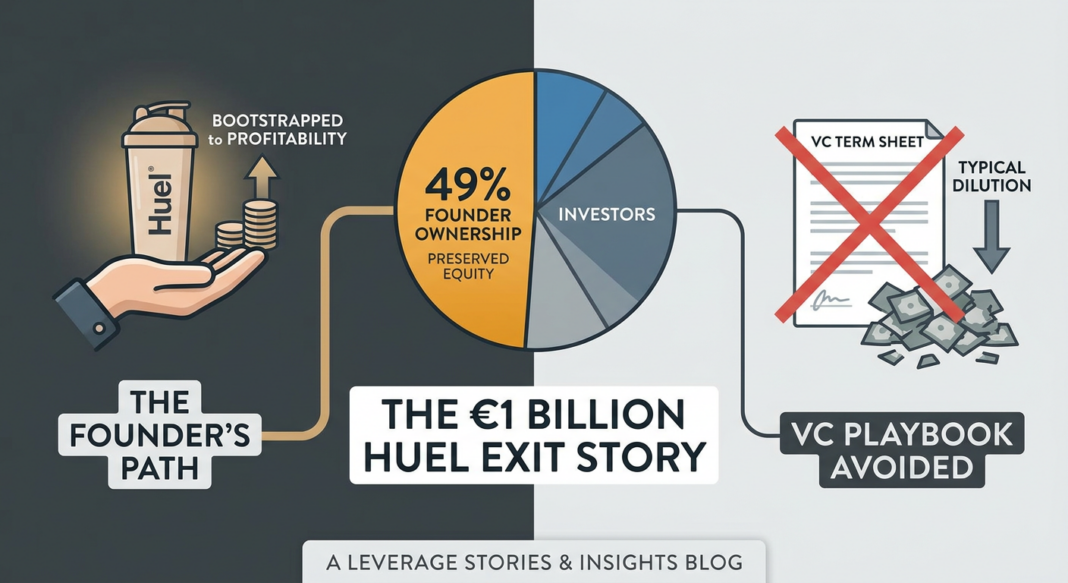
The Story: A Founder Who Refused to Follow the VC Playbook
In 2026, Julian Hearn sold Huel, his UK-based nutritionally complete food brand, to Danone for €1 billion. On the surface, that’s a clean exit headline. But buried inside it is one of the most instructive capital structure decisions in recent consumer brand history.
Hearn walked away with approximately £420 million personally. That’s roughly 49% of the exit proceeds, a figure that almost no founder retains after raising meaningful outside capital. Most direct-to-consumer brand founders who raise $184M across three rounds end up owning somewhere between 15% and 25% at exit, according to cap table analysis published by creatorsblueprint.co.
Hearn kept 49.3%.
How? Not through some exotic financial instrument. Not through a leveraged recap or a private credit facility. He did it through something more fundamental and more rare: fundraising discipline. He bootstrapped Huel to £18 million in annual revenue before ever approaching a Series A investor. He raised only at inflection points. He built real unit economics (gross margin expansion through vertical integration, improving marketing efficiency, and a pathway to genuine EBITDA profitability) before diluting a single basis point of ownership.
By the time Danone came knocking, Huel’s margins were premium enough to command a 17–20x EBITDA multiple. Hearn didn’t just preserve equity. He made his equity worth more.
The Decision: Bootstrap First, Raise Minimally, and Never Let Dilution Become the Default
The conventional DTC playbook in the 2010s and early 2020s was well-worn: raise a seed round to prove concept, raise a Series A to fuel growth marketing, raise a Series B to scale into retail, then raise a Series C or sell. Each round dilutes the founder by 15–25%. By the time you close a Series C, you may own less of your company than your lead VC.
Hearn’s playbook looked different from the start. Before he raised a single pound from an outside investor, he built Huel to a business generating £18 million in revenue: largely through direct-to-consumer subscription sales, low customer acquisition costs, and a product with genuinely strong repeat purchase dynamics. He had proof of demand, proof of retention, and proof of margin before he needed anyone else’s capital.
When he did raise, across three structured rounds totalling $184 million, he did so at valuations that reflected a real business, not a growth story. He raised at inflection points, where his leverage in negotiations was highest and where investor demand was driven by demonstrated performance rather than projected TAM.
The result: after $184 million raised across three rounds, he still owned 49.3% of the company at exit, per Companies House filings analysed by creatorsblueprint.co. That is not an accident. That is architecture.
Compare this to the typical VC-backed DTC outcome. A founder raises a $5M seed at a $20M post-money valuation, giving up 25%. Then a $20M Series A at a $80M post-money, giving up another 25%. Then a $50M Series B. By round three, the founder’s stake has often compressed below 30%, before any option pool refreshes or pro-rata dilution from follow-on investors. The math works against you from the first term sheet.
The Outcome: What Disciplined Equity Preservation Actually Looks Like in Pounds
The €1 billion Danone acquisition closed in 2026. At the point of exit, here is the rough math that made headlines, and should make founders rethink their default instinct to raise as much as possible, as early as possible.
- Total raised: $184 million across three rounds
- Founder ownership at exit: ~49.3%
- Founder proceeds: approximately £420 million
- Exit multiple on revenue: approximately 17–20x EBITDA, per creatorsblueprint.co
Now run the counterfactual. Suppose Hearn had followed the standard VC playbook and raised aggressively in those early years, perhaps $30M at Series A instead of raising minimally, forcing growth marketing spend before the unit economics were ready. He might have grown faster. He might also have owned 20% at exit instead of 49%. On a €1 billion exit, that difference is approximately £240 million in personal proceeds. Gone. Transferred to investors who provided capital he didn’t strictly need.
The premium multiple Danone paid, 17–20x EBITDA rather than the 10–12x typical for DTC brands with flattening growth, was itself a product of the capital discipline. Because Huel hadn’t over-invested in growth marketing to chase revenue, its contribution margins were healthy. Because it had vertically integrated, gross margins had expanded. Because it had built omnichannel distribution rather than relying purely on DTC, the revenue base was strategically attractive to a global acquirer. Disciplined capital use didn’t just preserve equity. It built a better business that commanded a better price.
The Lessons: A Framework for Founders Facing the Raise-or-Bootstrap Decision
Huel’s story is not an argument against raising capital. It is an argument against raising capital reflexively: before you have the leverage, the proof points, or the genuine need that justifies the dilution.
Here are the principles that emerge from Hearn’s playbook:
1. Bootstrap to a Fundable Business, Not Just a Fundable Story
The difference between raising at £2M revenue and raising at £18M revenue is not just valuation: it’s negotiating power, terms, and the quality of investors you attract. Investors competing to participate in a proven business offer better terms than investors taking a flyer on a concept. Every month you delay raising (while building real revenue) is a month your ownership percentage buys more dilution-adjusted value.
2. Raise at Inflection Points, Not at Need Points
Founders who raise when they’re running out of money raise on the investor’s terms. Founders who raise when they have multiple quarters of accelerating margins, strong retention data, and inbound investor interest raise on their own terms. Timing your raise to a genuine inflection point, not to a cash crisis, is the single most underrated capital structure skill in early-stage company building.
3. Vertical Integration Compounds Both Margins and Valuation Multiples
Huel’s decision to vertically integrate manufacturing was not just operational; it was financial. Every point of gross margin improvement that came from owning more of the supply chain translated directly into higher EBITDA, and higher EBITDA at exit meant a larger absolute number against which Danone’s 17–20x multiple was applied. Capital structure decisions and operational decisions are never fully separate.
4. Equity Dilution Has a Real, Calculable Cost
Founders rarely calculate the actual pound-for-pound cost of a funding round. The question is never just “what is the valuation?”; it is “what percentage of my eventual exit proceeds am I transferring to this investor, and what is the probability-weighted value of retaining that percentage instead?” Hearn’s £420M outcome versus a hypothetical £180M outcome under aggressive dilution is not abstract. It is a number that should inform every term sheet conversation.
5. The Market Is Evolving: Non-Dilutive Capital Is More Available Than Ever
While Huel’s story centres on bootstrapping and disciplined equity raises, the broader private credit market in 2026 offers founders more non-dilutive options than any prior generation. Private credit lending to companies has grown sharply across sectors: as seen in the $35 billion structured financing Apollo and Blackstone arranged for Anthropic’s infrastructure buildout, a deal that used lease-backed SPV structures rather than equity dilution to access institutional capital, per based.info and enterpriseai.economictimes.indiatimes.com. Private credit outstanding to technology and growth companies reached $200 billion as of mid-2026. For founders with real cash flows, the debt markets are open, and at a lower cost of capital than equity.
Key Insights
- Bootstrapping to revenue proof is a capital strategy, not just a survival tactic: Hearn’s decision to reach £18M in revenue before raising Series A directly preserved the ownership percentage that eventually translated into £240M+ in additional personal proceeds versus a typical VC-diluted outcome.
- Raise at strength, not at need: The timing of a capital raise (relative to your business’s proof points and your cash position) determines the terms you receive and the equity you surrender. Founders who raise from a position of leverage consistently retain more ownership at exit.
- Dilution math is exit math: Every percentage point of ownership transferred in a funding round has a direct, calculable cost at exit. On a €1 billion outcome, a single point of ownership is worth €10 million. Model it before you sign.
- Operational decisions compound into capital structure outcomes: Vertical integration, omnichannel distribution, and marketing efficiency are not just operational metrics; they are the inputs to exit multiples. Better margins command premium multiples, which amplify the value of preserved ownership.
- The non-dilutive capital menu has never been broader: From revenue-based financing for DTC brands to asset-backed private credit for infrastructure-heavy businesses, founders in 2026 have access to capital structures that preserve equity in ways unavailable to prior generations. Equity should be the last lever pulled, not the first.


