
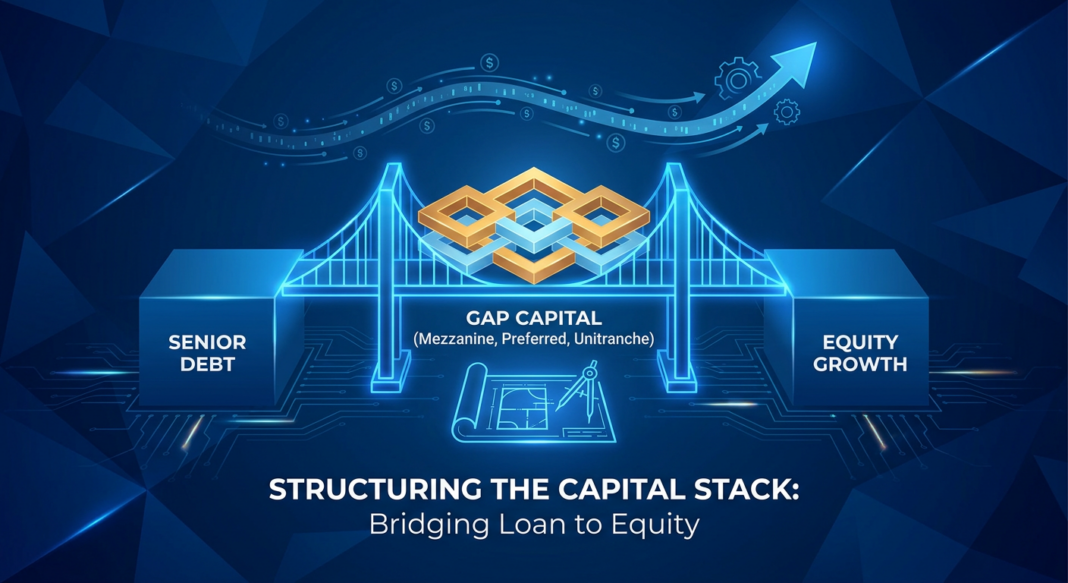
The Financing Problem That Sits Between Bank Debt and Equity
Growth-stage companies pursuing acquisitions routinely encounter the same structural problem: the business has outgrown venture financing terms but cannot yet access broadly syndicated leveraged credit markets. The organic cash flow is real but insufficient to service a fully debt-funded deal. The equity base exists but diluting it to close a bolt-on acquisition is a poor use of ownership. The result is a financing gap, a quantum of capital that sits above what a senior lender will provide and below what a pure equity raise would justify.
This gap is not a failure of creditworthiness. It is a structural feature of the growth stage, and it has a structured solution. The discipline required is not simply finding a capital provider; it is designing the right layer of capital, at the right cost, with the right terms, mapped precisely to the use of proceeds the acquisition demands. That design process is what separates companies that close well-structured deals from those that either overpay for capital or fail to close at all.
This article walks through the gap capital playbook for a growth-stage acquisition: how to size the gap, position the stack, evaluate the instruments, run the process, and negotiate the structure.
Step 1: Map the Stack Before You Approach a Single Lender
Capital stack design for an acquisition starts with a sources-and-uses schedule, not a pitch deck, not an introductory call. The schedule forces discipline: total enterprise value of the target, transaction fees, working capital requirements, and any reserves must all be quantified before you know how much capital you actually need.
Consider a representative growth-stage scenario: a company with $3M in EBITDA acquiring a target at a $15M enterprise value. The capital architecture might look like this:
- Senior debt (bank or ABL): $8M, sized at approximately 2.5–3.0x the combined EBITDA, reflecting a conventional bank’s appetite for a growth-stage borrower with moderate asset coverage.
- Seller note or earnout: $1M, bridges a valuation gap while keeping the seller aligned post-close.
- Sponsor or existing equity: Variable, determined after the gap is quantified.
- Gap capital: $6M, the residual that falls between senior debt capacity and total sources required.
That $6M gap is the structuring problem. It is too small for most institutional mezz funds operating above $10M minimums, too large to ignore, and too risky for conventional bank appetite. As the Bond Capital framework for growth-stage deals illustrates, the right approach is to model three scenarios (mezzanine debt, preferred equity, or a blend) and evaluate each against three metrics: post-close leverage ratio, annual debt service coverage above 1.20x FCCR, and pro-forma equity dilution below 15% of common. The scenario that clears all three thresholds simultaneously is the optimal structure, not simply the cheapest one on a coupon basis. See bondtv.vaultai.ca for the full use-of-proceeds framework.
Step 2: Understand the Cost-of-Capital Spectrum for This Layer
Gap capital does not live in one market; it spans a range of instruments, providers, and pricing points. Understanding where each instrument sits on the cost-of-capital spectrum is essential before approaching the market.
| Instrument | Typical All-In Cost | Dilution | Covenant Profile |
|---|---|---|---|
| Senior bank debt | 7–9% all-in | None | Maintenance (leverage, FCCR) |
| Unitranche (direct lender) | 10–13% all-in | Minimal (small warrant) | Light maintenance or incurrence |
| Mezzanine debt | 13–17% all-in (cash + PIK) | Low-to-moderate (warrant coverage 3–8%) | Incurrence-based, subordinated |
| Preferred equity | 15–20% IRR target | Moderate (conversion or participation rights) | Minimal covenants, governance rights |
| Common equity | 20–30%+ IRR expectation | High | Board control, information rights |
The key insight here is that a lower coupon does not always mean lower cost. A 14% mezzanine facility with maintenance covenants and 5% warrant coverage may constrain operational flexibility far more than a 16% preferred equity instrument with no scheduled repayment and no financial covenants. As alvren.com notes, the sequencing principle (take cheaper, lighter instruments first and reserve restrictive capital for last) applies directly to gap capital selection. The cheapest instrument on paper is rarely the cheapest instrument in practice if it restricts your next raise or your operating flexibility.
Step 3: Prepare the Materials That Gap Capital Providers Actually Underwrite
Gap capital providers (mezzanine funds, BDCs, family offices, and credit opportunity funds) underwrite to a fundamentally different thesis than senior lenders. Senior lenders model downside asset coverage. Gap capital providers model upside value creation and recovery in a stress scenario where senior lenders have already been made whole.
The materials package for a gap capital raise must include four components:
- A clear use-of-proceeds memo demonstrating how the acquisition creates measurable EBITDA accretion, not just revenue addition, but margin-adjusted contribution after integration costs.
- A three-year integrated financial model with sensitivity tables on revenue growth and margin compression scenarios. Gap providers will stress the model; present your own stress case first to demonstrate management credibility.
- A management presentation covering strategic rationale, competitive positioning, and the exit pathway: whether that is a strategic sale, a larger sponsor acquisition, or a recapitalization. Gap providers need to see a clear path to repayment or liquidity.
- A clean, current cap table showing pre- and post-transaction ownership across all classes of securities, including any existing warrants, options, or convertible instruments.
The quality of this package directly determines process efficiency. As bondtv.vaultai.ca observes, a clear capital plan and governance narrative materially shortens due diligence timelines with institutional capital providers. Gaps in the use-of-proceeds memo or inconsistencies between the model and the cap table are the two most common reasons gap capital processes stall.
Step 4: Run a Competitive Process, Not a Sequential Search
The most common mistake in gap capital raises is approaching providers sequentially. A company reaches out to Provider A, waits four weeks for a term sheet, rejects it, then approaches Provider B. This sequential approach eliminates pricing tension, extends timelines, and signals to the market that the deal is circulating without momentum.
The correct approach is simultaneous outreach to four to six providers, structured as a formal process with a defined response deadline and a standardized term sheet request. Require each provider to specify their position across five dimensions:
- Coupon structure: Cash pay versus PIK split, and the conditions under which PIK can be elected.
- Warrant coverage or equity participation: Percentage of fully diluted equity, strike price, and exercise mechanics.
- Covenant package: Maintenance versus incurrence, specific ratio levels, and cure rights.
- Board observer rights: Scope, information access, and sunset provisions.
- Change-of-control provisions: Whether a future sale or recap triggers repayment or conversion.
Evaluating responses across all five dimensions, not just headline rate, is where structuring discipline delivers its highest return. A provider offering 50 basis points less on the coupon but requiring quarterly maintenance covenant testing with no equity cure right may be the more expensive instrument over a three-year hold. The vcbeast.com capital stack framework reinforces that the best stack is the one that matches cash flow durability, lender appetite, and the sponsor’s operating plan, not the one with the lowest nominal cost.
Step 5: Negotiate the Structure, Not Just the Price
Once term sheets are received, negotiation should focus on structural flexibility rather than coupon reduction. Experienced borrowers know that a 50-basis-point improvement in rate is worth far less than winning the right structural terms. The highest-value negotiating points for a growth-stage borrower in a gap capital raise are:
- PIK toggle flexibility: The right to elect PIK interest during periods of acquisition integration or organic investment, without triggering a default or requiring lender consent.
- Equity cure rights: The ability to inject equity to cure a covenant breach before it becomes an event of default, standard in sponsor-led deals but negotiable in direct lender structures.
- Warrant coverage cap: Negotiate a ceiling on aggregate warrant dilution, and push for a fair market value strike price rather than a nominal or penny warrant structure.
- Prepayment flexibility: Soft call protection (a declining premium over 12–24 months) rather than hard no-call periods that lock the company into a high-cost instrument after the acquisition has performed.
- Information rights scope: Board observer rights are generally acceptable; voting rights for a non-equity gap capital provider are not standard and should be resisted.
The sequencing of negotiation matters. Reach agreement on structural terms before finalizing pricing. Providers who have already committed to their structural position are less likely to re-trade on rate once legal documentation begins.
Key Takeaways
- Size the gap before you source capital. A complete sources-and-uses schedule (including fees, working capital, and reserves) is the prerequisite for any gap capital process. Without it, you cannot evaluate whether a term sheet actually closes your deal.
- Model three scenarios, pick one. Mezzanine debt, preferred equity, and a blend each produce different leverage ratios, coverage metrics, and dilution outcomes. The optimal structure is the one that clears all three thresholds simultaneously, not the one with the lowest coupon.
- The cost of capital is not just the coupon. Covenant restrictiveness, warrant coverage, PIK mechanics, and change-of-control provisions are all components of true all-in cost. A cheaper rate with more restrictive terms is often the more expensive instrument over a three-year hold.
- Run a simultaneous process. Approaching four to six gap capital providers at once (with a standardized term sheet request and a defined deadline) creates competitive tension that sequential outreach cannot replicate.
- Negotiate structure before price. The highest-value concessions in a gap capital negotiation are PIK toggle flexibility, equity cure rights, warrant coverage caps, and prepayment optionality, not basis points on the coupon rate.


