
The Most Important Question in Private Credit
Before evaluating yield, before reading a fund’s track record, before looking at a single loan covenant, ask one question: where in the repayment line does this debt sit? The answer determines not just your expected return, but your probability of getting your capital back at all.
The capital stack is the formal hierarchy of claims on a company’s assets and cash flows. It is not an abstraction. It is a legally enforceable sequence that dictates, in precise order, who gets paid first when a borrower generates cash, and who absorbs losses first when a borrower cannot. Understanding capital stack position and subordination (the act of ranking one claim below another) is the foundational skill for anyone evaluating private credit, whether as an institutional allocator or a business owner deciding how to finance growth.
How the Capital Stack Works
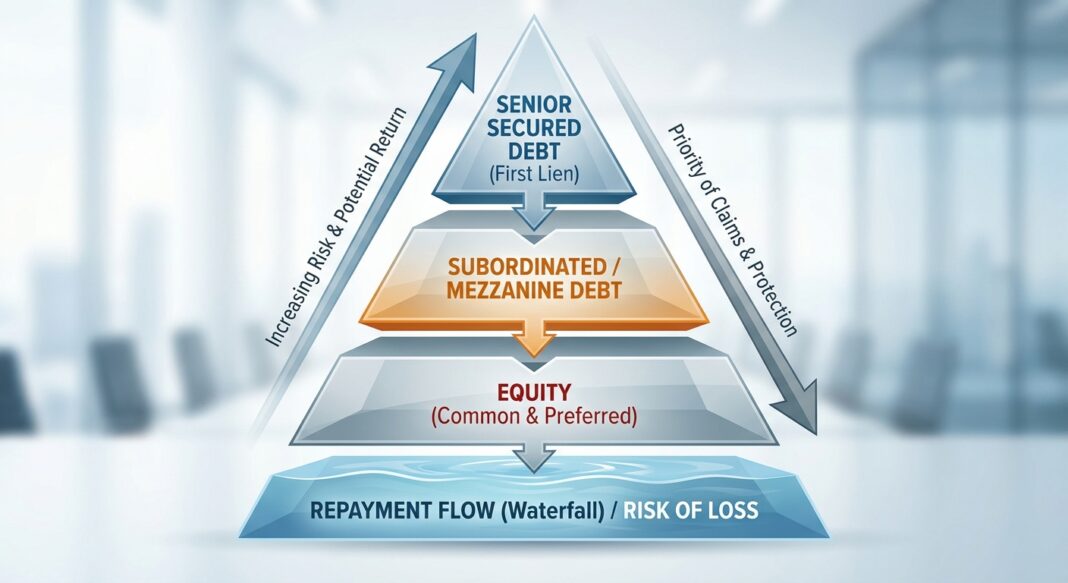
Think of the capital stack as a building. The lowest floors are flooded first during a financial storm. The highest floors stay dry the longest.
From most senior (safest, lowest return) to most junior (riskiest, highest potential return), a typical private credit capital stack is structured as follows:
- Working Capital / Revolving Credit Facility: The very top, short-term lines backed by receivables and inventory, repaid continuously.
- Senior Secured Debt (First Lien): Priority claim on all collateral. In a liquidation, this lender is paid from asset proceeds before anyone else. As explained by BIP Wealth, senior secured lenders stand at the front of the repayment line, backed by the company’s tangible assets.
- Unitranche Debt: A single blended loan that combines first-lien and second-lien characteristics into one instrument. According to PitchGrade’s Private Credit Primer (2026), unitranche eliminates the complexity of multi-tranche structures while offering a single lender or small club a negotiated blended rate.
- Second Lien / Subordinated Debt: Junior to senior secured, this layer accepts a lower recovery priority in exchange for a higher coupon. It absorbs losses before senior creditors do.
- Mezzanine Debt: Sits between senior debt and equity, often structured with equity upside through warrants, bridging the capital need that senior lenders will not cover and that equity sponsors do not want to dilute for.
- Preferred & Common Equity: The basement. Equity holders absorb all losses before any creditor is impaired. They get paid last, but they also capture all residual upside if the company thrives.
Subordination is the legal mechanism that makes this hierarchy enforceable. A subordination agreement formally contractualises that one creditor’s claim ranks below another’s, meaning the junior lender cannot be repaid until the senior lender is made whole.
A Concrete Example with Numbers
Consider a manufacturing company acquired by a private equity sponsor in a leveraged buyout. The company is valued at $100 million. The capital structure is financed as follows:
- Senior Secured Loan (First Lien): $50 million: priced at SOFR + 550 bps
- Mezzanine Debt: $15 million: priced at a fixed 13%, with equity warrants
- Sponsor Equity: $35 million
Now assume the business underperforms significantly. In a distressed sale, buyers are only willing to pay $55 million for the company’s assets.
Here is how the waterfall distributes that $55 million:
- Senior Secured Lender receives: $50 million: fully repaid (100 cents on the dollar)
- Mezzanine Lender receives: $5 million of their $15 million, a recovery of roughly 33 cents on the dollar
- Equity Sponsor receives: $0: a total loss on their $35 million investment
The senior secured lender walked away whole. The mezzanine lender absorbed a meaningful loss. The equity sponsor was wiped out. Same company. Same outcome. Entirely different experience, determined entirely by capital stack position.
This is why the senior secured layer carries lower yields: it is structurally protected. And it is why mezzanine and equity command higher returns; they are accepting the risk of sitting in the flood zone.
Current Market Relevance
Capital stack dynamics are not purely academic in 2026; they are being actively repriced across the private credit market, which has scaled dramatically in recent years.
According to PitchGrade (2026), global private credit AUM has surpassed $1.7 trillion as of Q1 2026, with Ares Management, Apollo Global, Blackstone, Blue Owl, and HPS Investment Partners collectively managing over $800 billion of the asset class. The structural shift is permanent: OCC Leveraged Lending Guidance effectively prohibits banks from underwriting deals with debt-to-EBITDA above 6.0x, redirecting those transactions directly to private credit funds not subject to that guidance. The practical result: more than 75% of leveraged buyout financing in deals below $500 million in EBITDA is now provided by private credit funds rather than bank syndicates.
For senior secured direct lending specifically, PitchGrade (2026) reports current pricing of SOFR + 500–650 bps for middle market borrowers and SOFR + 425–500 bps for large-cap borrowers, a spread that compensates lenders for illiquidity and credit risk while remaining below the returns demanded by mezzanine and equity capital.
From a credit quality perspective, Long Angle’s Private Credit Investment Guide (2026) notes that direct lending default rates have remained under 4% since 2021, according to Proskauer’s Private Credit Default Index, a figure that reflects the protective value of senior secured positioning. And as DeMarche’s Navigating Private Credit (January 2026) explains, private credit has consistently delivered 200–400 bps over broadly syndicated loans at comparable or lower default rates: demonstrating that illiquidity premium, not increased subordination risk, is the primary driver of outperformance in well-structured direct lending.
| Capital Stack Layer | Typical Pricing (2026) | Recovery Priority | Source |
|---|---|---|---|
| Senior Secured (MM) | SOFR + 500–650 bps | First, highest recovery | PitchGrade, 2026 |
| Senior Secured (Large Cap) | SOFR + 425–500 bps | First, highest recovery | PitchGrade, 2026 |
| Direct Lending Default Rate | Under 4% (since 2021) | N/A | Long Angle / Proskauer, 2026 |
| Private Credit Premium vs. BSL | +200–400 bps | N/A | DeMarche, Jan 2026 |
| MM LBO Financing from Private Credit | 75%+ of deals <$500M EBITDA | N/A | PitchGrade, 2026 |
Decision Framework: Investors and Operators
For Investors Evaluating Private Credit Funds: Capital stack position is the single most clarifying lens for due diligence. When a manager describes their fund as a “private credit” strategy, that label alone tells you very little. A senior secured direct lending fund and a mezzanine fund are both technically private credit, but they occupy fundamentally different risk profiles. Investors consider: What percentage of the portfolio is first-lien senior secured? What is the average loan-to-value ratio? Does the fund use leverage at the fund level, and if so, does that amplify subordination risk? Historical default rates under 4% for direct lending are encouraging, but recoveries depend on where in the stack a lender sits when defaults occur. Covenant structures also matter: as DeMarche (January 2026) outlines, financial covenants (minimum DSCR, debt yield thresholds) act as an early warning system that gives senior lenders the ability to intervene before losses compound. Investors evaluate how tightly those covenants are structured and whether the manager has the operational capacity to enforce them.
For Operators Deciding How to Finance Their Business: Every dollar of capital in your business has a cost, and that cost reflects where it sits in your stack. Senior secured debt is the cheapest because lenders are accepting the lowest risk. Mezzanine and subordinated debt cost more because those lenders sit behind senior creditors and demand compensation for that exposure. Equity is the most expensive on a long-run cost basis, equity holders get paid last, so they require the highest prospective returns. Operators evaluate: How much senior secured debt can the business support given its EBITDA and asset base? Is the incremental cost of mezzanine justified by the growth it enables? Can the business sustain the covenants that come with each layer? Understanding your own capital stack is not just a financing exercise; it tells you how much equity cushion protects your lenders, and therefore how much risk they perceive in lending to you.
Key Takeaways
- Position determines protection: Senior secured lenders hold the highest claim priority and historically recover the most in distressed scenarios, structural safety, not luck.
- Higher yield means lower stack position: When a private credit fund advertises a higher coupon, ask why. It is almost always because the lender is accepting subordination, more risk in exchange for more return.
- “Private credit” is not a monolith: Senior secured direct lending, unitranche, mezzanine, and subordinated debt are all categorised as private credit but carry materially different risk profiles. Clarity on stack position is non-negotiable before committing capital.
- The market has structurally shifted: With over 75% of middle market LBO financing now flowing through private credit rather than banks, understanding the capital stack is no longer optional; it is the baseline literacy for any participant in private markets.
- Covenants reinforce position: Capital stack seniority provides structural protection, but covenant packages (financial ratios, negative restrictions, reporting requirements) are the active monitoring tools that allow senior lenders to act before subordination becomes irrelevant.


