
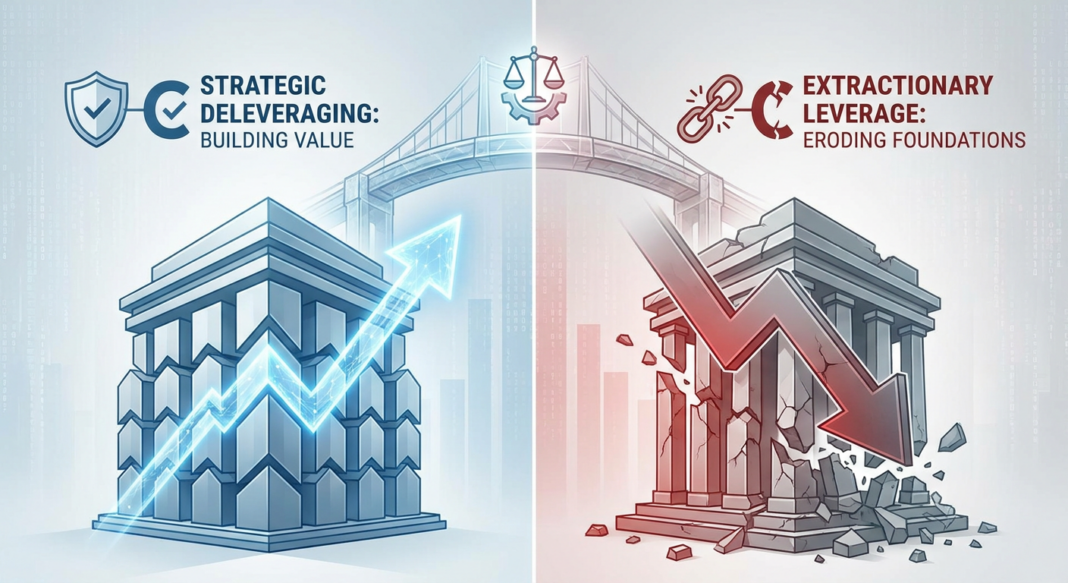
The Story: A Tale of Two Capital Structures
In June 2025, a little-known insurance brokerage headquartered in Lindon, Utah made a quiet but consequential capital decision. Trucordia, formerly PCF Insurance Services and now ranked among the top 20 U.S. insurance brokerages, announced a $1.3 billion structured equity investment from Carlyle’s Global Credit platform, valuing the company at $5.7 billion. The deal wasn’t a sale. It wasn’t a VC round. It was a precisely engineered ownership realignment designed to do something deceptively difficult: reduce debt, simplify governance, and position leadership to keep building, all without surrendering the wheel.
One year earlier, the country witnessed the polar opposite. Steward Health Care, once the largest private hospital operator in the United States, filed for Chapter 11 bankruptcy in May 2024, one of the largest hospital bankruptcies in American history. The system had ballooned to over 31 hospitals, 400 facilities, and 30,000 employees across eight states. And yet it collapsed under the weight of a capital structure that had been optimized not for the company’s longevity, but for its investors’ short-term extraction.
Both stories involve leverage. Both involve recapitalization. The outcomes could not be further apart, and the difference tells us everything worth knowing about when structured capital creates value and when it simply detonates it.
The Decision: Structure as Strategy vs. Structure as Extraction
Trucordia: Using Capital to Clean Up the Stack
Trucordia arrived at its 2025 recapitalization as a rollup-heavy platform that had executed 22 acquisitions in 2024 alone, with five more in the first half of 2025. That kind of acquisition velocity typically leaves a complex, layered ownership structure in its wake: minority investors with conflicting incentive horizons, fragmented governance, and leverage built up across multiple deal tranches. The company needed a capital partner who could navigate this complexity at speed and with precision.
The solution was a structured equity investment from Carlyle’s Credit Opportunities team: a strategy explicitly designed, per Carlyle’s own disclosures, to serve “family, founder, and management-owned companies, sponsor-backed companies, and special situations, with a focus on long-term value creation.” The $1.3 billion would accomplish three things simultaneously: reduce existing leverage, repurchase units from minority investors to simplify the governance structure, and deliver long-term financial flexibility for Trucordia to pursue further strategic outcomes on its own terms.
Crucially, the capital came from Carlyle’s credit platform, not its private equity buyout arm. The distinction matters enormously. This was not a control transaction. Trucordia’s CEO Felix Morgan described the deal as “transformative,” pointing to the new financial and governance structures it would create to support continued growth. The company’s CFO Brandon Gray was direct: the investment would “reduce Trucordia’s leverage, fortify our balance sheet and enhance our financial flexibility.” The capital’s purpose was operational, to strengthen the foundation beneath a growing platform, not to extract value from it.
Steward Health Care: Using Capital to Extract, Not Build
Steward’s story began in 2010 when Cerberus Capital Management acquired six Massachusetts hospitals in a leveraged buyout valued at approximately $895 million, putting up roughly $246 million in cash, or about 27% of deal value. From the outset, the structure prioritized investor returns over operational sustainability.
In 2016, Steward sold the real estate of its Massachusetts hospitals to Medical Properties Trust (MPT) in a transaction generating $1.2 billion, proceeds that Cerberus used in part to finance a $484 million dividend back to one of its own funds. This is the textbook definition of a dividend recapitalization: the operating company takes on lease obligations and strips out cash, transferring liquidity risk from the sponsor to the enterprise and ultimately to patients, workers, and vendors.
By the time Steward filed for bankruptcy, it reported over $9 billion in liabilities, including $290 million in unpaid employee wages and benefits and nearly $1 billion owed to vendors. Cerberus, by that point, had long exited its investment, reportedly extracting approximately $800 million through management fees, dividend recapitalizations, and related-party transactions before moving on.
The Outcome: Numbers That Tell the Story
| Factor | Trucordia (2025) | Steward Health Care (2010–2024) |
|---|---|---|
| Capital Event | $1.3B structured equity investment | $895M LBO + serial dividend recaps |
| Capital Purpose | Deleverage + governance simplification | Investor extraction + expansion |
| Valuation at Deal | $5.7 billion | $895 million (entry) |
| Leverage Direction | Reduced post-transaction | Compounded to $9B+ in liabilities |
| Ownership Outcome | Simplified, management-aligned | PE exited; creditors and workers left holding the bag |
| Operational Result | Platform continues acquisitive growth | 31 hospitals sold, 2,400+ jobs lost, Chapter 11 |
The contrast is not simply one of good versus bad management. It is a contrast in the intent embedded in the capital structure itself. Trucordia used structured capital to build platform durability. Steward’s capital structure was designed (by intent and incentive) to maximize near-term cash extraction. When leverage is instrumentalized for extraction rather than construction, the business becomes a vessel for transferring risk downward: from sponsors to management, from management to workers, from workers to the communities those hospitals were supposed to serve.
The broader market validates the Trucordia approach. Carlyle’s 2026 credit outlook notes strong and growing demand from founder- and family-owned businesses looking to recapitalize without giving up control, structures that often require hybrid instruments and bespoke covenants. Meanwhile, the private credit market has grown to nearly $2 trillion in AUM precisely because borrowers and operators are increasingly demanding capital partners who can underwrite complexity without demanding control as the price.
The Lessons: A Framework for Capital Decisions That Compound, Not Corrode
1. Understand What the Capital Is Designed to Do
Before any term sheet, the most important question is structural: Is this capital being deployed to strengthen the operating foundation or to extract value from it? Leverage that reduces complexity, funds growth, and aligns governance incentives compounds over time. Leverage that is layered to pay dividends to exiting investors (particularly in industries with thin margins and community obligations) is a deferred liability dressed as liquidity.
2. The Source of Capital Shapes the Intent
Trucordia turned to Carlyle’s credit platform, not its PE buyout arm. This is a meaningful signal. Private credit strategies today offer highly structured, privately negotiated solutions that sit between equity and traditional debt: capable of providing liquidity to existing owners, simplifying governance, or funding acquisitions without demanding the board seat or the exit clock that PE ownership typically brings. As Akin Gump’s 2025 market review noted, non-sponsor direct lending went mainstream in 2025, with founder-owned borrowers driving growth in bespoke structures like delayed-draw term loans, hybrid overlays, and asset-based facilities.
3. Leverage Works When Cash Flow Can Service It
Structured debt is a tool, not a strategy. It works when it is sized against durable, predictable free cash flow and when the business has operating leverage, the ability to grow EBITDA faster than it grows its debt service. Insurance brokerage is a fee-based, recurring-revenue business with attractive unit economics and significant acquisition-led synergies. Hospitals operating on thin Medicare and Medicaid reimbursements, facing unionized workforces and capital-intensive physical plants, are a fundamentally different risk profile. The Steward disaster is partly a story of applying the wrong capital model to the wrong business type.
4. The Cautionary Tale of Misaligned Time Horizons
PE funds typically hold investments for three to seven years before they must return capital to LPs. This creates structural pressure to extract value within that window (through dividend recaps, sale-leasebacks, or management fee charges) regardless of whether the underlying business needs that capital to reinvest. Founder-operators and family businesses, by contrast, tend to operate with a multi-generational time horizon that naturally aligns with long-term business health. When selecting a capital partner, the time horizon alignment between the operator and the capital source is as important as the rate or the structure.
5. Market Context: This Approach Is Growing
The Trucordia playbook is not a one-off. The persistent supply-demand imbalance in private credit, combined with credit spreads near multi-year lows, has created a borrower-friendly environment in which operators can pursue ownership realignments on favorable terms. Dividend recapitalization volumes within the leveraged loan market maintained a strong pace in the first half of 2025, as businesses sought to generate liquidity for shareholders without full exits. The lesson is not to avoid recapitalizations; it is to execute them with the right intent, the right structure, and the right capital partner.
Key Insights
- Capital structure embeds intent. Trucordia used structured equity to deleverage and simplify governance; Steward’s PE sponsors used leverage to extract. The difference in purpose produced radically different outcomes for operators, employees, and communities.
- Private credit is not PE. Carlyle’s credit platform, not its buyout arm, led the Trucordia deal. Structured credit solutions can provide liquidity, governance simplification, and acquisition capital without triggering control transfer or the exit-clock pressure inherent in PE ownership.
- Business model determines leverage capacity. Fee-based, recurring-revenue platforms like insurance brokerage can absorb and service structured debt more durably than thin-margin, capex-heavy, community-essential businesses like hospitals. The Steward collapse was partly a capital model misapplied to an incompatible business type.
- Time horizon alignment is a deal term. A capital partner whose fund life forces a 3-to-7-year exit has structurally different interests from an operator building across decades. Founders and family businesses should interrogate a potential partner’s hold-period incentives as carefully as their valuation or rate.
- Deleveraging can be a growth move. Conventional wisdom treats debt reduction as defensive. Trucordia’s 2025 transaction reframes it: reducing leverage and simplifying governance unlocked financial flexibility for continued acquisitions, improved the company’s strategic optionality, and positioned management to drive the next phase of growth from a position of strength rather than fragility.


