
The Story: A Hole-Digger Who Refused to Give Away His Company
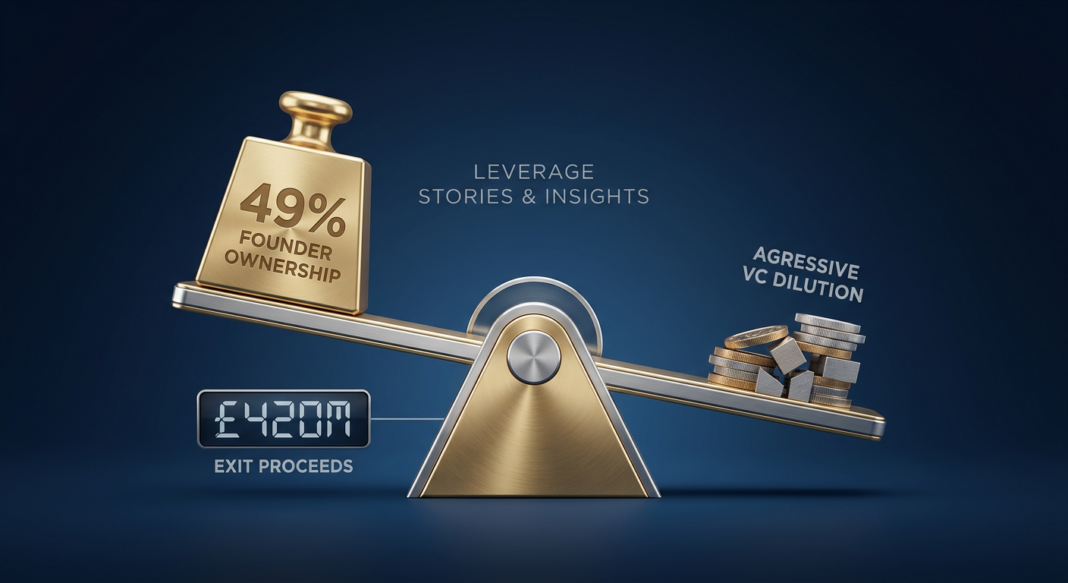
In 2026, Julian Hearn sold Huel, the UK-based complete nutrition brand he co-founded, to Danone for €1 billion. He personally walked away with £420 million. That’s roughly 49% of the exit proceeds flowing to a single founder after raising $184 million across three institutional funding rounds.
That number sounds impossible. Most direct-to-consumer (DTC) founders who raise comparable capital end up owning 15–25% at exit, according to cap table analysis from Companies House filings reviewed at the time of the deal. The venture machine is efficient at one thing above all others: diluting founders who come to it too early, too often, and too cheaply.
Hearn did something different. Before he ever sat across a table from an institutional investor, he had already built Huel to £18 million in annual revenue: entirely through bootstrapped operations. He sold nutritionally complete meal powders and RTD shakes directly to consumers, kept marketing lean, and reinvested cash flow rather than chasing growth with other people’s money. By the time he raised his Series A, he didn’t need capital to survive. He needed it to accelerate, and that distinction changed everything about the terms he could command and the ownership he could protect.
This is not a story about a lucky exit. It’s a story about capital discipline as a compounding asset: one that paid Hearn far more than any growth round ever could have.
The Decision: How to Fund Growth Without Surrendering the Company
The traditional DTC playbook is seductive and brutal in equal measure. Raise a seed round at a modest valuation, give away 20%. Raise a Series A on traction, give away another 20–25%. Repeat until you own a minority stake in your own creation, then hope the exit multiple is large enough to matter.
Hearn rejected that playbook structurally. By bootstrapping Huel to meaningful revenue before his first institutional raise, he arrived at the Series A negotiating table with a fundamentally different leverage position. He had proof, of demand, of unit economics, of his ability to grow without external capital. That proof didn’t just justify a higher valuation; it allowed him to raise only what he needed, when he needed it, preserving ownership at each step rather than accepting dilution as the cost of admission.
According to cap table analysis of Companies House filings cited by creatorsblueprint.co, Hearn retained 49.3% at exit after all three rounds, a figure that puts him in a class almost entirely separate from his VC-backed DTC peers. The discipline wasn’t accidental. Each round was sized to fund a specific operational inflection: vertical integration of manufacturing, international expansion, omnichannel retail entry. Capital was deployed against a defined thesis, not used to subsidize a loss-making growth engine.
Danone’s willingness to pay 17–20x EBITDA: a premium multiple despite revenue growth slowing to 17%, validated the underlying unit economics that Hearn’s capital discipline had protected. Strong contribution margins, improving marketing efficiency, and profitable omnichannel operations made Huel a strategic asset worth paying up for. A VC-diluted Huel, optimized for gross revenue over margin, might have fetched a far lower multiple on a far smaller ownership stake.
The Outcome: What 49% Actually Looks Like at the Exit Table
The math tells the story cleanly. At a €1 billion exit, Hearn’s 49.3% stake returned approximately £420 million personally. The investors who participated across three rounds received the remaining proceeds, a healthy return on their capital, but one that reflects the price of entering late into a business that had already de-risked itself.
Now run the counterfactual. A founder who raises aggressively from seed, common in VC-backed DTC, might surrender 20% at seed, 22% at Series A, 18% at Series B, and face further dilution through option pool refreshes and down-round provisions. By the time the same €1 billion exit arrives, that founder owns 12–18%. On identical exit proceeds, they net £120M–£180M: less than half of what Hearn took home, despite building a comparably valued company.
The gap, potentially £240M–£300M in personal proceeds, is the pure cost of early, excessive dilution. It doesn’t show up in a pitch deck. It doesn’t surface in a term sheet negotiation when a founder is desperate for runway. But it crystallises, with brutal clarity, at the exit.
Hearn’s outcome also illustrates a subtler principle: premium exit multiples reward operational quality, not just scale. Danone paid up because Huel had margin expansion, a loyal subscription base, and omnichannel reach, characteristics that bootstrapped discipline tends to produce, and that VC-fuelled growth-at-all-costs models frequently sacrifice.
The Lessons: A Framework for Founders Facing Capital Decisions
Huel’s story isn’t a blanket argument against raising equity. Hearn did raise $184 million, that’s not nothing. The argument is more precise: when you raise, how much you raise, and the business state you’re in when you raise are the three variables that determine how much of your company you own at exit. Getting all three right is the real game.
The broader capital markets are beginning to reflect this logic. General Catalyst’s Customer Value Fund, which recently deployed $360 million in non-dilutive, revenue-share financing to Musely, a profitable DTC health company: is explicitly designed for founders like Hearn: businesses past early-stage risk, generating consistent cash flow, but needing capital to accelerate without surrendering ownership, as reported by lazytechtalk.com. Musely’s CEO Jack Jia put it plainly: he “mathematically modeled” the non-dilutive structure and found it “absolutely compelling” compared to traditional VC.
Even at the institutional scale, the logic holds. Anthropic’s $35 billion structured financing package from Apollo and Blackstone, using a sale-leaseback of GPU infrastructure through a special-purpose vehicle rather than equity issuance, achieved a cost of capital of approximately 5.75% for senior notes, compared to the 20%+ implied return that venture equity investors typically require, per based.info. The principle scales from a nutrition brand to an AI frontier lab: when the business has real assets and predictable cash flows, structured debt beats equity dilution on cost, every time.
The Framework: Three Questions Before Every Capital Decision
- Can I bootstrap further? Every month of profitable operation before a raise increases your valuation floor and decreases dilution. Hearn’s £18M bootstrapped baseline was worth tens of millions in preserved ownership.
- What is this capital specifically for? Capital raised against a defined operational thesis (manufacturing, international, retail) gets deployed efficiently. Capital raised to “extend runway” gets burned subsidising a broken unit economics model.
- Is there a non-dilutive alternative? Revenue-based financing, structured debt, asset-backed lending, and project finance structures are increasingly available to profitable operators. The cost of capital is often materially lower than the implied equity cost of a VC round.
Key Insights
- Bootstrapping to proof is the highest-returning investment a founder can make. Hearn’s decision to reach £18M in revenue before raising institutionally preserved an estimated £240M–£300M in personal exit proceeds compared to an aggressively diluted peer outcome.
- Raise only at inflection points, and only what the inflection requires. Each of Huel’s three rounds funded a specific, measurable operational step, not a vague growth mandate. Precision in deployment preserves precision in ownership.
- Premium exit multiples reward margin quality, not just revenue scale. Danone paid 17–20x EBITDA for Huel’s operational discipline. VC-optimised growth models that sacrifice margin for topline frequently compress exit multiples at precisely the moment founders need them to expand.
- Non-dilutive capital is no longer a niche instrument. From General Catalyst’s revenue-share fund to Anthropic’s $35B structured infrastructure financing, institutional capital is actively building products designed to serve profitable operators who refuse to pay the equity premium.
- The cap table is a long game. Dilution decisions made in year two compound forward to exit. Founders who treat early-round terms as routine often discover, only at the exit table, the full cumulative cost of decisions that felt small at the time.


