
The Growth-Stage Funding Gap: Why Senior Debt Alone Leaves Capital on the Table
Every growth-stage operator eventually faces the same structural dilemma: the business has outgrown what a senior lender will support, but a full equity raise means selling ownership at a moment when the company hasn’t yet captured its full valuation. The gap between senior debt capacity and total capital need is one of the most common (and most expensive) financing problems in the middle market.
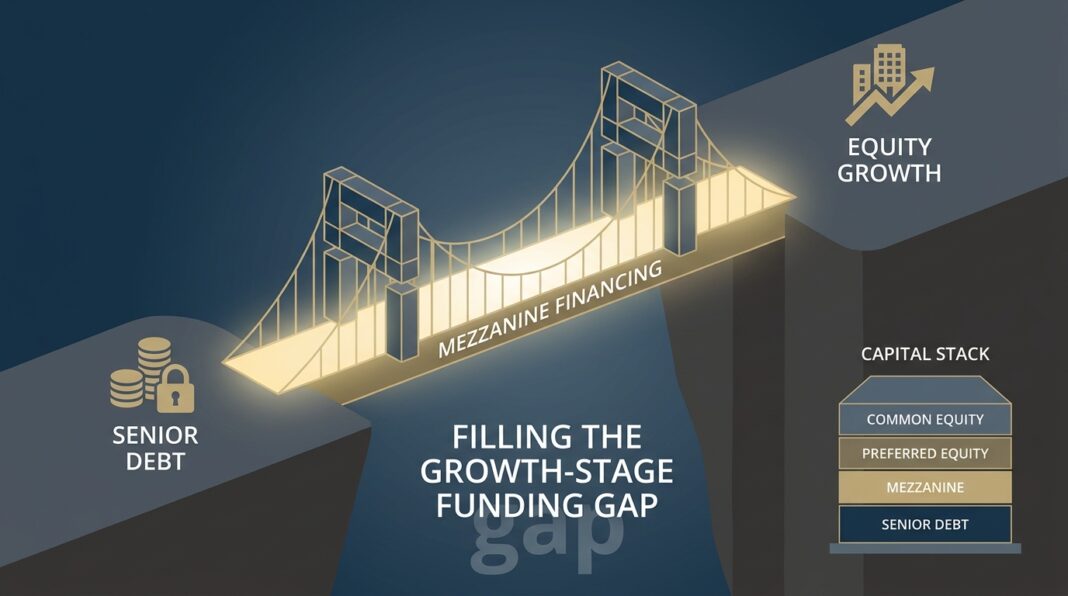
This is precisely the terrain that mezzanine financing is designed to occupy. Mezzanine debt is a hybrid financing solution positioned between senior debt and equity, offering growth capital with flexible terms and equity kickers. It functions, in structural terms, as a bridge that fills the gap between the amount a traditional bank will lend and a firm’s existing equity base, without requiring the owner to dilute as aggressively as a growth equity raise would demand.
For operators considering an acquisition, a recapitalization, or a meaningful capital expenditure cycle, understanding when and how to deploy mezzanine financing (and how to negotiate its terms) is a core strategic competency. This article maps the mechanics, the cost-access trade-offs, the process, and the negotiation points that determine whether a mezzanine structure works for or against the borrower.
Structure Breakdown: Components, Mechanics, and a Worked Example
The Position in the Stack
The capital stack, read from lowest to highest cost, runs: senior secured bank debt → private credit / unitranche → mezzanine → preferred equity → common equity. Mezzanine sits above senior debt in cost but below equity, meaning it is subordinated to senior claims in a default scenario. Because mezzanine lenders are last in line among debt holders, they charge a meaningful premium to compensate for that risk.
Component Breakdown
- Cash-Pay Interest: The regular, periodic cash coupon, typically paid quarterly. This is the base cost of the instrument and must be modeled against operating cash flow from day one.
- PIK (Payment-in-Kind) Interest: Rather than paying cash interest, the interest amount is added to the total loan balance, causing the principal to grow over time. PIK mechanics allow borrowers to conserve near-term liquidity during integration periods, capex cycles, or market downturns, but the trade-off is explicit: the borrower preserves liquidity at the cost of increased principal obligations and potentially higher all-in pricing measured by internal rate of return.
- Equity Kicker / Warrant Coverage: Mezzanine lenders commonly receive warrants, rights to purchase equity in the company at a set price in the future. This gives the lender potential participation in the company’s growth beyond the interest rate alone. Equity kickers typically take the form of warrants or options to buy between 1% and 5% of the borrower’s equity, conversion rights, profit participation rights, or co-investment rights. These add-ons let mezzanine providers share in upside while maintaining their priority position above pure equity investors.
- Bullet Repayment: Mezzanine loans are typically structured as a single bullet payment at maturity, with no mandatory principal amortization during the term. This preserves cash flow through the growth investment horizon.
- Maturity: Mezzanine financing usually has maturities of five to seven years, often aligning with expected exit or refinancing timelines.
Worked Example: $30M Manufacturing Expansion
Consider a manufacturer with $6M in EBITDA seeking $20M for a regional plant expansion. The senior bank lends $12M at approximately 7% secured against equipment and real estate. That leaves an $8M gap. Rather than dilute existing shareholders with a full equity raise, which would require giving up substantial ownership at what management believes is an undervalued moment, the company brings in a mezzanine fund to fill the gap:
- Facility: $8M mezzanine term loan
- Pricing: 13% cash interest + 2% PIK, compounding quarterly (total running yield: ~15%)
- Equity Kicker: Warrants for 3% of fully diluted equity, exercisable at current enterprise value
- Maturity: 6 years, bullet repayment
- Origination Fee: 2% of facility at close
- Covenants: Maximum total leverage (senior + mezz) of 4.5x EBITDA; minimum fixed charge coverage of 1.15x; quarterly maintenance testing
Management retains the majority of ownership and avoids the dilution that a full equity investor would require for the same $8M. The all-in cost (cash interest, PIK accrual, and equity kicker) is meaningfully higher than senior debt, but the structure preserves the equity upside that management has built.
As a structural note: mezzanine loans are typically unsecured or carry a second-priority lien, with a longer dated maturity than traditional senior debt, and are interest-only through the term, a combination of characteristics that makes this financing suitable for companies making growth investments in large capital projects where near-term cash flow preservation matters.
How Mezzanine Compares: Against Unitranche, Senior-Only, and Growth Equity
vs. Unitranche / One-Stop Lending
In recent years, unitranche has emerged as the dominant structure for sponsored middle-market acquisitions, combining senior and subordinated debt into a single facility with one lender. Unitranche dominates direct lending for cash flow leveraged buyouts in the core and upper middle market, and the market grew from roughly $20B in annual issuance in 2015 to over $200B in 2025 as direct lenders displaced traditional bank syndication for sub-$1B EBITDA borrowers. For acquisitions in the $25M–$200M enterprise value range, unitranche wins on execution speed and structural simplicity.
The key distinction is structural control and flexibility. In a unitranche, the borrower manages one lender relationship, one covenant package, and one credit agreement: a meaningful advantage for ongoing portfolio management, add-on acquisitions, and covenant modifications. In a senior-plus-mezzanine structure, the borrower manages two creditor relationships and a subordination/intercreditor framework that governs payment priorities in a stress scenario.
When to choose mezz over unitranche: When the borrower has an existing senior banking relationship they want to preserve, when the senior lender offers materially cheaper pricing on the first lien, or when total leverage needs exceed what a single unitranche provider will underwrite. The traditional senior + subordinated structure prices only marginally cheaper than unitranche on a blended basis, but may unlock higher total leverage in bespoke situations.
vs. Growth Equity
Equity financing involves raising capital by selling a percentage of ownership. Investors provide capital in exchange for shares, with returns coming from a future liquidity event. According to Carta’s State of Private Markets data, median dilution in 2025 sits at approximately 19.5% for seed rounds and 18% for Series A rounds, and Series A investors generally seek 15–30% ownership. Mezzanine, by contrast, delivers capital without immediate ownership transfer, though the equity kicker creates contingent dilution if the company performs well and an exit occurs.
The core trade-off: Mezzanine costs more in cash than senior debt and carries dilution risk through the warrant. Growth equity costs less in cash but requires more ownership transfer upfront. For operators confident in their trajectory, mezzanine is typically the cheaper path to capital at the moment of the investment, but the arithmetic reverses if the company substantially outperforms and the equity kicker becomes highly valuable to the lender.
Current Market Terms: What Mezzanine Looks Like in 2026
The rate environment of the past three years has materially repriced the mezzanine market. Here are the key data points operators and advisors should be benchmarking against:
- All-In Yield: Mezzanine debt is more expensive than senior debt, with a typical loan for a performing company expected to yield 12.5%–14% for the lender on the cash coupon alone. When PIK interest and equity kicker economics are included, the total effective return to the lender (and cost to the borrower) is often 20%–30% annually in successful exit scenarios.
- PIK Structure: Most deals include a mix of cash-pay interest and PIK components, with the PIK portion compounding into principal over time. A common market construct is 13% cash + 2% PIK, preserving near-term liquidity while keeping the running cost manageable.
- Equity Kicker / Warrant Coverage: Mezzanine lenders commonly receive warrants or options to buy between 1% and 5% of the borrower’s equity. The valuation at which equity kickers convert is a critical negotiation point; it can be set at closing or determined by a future valuation event such as a financing round or exit.
- Covenants, Maintenance Still Standard in Middle Market: This is a critical structural distinction from the broadly syndicated loan world. In the broadly syndicated loan market, approximately 90% of new loans in 2024 remained covenant-lite. Private credit lenders have maintained firmer positions on covenant inclusion, particularly for mid-market transactions: with maintenance covenants, quarterly tests of leverage or fixed charge coverage, returning to many PE-backed deals financed by non-bank lenders. In the lower-middle market (EBITDA below $25M), nearly every mezzanine loan includes at least one maintenance test. Maintenance covenants require borrowers to pass financial tests every quarter regardless of any action taken, while incurrence covenants only apply when the borrower takes a specific action like incurring new debt or paying a dividend. Maintenance is a trip wire; incurrence is a gate.
- Fees and Duration: Expect origination fees of 1%–3% of the loan amount, plus legal and due diligence costs that can range from $25,000 to $100,000 on larger deals. Maturity is typically 5–7 years with bullet repayment, and call protection, declining prepayment premiums, is standard for the first two to three years of the loan term.
One market evolution worth tracking: the compression of traditional mezzanine opportunities driven by unitranche’s dominance has forced mezzanine providers to evolve their strategies. Many have pivoted toward preferred equity structures sitting behind unitranche debt, or toward structured solutions in situations where the borrower needs leverage beyond what a single unitranche provider will underwrite.
The Gap Capital Playbook: Quantifying, Preparing, Running the Process
Step 1: Quantify the Gap
The gap is the delta between what the senior lender will provide and the total capital requirement. Map it explicitly: total use of proceeds → senior debt capacity (typically 3.0x–3.5x EBITDA for a bank, up to 4.5x–5.0x for private credit) → equity already committed or available → residual gap. If the residual gap is between $5M and $50M and the company has stable, demonstrable EBITDA, mezzanine is worth a structured process. Below $5M, the cost of execution often exceeds the benefit; above $50M, direct market or club unitranche solutions may be more efficient.
Step 2: Prepare the Package
Mezzanine providers evaluate historical and projected cash flow, growth potential, and the ability to service both existing senior debt and the new mezzanine layer. Expect lenders to scrutinize EBITDA quality (add-backs and adjustments will be challenged), fixed charge coverage, management track record, and the credibility of the deleveraging plan. The package should include: three years of audited financials, a detailed five-year model with scenario analysis, a clear articulation of use-of-proceeds and return on invested capital, the existing senior credit agreement, and a management presentation. Having clean financial records and organized documentation accelerates the process considerably.
Step 3: Run a Dual-Track Process
Do not approach a single mezzanine provider bilaterally without competitive context. Run a focused dual-track: approach three to five relevant mezzanine funds simultaneously, establish a term sheet deadline, and use competing offers to create pricing and structural tension. Mezzanine financing typically takes 4–12 weeks from initial discussion to funding: initial screening and term sheet (1–2 weeks), due diligence including financial review, management interviews, and legal review (4–8 weeks), and final documentation and closing (1–2 weeks). This is significantly faster than a private equity raise but slower than most bank loans.
Negotiation Guidance: The Five Points That Move the Most Value
- Warrant Coverage and Strike Price: This is the single highest-value negotiation point for the borrower. Push for the lowest possible warrant coverage percentage (targeting below 3%) and the highest possible strike price, ideally set at or above current enterprise value, not a discount to it. Coordinate valuation mechanics with prepayment terms to avoid double-counting economics between the debt and the warrant.
- PIK Toggle Control: Negotiate borrower-elected PIK rather than mandatory PIK. Performance-based triggers might require a minimum liquidity threshold, a maximum leverage ratio, or positive free cash flow before permitting cash-pay toggling. Ensure the agreement clearly defines whether prepayment premiums apply to capitalized PIK balances.
- Covenant Cushion: If maintenance covenants are unavoidable (and in the middle market, they typically are), negotiate the maximum cushion possible, ideally 25%–35% headroom over your base-case financial model. Leverage tests, if present at all, should allow borrower EBITDA to drop materially before triggering a breach. Push back on EBITDA definitions that are too narrow.
- Call Protection / Prepayment Terms: Call protection discourages early repayment, with declining premiums over the first few years of the loan. Negotiate the shortest possible no-call period (targeting 12–18 months rather than 24–36) and declining premiums rather than a flat make-whole. If the business outperforms, you want the flexibility to refinance into cheaper capital without a punitive exit cost.
- Change of Control Provisions: Mezzanine documents typically include change-of-control triggers that can accelerate or complicate a future sale. Understand the interaction between these provisions, the warrant strike mechanics, and the intercreditor agreement with the senior lender before you sign. Failure to define these aspects with specificity is a frequent source of post-closing disputes, especially when the company outperforms and the equity kicker becomes valuable.
Key Takeaways
- Mezzanine fills a structural gap that neither senior debt nor equity efficiently addresses; it is the instrument of choice when total leverage needs exceed senior capacity and equity dilution at current valuation is strategically unacceptable.
- The true cost of mezzanine is three-part: cash interest + PIK accrual + equity kicker. Model all three components at close, including the warrant value at a range of exit valuations, before comparing to alternative structures.
- Maintenance covenants are the norm in middle-market mezzanine: unlike the broadly syndicated market where covenant-lite dominates. Build 25%–35% cushion into your base case and stress-test the coverage ratios before signing.
- The gap capital playbook is a process, not a bilateral conversation. Competitive tension across three to five providers is the single most effective lever for improving pricing, reducing warrant coverage, and improving covenant headroom.
- Warrant and prepayment mechanics are the highest-value negotiation points. The strike price, coverage percentage, PIK toggle control, and call protection schedule collectively determine whether mezzanine financing is accretive or dilutive to long-term equity value, negotiate them with the same rigor as the coupon.


