
Why One Loan Changed Everything
For decades, financing a middle-market acquisition meant assembling a fragile coalition of lenders. A company raising $50 million in debt would negotiate senior terms with a bank, then return to the table with a mezzanine fund for a subordinated slice, and finally reconcile the two groups through a multi-layered intercreditor agreement that could take months to finalize. The process was slow, expensive, and full of potential failure points.
Then came the unitranche loan, and it quietly rewired how middle-market companies get financed.
Today, the unitranche is the dominant debt structure in U.S. middle-market leveraged finance. According to PipelineRoad / LCD-PitchBook data (March 2026), unitranche facilities now represent the majority of middle-market private credit transactions in the United States. CT Acquisitions (May 2026) estimates the market grew from roughly $20 billion in annual issuance in 2015 to over $200 billion in 2025 as direct lenders displaced traditional bank syndication for sub-$1 billion EBITDA borrowers.
This article explains what a unitranche loan is, how it works with real numbers, why it matters in the current bank-tightening environment, and what both investors and business owners should understand before stepping into one.
What Is a Unitranche Loan?
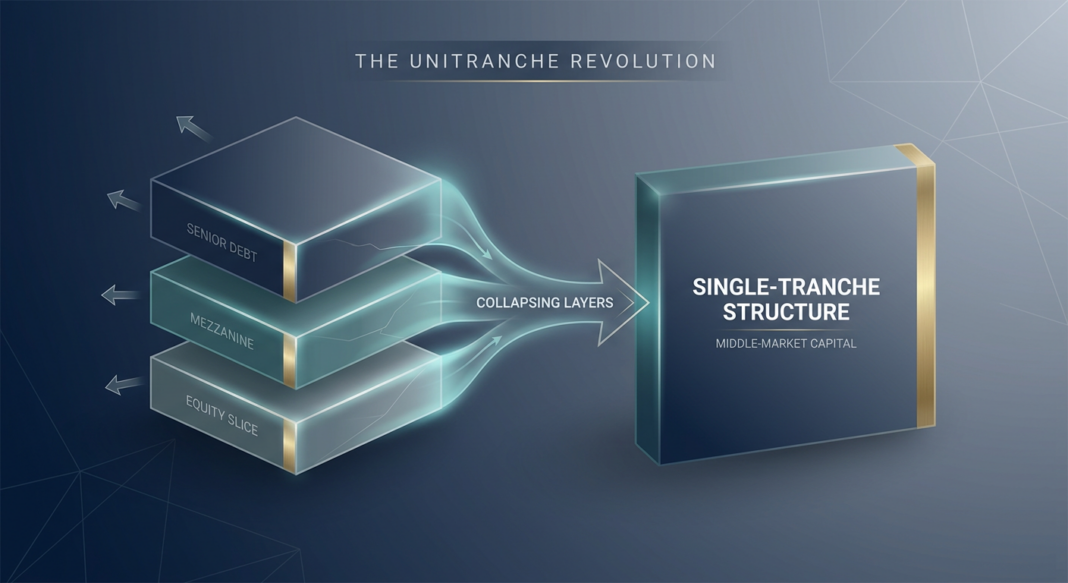
A unitranche loan is a single-facility debt instrument that combines what would traditionally be separate senior secured debt and subordinated mezzanine debt into one loan, with one credit agreement, one interest rate, and one lender relationship. As PipelineRoad (March 2026) describes it: the entire capital structure below equity collapses into a single instrument.
The traditional leveraged finance structure required a borrower to negotiate with multiple creditor groups (a senior lender (or syndicate), a mezzanine provider, and potentially a second-lien lender) each with its own documents, covenants, pricing, and enforcement rights. The intercreditor agreement between these parties was among the most complex and contentious documents in any financing.
The unitranche eliminates this layering. A single lender (or a small club of direct lenders acting as one) provides the entire debt package. For the borrower, the advantage is speed, simplicity, and deal certainty. For the lender, the advantage is earning a blended return that is higher than pure senior pricing while controlling the entire credit position.
According to Golub Capital (May 2026), the unitranche loan was invented in 2004, and its adoption grew alongside the direct lending industry’s post-2008 expansion as direct lending funds scaled and sought differentiated ways to deploy capital.
How It Works: A Concrete Example with Real Numbers
Consider a private equity sponsor acquiring a software services company with $10 million of EBITDA at a 7x purchase multiple, a $70 million enterprise value. In a traditional structure, the sponsor would raise roughly $30–35 million in senior bank debt (3.0–3.5x EBITDA) and $15–20 million in mezzanine (to reach 5.0x total leverage), contributing $20–25 million in equity.
Under a unitranche structure, a direct lender such as Ares Capital, Blue Owl, or Apollo provides a single $50 million facility, covering the full 5.0x leverage, in one loan, under one credit agreement.
The economics, per CT Acquisitions (May 2026) and PipelineRoad (March 2026), look like this in the current market:
- Interest rate: SOFR + 550–700 bps (blended pricing between senior risk at SOFR + 400–500 bps and subordinated risk at SOFR + 800–1,000+ bps)
- All-in yield: Approximately 9.5%–11% at current SOFR levels
- Original Issue Discount (OID): Typically 2–3% at funding. On a $50 million loan, the borrower receives ~$48.5 million but owes $50 million, with the OID functioning as upfront yield to the lender
- Leverage: 4–6x EBITDA for typical lower-middle-market (LMM) acquisitions; up to 7x for high-quality recurring-revenue businesses in SaaS or healthcare services
- Amortization: Typically 1% annually (term loan B-style), with a bullet repayment at maturity
- Prepayment fee (2026 standard): 102/101/par over years 1, 2, and 3, respectively, discouraging early refinancing-arbitrage if rates fall
The result: one negotiation, one closing, one lender relationship post-close, and a transaction that can close in 45–90 days versus the 90–150 days required by a traditional senior-plus-mezzanine syndication, according to CT Acquisitions (May 2026).
The Agreement Among Lenders (AAL): What Borrowers Don’t See
While the borrower sees a single facility, lenders often bifurcate the economics among themselves through an Agreement Among Lenders (AAL). According to PipelineRoad (March 2026), the unitranche is privately divided into a first-out tranche and a last-out tranche. The first-out lender receives payment priority and lower risk, similar to a traditional senior lender. The last-out lender absorbs more risk and earns a higher spread, similar to a mezzanine position. The borrower makes one payment; behind the scenes, the economics are allocated per the AAL waterfall. Critically, the details of the AAL are kept confidential from the borrower.
Current Market Relevance: Data Box
The unitranche structure has grown in direct proportion to the scale of private credit itself, and the persistent tightening of traditional bank lending. Here is a snapshot of key market metrics:
| Metric | Data Point | Source |
|---|---|---|
| North American Direct Lending AUM (yr-end 2025) | ~$644 billion (up from $93B in 2015) | PIMCO / Preqin, Dec 2025 |
| CDLI Total Return (Calendar Year 2025) | 9.3%; 20-year average of 9.5% | Cliffwater / Morningstar, Mar 2026 |
| CDLI Interest Income (2025) | 10.4%, primary return driver | Cliffwater / Morningstar, Mar 2026 |
| Unitranche All-In Yield (2026) | 9.5%–11% (SOFR + 500–700 bps) | CT Acquisitions, May 2026 |
| Bank C&I Lending Standards (Q1 2026) | Tighter for firms of all sizes, 5th consecutive tightening survey | Federal Reserve April 2026 SLOOS |
| Private Credit Global AUM (2025 estimate) | ~$2.1 trillion; projected $4.5 trillion by 2030 | Preqin via IQ-EQ, Feb 2026 |
| LP Satisfaction with Private Credit (2025 survey) | 91% said asset class met or exceeded expectations | Preqin via IQ-EQ, Feb 2026 |
The bank tightening backdrop is a critical driver. The Federal Reserve’s April 2026 SLOOS reported that banks, on balance, continued to tighten lending standards for commercial and industrial loans to firms of all sizes in Q1 2026, and separately reported tightening standards across all categories of loans to non-depository financial institutions (NDFIs), including higher risk premiums, stricter covenants, and lower maximum credit line sizes. This sustained constraint on bank credit supply is precisely the structural tailwind that has made unitranche lending a first-call solution for mid-market operators who need capital speed and certainty.
For perspective on BCRED’s Q1 2025 direct lending portfolio, Blackstone’s SEC filing (April 2025) disclosed that new private debt investments were underwritten at an average yield of 9.5% (composed of a 4.3% base rate floor and a 5.1% blended spread plus origination fees) illustrating how the unitranche yield math operates in practice at one of the largest direct lenders globally.
Decision Framework: Investors and Operators
For Investors Evaluating Unitranche Strategies
Unitranche funds occupy a distinct position on the private credit risk-return spectrum. According to PipelineRoad (March 2026), unitranche strategies generally target gross returns of 9–13%, positioning them between pure senior direct lending and mezzanine funds. Investors considering this strategy should evaluate:
- Yield vs. position in waterfall: The blended rate is higher than senior-only lending because the lender is absorbing both senior and subordinated risk. Investors should understand whether a fund is providing true unitranche (full exposure) or participating as a first-out lender in an AAL (lower risk, lower return).
- Covenant quality: Unlike broadly syndicated loans where covenant-lite has become standard, unitranche loans remain maintenance-covenant instruments. According to Private Equity Bro (Oct 2025), financial covenants typically carry an initial cushion of 25–35% over the borrower’s base-case plan, giving lenders an early seat at the table if performance deteriorates, well before a payment default occurs.
- Leverage compression post-2023: As SOFR rose above 5%, most direct lenders pulled back leverage from 6.5–7.5x (2021 peaks) to 4–6x to maintain manageable interest coverage ratios, per CT Acquisitions (May 2026). This tightened underwriting is a credit-positive for lenders.
- Concentration and sector risk: PIMCO (March 2026) notes that heavy involvement of private equity sponsors in software companies has driven pronounced sector concentration in direct lending portfolios, warranting scrutiny during manager diligence.
For Business Owners Considering Unitranche Financing
Business owners and operators evaluating debt capital options should understand where unitranche fits relative to alternatives:
- The speed premium is real: According to Private Equity Bro (Oct 2025), unitranche financing can close 30–45 days faster than a syndicated alternative. Sponsors often justify an extra 50–100 basis points of spread by avoiding financing gaps or broken syndications that jeopardize purchase agreements.
- Sweet spot by deal size: CT Acquisitions (May 2026) identifies the unitranche sweet spot as $25–$200 million enterprise value transactions. Below that range, SBA and traditional senior bank loans win on cost; above $300 million, the broadly syndicated loan market wins on cost.
- Understand the full cost: The headline spread is only part of the cost. OID (2–3%), prepayment fees (typically 102/101/par), and potential PIK components on weaker credits all affect the true cost of capital. Operators should model the all-in cost including any refinancing scenario.
- Fewer parties means faster amendments: Post-close, having one lender relationship makes covenant waivers, amendment requests, and add-on financing far more efficient than managing a syndicate of bank lenders.
Key Takeaways
- One loan, full stack: A unitranche collapses senior and subordinated debt into a single facility (one credit agreement, one lender, one set of covenants) dramatically simplifying the capital structure for middle-market borrowers.
- Blended pricing is the trade-off: Borrowers pay a blended rate (currently SOFR + 550–700 bps, or roughly 9.5–11% all-in) that is higher than pure senior debt but lower than a combined senior-plus-mezzanine stack when execution costs and time are factored in.
- Bank tightening is a structural tailwind: With the Federal Reserve’s April 2026 SLOOS confirming ongoing C&I lending tightening for all firm sizes, unitranche lenders continue to fill a gap that traditional bank capital increasingly cannot.
- The AAL is invisible to borrowers but critical for investors: Behind every unitranche is a potential first-out/last-out waterfall. Investors must understand whether they are in the first-out (lower risk) or last-out (higher yield, higher loss exposure) position.
- Covenant maintenance is a key structural advantage: Unlike the broadly syndicated loan market, unitranche facilities almost universally include financial maintenance covenants, giving lenders proactive intervention rights and a meaningful layer of downside protection that covenant-lite structures do not provide.


