
The Story: A Hole-Digger Who Refused to Give His Company Away
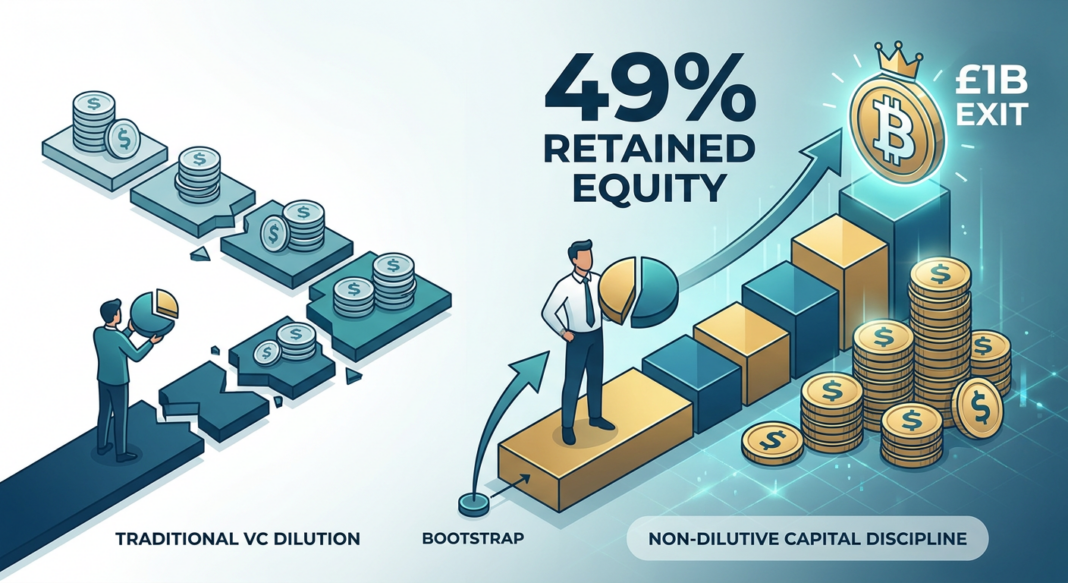
In 2026, Julian Hearn sold Huel, his meal-replacement nutrition brand, to Danone for €1 billion and personally walked away with £420 million. That figure alone is remarkable. What makes it extraordinary is this: by the time of the exit, Hearn had raised $184 million across three funding rounds, and he still owned 49.3% of the company he started from scratch.
Most founders who travel a similar fundraising path end up owning somewhere between 15% and 25% at exit. The typical venture dilution machine (successive priced rounds, option pool shuffles, pro-rata rights, and late-stage recaps) chips away at founder stakes with near-mathematical certainty. Hearn’s story breaks that mold, and the mechanics of how he did it offer a masterclass in capital discipline that has nothing to do with luck and everything to do with sequencing.
Huel started as a direct-to-consumer brand selling nutritionally complete powdered food. Hearn, a former marketing professional, bootstrapped the business to £18 million in revenue before he raised a single pound of external equity. By the time investors arrived, the company had proof of concept, real margins, and real customers, which meant Hearn negotiated from a position of strength, not desperation.
That distinction, when you raise versus whether you raise, is the foundation of everything that followed.
The Decision: Raise Minimally, Raise Late, and Only When the Leverage Is Yours
The conventional DTC playbook in the 2010s and early 2020s was aggressive: raise a seed, raise a Series A, raise a Series B, burn toward growth, and hope the market rewards top-line velocity. Hearn rejected that playbook almost entirely.
His fundraising decisions followed a different logic: raise only at proven inflection points, and only raise what is genuinely needed to accelerate, not to survive. By bootstrapping to £18M revenue first, each subsequent funding round was a choice, not a lifeline. That shift in power dynamics, from founder-needs-capital to investor-wants-access, allowed Hearn to control the terms, the dilution, and ultimately the ownership table.
According to public Companies House filings and waterfall analysis cited by financial analysts, Hearn’s cap table management across three rounds resulted in a 49.3% retained stake at exit. The contrast to the VC-dilution default is stark. A founder raising the same $184M through conventional venture rounds (seed, Series A, Series B, with standard option pools and liquidation preferences) would typically exit owning 15–25% of the same business. On a €1B exit, that gap is worth between £170M and £240M in personal proceeds. Hearn captured that difference.
His model was not debt-only, he did raise equity, but it was equity raised with extreme selectivity and at valuations that reflected real business performance, not speculative future projections. The result: each round diluted him less than the market average, and he never surrendered control of the board or the strategy.
The Outcome: 17–20x EBITDA and £420M in the Founder’s Pocket
When Danone acquired Huel in 2026, it paid a 17–20x EBITDA multiple: a premium valuation, even as Huel’s revenue growth had slowed to approximately 17% year-over-year. That premium is the second lesson embedded in Hearn’s story: strong unit economics command strategic multiples, regardless of growth velocity.
Because Huel had pursued vertical integration over the years (manufacturing control, direct supply chain relationships, and margin expansion) its contribution margins and EBITDA profile were structurally superior to most VC-backed DTC peers, many of which sacrificed margin for growth and arrived at exit with bloated customer acquisition costs and thin or negative profitability.
Danone, a strategic acquirer, was not buying a growth story. It was buying a profitable, scalable platform with a demonstrably loyal customer base and room for global expansion. That is precisely the kind of asset that commands an EBITDA premium over a revenue multiple, and it is the kind of asset that emerges when founders are not pressured by VC return timelines to grow at all costs.
The counterfactual is worth pausing on: a founder who raised aggressively, accepted standard dilution, and grew revenue faster but with thinner margins might have achieved a similar top-line exit, but walked away with £150–200M, not £420M. The capital structure was the exit strategy.
The Lessons: What Huel Teaches Every Founder About Capital and Control
Huel’s story is not a case against raising capital. It is a case for raising capital strategically, with a clear-eyed view of what dilution costs at exit and what leverage (in the broadest sense of the word) means for long-term founder outcomes.
This principle extends well beyond DTC brands. In mid-market industrials, SaaS platforms, and professional services firms, the same dynamic plays out constantly. Founders who bootstrap to meaningful revenue before raising give themselves negotiating leverage. Founders who raise to survive give away the company incrementally before they’ve even proven the model.
The broader market is beginning to catch up to this logic. General Catalyst’s Customer Value Fund (CVF), which recently deployed $360 million in non-dilutive revenue-share financing to Musely, a profitable DTC skincare company, represents an institutional acknowledgment that the equity-for-growth model is not the only model. Musely’s CEO Jack Jia had not raised equity since 2014 and told lazytechtalk.com that he had consistently turned down traditional VCs because he “didn’t want to reduce his ownership in the company.” CVF’s revenue-share structure gave him $360M of growth capital without a single point of dilution.
Meanwhile, in infrastructure and project finance, Hut 8 is running a parallel playbook at institutional scale, closing $4.25 billion in investment-grade, non-recourse, non-dilutive project financing for its Beacon Point data center, with zero expected equity issuance at the parent level. As Hut 8 CEO Asher Genoot noted publicly, the structure “eliminates refinancing risk and protects shareholder value”, a principle that applies as powerfully to a £18M nutrition brand as it does to a billion-dollar infrastructure project. Read the full announcement at gurufocus.com.
The framework that emerges across all of these stories is consistent: non-dilutive capital (whether bootstrapped revenue, project debt, or revenue-share structures) preserves optionality and concentrates exit proceeds for the people who built the business. Equity is not inherently bad. But equity raised before it is necessary, or at terms that do not reflect true enterprise value, is a permanent and expensive cost.
Key Insights
- Sequencing is everything: Bootstrapping to £18M revenue before raising gave Huel’s founder negotiating power that translated directly into 49.3% retained ownership and £420M in personal exit proceeds, compared to an estimated £150–200M under a conventional VC dilution path.
- Unit economics beat growth optics at exit: Danone paid 17–20x EBITDA for Huel despite slowing growth because strong margins and vertical integration signal durable value. Founders who preserve margin over raw growth are more attractive to strategic acquirers.
- Non-dilutive structures are going mainstream: From General Catalyst’s $360M revenue-share deal with Musely to Hut 8’s $4.25B investment-grade non-recourse project financing, institutional capital is increasingly packaging itself to avoid diluting founders and operators who have earned the right to terms.
- The capital structure is the exit strategy: The decisions made at funding rounds (how much to raise, at what valuation, on what terms) compound forward to determine what percentage of the exit you capture. Founders who treat capital decisions as strategic tools, not operational necessities, capture materially more value.
- Raise from strength, not survival: The single most powerful lever a founder or operator has in any capital raise is not needing the money urgently. Profitable, cash-flow-positive businesses attract better terms, less dilution, and more aligned capital partners: whether that capital is equity, debt, or a hybrid revenue-share instrument.


