
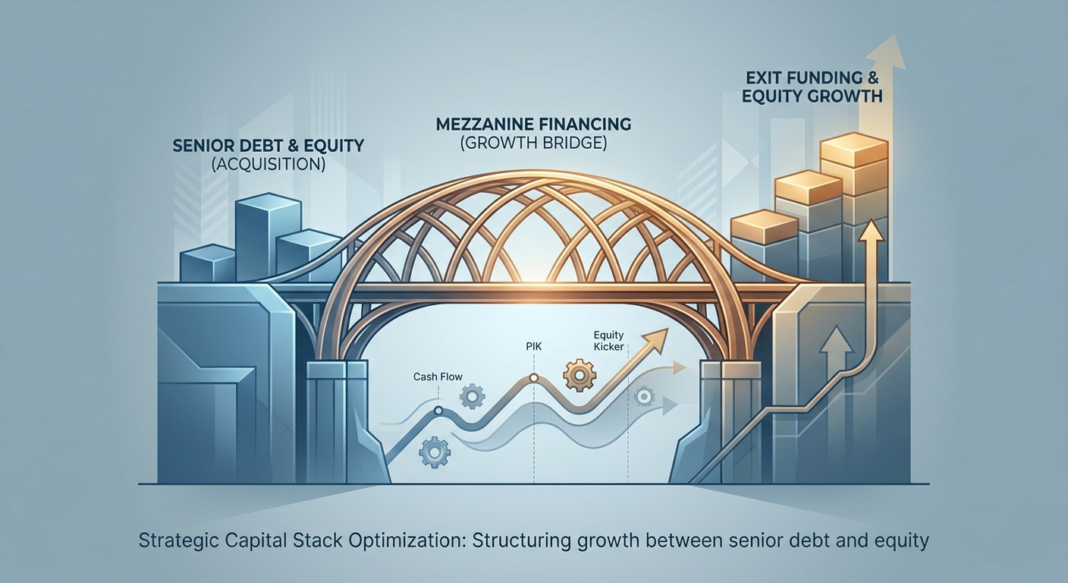
Filling the Growth-Stage Gap: How Mezzanine Financing Bridges the Capital Stack from Acquisition to Exit
When senior debt capacity is exhausted and equity dilution is a strategic non-starter, mezzanine financing occupies the critical layer between them: with a cost, a covenant package, and a clock that every operator and investor must fully understand before signing.
The Growth-Stage Capital Problem
Picture a services business with $6M in EBITDA, a motivated acquisition target on the table, and a management team that has already maximized its bank relationship. The regional lender will stretch to 3.0x EBITDA, call it $18M, secured by receivables and equipment. The acquisition price is $42M. The equity check the owner is willing to write is $12M. That leaves a $12M hole in the middle of the capital stack.
This is the growth-stage capital gap in its most common form: the business has proven cash flow, a clear use of proceeds, and a credible exit path, but the senior debt market won’t go far enough, and the cost of filling the remainder with equity is prohibitive. As one practitioner framework puts it, mezzanine financing bridges the gap between what senior lenders provide and total capital needs: functioning as the connective tissue of the acquisition capital stack.
For operators executing add-on acquisitions, recapitalizations, or large organic expansions at the growth stage, mezzanine is often the most precise instrument available. It is not cheap, and it is not simple. But when structured correctly, it is frequently the difference between a deal that closes and one that doesn’t.
Structure Breakdown: The Three Layers of a Mezzanine Deal
1. The Cash Interest Component
Mezzanine debt sits in a subordinated position, behind senior secured lenders but ahead of common equity in the liquidation waterfall. Its first financial component is a current cash coupon, paid monthly or quarterly. In 2026, that cash interest component typically ranges from 8% to 12% per annum, reflecting the subordination premium demanded by lenders for occupying the riskiest debt position in the stack.
This current-pay element is what distinguishes mezzanine from pure PIK instruments: the borrower is obligated to service part of the coupon in cash throughout the term, which means the structure only works for businesses with stable, recurring free cash flow. Mezzanine lenders evaluate EBITDA, coverage ratios, and management track record with a granularity that rivals senior underwriting.
2. PIK Interest: The Cash-Flow Preserving Mechanism
Most mezzanine deals include a Payment-in-Kind (PIK) component layered on top of the cash coupon. Rather than being paid in cash, PIK interest accrues and compounds into the outstanding principal balance. A typical structure in 2026 might carry 12% cash interest plus 2–4% PIK, producing a blended stated yield of 14–16% before the equity component is considered.
The PIK mechanism is strategically valuable for growth-stage borrowers: it preserves operating cash flow during the reinvestment phase, allowing capital that would otherwise go to debt service to be redeployed into growth initiatives. But the compounding math is unforgiving. As one practitioner framework observes, “PIK does not feel expensive until you see it capitalized year after year.” A $10M mezzanine tranche at 4% PIK accruing over five years adds more than $2.1M to the repayment obligation at maturity, well before warrant value is considered.
PIK structures are most appropriate when the use of proceeds has a clearly defined payback period and a credible exit or refinancing event within the 5–7 year loan tenor. They are a liability management tool, not a cost reducer.
3. The Equity Kicker: Warrants and Conversion Rights
The defining characteristic of mezzanine financing (and the source of its full economic complexity) is the equity kicker. Mezzanine lenders typically receive warrants or conversion rights covering 1% to 5% of the borrower’s equity at a predetermined strike price, giving them participation in enterprise value appreciation beyond the debt coupon alone.
The kicker mechanism compensates lenders for their subordinated risk position. When factoring in all components (cash interest, PIK accretion, and equity participation) all-in mezzanine returns to lenders often target 12% to 20% total yield, with the equity kicker potentially pushing realized returns significantly higher on successful exits.
For borrowers, the warrant requires precise negotiation: strike price, coverage percentage, vesting mechanics, and repurchase rights all affect the true cost of capital. If the business outperforms, the warrant exercises and dilutes existing shareholders, sometimes materially. If it underperforms, the debt obligations remain regardless of equity value. Borrowers who accept mezzanine with warrants must dedicate serious attention to cap table management from day one.
Worked Example: The $42M Acquisition Capital Stack
Target: $42M enterprise value services business, $6M EBITDA, 7.0x EV/EBITDA purchase multiple.
| Layer | Amount | Leverage Multiple | Pricing | Position |
|---|---|---|---|---|
| Senior Secured Term Loan | $18M | 3.0x EBITDA | SOFR + 375bps (~7.0% all-in) | 1st Lien |
| Mezzanine Tranche | $12M | 2.0x EBITDA add-on (5.0x total) | 12% cash + 3% PIK + warrants (3% equity) | Subordinated / 2nd Lien |
| Equity | $12M | – | Residual return | Common / Junior |
Blended cost of debt: ($18M × 7.0% + $12M × 15%) / $30M = approximately 10.2% before warrant value.
Origination fees: Mezz lenders typically charge 1–2% at closing ($120K–$240K on $12M), plus legal documentation costs of $75K–$150K.
Maturity structure: Senior: 5-year term with modest amortization. Mezz: 6–7 year bullet, aligned with expected exit or refinancing event.
Covenant package: Senior carries a maintenance leverage covenant; mezzanine carries a subordinated financial covenant package with standstill provisions triggered upon senior default.
Mezzanine vs. The Alternatives: A Capital Stack Trade-Off Map
Option A: Traditional Senior Debt Only
For most middle-market businesses, senior bank lenders will extend to 2.5x–3.5x EBITDA on a cash flow basis, secured by a first lien on all assets. Senior debt is the lowest-cost layer, conventional bank loans typically run 6% to 10% in 2026, but its reach into the capital stack is fundamentally constrained by senior lender risk appetite and regulatory leverage limits. In an acquisition requiring 5.0x–6.0x total leverage, senior debt alone cannot fill the gap without leaving significant equity requirement on the table.
Option B: Unitranche (Direct Lending)
The unitranche has become the dominant structural alternative to senior-plus-mezzanine in the lower middle market, and for good reason. A single direct lender provides the full debt package: collapsing what would have been a senior tranche and a subordinated tranche into one instrument with one credit agreement, one covenant package, and no intercreditor negotiation. In 2026, unitranche facilities in the lower middle market price at SOFR + 500–700bps, with total leverage running 4.0x–6.0x EBITDA for most transactions.
The unitranche premium over a comparable senior-only facility is real, typically 50–100 basis points, but it eliminates the coordination friction of managing two separate lender relationships across a multi-year hold. Sponsors running roll-up platforms with frequent add-ons have embraced unitranche precisely because it enables faster closes (45–90 days versus 100–130 days for senior-plus-mezz structures) and removes the intercreditor agreement as a potential deal-killing bottleneck.
When to choose mezzanine over unitranche: The traditional senior-plus-mezzanine split can achieve a lower weighted average cost of debt when the senior bank provides cheap first-lien capital at spreads inside what a direct lender would charge on the full unitranche facility. This advantage is most pronounced for borrowers with strong bank relationships, significant hard asset collateral, or senior facilities sized above $25M where bank pricing becomes highly competitive. The trade-off is structural complexity, longer execution timelines, and the ongoing management burden of two lender constituencies.
Option C: Growth Equity
Selling equity to fill the capital gap is always an option, but it carries costs that compound permanently. Unlike debt, which is retired at maturity, equity dilution is irreversible absent a repurchase. For operators executing a roll-up strategy or approaching a near-term sale, giving up 15–25% of equity to fill a capital gap that mezzanine could fill at 15–20% all-in debt cost is frequently the more expensive long-term path. The mezzanine interest tax shield further widens this differential: cash interest on mezzanine debt is generally tax-deductible as a business expense, while equity dividends are not.
The Optimal Mezzanine Scenario
Mezzanine financing is the structurally optimal choice when: (1) senior debt capacity is maximized but total leverage needed exceeds what senior lenders will provide; (2) the borrower’s EBITDA is sufficient to service both senior and subordinated interest without PIK leaning too heavily; (3) the business has a defined exit or refinancing catalyst within 5–7 years; and (4) ownership dilution from equity issuance would materially impair the economic return to existing shareholders.
Current Market Terms: What the Data Shows in 2026
8–12% per annum
Source: Ascendant Global Credit Group analysis, February 2026
2–4% accruing into principal
Source: Crestmont Capital mezzanine market survey, April 2026
12–20% total yield
Source: Carta / mezzanine market data, May 2026; Crestmont Capital, April 2026
1–5% of borrower equity (common); 3–8% on higher-risk credits
Source: Ascendant Global Credit Group, February 2026; Primior Group, December 2025
5–7 years, bullet repayment at maturity
Source: Ramp / mezzanine market survey, May 2026
SOFR + 500–700bps (approx. 9.5–11.0%)
Source: CTA Acquisitions direct lending market survey, May 2026
Rising, interest coverage ratios at record lows (2.3x avg in 2025); PIK usage spreading from mezz into senior direct loans
Source: Secured Research via ABF Journal, August 2025; With Intelligence Private Credit Trends, August 2025
What’s Changed in the 2025–2026 Cycle
The most significant shift in the mezzanine market over the past 12 months is the spread of PIK mechanics beyond traditional subordinated debt. What was once a feature exclusive to junior capital has migrated into senior direct loans as borrowers under elevated rate pressure have negotiated PIK toggles to preserve cash flow. Interest coverage ratios across U.S. private credit averaged just 2.3x in 2025, a record low, and the number of borrowers utilizing PIK facilities has risen materially. This matters for mezzanine borrowers: the PIK feature is no longer a red flag to senior lenders in the way it once was, which creates structuring flexibility. However, it also signals a market under stress, and mezzanine lenders are pricing that risk accordingly.
The private credit market overall continues to deepen the capital available for mezzanine strategies. Global private credit assets under management reached approximately $2.1 trillion in 2025, with allocators increasingly deploying multi-sleeve mandates that span senior, mezzanine, and special situations simultaneously, expanding the lender universe for borrowers seeking junior capital.
The Gap Capital Playbook: Quantify, Prepare, Run the Process
Step 1: Quantify the Gap Precisely
Before approaching any mezzanine lender, the borrower must construct a complete sources-and-uses analysis that maps exactly how much capital is needed, from which layers, and at what leverage multiples. The gap is the residual after: (a) maximum senior debt capacity (typically expressed as a multiple of trailing twelve-month EBITDA, net of adjustments); (b) available equity contribution; and (c) any seller notes or earnout deferrals. The mezzanine ticket should be sized to fill the gap precisely, not to maximize leverage beyond what free cash flow can support.
A critical preparatory step is building a debt service model that stress-tests coverage ratios under downside scenarios. Mezzanine lenders underwrite to EBITDA coverage and will walk away from deals where the interest burden compresses coverage below 1.2x–1.5x even in base-case projections. The borrower who arrives with this analysis pre-built signals credibility and accelerates the process.
Step 2: Build the Information Package
Mezzanine lenders conduct due diligence that rivals a private equity firm in depth. The information package should include: three years of audited or reviewed financials; trailing twelve-month management accounts; a detailed EBITDA bridge with add-backs clearly documented and defensible; a five-year financial model with multiple scenarios; a management biography package; a competitive landscape analysis; and a clear articulation of the use of proceeds tied to specific, measurable milestones. Lenders will also request the existing cap table and any outstanding obligations, warrants, or convertible instruments that would affect their priority position.
Step 3: Run a Competitive Process
Unlike bank lending, which is often a single-lender negotiation, the mezzanine market supports a competitive process. Approaching four to six mezzanine providers simultaneously and running a structured term sheet process, with a deadline, is standard practice. The process typically runs 4–12 weeks from initial discussion to funding, including 4–8 weeks of due diligence. Competition among providers drives tighter pricing, wider coverage on equity kicker strike prices, and more borrower-friendly covenant packages. Borrowers who run a process typically achieve better outcomes than those who accept the first term sheet received.
Step 4: Negotiate the Structure
The most important negotiation points in a mezzanine term sheet, in order of economic impact:
- Warrant coverage percentage and strike price: The difference between 2% and 5% warrant coverage can represent millions of dollars in equity dilution at exit. Push for the lowest coverage percentage and the highest strike price the lender will accept, ideally set at or above the current enterprise value at closing.
- PIK/cash split: Negotiate the ratio of current-pay to PIK based on your projected free cash flow. A higher PIK component preserves short-term liquidity but compounds the repayment obligation at maturity. Model both scenarios explicitly before committing to a structure.
- Call protection and prepayment premiums: Mezzanine lenders typically impose 2–3 year no-call periods followed by declining call premiums (e.g., 103/102/101/par). Negotiate the shortest possible no-call period and the steepest decline schedule; this matters acutely if the business outperforms and you want to refinance the mezz with cheaper senior capital early.
- Covenant headroom: Mezzanine covenants are typically set with meaningful cushion to the senior covenant levels, but that cushion can erode quickly in a business downturn. Negotiate for the widest possible EBITDA cushion on coverage tests and the ability to cure covenant breaches with equity contributions.
- Intercreditor agreement terms: In a senior-plus-mezzanine structure, the intercreditor agreement governs the relative rights of the two lender groups in a distress or enforcement scenario. This document is as important as the credit agreement itself. Pay close attention to standstill periods, enforcement rights, and the mezzanine lender’s ability to purchase out the senior position.
Key Takeaways
- Mezzanine fills the leverage gap, not just the capital gap. Its primary strategic function is to extend total debt capacity beyond senior lender limits, typically from 3.0x to 5.0x+ EBITDA, enabling transactions that senior debt alone cannot finance and avoiding the permanent cost of equity dilution.
- The all-in cost is three layers deep. Cash coupon, PIK accretion, and equity kicker warrant value must all be modeled simultaneously to understand the true economic cost. Lenders targeting 12–20% total returns will recover value through whichever combination of these three levers produces it, borrowers must account for all three in their ROIC analysis.
- PIK preserves cash flow but compounds the exit obligation. Deferring interest through PIK is a legitimate cash management tool, but the compounding math means that PIK-heavy structures require either significant EBITDA growth or a near-term exit to remain economically rational. Model the PIK cliff at maturity explicitly.
- Unitranche has displaced senior-plus-mezz for many lower-middle-market acquisitions. In the $25M–$200M EV band, a unitranche from a direct lender offers comparable leverage at a 50–100bps premium with dramatically simpler execution. Mezzanine retains its structural advantage when a deep bank relationship provides senior capital at spreads that make the weighted average cost of a split structure competitive with unitranche all-in pricing.
- Process discipline determines structure. Running a competitive process among four to six mezzanine providers (with a structured deadline and complete information package) consistently produces tighter pricing, better warrant terms, and longer call protection than a bilateral negotiation. Treat it as a capital markets event, not a bank renewal.


