
The Capital Challenge at the Growth Stage: You Have a Target. Your Bank Won’t Go Far Enough.
You have $5M–$20M in revenue, proven unit economics, and a $15M acquisition on the table. Your senior lender will stretch to $8M. That leaves a $7M gap, and how you fill it will define your cost of capital, your dilution profile, and your operational flexibility for the next three to five years.
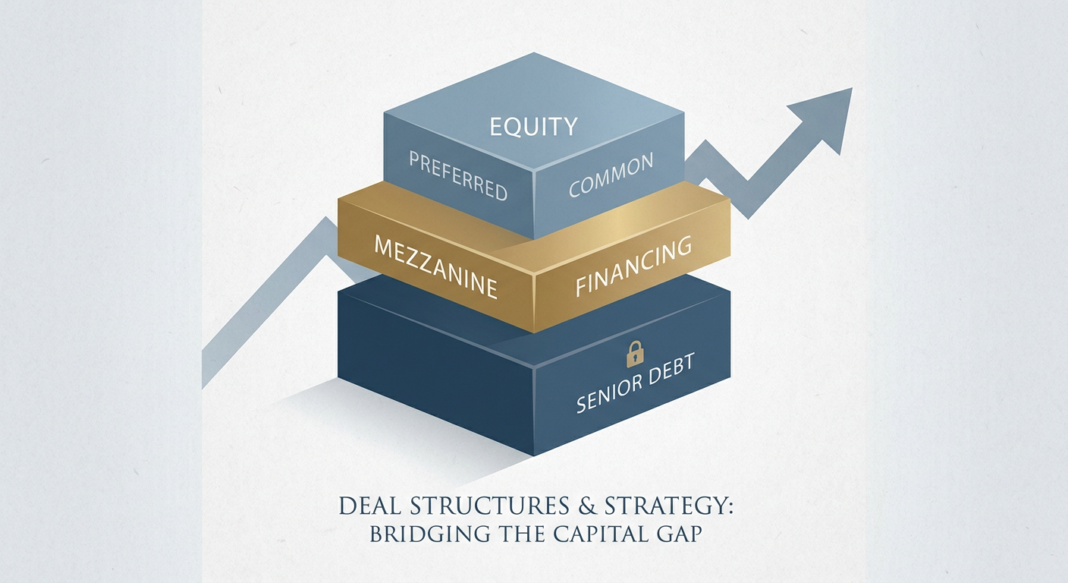
This is the defining financing challenge of the growth stage. The business is too mature for venture equity terms, too early for broadly syndicated leveraged finance, and too acquisitive to wait for organic cash flow alone. The answer is not a single funding call. It is a deliberate capital stack strategy: one that sequences each layer of capital to its appropriate risk, cost, and structural role, starting from senior debt at the foundation and working up to equity at the top.
The instrument that most often fills this gap is mezzanine debt. Understanding how it works, what it costs, and how to negotiate it is one of the highest-leverage skills a growth-stage operator can develop.
Mapping the Capital Stack: Four Layers, Four Roles
For a $15M acquisition at a growth-stage company generating $3M–$5M in EBITDA, the capital stack typically involves three to four distinct layers. Each carries different pricing, seniority, and negotiating dynamics.
Layer 1: Senior Debt, The Foundation
Senior bank debt or a direct lending facility forms the base of the stack. It is secured by company assets and cash flows, carries the highest repayment priority, and is priced accordingly. For a software or services business at this scale, lenders will typically advance 2.5x–3.5x leverage. In the current environment, all-in pricing sits in the SOFR + 250–400 bps range for bank facilities, or SOFR + 450–600 bps for direct lending unitranche structures. This layer provides the cheapest capital, but it comes with the most structural restrictions: financial maintenance covenants on leverage ratio and fixed charge coverage, negative covenants limiting additional debt and capex, and full collateral requirements. As bondtv.vaultai.ca notes, senior debt sits at the bottom of the stack precisely because it carries the highest repayment priority and the lowest risk, and lenders price it accordingly.
Layer 2: Mezzanine Debt, The Gap Filler
Mezzanine capital fills the gap between what senior lenders will advance and what equity providers want to deploy. It is subordinated to senior debt in the repayment waterfall, absorbs more risk, and demands higher returns. Typical all-in pricing ranges from 12%–18%, structured as a combination of cash pay interest (8%–12%) and PIK (payment-in-kind) interest that accrues to the principal balance rather than requiring immediate cash outflow. Many mezzanine structures also include an equity kicker: warrants or a co-investment right representing 1%–5% of the business, providing the lender with upside participation beyond the coupon. Critically, mezzanine is covenant-lite relative to senior debt; it typically uses incurrence-based tests rather than maintenance covenants, meaning covenants are only triggered if the borrower takes a specific action, not simply by operating below a financial threshold. This distinction materially affects operational flexibility during integration.
Layer 3: Preferred Equity, When Debt Capacity Is Exhausted
Where debt is unavailable or the leverage burden is too high, preferred equity steps in. Preferred instruments sit above common equity in the liquidation waterfall but below all debt. Returns are delivered via a preferred dividend, often 8%–14%, sometimes PIK, a liquidation preference (typically 1x invested capital), and participation rights in upside. For growth-stage operators, preferred equity is more expensive than debt on an annualized basis but preserves operating flexibility: there is no scheduled repayment, no acceleration risk, and generally no financial maintenance covenants. As re-cap.com observes, the true cost of equity must account for dilution, governance rights, and liquidation preferences, not just the headline dividend rate.
Layer 4: Common Equity, The Risk-Bearer
Founder equity, management rollover, and sponsor co-investment sit at the top of the stack, bearing the most risk and capturing the most upside. In a growth-stage acquisition, the goal is to minimize how much new common equity is issued at current valuation. Every dollar of debt or preferred equity placed below common equity is a dollar of acquisition price funded without diluting existing ownership.
The Gap Capital Playbook: Quantify, Prepare, Run, Negotiate
Step 1: Quantify the Gap
Start with the acquisition price and work backward. In a $15M acquisition scenario: senior debt capacity based on EBITDA and lender appetite is $8M; a seller note or earnout (if applicable) is $1M; the remaining gap is $6M. This $6M is your gap capital, the quantum that requires a structured solution outside conventional bank financing. Model three scenarios: (a) fill the gap with mezzanine debt, (b) fill it with preferred equity, (c) blend both. For each scenario, calculate your post-close leverage ratio, annual debt service coverage, and pro-forma equity dilution. As bondtv.vaultai.ca outlines, the optimal structure is the one that maintains fixed charge coverage above 1.20x FCCR while keeping total leverage below 5.0x EBITDA and limiting common equity dilution below 15%.
Step 2: Prepare the Materials
Gap capital providers (mezzanine funds, family offices, BDCs, and credit opportunity funds) underwrite to a different thesis than senior lenders. They want to see: (1) a clear use-of-proceeds memo showing how the acquisition creates EBITDA accretion; (2) a three-year integrated financial model with sensitivity tables on revenue growth and margin compression; (3) a management presentation articulating the strategic rationale, competitive moat, and exit pathway; and (4) a clean cap table showing pre- and post-transaction ownership. A clear capital plan and governance narrative materially shortens due diligence timelines with institutional capital providers.
Step 3: Run a Structured, Parallel Process
Approach four to six gap capital providers simultaneously, not sequentially. Create competitive tension. Send a structured term sheet request with a defined response deadline. Require providers to specify: coupon structure (cash pay vs. PIK split), warrant coverage or equity participation, covenant package, board observer rights, and any change-of-control provisions. Evaluate responses across all five dimensions, not just price. A 14% all-in mezzanine facility with a 3% warrant and maintenance covenants may be more operationally restrictive than a 16% preferred equity instrument with no covenants and no scheduled repayment. As mercury.com notes, every instrument you add should either buy time or reduce risk, if it does neither, it is not worth the structural complexity.
Negotiation Guidance: Five Terms That Move the Needle
Once you have competing term sheets, the negotiation phase begins. The most negotiable terms in a mezzanine or gap capital structure are:
- PIK vs. cash pay split: Push for more PIK in years one and two to preserve cash flow during integration. A 6% cash / 6% PIK split in year one converts to full cash pay in year three as EBITDA ramps.
- Warrant coverage: Negotiate coverage as a percentage of fully diluted equity, not a fixed share count. A fixed share count becomes disproportionately dilutive after future equity rounds. Always model warrant dilution across exit scenarios, a 3% warrant at a $15M valuation has a materially different dollar value at a $60M exit than at a $20M exit, as bondtv.vaultai.ca emphasizes.
- EBITDA definition in covenant calculations: Ensure it includes pro-forma synergies and excludes non-recurring transaction costs. A narrow EBITDA definition can turn a profitable post-close business into a technical covenant breach.
- Call protection schedule: A 2%/1%/0% step-down over three years is standard. For creditworthy borrowers with strong EBITDA visibility, a no-call period in year one can sometimes be negotiated away entirely.
- Board observer rights: Mezzanine providers often request an observer seat. Negotiate this to an information rights package only (monthly financials, annual budgets, and notice of material events) without a standing meeting presence.
As vcbeast.com makes clear, the best capital stack is not the one with the most leverage or the lowest equity check; it is the one that matches cash flow durability, lender appetite, and the operating plan. Capital stack design is where an acquisition becomes financeable or falls apart.
Key Takeaways
- Match capital to risk layer: Senior debt funds collateralizable cash flows; mezzanine funds the acquisition gap; preferred equity funds where debt capacity is exhausted. Each layer has a structural role, do not conflate them.
- PIK interest preserves integration-phase cash flow: Negotiating a PIK toggle on mezzanine debt in years one and two meaningfully reduces cash debt service during the period of highest operational risk.
- Equity kickers must be modeled, not accepted at face value: A 3% warrant has a very different economic impact at a $20M exit versus a $60M exit, always run the dilution math across multiple exit scenarios before agreeing to coverage levels.
- Incurrence vs. maintenance covenants is a structural fault line: Mezzanine debt typically uses incurrence-based tests, which only trigger on borrower action, not on underperformance. This distinction can determine whether a difficult operating quarter causes a covenant breach or not.
- Competitive tension is a structural tool: Running a parallel process with four to six gap capital providers, not a single bilateral conversation, is the single most effective way to compress pricing, improve covenant terms, and reduce equity participation requirements.


